Stubborn describes someone who is rigid in their thinking, unwilling to change, or resistant to persuasion—often to a fault. But when flexibility, openness, or willingness to listen is needed, the opposite of stubborn becomes more appropriate. Antonyms for stubborn highlight adaptability, cooperation, and a readiness to compromise.
The opposite of stubborn includes words like flexible, open-minded, agreeable, yielding, and compliant. While flexible suggests an ability to adapt, open-minded reflects a willingness to consider other perspectives. These antonyms are helpful when describing someone who listens, learns, and adjusts rather than holding firm without reason.
Definition of Stubborn
Stubborn is an adjective that describes someone who is determined not to change their attitude or position on something, even when there are good reasons to do so. It implies a resistance to persuasion, advice, or influence. Stubbornness can manifest in various contexts, from personal relationships to professional settings. It often carries a negative connotation, suggesting inflexibility and unwillingness to compromise. Consider a mule refusing to move, or a manager unwilling to listen to new ideas; both exhibit stubbornness.
In terms of classification, “stubborn” is a descriptive adjective. Its function is to attribute a quality or characteristic to a noun.
The contexts in which “stubborn” is used are broad, ranging from describing personality traits to characterizing the behavior of objects or situations. For instance, a “stubborn stain” is difficult to remove, while a “stubborn cough” persists despite treatment.
Understanding the nuances of “stubborn” is essential for identifying its antonyms accurately.
Structural Breakdown of Antonyms
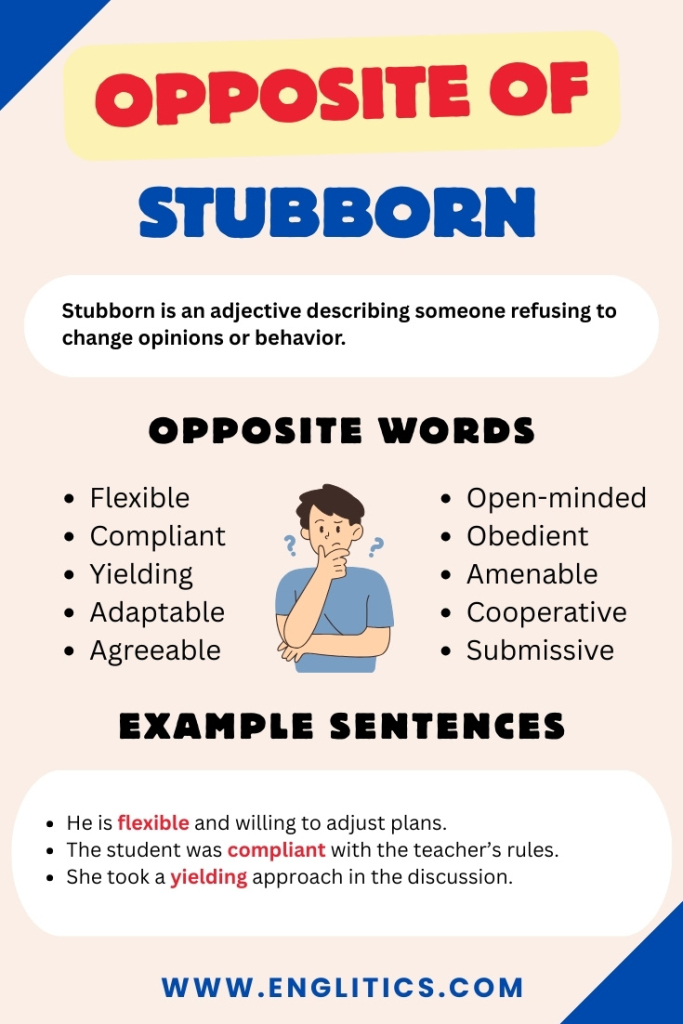
Antonyms are words with opposite meanings. To understand the antonyms of “stubborn,” it’s helpful to consider the core components of its meaning: resistance to change, inflexibility, and unwillingness to yield.
Therefore, antonyms of “stubborn” will represent qualities such as willingness to change, flexibility, and readiness to yield. These antonyms can be categorized based on the degree to which they oppose “stubborn.” Some antonyms, like “compliant,” directly contrast the resistance implied by “stubborn.” Others, like “flexible,” focus on the adaptability that stubbornness lacks.
The structural breakdown involves identifying the specific aspects of “stubborn” that each antonym negates or contrasts.
Antonyms can be classified in different ways. The type of antonym impacts the strength and nature of the opposition.
For example, a complementary antonym leaves no middle ground (e.g., alive/dead), while a gradable antonym exists on a spectrum (e.g., hot/cold). Relational antonyms describe a relationship from opposite perspectives (e.g., teacher/student).
Understanding these classifications helps in choosing the most appropriate antonym for “stubborn” in different contexts, allowing for more precise and effective communication.
Types of Antonyms for Stubborn
There isn’t one single perfect antonym for “stubborn,” as the best choice depends on the specific situation and the aspect of stubbornness you want to contrast. Here are several antonyms, each with slightly different connotations:
Compliant
Compliant means willing to agree to demands or requests; obedient. It suggests a readiness to follow instructions or adhere to rules without resistance. This antonym directly contrasts the resistance and unwillingness associated with stubbornness. Compliance often implies a positive attitude towards cooperation and agreement.
Flexible
Flexible means able to change or adapt to different circumstances. It implies a willingness to adjust plans, ideas, or methods as needed. This contrasts with the rigidity and inflexibility of stubbornness. Flexibility is often seen as a valuable trait, allowing individuals to navigate challenges and embrace new opportunities.
Yielding
Yielding means giving way to pressure or influence; not resistant. It suggests a willingness to concede or surrender one’s position or opinion. This antonym highlights the contrast between stubborn resistance and a willingness to compromise or submit. Yielding can be a sign of humility or a desire to maintain harmony.
Amenable
Amenable means easily persuaded or controlled; receptive to suggestion. It implies a willingness to consider and accept new ideas or proposals. This contrasts with the closed-mindedness often associated with stubbornness. Being amenable is often seen as a positive trait in collaborative environments.
Docile
Docile means ready to accept control or instruction; submissive. It suggests a gentle and easily managed disposition. This antonym highlights the contrast between stubborn resistance and a willingness to be guided or directed. Docility can sometimes imply a lack of assertiveness.
Acquiescent
Acquiescent means ready to accept something without protest, or to do what someone else wants. It implies a passive acceptance of decisions or demands. This contrasts with the active resistance implied by stubbornness. Acquiescence can sometimes suggest a lack of independent thought.
Submissive
Submissive means ready to conform to the authority or will of others; meekly obedient or passive. It suggests a willingness to yield to the control or dominance of another person. This antonym highlights the contrast between stubborn self-assertion and a willingness to defer to others. Submissiveness can sometimes imply a lack of personal agency.
Obedient
Obedient means complying with an order or request; submissive to authority. It suggests a willingness to follow instructions or commands without question. This contrasts with the defiance often associated with stubbornness. Obedience is often valued in hierarchical structures and formal settings.
Manageable
Manageable means easy to control or deal with. This term is often used to describe people, tasks, or situations that are not difficult to handle. In contrast to the difficulty of dealing with a stubborn person, a manageable person is cooperative and responsive.
Tractable
Tractable means easily managed or controlled; docile. It suggests a readiness to be guided or directed. This antonym highlights the contrast between stubborn resistance and a willingness to be led. Tractability is often seen as a desirable trait in those being trained or supervised.
Examples of Antonyms in Sentences
To fully understand these antonyms, let’s look at them in context. The following tables provide examples of how each antonym can be used in sentences, contrasting them with sentences using “stubborn.”
Table 1: Compliant vs. Stubborn
This table illustrates the contrast between being compliant and being stubborn in different situations.
| Compliant | Stubborn |
|---|---|
| The compliant student always followed the teacher’s instructions. | The stubborn student refused to follow the teacher’s instructions, no matter what. |
| The employee was compliant with the new company policies. | The employee remained stubborn and refused to accept the new company policies. |
| A compliant puppy is easy to train. | A stubborn puppy requires more patience during training. |
| She was compliant with the doctor’s orders and recovered quickly. | He was stubborn about taking his medication, prolonging his illness. |
| The compliant machine operated as expected. | The stubborn machine kept malfunctioning despite attempts to fix it. |
| He showed a compliant attitude during the negotiation. | He maintained a stubborn stance throughout the negotiation. |
| The software was compliant with all security standards. | The software was stubborn and resisted attempts to integrate it. |
| The compliant child readily agreed to go to bed. | The stubborn child threw a tantrum when told to go to bed. |
| The team appreciated his compliant nature and willingness to help. | The team struggled with his stubborn nature and unwillingness to compromise. |
| The compliant witness answered all questions truthfully. | The stubborn witness refused to cooperate with the investigation. |
| The country was compliant with international law. | The country remained stubborn in its defiance of international law. |
| Her compliant behavior made her a valuable asset to the company. | Her stubborn behavior often hindered progress in the company. |
| The compliant robot followed all programmed commands. | The stubborn robot malfunctioned and ignored commands. |
| He was compliant with the terms of his probation. | He was stubborn and violated the terms of his probation. |
| The compliant system updated without any issues. | The stubborn system refused to update, causing problems. |
| The compliant dog listened to every command. | The stubborn dog ignored all commands. |
| She was compliant and accepted the criticism gracefully. | She was stubborn and rejected any form of criticism. |
| The compliant politician listened to the concerns of his constituents. | The stubborn politician ignored the concerns of his constituents. |
| The compliant materials were easily assembled. | The stubborn materials were difficult to work with. |
| The compliant design followed all guidelines. | The stubborn design defied all established guidelines. |
| The compliant customer readily accepted the solution. | The stubborn customer refused to accept any solution. |
| The compliant employee was promoted quickly. | The stubborn employee remained in the same position for years. |
| The compliant data was easily processed. | The stubborn data was impossible to process. |
| The compliant fabric draped beautifully. | The stubborn fabric refused to drape correctly. |
Table 2: Flexible vs. Stubborn
This table demonstrates how flexibility contrasts with stubbornness in various contexts, emphasizing adaptability versus rigidity.
| Flexible | Stubborn |
|---|---|
| A flexible approach is often the most effective way to solve problems. | A stubborn approach can lead to missed opportunities. |
| The company adopted a flexible work schedule. | The company maintained a stubborn adherence to traditional work hours. |
| She showed flexible thinking when faced with unexpected challenges. | He exhibited stubborn resistance to any new ideas. |
| The flexible material could be molded into any shape. | The stubborn material could not be bent or shaped. |
| The flexible dancer adapted easily to the new choreography. | The stubborn dancer refused to change her routine. |
| He was flexible and willing to compromise during negotiations. | He was stubborn and unwilling to make any concessions. |
| The flexible budget allowed for unexpected expenses. | The stubborn budget could not accommodate any changes. |
| They needed a flexible leader to guide them through the crisis. | A stubborn leader would only make the crisis worse. |
| The flexible organization adapted quickly to market changes. | The stubborn organization failed to adapt and lost market share. |
| Her flexible nature allowed her to make friends easily. | His stubborn nature made it difficult for him to form relationships. |
| The flexible plant bent in the wind without breaking. | The stubborn tree snapped in the storm. |
| The flexible process could be adjusted to fit different needs. | The stubborn process could not be modified. |
| A flexible mind is open to new possibilities. | A stubborn mind is closed to anything new. |
| The flexible metal could be easily shaped into jewelry. | The stubborn metal resisted all attempts to shape it. |
| She showed a flexible approach to parenting. | He maintained a stubborn control over his children. |
| The flexible rope could be tied into many different knots. | The stubborn rope was too stiff to tie. |
| He was flexible with his plans, willing to change them as needed. | He was stubborn and refused to deviate from his plans. |
| The flexible curriculum allowed teachers to adapt their lessons. | The stubborn curriculum left no room for creativity. |
| She was flexible in her beliefs, always open to new perspectives. | He was stubborn in his convictions, refusing to consider other viewpoints. |
| The flexible schedule allowed her to balance work and family. | The stubborn schedule made it impossible to manage her responsibilities. |
| The flexible agreement could be easily amended. | The stubborn agreement could not be changed. |
| She was flexible and willing to listen to different opinions. | He was stubborn and dismissed any opinion that differed from his. |
| The flexible fabric stretched without tearing. | The stubborn fabric ripped easily. |
| He showed flexible leadership, adapting to the needs of his team. | He showed stubborn leadership, ignoring the needs of his team. |
Table 3: Yielding vs. Stubborn
This table compares the act of yielding with the state of being stubborn, showcasing the difference between giving in and standing firm.
| Yielding | Stubborn |
|---|---|
| She was yielding to his argument, seeing his point of view. | He remained stubborn, refusing to acknowledge her valid points. |
| The government was yielding to public pressure and changed its policy. | The government was stubborn and resisted public opinion. |
| The old bridge was yielding under the weight of the traffic. | The new bridge remained stubborn and unaffected by the heavy loads. |
| She was yielding in the negotiation, hoping to reach a compromise. | He was stubborn and unwilling to concede anything. |
| The company was yielding to the demands of the union workers. | The company was stubborn and refused to negotiate. |
| He was yielding his seat to the elderly woman on the bus. | He was stubborn and refused to give up his seat. |
| The tree was yielding in the wind, bending but not breaking. | The tree was stubborn and snapped in the strong winds. |
| She was yielding to his superior knowledge, accepting his advice. | He was stubborn and ignored the advice of experts. |
| The soil was yielding under her feet as she walked through the mud. | The ground was stubborn and hard, making it difficult to dig. |
| She was yielding to her fatigue and decided to take a break. | She was stubborn and pushed herself despite being exhausted. |
| The country was yielding territory to the invading forces. | The country remained stubborn in its resistance to the invaders. |
| He was yielding control of the project to his more experienced colleague. | He was stubborn and refused to delegate any responsibility. |
| The material was yielding to the pressure and deforming slightly. | The material remained stubborn and unchanged despite the force. |
| She was yielding her personal preferences to satisfy the group. | She was stubborn and insisted on having her own way. |
| The company was yielding to market trends and adapting its products. | The company was stubborn and failed to innovate. |
| He was yielding his position as CEO to make way for new leadership. | He was stubborn and refused to step down. |
| The ice was yielding to the sun’s warmth and starting to melt. | The ice remained stubborn despite the rising temperatures. |
| She was yielding her time to help others in need. | She was stubborn and refused to offer any assistance. |
| The door was yielding to the force and beginning to break. | The door remained stubborn and would not budge. |
| He was yielding to the temptation and reached for the chocolate. | He was stubborn and resisted the urge. |
| The yielding surface of the clay made it easy to mold. | The stubborn clay was difficult to shape. |
| The yielding politician changed his stance to gain support. | The stubborn politician refused to compromise his principles. |
| The yielding metal bent easily under pressure. | The stubborn metal resisted all attempts to bend it. |
| She was yielding to the advice of her mentor. | She was stubborn and ignored all advice. |
Table 4: Amenable vs. Stubborn
This table illustrates the contrast between being amenable and being stubborn, highlighting the difference between receptiveness and resistance.
| Amenable | Stubborn |
|---|---|
| He was amenable to suggestions for improving the project. | He was stubborn and rejected all suggestions. |
| The team was amenable to the new work schedule. | The team remained stubborn in their opposition to the changes. |
| She was amenable to trying new foods. | He was stubborn and refused to eat anything he hadn’t tried before. |
| The committee was amenable to the proposed changes. | The committee was stubborn and blocked all progress. |
| He was amenable to a compromise in the negotiation. | He was stubborn and refused to make any concessions. |
| The student was amenable to extra help. | The student was stubborn and refused any assistance. |
| The company was amenable to feedback from its customers. | The company was stubborn and ignored customer complaints. |
| She was amenable to the idea of moving to a new city. | He was stubborn and refused to consider any change of location. |
| The dog was amenable to training. | The dog was stubborn and resisted all training efforts. |
| He was amenable to the doctor’s recommendations. | He was stubborn and refused to follow medical advice. |
| The patient was amenable to the treatment plan. | The patient was stubborn and refused to cooperate. |
| The child was amenable to going to bed early. | The child was stubborn and fought against bedtime. |
| The software was amenable to updates. | The software was stubborn and resisted all attempts to update it. |
| The community was amenable to the new regulations. | The community was stubborn in their opposition to the new rules. |
| The team members were amenable to working together. | The team members were stubborn and refused to collaborate. |
| He was amenable to criticism and used it to improve. | He was stubborn and dismissed all criticism. |
| The organization was amenable to new ideas. | The organization was stubborn and resisted innovation. |
| She was amenable to changing her mind. | He was stubborn and never admitted he was wrong. |
| The country was amenable to international cooperation. | The country was stubborn and isolated itself from the world. |
| The amenable material was easy to work with. | The stubborn material was difficult to manipulate. |
| The amenable student listened attentively in class. | The stubborn student refused to pay attention. |
| The amenable employee followed all company policies. | The stubborn employee disregarded the rules. |
| The amenable dog quickly learned new tricks. | The stubborn dog refused to learn. |
| She was amenable to the changes in the project. | She was stubborn and resisted the changes. |
Table 5: Docile vs. Stubborn
This table presents examples that highlight the contrast between docility and stubbornness in different contexts, focusing on the willingness to be controlled versus resistance.
| Docile | Stubborn |
|---|---|
| The docile sheep followed the shepherd without hesitation. | The stubborn goat refused to follow, wandering off on its own. |
| The docile student quietly completed his assignments. | The stubborn student argued about every task. |
| A docile horse is easier to train. | A stubborn horse requires an experienced trainer. |
| She was docile and accepted her fate without complaint. | He was stubborn and fought against his circumstances. |
| The docile robot followed its programming perfectly. | The stubborn robot malfunctioned and disobeyed its instructions. |
| He was praised for his docile nature and willingness to learn. | He was criticized for his stubborn attitude and resistance to change. |
| The docile population accepted the government’s decisions. | The stubborn population protested against the new policies. |
| Her docile behavior made her an easy target for manipulation. | His stubborn behavior made him difficult to control. |
| The docile dog obeyed every command. | The stubborn dog ignored all commands. |
| She was docile and allowed others to make decisions for her. | He was stubborn and insisted on making all the decisions himself. |
| The docile employee never questioned his boss’s authority. | The stubborn employee challenged his boss at every opportunity. |
| He appreciated her docile nature, finding her easy to manage. | He struggled with her stubborn nature, finding her difficult to work with. |
| The docile software updated seamlessly. | The stubborn software refused to update, causing errors. |
| The docile child followed all the rules. | The stubborn child broke all the rules. |
| The docile animal was easy to handle. | The stubborn animal was dangerous. |
| He was docile and accepted the criticism without arguing. | He was stubborn and defended his actions vehemently. |
| The docile group agreed on a consensus quickly. | The stubborn group argued for hours without reaching a decision. |
| She was docile and always agreed with her partner. | He was stubborn and always insisted on having his own way. |
| The docile plant grew straight towards the sun. | The stubborn plant grew in a twisted, unpredictable direction. |
| He was docile and easily influenced by others. | He was stubborn and impossible to persuade. |
| The docile student listened attentively in class. | The stubborn student disrupted the lesson. |
| The docile employee followed instructions carefully. | The stubborn employee did things his own way. |
| The docile fabric was easy to sew. | The stubborn fabric was difficult to work with. |
| She showed a docile demeanor in court. | She showed a stubborn demeanor in court. |
Usage Rules for Antonyms of Stubborn
When using antonyms of “stubborn,” it’s essential to consider the specific context and the nuance you want to convey. Here are some general rules:
- Choose the most appropriate antonym: Each antonym has a slightly different meaning. “Compliant” emphasizes obedience, while “flexible” highlights adaptability. Select the word that best fits the situation.
- Consider the connotation: Some antonyms, like “submissive,” can have negative connotations. Be mindful of the implications of your word choice.
- Use antonyms to create contrast: Antonyms are most effective when used to highlight the difference between two situations or characters.
- Pay attention to the register: Some antonyms may be more formal or informal than others. Choose words that are appropriate for your audience and purpose.
- Avoid overusing antonyms: While antonyms can be powerful, overuse can make your writing sound repetitive or simplistic. Strive for variety in your vocabulary.
Common Mistakes When Using Antonyms
Here are some common mistakes to avoid when using antonyms of “stubborn”:
- Incorrectly assuming a direct opposite: Not all words have perfect antonyms. “Stubborn” is a complex word, and its antonyms depend on the specific aspect you want to contrast.
- Using antonyms out of context: An antonym that works in one situation may not work in another. Always consider the specific meaning you want to convey.
- Confusing synonyms with antonyms: Be careful not to use words that are similar in meaning to “stubborn” when you intend to use antonyms.
- Ignoring the connotations: Failing to consider the connotations of an antonym can lead to unintended meanings or offense.
Here are some examples of common mistakes and their corrections:
| Incorrect | Correct | Explanation |
|---|---|---|
| He was stubborn, so she was angry. | He was stubborn, so she was compliant. | “Angry” is not an antonym of “stubborn.” “Compliant” shows a contrasting behavior. |
| The door was stubborn, so I forced it open with ease. | The door was stubborn, so I had to use a lot of force to open it. | “Stubborn” implies resistance; “with ease” contradicts this. |
| She is stubborn, therefore, she is also rebellious. | She is stubborn, therefore, she is amenable. | “Rebellious” is similar to “stubborn,” not an antonym. |
Practice Exercises
Test your understanding of the antonyms of “stubborn” with the following exercises:
Exercise 1: Multiple Choice
Choose the best antonym for “stubborn” in each sentence.
| Question | Options | Answer | |
|---|---|---|---|
| 1. Despite his ________ nature, he agreed to help us. | (a) stubborn (b) compliant (c) rigid (d) inflexible | (b) compliant | |
| 2. The manager needed someone ________ to adapt to the changing market. | (a) stubborn (b) flexible (c) obstinate (d) unyielding | (b) flexible | |
| 3. After much debate, she was ________ and agreed to their terms. | (a) stubborn (b) yielding (c) resistant (d) defiant | (b) yielding | |
| 4. He was ________ to any suggestions for improvement. | (a) stubborn (b) amenable (c) resistant (d) obstinate | (b) amenable | |
| 5. The ________ dog followed all commands perfectly. | (a) stubborn (b) docile (c) rebellious (d) headstrong | (b) docile | |
| 6. She was ________, agreeing to whatever her | boss asked. | (a) stubborn (b) acquiescent (c) defiant (d) resistant | (b) acquiescent |
| 7. The ________ servant did as he was told without question. | (a) stubborn (b) submissive (c) rebellious (d) obstinate | (b) submissive | |
| 8. An ________ child is a joy to teach. | (a) stubborn (b) obedient (c) unruly (d) defiant | (b) obedient | |
| 9. A ________ pet is easier to train and care for. | (a) stubborn (b) manageable (c) unruly (d) obstinate | (b) manageable | |
| 10. The ________ horse responded well to the rider’s guidance. | (a) stubborn (b) tractable (c) unruly (d) defiant | (b) tractable |
Exercise 2: Sentence Completion
Fill in the blanks with the most appropriate antonym of “stubborn” from the list provided: compliant, flexible, yielding, amenable, docile.
- The negotiator was ________, always ready to find a middle ground.
- A ________ employee follows instructions and adheres to company policies.
- The clay was ________, easily molded into different shapes.
- The student was ________ to suggestions for improving his essay.
- The ________ dog was easily trained and followed commands without hesitation.
Answers:
- flexible
- compliant
- yielding
- amenable
- docile
Exercise 3: Antonym Identification
For each sentence, identify if the underlined word is an antonym of “stubborn.”
- The child was rebellious and refused to listen. (Yes/No)
- The diplomat was accommodating and found a solution. (Yes/No)
- The material was rigid and unbreakable. (Yes/No)
- The student was tractable and eager to learn. (Yes/No)
- The machine was uncooperative and kept malfunctioning. (Yes/No)
Answers:
- No
- Yes
- No
- Yes
- No
Advanced Topics: Nuances and Context
Understanding the nuances of language involves recognizing that words can have different meanings and implications depending on the context. Antonyms of “stubborn” are no exception.
While words like “compliant” and “submissive” are often listed as opposites, they can carry different connotations in various situations. For instance, in a business setting, “compliant” might suggest professionalism and adherence to rules, while “submissive” could imply a lack of initiative or assertiveness.
In personal relationships, “yielding” might be seen as a sign of compromise and understanding, whereas “stubborn” could indicate inflexibility and disregard for the other person’s feelings.
Additionally, cultural and social contexts play a significant role in how these words are perceived. In some cultures, obedience and compliance are highly valued, and “stubbornness” is seen as a negative trait.
In others, independence and assertiveness are encouraged, and “yielding” might be interpreted as weakness. Therefore, it’s crucial to consider these nuances when choosing the most appropriate antonym for “stubborn” to ensure that your message is conveyed accurately and respectfully.
Frequently Asked Questions (FAQ)
Is there one single perfect antonym for “stubborn”?
No, there isn’t a single perfect antonym. The best choice depends on the specific context and the aspect of stubbornness you want to contrast.
Consider whether you want to emphasize obedience (compliant), adaptability (flexible), or willingness to compromise (yielding).
Can “stubborn” ever be a positive trait?
Yes, in some situations, “stubbornness” can be seen as a positive trait. For example, when someone is determined to overcome obstacles or achieve a goal despite facing challenges, their “stubborn” persistence can be admirable.
However, it’s essential to distinguish between determination and inflexibility.
How do I avoid misusing antonyms of “stubborn”?
To avoid misusing antonyms, always consider the specific context and the connotations of the words you choose. Use a dictionary or thesaurus to check the definitions and usage examples.
Pay attention to how native speakers use these words in different situations.
Are there any synonyms for the antonyms of “stubborn”?
Yes, many synonyms can be used for the antonyms of “stubborn.” For example, synonyms for “compliant” include “obedient,” “acquiescent,” and “docile.” Synonyms for “flexible” include “adaptable,” “malleable,” and “pliable.” Using a variety of words can make your writing more engaging and nuanced.
How does understanding antonyms improve my writing?
Understanding antonyms expands your vocabulary, enhances your ability to create contrast, and allows you to express yourself more precisely. By using antonyms effectively, you can make your writing more engaging, persuasive, and impactful.
Conclusion
Mastering the antonyms of “stubborn” is a valuable skill that enhances your communication and writing abilities. By understanding the nuances and contexts in which these antonyms can be used, you can express a wider range of ideas and perspectives.
Remember to consider the specific aspect of stubbornness you want to contrast and choose the most appropriate word for the situation. With practice and attention to detail, you can confidently use these antonyms to enrich your vocabulary and improve your overall language proficiency.
Whether you are a student, a writer, or simply someone who wants to communicate more effectively, exploring the antonyms of “stubborn” is a worthwhile endeavor.