Pessimistic describes someone who expects the worst or sees the negative side of things. It’s a mindset that focuses on doubt, fear, or disappointment—often assuming things won’t work out. But not everyone sees the world that way. Some people stay hopeful, trust the process, or look on the bright side—and that’s where the opposite of pessimistic comes in.
Antonyms for pessimistic include words like optimistic, hopeful, positive, confident, and encouraging. These words reflect belief in good outcomes, resilience, and emotional strength. Whether you’re describing someone’s attitude or approach to challenges, choosing the right opposite adds positivity and balance to your message.
Definition of Pessimistic
Pessimistic is an adjective that describes a tendency to see the worst aspect of things or believe that the worst will happen. A pessimistic person typically lacks hope and confidence in the future. They often anticipate negative outcomes and focus on the potential drawbacks or failures in any given situation.
In essence, pessimism is an outlook characterized by a negative or bleak perspective. It can manifest in various aspects of life, from personal expectations to broader views on society and the world.
Understanding the definition of “pessimistic” is the first step in appreciating the range of its antonyms, which represent more positive and hopeful viewpoints.
The term is often used in psychology to describe a cognitive bias or a learned pattern of thinking. Pessimism can be contrasted with optimism, which represents the opposite tendency to expect positive outcomes and focus on the brighter side of things.
Structural Breakdown of “Pessimistic”
To fully grasp the meaning of “pessimistic,” it’s helpful to break down its structure:
- pessim-: This is the root of the word, derived from the Latin “pessimus,” meaning “worst.”
- -istic: This suffix is used to form adjectives that describe a characteristic or tendency.
Therefore, “pessimistic” literally means “having a tendency to see the worst.” This structural understanding reinforces the definition and helps in distinguishing it from related terms. The adjective form allows it to modify nouns, describing people, attitudes, or situations.
The word “pessimism,” the noun form, refers to the belief that the world is inherently bad or that things are most likely to turn out for the worst. It’s important to note the difference between the adjective “pessimistic” and the noun “pessimism,” as their grammatical functions differ.
Opposite of Pessimistic
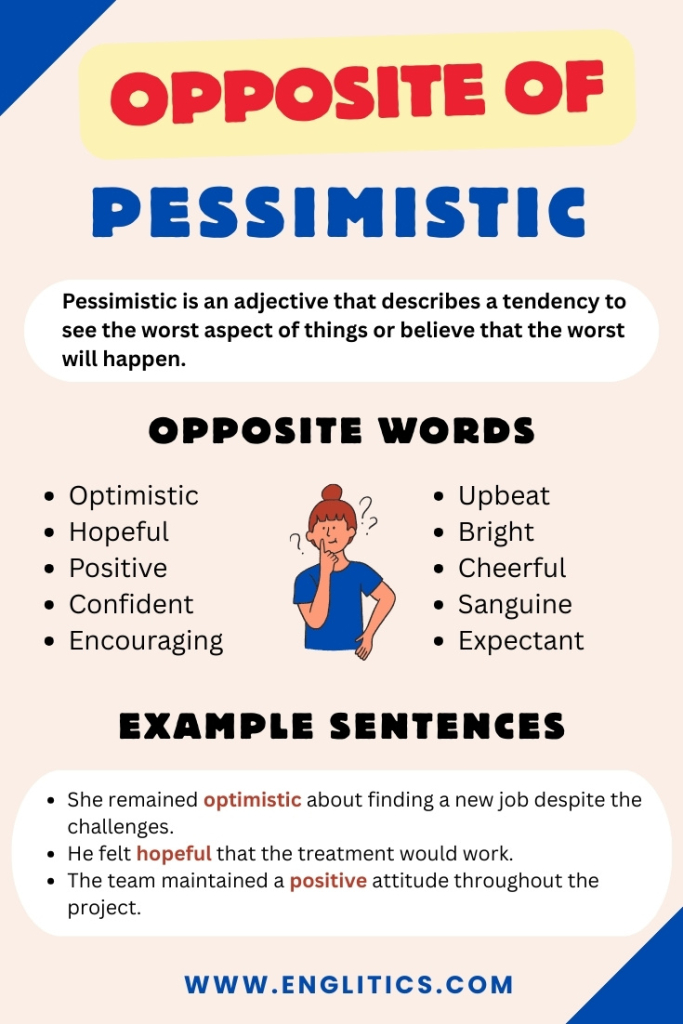
There isn’t just one perfect antonym for “pessimistic.” The best choice depends on the specific context and the nuance you want to convey. Here are several common antonyms, each with slightly different shades of meaning:
Optimistic
Optimistic is perhaps the most direct and common antonym for “pessimistic.” It describes a tendency to look on the bright side of things and expect positive outcomes. An optimistic person typically believes that good things will happen and focuses on the potential for success.
Optimism is often associated with resilience and a positive outlook on life. It can be a valuable trait in overcoming challenges and maintaining a sense of hope in difficult situations.
Hopeful
Hopeful suggests a feeling of expectation and desire for a particular thing to happen. It implies a belief that something positive is possible, even if it’s not guaranteed. A hopeful person looks forward to a favorable outcome with anticipation.
Hopefulness is often linked to perseverance and the ability to maintain a positive attitude in the face of adversity. It’s a crucial element in motivating oneself and others to work towards desired goals.
Positive
Positive is a broad term that encompasses a wide range of positive attributes, including optimism, hope, and confidence. A positive person focuses on the good aspects of a situation and tries to find solutions rather than dwelling on problems.
Positivity can be contagious and can have a significant impact on morale and productivity. It involves a conscious effort to maintain a constructive and upbeat attitude.
Cheerful
Cheerful describes a state of being noticeably happy and optimistic. A cheerful person radiates joy and enthusiasm, often bringing a sense of lightness and positivity to their surroundings.
Cheerfulness is often associated with good humor and a friendly disposition. It can be a valuable asset in building relationships and creating a positive atmosphere.
Sanguine
Sanguine suggests a confident and optimistic outlook, especially in a difficult or uncertain situation. A sanguine person tends to remain calm and hopeful, even when facing challenges.
Sanguinity is often seen as a sign of resilience and inner strength. It implies a belief in one’s ability to overcome obstacles and achieve desired outcomes.
Buoyant
Buoyant describes a cheerful and optimistic attitude, often in the face of adversity. It suggests a resilience and ability to bounce back from setbacks.
Buoyancy is often associated with a strong sense of self-belief and a positive mindset. It can be a key factor in maintaining morale and motivation during challenging times.
Upbeat
Upbeat describes a cheerful and optimistic mood or attitude. An upbeat person is generally positive and enthusiastic, bringing a sense of energy and optimism to their interactions.
An upbeat attitude can be contagious and can have a positive impact on those around you. It often involves a focus on the positive aspects of a situation and a belief in the possibility of success.
Confident
Confident describes a feeling of self-assurance and belief in one’s abilities. A confident person trusts in their own capabilities and expects to succeed in their endeavors.
Confidence is often built through experience and success, but it can also be cultivated through positive self-talk and a focus on one’s strengths. It is a key ingredient in achieving goals and overcoming challenges.
Pollyannaish
Pollyannaish describes someone who is excessively or blindly optimistic. While optimism is generally positive, being Pollyannaish can suggest a naive or unrealistic view of the world, ignoring potential problems or negative aspects.
The term comes from the novel “Pollyanna,” where the main character always looks for the best in every situation, sometimes to an extreme. While well-intentioned, a Pollyannaish attitude might not always be helpful in addressing serious issues.
Examples of Antonyms in Sentences
To illustrate the usage of these antonyms, here are some examples in sentences:
The following tables showcase the antonyms of ‘pessimistic’ used in various contexts. Each table provides 20-30 examples, helping to illustrate the nuances of each word and how they can be used to express different shades of positive outlooks.
Table 1: Examples Using “Optimistic”
| Sentence |
|---|
| Despite the challenges, she remained optimistic about the company’s future. |
| He had an optimistic outlook on life, always expecting the best. |
| An optimistic forecast predicted a significant increase in sales. |
| Even when things went wrong, she tried to stay optimistic. |
| The team was optimistic about their chances of winning the championship. |
| Her optimistic attitude was contagious, lifting everyone’s spirits. |
| He approached the project with an optimistic mindset, believing it would succeed. |
| Despite the setbacks, they remained optimistic that a solution could be found. |
| She was optimistic about the future, confident that things would improve. |
| The optimistic report boosted investor confidence in the market. |
| He is an optimistic person who always sees the glass as half full. |
| They adopted an optimistic approach to problem-solving, focusing on solutions. |
| Her optimistic perspective helped the team overcome many obstacles. |
| The company’s CEO presented an optimistic vision for the next decade. |
| The students were optimistic about their exam results after studying hard. |
| An optimistic evaluation of the situation suggested a positive outcome. |
| She tried to maintain an optimistic outlook despite the difficult circumstances. |
| The optimistic predictions for economic growth encouraged new investments. |
| He remained optimistic even after facing numerous rejections. |
| Her optimistic nature made her a great leader and motivator. |
| The optimistic appraisal of the property increased its market value. |
| Despite the tough competition, the athlete was optimistic about winning. |
Table 2: Examples Using “Hopeful”
| Sentence |
|---|
| We are hopeful that the negotiations will lead to a peaceful resolution. |
| She felt hopeful about her chances of getting the job after the interview. |
| The family remained hopeful that their missing pet would be found. |
| He was hopeful for a better future, despite his current struggles. |
| The doctors were hopeful that the new treatment would be effective. |
| They looked hopeful as they waited for the test results. |
| The community was hopeful that the new park would revitalize the neighborhood. |
| She sent a hopeful message to her friend, encouraging her to keep going. |
| He remained hopeful, clinging to the belief that things would get better. |
| The team was hopeful of securing a spot in the playoffs. |
| She is hopeful that her hard work will pay off in the end. |
| They approached the situation with a hopeful attitude, expecting positive results. |
| Her hopeful outlook inspired others to believe in the possibility of success. |
| The organization is hopeful that their fundraising efforts will meet their goal. |
| The researchers are hopeful that their findings will lead to a breakthrough. |
| A hopeful sign emerged as the negotiations progressed smoothly. |
| She tried to stay hopeful despite the discouraging news. |
| The hopeful anticipation of the holidays brought joy to the family. |
| He remained hopeful even when the odds were stacked against him. |
| Her hopeful spirit helped her overcome many challenges in life. |
| The hopeful prospects for the new business venture attracted investors. |
| Despite the setback, the entrepreneur was hopeful about the future. |
Table 3: Examples Using “Positive”
| Sentence |
|---|
| She tried to maintain a positive attitude despite the difficult circumstances. |
| His positive feedback encouraged the team to keep up the good work. |
| The test results came back positive, confirming her suspicions. |
| He had a very positive influence on his younger siblings. |
| The company received positive reviews for its customer service. |
| She is a positive and encouraging person to be around. |
| The new policy had a positive impact on employee morale. |
| He always tries to find a positive way to resolve conflicts. |
| The teacher gave positive reinforcement to the students for their efforts. |
| They received positive news about their application being approved. |
| She has a positive outlook on life, always seeing the good in things. |
| They approached the problem with a positive mindset, seeking solutions. |
| Her positive energy was infectious, lifting the spirits of everyone around her. |
| The company is aiming for a positive outcome in the upcoming negotiations. |
| The researchers are looking for positive results from their experiments. |
| A positive change occurred as the new management took over. |
| She tried to stay positive despite the challenges she faced. |
| The positive impact of the new program was evident in the improved results. |
| He remained positive even when faced with adversity. |
| Her positive disposition made her a valuable asset to the team. |
| The positive assessment of the project led to further funding. |
| Despite the initial difficulties, the team maintained a positive attitude. |
| The positive effects of exercise on mental health are well-documented. |
Table 4: Examples Using “Cheerful”
| Sentence |
|---|
| She had a cheerful disposition that brightened up the room. |
| He always greeted everyone with a cheerful smile. |
| The children sang cheerful songs during the holiday season. |
| She maintained a cheerful attitude despite her personal struggles. |
| The cheerful decorations made the office feel more welcoming. |
| He is a cheerful and friendly person, always ready to help others. |
| The cheerful atmosphere at the party made everyone feel relaxed and happy. |
| She sent a cheerful card to her friend who was feeling down. |
| He remained cheerful, even when faced with difficult tasks. |
| The team celebrated their victory with cheerful enthusiasm. |
| She is known for her cheerful demeanor, which uplifts everyone around her. |
| They approached the day with a cheerful spirit, ready to tackle any challenges. |
| Her cheerful presence made the meeting more enjoyable and productive. |
| The company organized a cheerful event to boost employee morale. |
| The students greeted their teacher with cheerful enthusiasm. |
| A cheerful melody filled the air as the band began to play. |
| She tried to stay cheerful despite the gloomy weather. |
| The cheerful laughter of children filled the playground. |
| He remained cheerful even after working long hours. |
| Her cheerful nature made her a popular figure in the community. |
| The cheerful decorations transformed the venue into a festive space. |
| Despite the challenges, the volunteer remained cheerful and dedicated. |
Table 5: Examples Using “Sanguine”
| Sentence |
|---|
| Despite the market crash, he remained sanguine about the long-term prospects. |
| She was sanguine that the project would be completed on time. |
| The CEO presented a sanguine outlook for the company’s future. |
| He remained sanguine even in the face of adversity. |
| The team was sanguine about their chances of winning the competition. |
| Her sanguine attitude inspired confidence in others. |
| He approached the negotiations with a sanguine mindset, expecting a positive outcome. |
| Despite the challenges, they remained sanguine that a solution could be found. |
| She was sanguine about the future, confident that things would improve. |
| The sanguine report boosted investor confidence. |
| He is a sanguine person who always sees the potential for success. |
| They adopted a sanguine approach to problem-solving, focusing on opportunities. |
| Her sanguine perspective helped the team stay motivated. |
| The company’s leadership presented a sanguine vision for growth. |
| The students were sanguine about their results after thorough preparation. |
| A sanguine evaluation of the situation suggested a promising future. |
| She tried to maintain a sanguine outlook despite the uncertainties. |
| The sanguine predictions for economic recovery encouraged investment. |
| He remained sanguine even after encountering numerous obstacles. |
| Her sanguine nature made her an effective leader and motivator. |
| The sanguine appraisal of the market increased confidence. |
| Despite the tough competition, the athlete was sanguine about achieving victory. |
These examples demonstrate how the antonyms of “pessimistic” can be used to express a variety of positive and hopeful attitudes.
Usage Rules and Considerations
While the antonyms discussed above all convey a sense of positivity, it’s important to choose the word that best fits the specific context. Here are some usage rules and considerations:
- Optimistic vs. Hopeful: “Optimistic” implies a general belief that things will turn out well, while “hopeful” suggests a specific desire for a particular outcome. For example, you might be “optimistic” about the future of the economy, but “hopeful” that you will get a promotion.
- Positive vs. Cheerful: “Positive” is a broader term that encompasses a range of positive attributes, while “cheerful” specifically refers to a state of being noticeably happy and optimistic. You can have a “positive” attitude even when you’re not feeling particularly “cheerful.”
- Sanguine vs. Confident: “Sanguine” suggests a calm and confident optimism, especially in difficult situations, while “confident” focuses on self-assurance and belief in one’s abilities. A “sanguine” leader might inspire confidence in their team.
- Pollyannaish vs. Optimistic: Be cautious when using “Pollyannaish,” as it can be seen as critical. It implies an unrealistic or naive level of optimism that ignores potential problems.
Consider the specific nuance you want to convey and choose the antonym that best reflects that meaning. Pay attention to the context and the connotations of each word.
Common Mistakes to Avoid
Here are some common mistakes to avoid when using antonyms for “pessimistic”:
| Incorrect | Correct | Explanation |
|---|---|---|
| She was pessimistic about her chances, so she didn’t even hopeful. | She was pessimistic about her chances, so she wasn’t even hopeful. | Using the correct negative form is crucial for clarity. |
| He is very optimistic, almost like Pollyanna. | He is very optimistic, but not Pollyannaish. | Avoid implying that optimism is inherently negative. Use “but not Pollyannaish” to clarify the distinction. |
| The situation was positive, but they remained pessimist. | The situation was positive, but they remained pessimistic. | Ensure correct adjective form is used. |
Pay close attention to grammatical correctness and the specific connotations of each word to avoid these common mistakes.
Practice Exercises
Test your understanding of the antonyms for “pessimistic” with these practice exercises:
Exercise 1: Choose the best antonym for “pessimistic” in each sentence.
| Question | Answer |
|---|---|
| Despite the economic downturn, the CEO remained ________ about the company’s future. (optimistic, cheerful, Pollyannaish) | optimistic |
| They were ________ that their missing cat would eventually return home. (hopeful, positive, sanguine) | hopeful |
| She always has a ________ attitude, even when things are tough. (positive, upbeat, confident) | positive |
| His ________ personality made him a joy to be around. (cheerful, buoyant, optimistic) | cheerful |
| Even after the setback, he remained ________ that they would succeed. (sanguine, confident, hopeful) | sanguine |
| The team felt ________ about their chances after a strong performance. (confident, optimistic, positive) | confident |
| Despite the challenges, she remained ________ and resilient. (buoyant, cheerful, optimistic) | buoyant |
| He approached the task with an ________ attitude, ready to tackle anything. (upbeat, positive, hopeful) | upbeat |
| She was ________ about the possibilities, perhaps unrealistically so. (Pollyannaish, optimistic, cheerful) | Pollyannaish |
| The coach tried to instill a ________ mindset in his players. (positive, hopeful, sanguine) | positive |
Exercise 2: Rewrite the following sentences, replacing the word “pessimistic” with a suitable antonym.
| Question | Answer |
|---|---|
| He had a pessimistic view of the project’s success. | He had an optimistic view of the project’s success. |
| She was pessimistic about the outcome of the negotiations. | She was hopeful about the outcome of the negotiations. |
| They were pessimistic that they would meet their deadline. | They were confident that they would meet their deadline. |
| His pessimistic attitude brought down the team’s morale. | His cheerful attitude boosted the team’s morale. |
| She felt pessimistic about her chances of getting the job. | She felt positive about her chances of getting the job. |
| Despite the challenges, he wasn’t pessimistic and kept trying. | Despite the challenges, he was upbeat and kept trying. |
| Even after the setback, she refused to be pessimistic. | Even after the setback, she remained buoyant. |
| The market analysts were not pessimistic about the economic forecast. | The market analysts were sanguine about the economic forecast. |
| He was pessimistic, always expecting the worst to happen. | He was optimistic, always expecting the best to happen. |
| The pessimist saw only problems; the rest saw opportunities. | The optimist saw only opportunities; the pessimist saw only problems. |
Advanced Topics: Nuances and Context
For advanced learners, understanding the nuances and context in which these antonyms are used is crucial. Consider the following:
- Cultural differences: The expression and perception of optimism and pessimism can vary across cultures. What is considered optimistic in one culture might be seen as naive in another.
- Psychological implications: Optimism and pessimism are not simply personality traits; they can also have a significant impact on mental and physical health. Understanding the psychological implications of these attitudes can provide a deeper understanding of their importance.
- Rhetorical usage: Antonyms can be used effectively in rhetoric to create contrast and emphasize a particular point. Mastering the use of antonyms can enhance your writing and speaking skills.
Exploring these advanced topics can further refine your understanding of the antonyms for “pessimistic” and their role in communication.
Frequently Asked Questions
Here are some frequently asked questions about antonyms for “pessimistic”:
- What is the most common antonym for “pessimistic”?The most common antonym is “optimistic,” as it directly opposes the tendency to expect negative outcomes.
- Is “hopeful” a synonym for “optimistic”?While related, “hopeful” suggests a specific desire for something to happen, whereas “optimistic” is a more general belief that things will turn out well.
- When is it appropriate to use “Pollyannaish”?“Pollyannaish” should be used cautiously, as it can imply an unrealistic or naive level of optimism that ignores potential problems. It’s best used when you want to suggest that someone’s optimism is excessive.
- How can I improve my ability to use these antonyms correctly?Practice using them in different contexts, pay attention to the nuances of each word, and read widely to see how they are used by native speakers.
- What’s the difference between “sanguine” and “confident”?“Sanguine” suggests a calm and confident optimism, especially in difficult situations, while “confident” focuses on self-assurance and belief in one’s abilities. Sanguinity is more about maintaining hope in challenging times, while confidence is about trusting one’s own capabilities.
- Are there any negative connotations to being overly optimistic?Yes, being overly optimistic, especially to the point of being “Pollyannaish,” can be seen as naive or unrealistic. It’s important to balance optimism with a realistic assessment of potential challenges.
- Can someone be both pessimistic and optimistic at the same time?While it might seem contradictory, it’s possible for someone to be generally optimistic but also have pessimistic tendencies in certain situations. This is often referred to as being a “realistic optimist.”
- How does culture influence the expression of optimism and pessimism?Cultural norms can significantly influence how optimism and pessimism are expressed. Some cultures may value a more reserved or cautious approach, while others may encourage a more openly optimistic outlook.
Conclusion
Mastering the antonyms for “pessimistic” is a valuable step in expanding your vocabulary and enhancing your ability to express a wide range of attitudes and perspectives. By understanding the nuances of words like “optimistic,” “hopeful,” “positive,” and others, you can communicate more effectively and accurately.
Remember to consider the context and the specific meaning you want to convey when choosing an antonym. Practice using these words in your writing and speaking, and pay attention to how they are used by native speakers.
With continued effort, you can confidently and accurately express positive and hopeful viewpoints in your communication.
Continue to explore the richness of the English language and strive for precision in your word choices. The ability to articulate subtle differences in meaning is a hallmark of effective communication and a valuable asset in all aspects of life.