The Opposite of Over refers to positions, movements, or situations that are beneath, under, or incomplete. While “over” suggests something above, finished, or across, its antonyms describe being below, ongoing, or not yet complete.
Antonyms for Over include under, beneath, and unfinished. This guide breaks down these opposites with simple examples to make their meanings clear. Whether you’re improving your writing or fine-tuning your everyday English, understanding these terms will help you describe directions, stages, and relationships more accurately.
Definition of “Over” and Antonyms
The word “over” is a versatile term used as a preposition, adverb, adjective, and noun. Its meanings range from indicating position and direction to describing completion, authority, and quantity.
Understanding these varied meanings is essential for identifying appropriate antonyms. An antonym is a word that means the opposite of another word.
Therefore, the antonyms for “over” will differ depending on the specific context in which “over” is used.
For example, if “over” means “above” (position), its antonym might be “under” or “below.” If “over” signifies “finished” (completion), an antonym could be “underway” or “ongoing.”
In the context of authority, where “over” implies control, its antonym might be “under” or “subject to.” Therefore, a comprehensive approach is needed to explore the diverse antonyms for “over.” This article aims to provide clarity and practical guidance in selecting the most suitable antonym for “over” in various contexts.
Structural Breakdown
The structural breakdown of “over” helps clarify how it functions within a sentence and, consequently, how to identify its antonyms. “Over” can function as a preposition, adverb, adjective, or a prefix. As a preposition, it typically indicates position or movement, such as “The bird flew over the house.” As an adverb, it can denote completion or repetition, like “The meeting is over” or “Do it over.”
As an adjective, it can describe a state of completion, as in “The game is over.” The prefix “over-” often indicates excess or superiority, for instance, “overestimate” or “overlord.” Understanding these structural roles is crucial for choosing the correct antonym.
To find suitable antonyms, one must consider the specific function and meaning of “over” in each context. This detailed understanding forms the basis for selecting the appropriate opposite term.
Opposite of Over
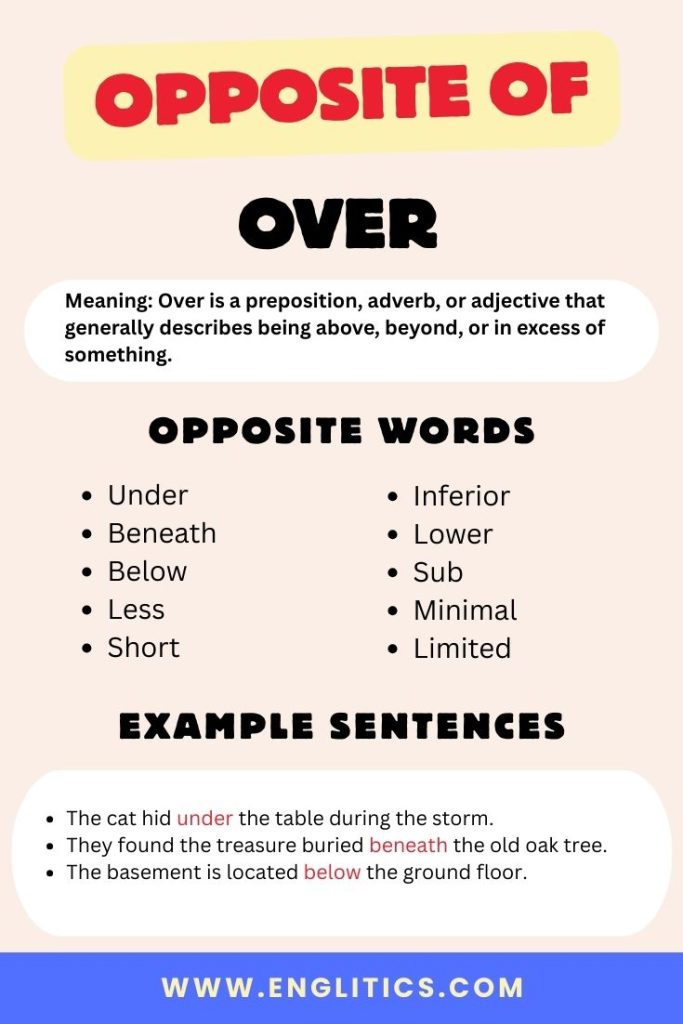
The antonyms for “over” can be categorized based on the different meanings and contexts in which “over” is used. Here are several key categories and examples:
Position and Location
When “over” refers to a position above or across, its antonyms indicate a position below or beneath.
Completion and State
When “over” signifies that something is finished or completed, its antonyms suggest that something is still in progress or has not yet begun.
Authority and Control
When “over” implies having authority or control, its antonyms denote being under authority or lacking control.
Quantity and Amount
When “over” suggests an excess or surplus, its antonyms indicate a deficiency or lack.
Emotion and Feeling
When “over” is used to describe an emotional state that has passed, its antonyms suggest a current or ongoing emotional state.
Duration and Time
When “over” refers to the end of a period of time, its antonyms indicate the beginning or continuation of that period.
Examples of Antonyms for “Over”
To illustrate the various antonyms for “over,” here are several examples organized by category:
Position and Location Examples
This table provides examples of antonyms for “over” when it refers to position and location.
| “Over” in Context | Antonym | Example Sentence with “Over” | Example Sentence with Antonym |
|---|---|---|---|
| Above | Below | The plane flew over the clouds. | The submarine dove below the surface. |
| Across | Under | The bridge goes over the river. | The tunnel goes under the river. |
| On top of | Beneath | The blanket is over the child. | The toys are stored beneath the bed. |
| Upon | Underneath | The painting hung over the fireplace. | The wires ran underneath the floor. |
| Higher than | Lower than | The temperature is over 20 degrees. | The temperature is lower than 20 degrees. |
| Above | Under | The helicopter hovered over the building. | The cat hid under the table. |
| Across | Within | The sound carried over the field. | The conversation stayed within the room. |
| On top of | Inside | The lid is over the jar. | The treasure is inside the chest. |
| Upon | Below | The spotlight shone over the stage. | The orchestra sat below the stage. |
| Higher than | Less than | The water level is over the mark. | The water level is less than the mark. |
| Above | Under | The kite soared over the trees. | The roots grew under the ground. |
| Across | Through | The message traveled over the network. | The data moved through the cables. |
| On top of | Below | The snow piled over the cars. | The pipes ran below the street. |
| Upon | Under | The shadow fell over the garden. | The flowers bloomed under the sunlight. |
| Higher than | Shorter than | The building is over 100 stories tall. | The building is shorter than 100 stories tall. |
| Covering | Exposing | The cloth was over the table. | The cloth was exposing the table. |
| Spanning | Contained Within | The film went over two hours. | The meeting was contained within one hour. |
| Surmounting | Underneath | The climber went over the mountain. | The miner went underneath the mountain. |
| Enveloping | Revealing | Darkness spread over the land. | The dawn was revealing the land. |
| Dominating | Subservient To | The tower stood over the city. | The village was subservient to the city. |
Completion and State Examples
This table demonstrates antonyms for “over” when it indicates completion and state.
| “Over” in Context | Antonym | Example Sentence with “Over” | Example Sentence with Antonym |
|---|---|---|---|
| Finished | Ongoing | The project is over. | The project is ongoing. |
| Completed | Incomplete | The task is over. | The task is incomplete. |
| Ended | Continuing | The game is over. | The game is continuing. |
| Concluded | Beginning | The discussion is over. | The discussion is beginning. |
| Past | Future | That era is over. | The best is yet to come in the future. |
| Done | Pending | The assignment is over. | The assignment is pending. |
| Terminated | Active | The contract is over. | The contract is still active. |
| Expired | Valid | The warranty is over. | The warranty is still valid. |
| Settled | Unresolved | The dispute is over. | The dispute remains unresolved. |
| Ended | In progress | The show is over. | The show is still in progress. |
| Finished | Continuing | The rain is over. | The rain is still continuing. |
| Completed | Unfinished | The construction is over. | The construction is still unfinished. |
| Concluded | Underway | The experiment is over. | The experiment is underway. |
| Past | Present | The worries are over. | The worries are present. |
| Done | In the works | The preparations are over. | The preparations are still in the works. |
| Terminated | Current | Our relationship is over. | Our relationship is still current. |
| Expired | Effective | The promotion is over. | The promotion is still effective. |
| Settled | Open | The case is over. | The case remains open. |
| Ended | Existing | The empire is over. | The culture is still existing. |
Authority and Control Examples
This table showcases antonyms for “over” when it denotes authority and control.
| “Over” in Context | Antonym | Example Sentence with “Over” | Example Sentence with Antonym |
|---|---|---|---|
| In charge of | Under | He is over the department. | He is under the manager. |
| Controlling | Subject to | The government is over its citizens. | The citizens are subject to the government. |
| Ruling | Subordinate | The king is over the kingdom. | The knight is subordinate to the king. |
| Supervising | Overseen | The manager is over the team. | The team is being overseen by the manager. |
| Dominating | Submissive to | The corporation is over its subsidiaries. | The subsidiaries are submissive to the corporation. |
| Governing | Led By | The president is over the country. | The country is led by the president. |
| Commanding | Following | The general is over the troops. | The troops are following the general. |
| Managing | Managed By | She is over the project. | The project is managed by her. |
| Leading | Guided By | He is over the expedition. | The expedition is guided by him. |
| Controlling | Dependent On | The parent company is over its branches. | The branches are dependent on the parent company. |
| In control of | Under the control of | The captain is over the ship. | The ship is under the control of the captain. |
| Supervising | Reporting to | The senior engineer is over the junior engineers. | The junior engineers are reporting to the senior engineer. |
| Ruling | Governed by | The emperor is over the empire. | The empire is governed by the emperor. |
| Commanding | Taking orders from | The officer is over the soldiers. | The soldiers are taking orders from the officer. |
| Managing | Collaborating with | The director is over the actors. | The actors are collaborating with the director. |
| Leading | Supporting | The conductor is over the orchestra. | The orchestra is supporting the conductor. |
| Controlling | Influenced by | The board is over the company. | The company is influenced by the board. |
| In charge | Accountable to | The supervisor is over the employees. | The employees are accountable to the supervisor. |
| Directing | Assisting | The coach is over the team. | The team is assisting the coach. |
| Presiding over | Attending | The chairman is presiding over the meeting. | The members are attending the meeting. |
Quantity and Amount Examples
This table provides examples of antonyms for “over” when referring to quantity and amount.
| “Over” in Context | Antonym | Example Sentence with “Over” | Example Sentence with Antonym |
|---|---|---|---|
| Excessive | Insufficient | There is an over abundance of food. | There is an insufficient amount of water. |
| Too much | Too little | He has over spent his budget. | He has too little money to spend. |
| Surplus | Deficit | There is an over supply of goods. | There is a deficit of essential resources. |
| More than enough | Less than required | They have over estimated the demand. | They have less than required resources. |
| Abundant | Scarce | The resources are over abundant. | The resources are scarce. |
| Exceeding | Lacking | The inventory is over its limit. | The inventory is lacking items. |
| Overflowing | Depleted | The river is over its banks. | The well is depleted of water. |
| Extra | Inadequate | There is an over dosage of medication. | There is an inadequate supply of medicine. |
| Surpassing | Below | The sales are over expectations. | The sales are below expectations. |
| Beyond | Within | The cost is over budget. | The cost is within budget. |
| In excess of | Less than | The weight is over the limit. | The weight is less than the limit. |
| Too many | Too few | There are over many applicants. | There are too few volunteers. |
| Surplus | Shortage | There is an over abundance of food. | There is a shortage of supplies. |
| More than enough | Not enough | We have over estimated the crowd size. | We have not enough chairs for everyone. |
| Abundant | Limited | The natural resources are over abundant. | The water supply is limited. |
| Exceeding | Deficient | The stock is over the required amount. | The stock is deficient in certain items. |
| Overflowing | Empty | The container is over flowing with water. | The container is empty. |
| Extra | Lacking | There is an over supply of materials. | We are lacking certain essential tools. |
| Surpassing | Under | The demand is over our expectations. | The demand is under our predictions. |
| Beyond | Inside | The noise level is over the allowed limit. | The noise level is inside the permitted range. |
Emotion and Feeling Examples
This table demonstrates antonyms for “over” when it relates to emotions and feelings.
| “Over” in Context | Antonym | Example Sentence with “Over” | Example Sentence with Antonym |
|---|---|---|---|
| Ended | Lingering | The sadness is over. | The sadness is lingering. |
| Past | Present | The grief is over. | The grief is present. |
| Gone | Remaining | The anger is over. | The anger is remaining. |
| Finished | Continuing | The fear is over. | The fear is continuing. |
| Resolved | Unresolved | The anxiety is over. | The anxiety is unresolved. |
| Dissipated | Intensifying | The tension is over. | The tension is intensifying. |
| Subsided | Building | The excitement is over. | The excitement is building. |
| Eased | Heightening | The pain is over. | The pain is heightening. |
| Vanished | Persisting | The disappointment is over. | The disappointment is persisting. |
| Ended | Existing | The frustration is over. | The frustration is existing. |
| Finished | Ongoing | The excitement is over. | The excitement is ongoing. |
| Ended | Lasting | The shock is over. | The shock is lasting. |
| Past | Current | The worry is over. | The worry is current. |
| Gone | Present | The bitterness is over. | The bitterness is present. |
| Finished | In progress | The suffering is over. | The suffering is in progress. |
| Resolved | Unsettled | The conflict is over. | The conflict is unsettled. |
| Dissipated | Growing | The fear is over. | The fear is growing. |
| Subsided | Increasing | The stress is over. | The stress is increasing. |
| Eased | Worsening | The discomfort is over. | The discomfort is worsening. |
| Vanished | Enduring | The despair is over. | The despair is enduring. |
Duration and Time Examples
This table illustrates antonyms for “over” concerning duration and time.
| “Over” in Context | Antonym | Example Sentence with “Over” | Example Sentence with Antonym |
|---|---|---|---|
| Ended | Beginning | The summer is over. | The summer is beginning. |
| Finished | Starting | The day is over. | The day is starting. |
| Past | Future | The era is over. | The era is in the future. |
| Concluded | Commencing | The meeting is over. | The meeting is commencing. |
| Expired | Upcoming | The deadline is over. | The deadline is upcoming. |
| Terminated | Continuing | The subscription is over. | The subscription is continuing. |
| Ceased | Resuming | The break is over. | The break is resuming. |
| Completed | Initiating | The project is over. | The project is initiating. |
| Done | About to begin | The shift is over. | The shift is about to begin. |
| Elapsed | Approaching | The time is over. | The time is approaching. |
| Ended | About to start | The school year is over. | The school year is about to start. |
| Finished | In the future | The old regime is over. | The new era is in the future. |
| Concluded | Impending | The investigation is over. | The next phase is impending. |
| Expired | Immediate | The permit is over. | The renewal is immediate. |
| Terminated | Prolonged | The agreement is over. | The agreement is being prolonged. |
| Ceased | Recommencing | The broadcast is over. | The transmission is recommencing. |
| Completed | Launching | The test is over. | The next experiment is launching. |
| Done | Soon to start | The semester is over. | The next term is soon to start. |
| Elapsed | Forthcoming | The waiting period is over. | The result is forthcoming. |
| Ended | Awaiting | The reign is over. | The next coronation is awaiting. |
Usage Rules for Antonyms of “Over”
Using the correct antonym for “over” requires careful consideration of the context. Here are some guidelines:
- Consider the Specific Meaning: Identify precisely what “over” means in the sentence. Is it about position, completion, control, or quantity?
- Context is Key: The surrounding words and the overall situation will guide you to the appropriate antonym.
- Formal vs. Informal: Some antonyms may be more suitable for formal writing, while others are better for informal communication.
- Avoid Overgeneralization: Not every antonym will work in every situation. Always test the antonym in the sentence to ensure it makes sense.
- Be Precise: Choose the antonym that most accurately conveys the opposite meaning of “over” in that specific context.
For instance, if you are discussing a project that is “over,” using “ongoing” is more precise than simply saying “not over.” Similarly, when discussing authority, “under” is often more accurate than “without.”
Common Mistakes
Here are some common mistakes to avoid when using antonyms for “over”:
- Using a General Antonym: Choosing an antonym that is too broad and doesn’t accurately reflect the opposite meaning.
- Ignoring Context: Selecting an antonym without considering the specific context in which “over” is used.
- Incorrect Word Choice: Mistaking synonyms for antonyms, leading to inaccurate sentences.
- Overcomplicating: Using overly complex or formal antonyms when a simpler word would suffice.
Here are some examples of common mistakes with corrections:
| Incorrect | Correct | Explanation |
|---|---|---|
| The rain is over, so it is dry. | The rain is over, so it is continuing. | “Continuing” accurately reflects the opposite of the rain stopping. |
| He is over the team, which means he is without the team. | He is over the team, which means he is under the manager. | “Under” indicates a position of being managed, which is the opposite of being in charge. |
| There is over supply, so there is less. | There is over supply, so there is a shortage. | “Shortage” is a more precise antonym for “over supply” than “less.” |
| The sadness is over, so it is happy. | The sadness is over, so it is lingering. | “Lingering” is the opposite of the feeling having ended. |
| The summer is over, so it is future. | The summer is over, so it is beginning. | “Beginning” indicates the start of something new. |
Practice Exercises
Test your understanding with these practice exercises. Choose the best antonym for “over” in each sentence.
Exercise 1: Choose the best antonym related to position.
| Question | Options | Answer |
|---|---|---|
| The plane flew over the city. The submarine swam ____ the sea. | a) under, b) above, c) across, d) on | a) under |
| The blanket is over the child. The toys are ____ the bed. | a) beneath, b) over, c) beside, d) around | a) beneath |
| The spotlight shone over the stage. The orchestra sat ____ the stage. | a) below, b) above, c) beside, d) around | a) below |
| The climber went over the mountain. The miner went ____ the mountain. | a) underneath, b) above, c) beside, d) around | a) underneath |
| The tower stood over the city. The village was ____ the city. | a) subservient to, b) above, c) beside, d) around | a) subservient to |
Exercise 2: Identify the most suitable antonym related to time.
| Question | Options | Answer |
|---|---|---|
| The meeting is over. The next meeting is ____. | a) commencing, b) past, c) finished, d) done | a) commencing |
| The summer is over. The winter is ____. | a) beginning, b) past, c) completed, d) elapsed | a) beginning |
| The warranty is over. The new warranty is ____. | a) upcoming, b) terminated, c) ceased, d) completed | a) upcoming |
| The shift is over. The next shift is ____. | a) about to begin, b) expired, c) done, d) elapsed | a) about to begin |
| The semester is over. The next semester is ____. | a) soon to start, b) ceased, c) completed, d) elapsed | a) soon to start |
Exercise 3: Find the best antonym related to authority.
| Question | Options | Answer |
|---|---|---|
| He is over the department. He is ____ the manager. | a) under, b) ruling, c) supervising, d) governing | a) under |
| She is over the project. The project is ____ her. | a) managed by, b) controlling, c) commanding, d) leading | a) managed by |
| The general is over the troops. The troops are ____ the general. | a) following, b) dominating, c) governing, d) leading | a) following |
| The president is over the country. The country is ____ the president. | a) led by, b) in charge of, c) managing, d) directing | a) led by |
| The parent company is over its branches. The branches are ____ the parent company. | a) dependent on, b) controlling, c) governing, d) presiding over | a) dependent on |
Advanced Topics
For advanced learners, consider these topics related to antonyms of “over”:
- Nuances in Meaning: Explore how subtle differences in context can drastically change the appropriate antonym.
- Regional Variations: Investigate how antonym usage might differ between dialects or regions.
- Literary Usage: Analyze how authors use antonyms of “over” to create specific effects in their writing.
- Historical Changes: Research how the meanings of “over” and its antonyms have evolved over time.
FAQ
Q: Can “under” always be used as an antonym for “over”?
A: No, “under” is only an antonym for “over” when “over” refers to a position above or a state of authority. In other contexts, different antonyms are more appropriate.
Q: How do I choose the right antonym for “over” in a sentence?
A: Identify the specific meaning of “over” in the sentence and consider the context. Choose the antonym that most accurately conveys the opposite meaning.
Q: Are there situations where “over” has no direct antonym?
A: Yes, in some idiomatic expressions or nuanced contexts, there might not be a single, perfect antonym. In such cases, rephrasing the sentence might be necessary.
Q: Is it possible for a word to be both a synonym and an antonym of “over”?
A: While not common, it’s possible depending on the specific context. For example, “finished” can be a synonym for “over” when indicating completion, but its antonym could be “unfinished,” creating a complex relationship.
Conclusion
Mastering the antonyms for “over” involves understanding its diverse meanings and contexts. By categorizing antonyms based on position, completion, authority, quantity, emotion, and duration, you can more effectively choose the right word to convey the opposite meaning.
Avoid common mistakes by always considering the specific context and testing the antonym in the sentence. With practice and attention to detail, you can confidently use antonyms for “over” to enhance your communication skills and enrich your vocabulary.