The opposite of superior refers to anything considered lower in quality, rank, ability, or importance. Whether we’re talking about skills, performance, or social status, these contrasting terms help us describe the other end of the spectrum.
Antonyms for superior include words that reflect inferiority, weakness, or substandard qualities. They are useful for expressing distinctions in excellence, authority, or value—especially in comparison to a defined standard. By learning these opposites, we develop a stronger grasp of comparative language and sharpen our ability to communicate contrast clearly.
These terms can be applied across many areas, from personal relationships to professional evaluations. Understanding the full range of meanings behind these antonyms helps deepen our vocabulary and express differences more precisely in both writing and conversation.
Definition of “Superior”
The word “superior” is an adjective that describes something or someone that is higher in rank, status, or quality. It can also refer to something that is greater in number or amount.
In essence, “superior” denotes a position of advantage or excellence compared to others. The term is used across various contexts, from describing the quality of a product to indicating a person’s position in a hierarchy.
Understanding the nuances of “superior” is vital to correctly identifying its antonyms.
Classification: Adjective
Function: Descriptive; indicates a higher level of quality, rank, or status.
Contexts: Business, academics, social hierarchies, product comparisons, and general evaluations.
Structural Breakdown of “Superior”
The word “superior” originates from the Latin word superior, which means “higher” or “upper.” This Latin root provides insight into the word’s core meaning of being above or beyond others. The suffix “-ior” in Latin often indicates a comparative degree, suggesting that something is “more” than something else. Understanding the etymology of “superior” helps to reinforce its meaning and differentiate it from related words.
Structurally, “superior” functions primarily as an adjective, modifying nouns to indicate a higher quality or status. It can also be used in comparative constructions, such as “superior to,” to explicitly compare two items or individuals.
Recognizing the structural role of “superior” is essential for using it correctly in sentences and understanding its relationship to its antonyms.
Types of Antonyms for “Superior”
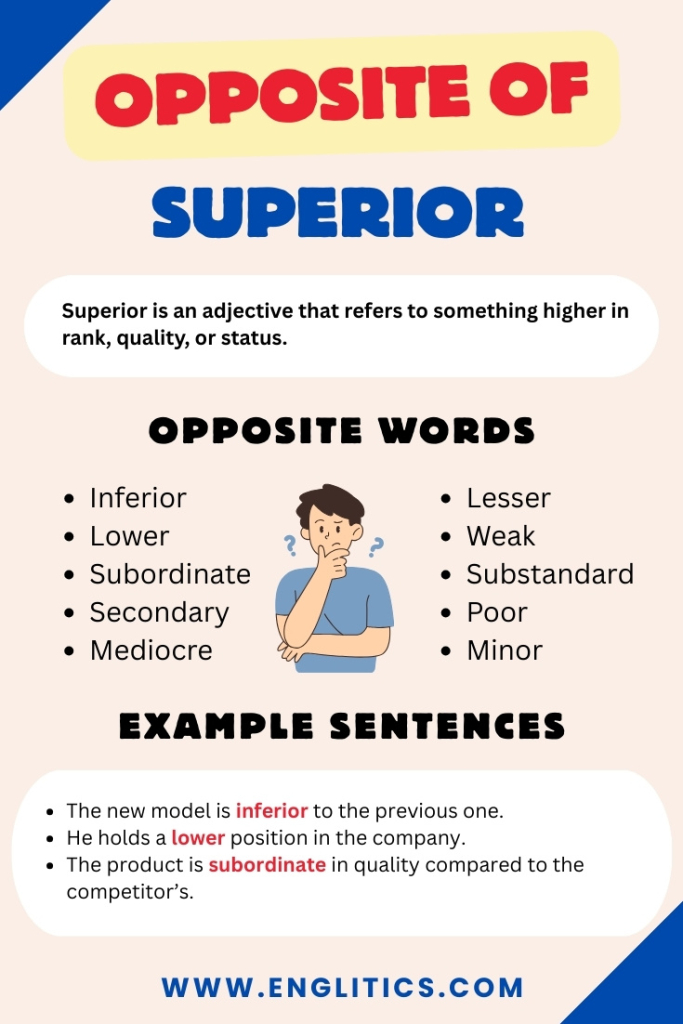
There are several words that can function as antonyms for “superior,” depending on the specific context. These antonyms can be broadly classified based on the aspect of “superior” they oppose, whether it’s quality, rank, or status.
Here are some of the most common antonyms for “superior,” each with its own distinct meaning and usage:
Inferior
“Inferior” is perhaps the most direct and common antonym of “superior.” It signifies something that is lower in rank, quality, or importance. It implies a deficiency or inadequacy compared to a standard or another item.
Subordinate
“Subordinate” refers to something or someone that is lower in rank or position within a hierarchy. It often implies a relationship of authority, where one entity is under the control or direction of another.
Lesser
“Lesser” indicates something that is smaller in size, amount, or importance. It suggests a reduced degree of significance or value.
Lower
“Lower” denotes a position that is physically or figuratively below something else. It can refer to rank, status, or even physical placement.
Secondary
“Secondary” signifies something that is less important or less prominent than something else. It implies that something is not the primary focus or concern.
Worse
“Worse” indicates a decline in quality or condition. It suggests that something has deteriorated or is of a lower standard than before.
Deficient
“Deficient” means lacking something essential or necessary. It implies a shortage or inadequacy that impairs functionality or quality.
Common
When “superior” is used to mean rare or special, “common” can be an antonym. It suggests ordinariness and lack of distinction.
Ordinary
“Ordinary” is similar to “common” and emphasizes a lack of exceptional qualities. It implies that something is typical and unremarkable.
Examples of Antonyms in Sentences
To fully grasp the usage of antonyms for “superior,” it’s helpful to see them in context. Here are several examples, categorized by the specific antonym used:
The following table provides examples using “inferior” as an antonym for “superior.” It illustrates how “inferior” can be used to describe products, performance, or quality that is less than ideal.
| Sentence with “Superior” | Sentence with “Inferior” |
|---|---|
| This product is of superior quality. | This product is of inferior quality. |
| The team’s performance was superior this year. | The team’s performance was inferior this year. |
| The superior design made it a best-seller. | The inferior design led to poor sales. |
| He has a superior intellect. | He has an inferior understanding of the subject. |
| The general had superior strategic skills. | The lieutenant displayed inferior leadership skills. |
| The new model boasts superior fuel efficiency. | The old model had inferior fuel efficiency. |
| The chef used superior ingredients. | The cook used inferior ingredients, affecting the taste. |
| The athlete demonstrated superior stamina. | The athlete displayed inferior stamina and tired quickly. |
| The painting was done with superior skill. | The amateur’s painting showed inferior technique. |
| The software has a superior user interface. | The software has an inferior and clunky user interface. |
| The company’s customer service is superior. | The company’s customer service is inferior and unhelpful. |
| The doctor provided superior medical care. | The patient received inferior medical care. |
| This car offers superior handling. | This car offers inferior handling, making it unsafe. |
| The research team had superior funding. | The research team had inferior funding. |
| The security system provided superior protection. | The security system provided inferior protection. |
| The new building has superior insulation. | The old building has inferior insulation. |
| The professor delivered a superior lecture. | The professor delivered an inferior lecture. |
| The company achieved superior results. | The company achieved inferior results this quarter. |
| The system’s architecture is superior. | The system’s architecture is inferior and outdated. |
| The detective had superior observation skills. | The detective had inferior observation skills. |
| The technology offers superior performance. | The technology offers inferior performance. |
| The product has a superior warranty. | The product has an inferior warranty. |
| The student showed superior understanding of the material. | The student showed inferior understanding of the material. |
| The pilot had superior flying skills. | The pilot had inferior flying skills. |
| The company has a superior reputation. | The company has an inferior reputation. |
The following table illustrates how “subordinate” serves as an antonym, emphasizing hierarchical relationships and positions of lower rank.
| Sentence with “Superior” | Sentence with “Subordinate” |
|---|---|
| The general is superior to the lieutenant. | The lieutenant is subordinate to the general. |
| The CEO holds a superior position in the company. | The assistant holds a subordinate position in the company. |
| The manager has superior authority. | The employee has subordinate responsibilities. |
| The president is superior to the vice president. | The vice president is subordinate to the president. |
| The senior partner is superior to the junior associate. | The junior associate is subordinate to the senior partner. |
| The lead developer is superior to the junior programmer. | The junior programmer is subordinate to the lead developer. |
| The head chef is superior to the sous chef. | The sous chef is subordinate to the head chef. |
| The captain is superior to the sailors. | The sailors are subordinate to the captain. |
| The director is superior to the actors. | The actors are subordinate to the director. |
| The principal is superior to the teachers. | The teachers are subordinate to the principal. |
| The queen is superior to her subjects. | The subjects are subordinate to the queen. |
| The supervisor is superior to the team members. | The team members are subordinate to the supervisor. |
| The senior editor is superior to the junior editor. | The junior editor is subordinate to the senior editor. |
| The professor is superior to the students. | The students are subordinate to the professor. |
| The manager is superior to the staff. | The staff is subordinate to the manager. |
| The president’s decisions are superior and final. | The staff has subordinate roles in implementing decisions. |
| The senior scientist is superior in research projects. | The junior scientist is subordinate in research projects. |
| The head nurse is superior to the nursing assistants. | The nursing assistants are subordinate to the head nurse. |
| The executive is superior in the decision-making process. | The administrative assistant is subordinate in the company’s hierarchy. |
| The general is superior in command. | The soldiers are subordinate to the general’s command. |
| The project lead is superior in directing tasks. | The team members are subordinate, following the project lead’s directions. |
| The head of the department is superior to the members. | The department members are subordinate to the head of the department. |
| The senior engineer is superior in technical expertise. | The junior engineer is subordinate, learning from the senior engineer. |
| The lead artist is superior in artistic direction. | The assistant artists are subordinate, helping with the lead artist’s vision. |
| The city council member is superior in governing. | The city employees are subordinate, carrying out the council’s directives. |
This table presents examples using “lesser” as an antonym, highlighting situations where something is of reduced importance or size.
| Sentence with “Superior” | Sentence with “Lesser” |
|---|---|
| He showed superior strength. | He showed lesser strength compared to his opponent. |
| She had a superior understanding of the topic. | She had a lesser understanding of the topic. |
| The superior road had more lanes. | The lesser road had only two lanes. |
| The superior task received more attention. | The lesser task received less attention. |
| He had a superior role in the project. | He had a lesser role in the project. |
| The superior reward was a vacation. | The lesser reward was a gift card. |
| The superior concern was the company’s profit. | The lesser concern was the office decor. |
| The superior amount of rain caused flooding. | The lesser amount of rain barely dampened the ground. |
| The superior effort resulted in a promotion. | The lesser effort resulted in no recognition. |
| The superior advantage led to victory. | The lesser advantage wasn’t enough to win. |
| The superior authority was vested in the president. | The lesser authority was delegated to the managers. |
| The superior knowledge was possessed by the expert. | The lesser knowledge was held by the novice. |
| The superior skill was evident in the master craftsman. | The lesser skill was evident in the apprentice. |
| The superior importance was given to the main event. | The lesser importance was given to the side activities. |
| The superior quantity was available in bulk. | The lesser quantity was available in single servings. |
| The superior influence was exerted by the leader. | The lesser influence was exerted by the follower. |
| The superior contribution was made by the lead researcher. | The lesser contribution was made by the research assistant. |
| The superior visibility was available from the top floor. | The lesser visibility was available from the ground floor. |
| The superior security was provided by the fortress. | The lesser security was provided by the fence. |
| The superior focus was required for the critical task. | The lesser focus was required for the routine task. |
| The superior access was reserved for VIPs. | The lesser access was available to the general public. |
| The superior benefit was the health insurance. | The lesser benefit was the company t-shirt. |
| The superior commitment was shown by the volunteers. | The lesser commitment was shown by those who only attended once. |
| The superior creativity was evident in the artist’s masterpiece. | The lesser creativity was evident in the student’s artwork. |
| The superior detail was included in the official report. | The lesser detail was included in the summary. |
Here the examples show “lower” being used as an antonym for superior.
| Sentence with “Superior” | Sentence with “Lower” |
|---|---|
| The superior officers ate in the main mess hall. | The lower ranks ate in the auxiliary mess hall. |
| The superior court overturned the ruling. | The lower court’s ruling was overturned. |
| The mountain’s superior peak was covered in snow. | The lower slopes were green with vegetation. |
| A superior temperature is needed for sterilizing equipment. | A lower temperature may not kill all the bacteria. |
| The superior floors of the building have the best views. | The lower floors have views of the street. |
| The superior cost makes the item unattainable. | The lower cost makes the item a good deal. |
| The superior level of play is required for the pros. | The lower level of play is for the amateurs. |
| The superior number of participants is required for the event. | The lower number of participants will cause the event to be cancelled. |
| The superior grade makes the cut. | The lower grade failed the test. |
| The superior price is worth the craftsmanship. | The lower price is worth the savings. |
| The superior quality of the materials is appreciated. | The lower quality of the materials is not appreciated. |
| The superior level of security is needed. | The lower level of security is not good enough. |
| The superior standard is difficult to reach. | The lower standard is easily met. |
| The superior amount is more than enough. | The lower amount is not enough. |
| The superior position is highly coveted. | The lower position is not as coveted. |
| The superior rank is only for the best. | The lower rank is where everyone starts. |
| The superior standard is used as a reference. | The lower standard is not used. |
| The superior degree is needed for the job. | The lower degree is not accepted. |
| The superior form is the best one possible. | The lower form is not the best. |
| The superior value is the more expensive one. | The lower value is the cheaper one. |
| The superior rate is only for certain clients. | The lower rate is for everyone. |
| The superior limit is the highest. | The lower limit is the lowest. |
| The superior end is where the action is. | The lower end is where there is no action. |
| The superior part is needed. | The lower part is not needed. |
| The superior section is reserved. | The lower section is not reserved. |
This table shows examples using “secondary” as an antonym for superior.
| Sentence with “Superior” | Sentence with “Secondary” |
|---|---|
| The superior goal is to win the championship. | The secondary goal is to improve teamwork. |
| Her superior focus was on her career. | Her secondary focus was on hobbies. |
| The superior objective is to increase sales. | The secondary objective is to improve customer relations. |
| The superior concern is patient safety. | The secondary concern is hospital aesthetics. |
| The superior need is for food and shelter. | The secondary need is for entertainment. |
| The superior role is that of the director. | The secondary role is that of the assistant director. |
| The superior level of importance is assigned to the main task. | The secondary level of importance is assigned to the supporting tasks. |
| The superior focus is on completing the project. | The secondary focus is on documenting the process. |
| The superior priority is to meet the deadline. | The secondary priority is to refine the details. |
| The superior aim is to achieve financial stability. | The secondary aim is to expand the business. |
| The superior consideration is the ethical implications. | The secondary consideration is the public perception. |
| The superior purpose is to educate the public. | The secondary purpose is to raise funds. |
| The superior advantage is the company’s reputation. | The secondary advantage is the location of the office. |
| The superior benefit is the health insurance. | The secondary benefit is the free coffee. |
| The superior ingredient is the high-quality chocolate. | The secondary ingredient is the vanilla extract. |
| The superior talent is her singing ability. | The secondary talent is her dancing ability. |
| The superior skill is problem-solving. | The secondary skill is communication. |
| The superior reason for attending is the networking opportunity. | The secondary reason for attending is the free lunch. |
| The superior method is the scientific approach. | The secondary method is the experimental approach. |
| The superior goal is to save lives. | The secondary goal is to prevent injuries. |
| The superior objective is to conduct the research. | The secondary objective is to publish the results. |
| The superior concern is the environmental impact. | The secondary concern is the economic impact. |
| The superior need is for clean water. | The secondary need is for sanitation. |
| The superior role is that of the lead investigator. | The secondary role is that of the research assistant. |
Usage Rules for Antonyms of “Superior”
The correct usage of antonyms for “superior” depends heavily on the context. Here are some general guidelines:
- “Inferior” is best used when directly contrasting quality or performance.
- “Subordinate” is appropriate when discussing hierarchical relationships.
- “Lesser” is suitable for indicating a smaller quantity or reduced importance.
- “Lower” is used to describe a position that is physically or figuratively below.
- “Secondary” is appropriate when something is of lesser importance or priority.
- “Worse” is suitable to show a decrease in quality.
- “Deficient” is best when something essential is lacking.
- “Common” and “Ordinary” are suitable when ‘superior’ is used in the sense of rare or special.
It’s crucial to consider the specific nuance you want to convey when choosing an antonym. For instance, saying a product is “inferior” implies a flaw or deficiency, while saying it is “lesser” simply suggests it is smaller or less significant.
Common Mistakes When Using Antonyms of “Superior”
One common mistake is using “inferior” when “lesser” or “secondary” would be more appropriate. For example, saying “The secondary task is inferior” is incorrect; “The secondary task is less important” is more accurate.
Another mistake is using “subordinate” to describe quality. “Subordinate” should only be used in the context of rank or position.
For example, saying “The inferior product is subordinate” is incorrect; “The inferior product” is correct.
Here are some examples of correct and incorrect usage:
| Incorrect | Correct |
|---|---|
| The subordinate quality of the product was evident. | The inferior quality of the product was evident. |
| He had a lesser position in the company, making him inferior. | He had a lower position in the company, making his influence lesser. |
| The secondary task was inferior to the primary one. | The secondary task was less important than the primary one. |
| The common painting was superior to the rest. | The ordinary painting was inferior to the rest. |
Practice Exercises
Test your understanding with these practice exercises. Choose the best antonym for “superior” in each sentence.
Exercise 1:
| Question | Options | Answer |
|---|---|---|
| The team’s ________ performance led to their defeat. | a) superior b) inferior c) subordinate d) lesser | b) inferior |
| The ________ officer reported to the captain. | a) superior b) inferior c) subordinate d) higher | c) subordinate |
| He had a ________ role in the project, focusing on minor tasks. | a) superior b) greater c) lesser d) higher | c) lesser |
| The ________ floors of the building were less desirable. | a) superior b) higher c) lower d) greater | c) lower |
| His ________ concern was the safety of his family. | a) superior b) primary c) secondary d) higher | c) secondary |
| The product was ________; it broke after only a week. | a) superior b) better c) worse d) improved | c) worse |
| The meal was ________ in nutrients. | a) abundant b) superior c) deficient d) sufficient | c) deficient |
| The ________ model was widely available. | a) unique b) superior c) ordinary d) expensive | c) ordinary |
| The ________ option was the one everyone chose. | a) rare b) superior c) common d) special | c) common |
| The ________ standard was unacceptable. | a) superior b) higher c) lower d) better | c) lower |
Exercise 2:
| Question | Options | Answer |
|---|---|---|
| The second-rate ingredients made the dish ________. | a) superior b) delicious c) inferior d) exquisite | c) inferior |
| A ________ position in the hierarchy means less authority. | a) superior b) leading c) subordinate d) commanding | c) subordinate |
| The ________ amount of effort resulted in minimal progress. | a) superior b) excessive c) lesser d) greater | c) lesser |
| The ________ deck of the ship was closer to the water. | a) superior b) upper c) lower d) higher | c) lower |
| His ________ priority was to finish his education. | a) superior b) main c) secondary d) primary | c) secondary |
| The new version was ________ than the old one. | a) superior b) better c) worse d) improved | c) worse |
| The soil was ________ in essential minerals. | a) abundant b) rich c) deficient d) full | c) deficient |
| A ________ brand is found in every store. | a) exclusive b) superior c) ordinary d) luxury | c) ordinary |
| The ________ choice is the one everyone makes. | a) unique b) rare c) common d) special | c) common |
| The ________ quality made the product undesirable. | a) superior b) higher c) lower d) better | c) lower |
Advanced Topics
For advanced learners, it’s important to understand the subtle differences between synonyms of antonyms. For example, “poor” can sometimes be used similarly to “inferior,” but it often carries a stronger connotation of destitution or lack of resources.
Similarly, “junior” can be used instead of “subordinate,” particularly in professional contexts, but it specifically refers to someone with less experience.
Another advanced topic is understanding how antonyms can be used rhetorically to create emphasis or contrast. For example, a speaker might say, “This is not just good; it is superior,” to highlight the exceptional quality of something.
Recognizing these rhetorical uses can enhance your ability to interpret and analyze complex texts.
Frequently Asked Questions
- What is the most common antonym for “superior”?The most common antonym is “inferior,” which directly contrasts the quality or rank implied by “superior.”
- When should I use “subordinate” instead of “inferior”?Use “subordinate” when referring to a hierarchical relationship, where one entity is under the authority or control of another. “Inferior” is more general and refers to quality or performance.
- Can “worse” be considered an antonym for “superior”?Yes, “worse” can be an antonym when “superior” implies a high standard or condition. “Worse” indicates a decline in that standard.
- Is “lesser” always a suitable antonym for “superior”?“Lesser” is suitable when you want to emphasize a smaller quantity or reduced importance. However, it might not be appropriate if you are contrasting quality or rank.
- How does context affect the choice of an antonym for “superior”?Context is crucial. The specific meaning of “superior” in a sentence will determine the most appropriate antonym. Consider whether you are contrasting quality, rank, importance, or another aspect.
- Are there any situations where “equal” could be considered an antonym for “superior”?In some contexts, particularly when discussing fairness or parity, “equal” can function as an antonym. For example, “They demanded equal treatment” implies a rejection of superior status for some.
- Can “deficient” be used in all contexts as an antonym for “superior”?No, “deficient” is best used when describing a lack of essential qualities or components. It’s not a general antonym, but specific to situations involving inadequacy.
- When is it appropriate to use “common” or “ordinary” as an antonym for “superior”?Use “common” or “ordinary” when “superior” is used to imply something rare or exceptional. These antonyms highlight the lack of distinction or uniqueness.
Conclusion
Mastering the antonyms for “superior” is a valuable step in expanding your English vocabulary and improving your communication skills. By understanding the nuances of words like “inferior,” “subordinate,” “lesser,” and “lower,” you can express contrasting ideas with greater precision and clarity.
Remember to consider the context carefully when choosing an antonym, and practice using these words in various sentences.
Continue to explore the relationships between words, including synonyms and antonyms, to deepen your understanding of the English language. With consistent effort and practice, you can confidently use a wide range of vocabulary to communicate effectively and express yourself with nuance and accuracy.
Keep practicing, and you will see significant improvements in your overall language proficiency.