The Opposite of Apparent refers to something that is hidden, unclear, or not easily noticed. While apparent things are obvious or seem true at first glance, their opposites are concealed, doubtful, or hard to detect.
Antonyms for Apparent include hidden, obscure, and uncertain. For example, a hidden meaning might require deep thought to uncover. Something obscure may not be easily understood or seen. When a fact is uncertain, it lacks the clarity or certainty that makes it appear obvious.
Definition of “Apparent”
“Apparent” is an adjective that describes something easily seen or understood. It implies clarity, obviousness, and a lack of ambiguity.
The word often suggests that something is evident to the senses or to the mind. In essence, “apparent” signifies that something is readily perceptible or comprehensible.
The term can be used in various contexts, ranging from physical appearances to abstract concepts. For instance, a physical symptom might be described as “apparent” if it is easily noticeable.
Similarly, a logical conclusion might be described as “apparent” if it follows naturally from the given premises.
Classification and Function
“Apparent” functions primarily as an adjective, modifying nouns to indicate their visibility or comprehensibility. It can describe both tangible objects and intangible ideas.
Its role is to highlight the quality of being easily perceived or understood.
In grammar, “apparent” typically precedes the noun it modifies. For example: “The apparent cause of the accident was speeding.” Here, “apparent” modifies “cause” to indicate that the cause was easily discernible.
Contexts of Usage
“Apparent” finds application across diverse fields, including:
- Science: Describing observable phenomena.
- Law: Referring to evidential facts.
- Mathematics: Indicating obvious solutions.
- Everyday conversation: Expressing clarity or understanding.
Structural Breakdown of “Apparent”
The word “apparent” originates from the Latin word “apparēns,” the present participle of “apparēre,” meaning “to appear.” This etymological root provides insight into the word’s core meaning of visibility and emergence.
The structure of “apparent” is relatively straightforward. It consists of the root “appear” and the suffix “-ent,” which transforms the verb into an adjective.
This suffix is commonly used to form adjectives that describe a quality or characteristic.
Understanding the word’s etymology and structure can aid in grasping its nuances and in differentiating it from related terms. By recognizing the connection to “appear,” one can better appreciate the sense of visibility inherent in “apparent.”
Types of Antonyms
Antonyms, or opposite words, can be categorized into several types, each representing a distinct relationship between words. Understanding these categories is crucial for selecting the most appropriate antonym for “apparent” in various contexts.
Complementary Antonyms
Complementary antonyms represent an either/or relationship. If one word applies, the other cannot.
For example, “alive” and “dead” are complementary antonyms. With “apparent,” a complementary antonym might be “non-apparent” or “unapparent,” although these are less commonly used.
Gradable Antonyms
Gradable antonyms exist on a spectrum, allowing for degrees of meaning. Examples include “hot” and “cold,” where there are intermediate states like “warm” and “cool.” For “apparent,” gradable antonyms include “unclear,” “vague,” and “obscure,” which represent varying degrees of lack of clarity.
Relational Antonyms
Relational antonyms describe a relationship from opposite perspectives. Examples include “teacher” and “student” or “buy” and “sell.” While less directly applicable to “apparent,” one could consider the relationship between something being “apparent” to an observer and being “hidden” from that observer.
Opposite of Apparent
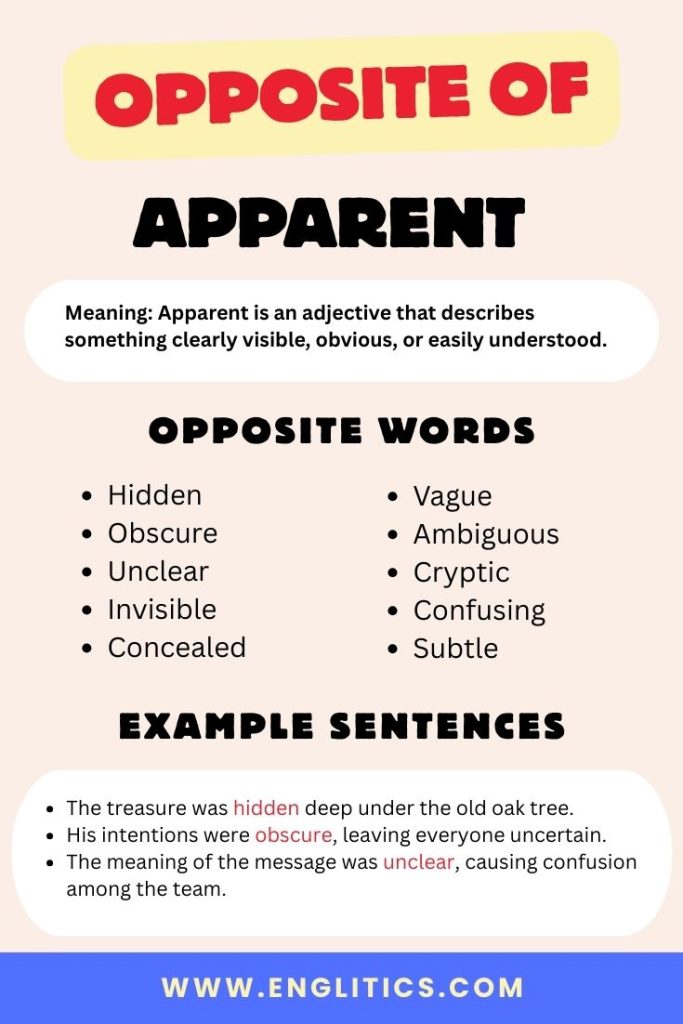
This section provides extensive examples of antonyms for “apparent,” categorized for clarity. Each category includes numerous examples to illustrate the diverse ways in which these antonyms can be used.
Obscure
“Obscure” signifies something not easily understood or clearly expressed. It implies a lack of clarity and visibility.
The following table illustrates the use of “obscure” as an antonym for “apparent”:
| Sentence with “Apparent” | Sentence with “Obscure” |
|---|---|
| The apparent reason for his absence was illness. | The obscure reason for his absence remained a mystery. |
| It was apparent that she was upset. | It was obscure why she was upset. |
| The apparent solution to the problem was simple. | The obscure solution to the problem required complex calculations. |
| The apparent meaning of the poem was straightforward. | The obscure meaning of the poem was open to interpretation. |
| The apparent cause of the fire was arson. | The obscure cause of the fire was never determined. |
| His apparent joy was contagious. | His obscure motives were suspicious. |
| The apparent truth was undeniable. | The obscure truth was buried beneath layers of lies. |
| The apparent danger was minimal. | The obscure danger was lurking in the shadows. |
| The apparent benefits were numerous. | The obscure drawbacks were significant. |
| The apparent winner was clear to everyone. | The obscure winner was only known to a few. |
| The apparent source of the leak was the roof. | The obscure source of the leak remained elusive. |
| The apparent motive for the crime was robbery. | The obscure motive for the crime baffled investigators. |
| The apparent evidence pointed to his guilt. | The obscure evidence was circumstantial at best. |
| The apparent objective was to win the game. | The obscure objective remained hidden from the public. |
| The apparent impact of the policy was positive. | The obscure impact of the policy was difficult to assess. |
| The apparent purpose of the meeting was to discuss finances. | The obscure purpose of the meeting was never revealed. |
| The apparent message was one of hope and resilience. | The obscure message was shrouded in symbolism and metaphor. |
| The apparent trend indicated a rise in sales. | The obscure trend suggested underlying economic instability. |
| The apparent intention was to help those in need. | The obscure intention was manipulative and self-serving. |
| The apparent solution was to increase funding for education. | The obscure solution involved complex political negotiations. |
| The apparent aim was to improve healthcare access for all citizens. | The obscure aim was to consolidate power within a select group. |
| The apparent reason for the change in policy was public demand. | The obscure reason involved behind-the-scenes lobbying by special interest groups. |
| The apparent goal was to foster international cooperation and understanding. | The obscure goal was to undermine the sovereignty of certain nations. |
| The apparent motivation was to protect the environment and promote sustainability. | The obscure motivation was to exploit natural resources for personal gain. |
Hidden
“Hidden” implies something concealed or not easily found. It suggests a deliberate attempt to keep something out of sight.
The following table illustrates the use of “hidden” as an antonym for “apparent”:
| Sentence with “Apparent” | Sentence with “Hidden” |
|---|---|
| The apparent treasure was easy to find. | The hidden treasure was buried deep underground. |
| Her apparent sadness was visible to everyone. | Her hidden sadness was masked by a forced smile. |
| The apparent truth was out in the open. | The hidden truth was carefully guarded. |
| The apparent agenda was discussed openly. | The hidden agenda was kept secret. |
| The apparent meaning was clear. | The hidden meaning was layered and complex. |
| The apparent danger was obvious. | The hidden danger was subtle and insidious. |
| The apparent motive was simple greed. | The hidden motive was a desire for revenge. |
| The apparent flaws were minor and easily overlooked. | The hidden flaws threatened to undermine the entire structure. |
| The apparent solution was straightforward and practical. | The hidden solution required unconventional thinking. |
| The apparent benefits were immediate and tangible. | The hidden benefits would only be realized in the long term. |
| The apparent risks were minimal and well-managed. | The hidden risks posed a significant threat to the project’s success. |
| The apparent costs were clearly outlined in the budget. | The hidden costs began to accumulate as the project progressed. |
| The apparent purpose was to provide assistance to those in need. | The hidden purpose was to exploit their vulnerabilities. |
| The apparent goal was to promote peace and understanding. | The hidden goal was to destabilize the region and gain political advantage. |
| The apparent reason for the decision was a lack of funding. | The hidden reason was political pressure from influential stakeholders. |
| The apparent objective was to improve the quality of education. | The hidden objective was to indoctrinate students with a particular ideology. |
| The apparent intention was to create a more equitable society. | The hidden intention was to consolidate power within a select elite. |
| The apparent message was one of unity and solidarity. | The hidden message was divisive and intended to sow discord. |
| The apparent trend indicated a growing interest in sustainable practices. | The hidden trend revealed a growing dependence on fossil fuels. |
| The apparent impact of the policy was positive and beneficial. | The hidden impact was detrimental and caused significant harm to vulnerable populations. |
| The apparent source of the problem was a technical malfunction. | The hidden source was a deliberate act of sabotage. |
| The apparent cause of the accident was human error. | The hidden cause was a design flaw that had been overlooked. |
| The apparent evidence supported the defendant’s alibi. | The hidden evidence suggested that he was lying. |
| The apparent explanation was plausible and convincing. | The hidden explanation was far more complex and disturbing. |
Unclear
“Unclear” signifies a lack of clarity or precision. It suggests ambiguity and a difficulty in understanding.
The following table illustrates the use of “unclear” as an antonym for “apparent”:
| Sentence with “Apparent” | Sentence with “Unclear” |
|---|---|
| The apparent meaning of his words was obvious. | The unclear meaning of his words caused confusion. |
| It was apparent that he was lying. | It was unclear whether he was telling the truth. |
| The apparent outcome of the election was decisive. | The unclear outcome of the election led to recounts. |
| The apparent purpose of the project was well-defined. | The unclear purpose of the project hindered its progress. |
| The apparent benefits of the new policy were substantial. | The unclear benefits of the new policy made it difficult to justify its cost. |
| The apparent risks were minimal and easily mitigated. | The unclear risks made it difficult to assess the potential consequences. |
| The apparent solution was simple and straightforward. | The unclear solution required further investigation and analysis. |
| The apparent cause of the problem was a technical malfunction. | The unclear cause of the problem made it difficult to implement effective solutions. |
| The apparent motive for the crime was robbery. | The unclear motive for the crime perplexed investigators. |
| The apparent evidence pointed to the suspect’s guilt. | The unclear evidence made it difficult to secure a conviction. |
| The apparent objective was to improve the quality of life for all citizens. | The unclear objective made it difficult to measure the project’s success. |
| The apparent intention was to create a more equitable society. | The unclear intention raised questions about the true motivations of the policymakers. |
| The apparent message was one of hope and resilience. | The unclear message left many feeling confused and uncertain. |
| The apparent trend indicated a growing interest in sustainable practices. | The unclear trend made it difficult to predict the future of the industry. |
| The apparent impact of the policy was positive and beneficial. | The unclear impact made it difficult to determine whether the policy was truly effective. |
| The apparent source of the information was a reliable and trustworthy source. | The unclear source of the information raised concerns about its accuracy and validity. |
| The apparent reason for the decision was a lack of funding. | The unclear reason led to speculation and rumors. |
| The apparent goal was to foster international cooperation and understanding. | The unclear goal made it difficult to assess the project’s long-term impact. |
| The apparent motivation was to protect the environment and promote sustainability. | The unclear motivation sparked controversy and debate. |
Usage Rules for Antonyms of “Apparent”
When using antonyms for “apparent,” it’s crucial to consider the specific context and the intended meaning. The choice of antonym depends on the particular aspect of “apparent” that you wish to negate.
- “Obscure” is suitable when you want to emphasize that something is not easily understood or known.
- “Hidden” is appropriate when you want to highlight that something is deliberately concealed.
- “Unclear” is fitting when you want to indicate a lack of clarity or precision.
Pay attention to the connotations of each antonym. “Obscure” can suggest complexity or mystery, while “hidden” can imply secrecy or deception.
“Unclear” often conveys uncertainty or ambiguity.
Common Mistakes When Using Antonyms of “Apparent”
A common mistake is using an antonym that doesn’t accurately reflect the intended meaning. For instance, using “hidden” when “unclear” would be more appropriate, or vice versa.
Here are some examples of common mistakes and their corrections:
| Incorrect | Correct | Explanation |
|---|---|---|
| The apparent motive was hidden. | The apparent motive was obscure. | “Hidden” implies deliberate concealment, while “obscure” suggests a lack of clarity. |
| The unclear solution was obvious. | The apparent solution was obvious. | “Unclear” contradicts “obvious.” |
| His apparent feelings were obscure. | His hidden feelings were obscure. | “Hidden” is better because it suggests the feelings were intentionally concealed. |
Practice Exercises
Test your understanding of antonyms for “apparent” with these practice exercises.
Exercise 1: Fill in the Blanks
Choose the best antonym for “apparent” to complete each sentence.
| Question | Answer |
|---|---|
| The _______ reason for his success was hard work. | obscure |
| The _______ truth was revealed after years of investigation. | hidden |
| The _______ meaning of the symbol puzzled the experts. | unclear |
| The _______ dangers of the situation were not immediately recognized. | hidden |
| The _______ benefits of the new policy were questioned by economists. | unclear |
| The ________ source of the river remained a mystery to explorers. | obscure |
| The ________ motive behind his actions was never fully understood. | obscure |
| The ________ flaws in the design were eventually discovered during testing. | hidden |
| The ________ solution to the problem was not immediately apparent. | unclear |
| The ________ agenda of the organization was suspected by many. | hidden |
Exercise 2: Sentence Completion
Rewrite each sentence using an antonym for “apparent.”
| Original Sentence | Rewritten Sentence |
|---|---|
| The apparent cause of the accident was speeding. | The obscure cause of the accident remained a mystery. |
| It was apparent that she was angry. | It was unclear whether she was truly angry. |
| The apparent winner of the competition was announced. | The hidden winner of the competition was kept secret until the final ceremony. |
| The apparent benefits of exercise are well-documented. | The unclear benefits of the experimental treatment made it difficult to justify its use. |
| The apparent motive for the crime was robbery. | The obscure motive for the crime baffled investigators. |
| The apparent objective of the mission was to rescue the hostages. | The hidden objective of the mission was to gather intelligence on the enemy. |
| The apparent reason for his departure was a better job offer. | The obscure reason for his departure was never fully explained. |
| The apparent impact of the new law was positive. | The unclear impact of the new law made it difficult to assess its effectiveness. |
| The apparent trend was a decline in sales. | The unclear trend made it difficult to predict future performance. |
| The apparent source of the leak was the roof. | The obscure source of the leak could not be located. |
Advanced Topics: Nuances and Connotations
At an advanced level, understanding the subtle nuances and connotations of antonyms for “apparent” is crucial. Consider the emotional weight and implications carried by each word.
For example, “hidden” can suggest a deliberate act of deception, while “obscure” might simply indicate a lack of knowledge or understanding. The choice of word can significantly impact the tone and message of your writing.
Furthermore, explore the use of figurative language with these antonyms. Metaphors and similes can add depth and complexity to your expressions.
Frequently Asked Questions (FAQ)
- What is the difference between “obscure” and “hidden”?“Obscure” means not easily discovered or understood, while “hidden” implies intentional concealment. An obscure fact might be difficult to find due to its complexity, while a hidden fact is deliberately kept secret.
- Can “apparent” have a positive connotation?Yes, “apparent” can have a positive connotation when it implies clarity and understanding. For example, “The apparent solution was elegant and effective.”
- What are some other antonyms for “apparent”?Other antonyms include “vague,” “ambiguous,” “covert,” and “latent,” depending on the specific context.
- How do I choose the best antonym for “apparent”?Consider the specific meaning you want to convey. Do you want to emphasize a lack of clarity, intentional concealment, or simply something not easily understood?
- Is “unapparent” a valid word?While “unapparent” is technically a valid word, it is less commonly used than “not apparent,” “obscure,” or “hidden.” It’s often better to opt for a more common and natural-sounding antonym.
- How can understanding antonyms improve my writing?Understanding antonyms allows you to express contrasting ideas with greater precision and nuance, enriching your writing and making it more engaging.
- Are there any regional differences in the usage of these antonyms?While the core meanings remain consistent, some regional variations in usage and preference may exist. Pay attention to how native speakers use these words in different contexts.
- How can I practice using antonyms for “apparent”?Engage in writing exercises, read widely, and pay attention to how antonyms are used in various texts. Practice using them in your own conversations and writing to solidify your understanding.
Conclusion
Mastering the antonyms for “apparent” is a valuable step in expanding your English vocabulary and improving your communication skills. By understanding the nuances of words like “obscure,” “hidden,” and “unclear,” you can express yourself with greater precision and clarity.
Remember to consider the context and intended meaning when choosing an antonym. Pay attention to the connotations and emotional weight of each word.
With practice and attention to detail, you can confidently use these antonyms to enrich your writing and conversations.
Continue to explore the fascinating world of antonyms and synonyms to further enhance your linguistic abilities. The more you learn, the more effectively you can communicate your thoughts and ideas.