Opposite of efficient means doing things in a slow, wasteful, or disorganized way. While “efficient” describes someone or something that works well and gets results with little waste, its opposite shows poor use of time, effort, or resources.
Antonyms for efficient include inefficient, wasteful, slow, disorganized, or unproductive. For example, instead of using an efficient method to clean a room quickly, someone might be inefficient and take twice as long without getting good results. These words help describe when things don’t work smoothly or effectively. Knowing these antonyms helps you speak clearly about performance and results.
Definition of Efficient
Efficient, in its simplest form, means achieving maximum productivity with minimum wasted effort or expense. It describes the ability to accomplish a task effectively and resourcefully. An efficient process is one that is well-organized, streamlined, and optimized to produce the desired outcome with the least amount of time, energy, and materials.
The term can apply to various contexts, from personal time management to industrial processes. In personal contexts, an efficient individual might complete tasks quickly and effectively, minimizing distractions and maximizing focus.
In a business context, an efficient operation may involve optimizing workflows, reducing overhead costs, and leveraging technology to improve productivity. Efficiency is highly valued in modern society, as it contributes to increased productivity, reduced costs, and improved overall performance.
The word “efficient” is typically classified as an adjective. As an adjective, it modifies nouns, describing their quality or state. For example, “an efficient worker” or “an efficient system.” It can also be used in comparative and superlative forms, such as “more efficient” and “most efficient.” The noun form of efficient is “efficiency,” which refers to the state or quality of being efficient.
Structural Breakdown
The word “efficient” comes from the Latin word efficiens, which is the present participle of efficere, meaning “to accomplish” or “to produce.” Understanding its etymology helps to grasp its core meaning of achieving results effectively. The word consists of the following parts:
- ef-: A prefix meaning “out” or “thoroughly.”
- fic-: The root from facere, meaning “to do” or “to make.”
- -ient: A suffix indicating a quality or state of being.
Understanding the structure of the word “efficient” can help in recognizing related words and understanding their meanings. For example, “efficacy” (the ability to produce a desired or intended result) shares the same root and is closely related in meaning.
Opposite of Efficient
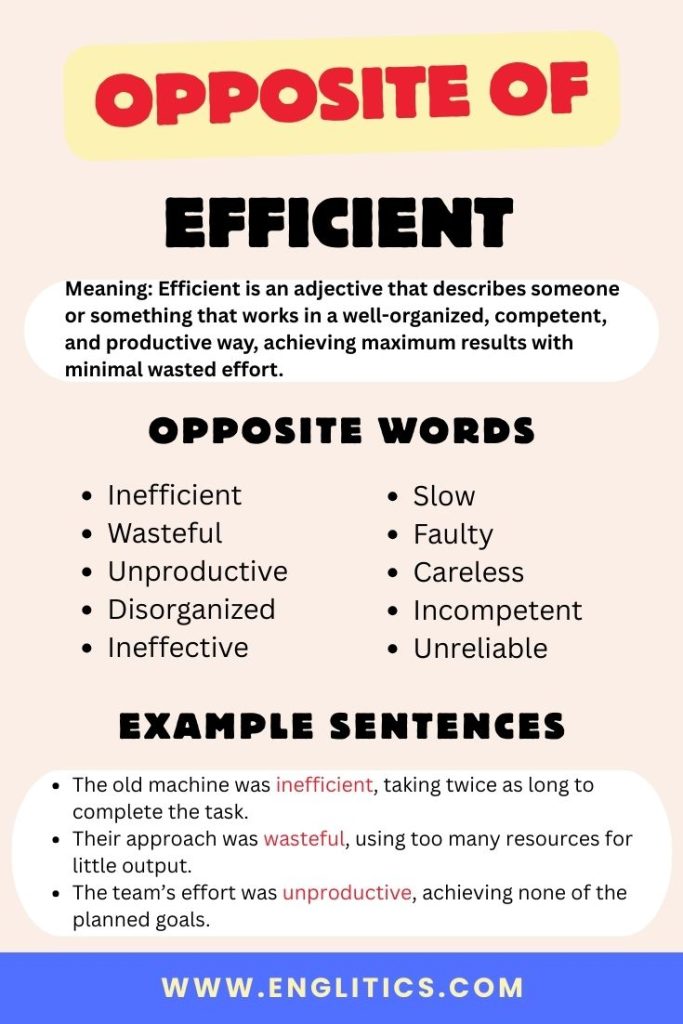
Antonyms for “efficient” can be categorized based on the specific aspect of efficiency they oppose. Here are some key categories:
Inefficient
Inefficient is the most direct and common antonym for “efficient.” It refers to the state of not achieving maximum productivity with the available resources. An inefficient process is one that wastes time, energy, or materials.
Wasteful
Wasteful describes the act of using resources carelessly or extravagantly. A wasteful process consumes more resources than necessary and fails to maximize their value. This can apply to time, money, energy, or materials.
Unproductive
Unproductive refers to the state of not producing significant results or output. An unproductive activity fails to generate the desired outcome and may even hinder progress.
Clumsy
Clumsy describes a lack of skill or grace in performing a task. A clumsy process is awkward, disorganized, and prone to errors, leading to inefficiency.
Slow
Slow refers to the pace at which a task is completed. A slow process takes more time than necessary, resulting in inefficiency.
Examples of Antonyms in Sentences
To illustrate the usage of these antonyms, here are several examples in sentences, categorized by each antonym.
Inefficient Examples
The following table provides examples of “inefficient” used in sentences, highlighting different aspects of inefficiency.
| # | Sentence |
|---|---|
| 1 | The old computer system was inefficient, causing delays and errors. |
| 2 | Their inefficient management led to a significant loss of revenue. |
| 3 | The company’s inefficient use of energy increased their operating costs. |
| 4 | The inefficient bureaucracy made it difficult to get anything done. |
| 5 | His inefficient work habits meant he was always behind schedule. |
| 6 | The inefficient heating system wasted a lot of energy. |
| 7 | The inefficient allocation of resources hindered the project’s progress. |
| 8 | The inefficient design of the machine caused frequent breakdowns. |
| 9 | The inefficient communication channels led to misunderstandings. |
| 10 | Their inefficient inventory management resulted in stockouts and overstocking. |
| 11 | The software proved to be inefficient, consuming too much memory. |
| 12 | The inefficient workflow slowed down the entire production line. |
| 13 | The inefficient use of manpower led to unnecessary overtime costs. |
| 14 | The inefficient distribution network caused delays in delivery. |
| 15 | The inefficient coding resulted in slow loading times for the website. |
| 16 | The government’s inefficient policies stifled economic growth. |
| 17 | The inefficient agricultural practices depleted the soil’s nutrients. |
| 18 | The hospital’s inefficient scheduling system caused long wait times for patients. |
| 19 | The inefficient data management made it difficult to retrieve information. |
| 20 | The inefficient recruitment process resulted in hiring unqualified candidates. |
| 21 | The inefficient public transportation system discourages people from using it. |
| 22 | The company’s inefficient supply chain increased production costs. |
| 23 | The project suffered due to inefficient planning and execution. |
| 24 | The inefficient filing system made it nearly impossible to locate documents. |
| 25 | The team’s inefficient collaboration methods led to duplicated effort. |
Wasteful Examples
This table illustrates the use of “wasteful” in various contexts, emphasizing the unnecessary consumption of resources.
| # | Sentence |
|---|---|
| 1 | It’s wasteful to leave the lights on when no one is in the room. |
| 2 | The wasteful spending habits of the government concerned many citizens. |
| 3 | The factory’s wasteful use of water contributed to the drought. |
| 4 | His wasteful lifestyle led to financial problems. |
| 5 | The wasteful packaging of the product angered environmentally conscious consumers. |
| 6 | It is wasteful to throw away food that is still edible. |
| 7 | The wasteful energy consumption of the building increased its carbon footprint. |
| 8 | The wasteful disposal of electronic waste polluted the environment. |
| 9 | Their wasteful use of paper contributed to deforestation. |
| 10 | The wasteful allocation of funds resulted in a budget deficit. |
| 11 | The company was criticized for its wasteful marketing campaigns. |
| 12 | It’s wasteful to buy more than you need and let it go to waste. |
| 13 | The wasteful use of time during meetings reduced overall productivity. |
| 14 | The wasteful agricultural practices led to soil degradation. |
| 15 | The wasteful use of plastic contributed to ocean pollution. |
| 16 | The government’s wasteful spending on unnecessary projects was heavily criticized. |
| 17 | The wasteful habits of the community strained local resources. |
| 18 | The wasteful consumption of electricity increased utility bills. |
| 19 | The wasteful disposal of water bottles contributed to landfill overflow. |
| 20 | The wasteful use of fuel increased transportation costs. |
| 21 | His wasteful attitude towards money led to financial instability. |
| 22 | The wasteful manufacturing processes generated excessive amounts of scrap. |
| 23 | The wasteful approach to resource management depleted natural reserves. |
| 24 | The wasteful production of single-use items harmed the environment. |
| 25 | Their wasteful dietary habits had negative health consequences. |
Unproductive Examples
The following table demonstrates how “unproductive” is used to describe activities or processes that fail to yield significant results.
| # | Sentence |
|---|---|
| 1 | The meeting was largely unproductive, with no decisions made. |
| 2 | His unproductive efforts failed to yield any positive results. |
| 3 | The unproductive discussions led to frustration among the team members. |
| 4 | The unproductive soil made it difficult to grow crops. |
| 5 | Her unproductive work habits hindered her career progression. |
| 6 | The day felt unproductive because of constant interruptions. |
| 7 | The unproductive research yielded no significant findings. |
| 8 | The unproductive negotiations failed to reach a consensus. |
| 9 | His unproductive time spent on social media reduced his study hours. |
| 10 | The unproductive investment led to financial losses. |
| 11 | The unproductive training program failed to improve employee skills. |
| 12 | The unproductive brainstorming session generated no new ideas. |
| 13 | The unproductive use of technology hindered workflow. |
| 14 | The unproductive farming methods resulted in low yields. |
| 15 | Her unproductive attempts to fix the machine only made it worse. |
| 16 | The unproductive management style led to low employee morale. |
| 17 | The unproductive political debates failed to address the pressing issues. |
| 18 | The unproductive approach to problem-solving prolonged the crisis. |
| 19 | The unproductive use of resources undermined the project’s success. |
| 20 | The unproductive labor practices affected the company’s bottom line. |
| 21 | The unproductive search for a solution wasted valuable time. |
| 22 | The unproductive conservation efforts failed to protect the endangered species. |
| 23 | The unproductive collaboration led to duplicated efforts and wasted resources. |
| 24 | The unproductive learning environment hindered student progress. |
| 25 | The unproductive bureaucracy stifled innovation and growth. |
Clumsy Examples
This table provides examples of “clumsy” used to describe processes or actions that lack skill and coordination, leading to inefficiency.
| # | Sentence |
|---|---|
| 1 | The clumsy design of the app made it difficult to use. |
| 2 | His clumsy handling of the situation made it worse. |
| 3 | The clumsy execution of the plan led to its failure. |
| 4 | The clumsy interface of the software frustrated users. |
| 5 | Her clumsy attempts to repair the device damaged it further. |
| 6 | The clumsy management of the project resulted in delays and cost overruns. |
| 7 | The clumsy way he presented the information confused the audience. |
| 8 | The clumsy coding caused frequent errors in the program. |
| 9 | Their clumsy approach to customer service alienated many clients. |
| 10 | The clumsy construction of the building made it unsafe. |
| 11 | The clumsy distribution of resources led to shortages in some areas. |
| 12 | The clumsy integration of the new system caused numerous problems. |
| 13 | The clumsy attempt to merge the two departments created chaos. |
| 14 | The clumsy wording of the contract led to misunderstandings. |
| 15 | The clumsy reorganization of the company disrupted operations. |
| 16 | His clumsy social skills made it difficult for him to network. |
| 17 | The clumsy implementation of the new policy caused confusion among employees. |
| 18 | The clumsy navigation of the website frustrated visitors. |
| 19 | The clumsy coordination between teams slowed down progress. |
| 20 | The clumsy handling of the data breach damaged the company’s reputation. |
| 21 | The clumsy editing of the document resulted in inconsistencies. |
| 22 | The clumsy translation of the text altered its original meaning. |
| 23 | The clumsy response to the crisis worsened the situation. |
| 24 | The clumsy management of the budget led to financial instability. |
| 25 | The clumsy delivery of the news offended many people. |
Slow Examples
The table below provides examples of “slow” used to describe processes or progress that take more time than necessary, indicating inefficiency.
| # | Sentence |
|---|---|
| 1 | The slow internet connection made it difficult to work online. |
| 2 | The slow pace of the project frustrated stakeholders. |
| 3 | The slow processing speed of the computer hindered productivity. |
| 4 | The slow response time of the customer service department annoyed customers. |
| 5 | The slow progress of the negotiations led to a breakdown in talks. |
| 6 | The slow delivery of the goods caused delays for the customers. |
| 7 | The slow bureaucratic process made it difficult to obtain permits. |
| 8 | The slow adoption of new technologies hindered the company’s growth. |
| 9 | The slow reaction to the changing market conditions caused financial losses. |
| 10 | The slow implementation of the new regulations created confusion. |
| 11 | The slow learning curve of the new employees reduced productivity. |
| 12 | The slow decision-making process delayed critical projects. |
| 13 | The slow recovery from the economic downturn worried investors. |
| 14 | The slow development of the vaccine prolonged the pandemic. |
| 15 | The slow communication channels hindered collaboration. |
| 16 | The slow adaptation to the new software reduced efficiency. |
| 17 | The slow pace of innovation hampered the company’s competitiveness. |
| 18 | The slow speed of the assembly line reduced output. |
| 19 | The slow progress in resolving the conflict led to further instability. |
| 20 | The slow response to the natural disaster exacerbated the crisis. |
| 21 | The slow processing of applications caused delays for applicants. |
| 22 | The slow implementation of the new policy created resentment. |
| 23 | The slow rate of economic growth concerned analysts. |
| 24 | The slow progress in addressing climate change worried scientists. |
| 25 | The slow adoption of sustainable practices harmed the environment. |
Usage Rules
When using antonyms for “efficient,” it’s important to consider the specific context and the nuance you want to convey. Here are some usage rules:
- Inefficient is a general term that can be used in most contexts where you want to describe a lack of efficiency.
- Wasteful is best used when you want to emphasize the unnecessary consumption of resources.
- Unproductive is suitable when you want to focus on the lack of output or results.
- Clumsy is appropriate when describing a lack of skill or coordination in a process.
- Slow is used to emphasize the time taken to complete a task.
It’s also important to note that some antonyms may overlap in meaning, and the choice of word will depend on the specific aspect you want to highlight. For example, a process can be both inefficient and wasteful if it consumes excessive resources and fails to produce the desired results.
Similarly, a process can be both slow and unproductive if it takes a long time and yields minimal output.
Common Mistakes
One common mistake is using “ineffective” interchangeably with “inefficient.” While both terms describe a lack of success, “ineffective” means not producing the desired result at all, while “inefficient” means not producing the desired result in the most economical way. For example:
- Incorrect: The new strategy was inefficient because it didn’t increase sales.
- Correct: The new strategy was ineffective because it didn’t increase sales.
- Correct: The new strategy was inefficient because it required too much investment for the small increase in sales.
Another common mistake is using “wasteful” when “inefficient” is more appropriate. “Wasteful” specifically refers to the misuse of resources, while “inefficient” is a broader term.
For example:
- Incorrect: The process was wasteful because it took too long.
- Correct: The process was inefficient because it took too long.
- Correct: The process was wasteful because it used too much water.
Practice Exercises
Test your understanding of antonyms for “efficient” with the following exercises.
Exercise 1: Multiple Choice
Choose the best antonym for “efficient” in each sentence.
| # | Question | A | B | C | D | Answer |
|---|---|---|---|---|---|---|
| 1 | The old machine was very __________. | productive | inefficient | effective | streamlined | B |
| 2 | Their __________ spending led to financial trouble. | frugal | economical | wasteful | thrifty | C |
| 3 | The meeting was completely __________. | fruitful | productive | unproductive | successful | C |
| 4 | His __________ handling of the situation made it worse. | skillful | adroit | clumsy | dexterous | C |
| 5 | The __________ delivery of the package caused delays. | quick | swift | slow | rapid | C |
| 6 | The factory’s __________ use of resources angered environmentalists. | careful | wasteful | prudent | conservative | B |
| 7 | The __________ progress of the project frustrated the team. | rapid | swift | slow | expeditious | C |
| 8 | The __________ bureaucracy made it hard to get anything done. | streamlined | efficient | inefficient | organized | C |
| 9 | It was __________ to leave the lights on all night. | economical | wasteful | thrifty | efficient | B |
| 10 | His __________ work resulted in no tangible results. | productive | fruitful | unproductive | effective | C |
Exercise 2: Sentence Completion
Fill in the blank with the most appropriate antonym for “efficient.”
| # | Sentence | Answer |
|---|---|---|
| 1 | The new system was designed to replace the old, __________ one. | inefficient |
| 2 | It’s __________ to use disposable plates when you have reusable ones. | wasteful |
| 3 | The meeting was __________ because no decisions were made. | unproductive |
| 4 | His __________ handling of the equipment resulted in damage. | clumsy |
| 5 | The __________ pace of the construction project caused significant delays. | slow |
| 6 | The company’s __________ energy practices led to higher utility bills. | wasteful |
| 7 | The __________ process of obtaining permits discouraged new businesses. | slow |
| 8 | The __________ use of resources undermined the project’s goals. | wasteful |
| 9 | The __________ design of the product made it difficult to assemble. | clumsy |
| 10 | The __________ communication system caused misunderstandings and delays. | inefficient |
Exercise 3: Antonym Identification
Identify the antonym for “efficient” used in each sentence.
| # | Sentence | Antonym |
|---|---|---|
| 1 | The old process was incredibly cumbersome and time-consuming. | cumbersome |
| 2 | His bungling of the project led to its ultimate failure. | bungling |
| 3 | The company’s operations were sluggish due to outdated technology. | sluggish |
| 4 | The old system was laborious and required too much manual effort. | laborious |
| 5 | The project became stalled due to bureaucratic delays. | stalled |
| 6 | Their approach to problem-solving was circuitous and ineffective. | circuitous |
| 7 | The factory’s production methods were highly uneconomical. | uneconomical |
| 8 | The team’s work was often abortive, failing to produce results. | abortive |
| 9 | The project was bogged down in endless meetings and discussions. | bogged down |
| 10 | The system was unwieldy and difficult to manage. | unwieldy |
Advanced Topics
For advanced learners, understanding the nuances between different degrees of inefficiency can be valuable. For example, a process might be “slightly inefficient” or “grossly inefficient,” depending on the extent of the waste or lack of productivity.
Additionally, exploring the root causes of inefficiency can provide deeper insights into how to improve processes and systems. This could involve analyzing workflows, identifying bottlenecks, and implementing strategies to streamline operations.
Another advanced topic is the concept of “relative efficiency.” A process might be efficient compared to one standard but inefficient compared to another. Understanding these relative comparisons can help in setting realistic goals and benchmarks for improvement.
For example, a manufacturing process might be efficient compared to industry averages but inefficient compared to best-in-class standards.
FAQ
Here are some frequently asked questions about antonyms for “efficient.”
- What is the most common antonym for “efficient”?The most common antonym for “efficient” is inefficient. It is a direct opposite and can be used in most contexts to describe a lack of efficiency.
- When should I use “wasteful” instead of “inefficient”?Use wasteful when you want to emphasize the unnecessary consumption or misuse of resources, such as time, money, energy, or materials. “Inefficient” is a more general term for a lack of productivity or effectiveness.
- What is the difference between “unproductive” and “inefficient”?Unproductive focuses on the lack of output or results. Something that is unproductive does not yield significant results. Inefficient focuses on how resources are used to achieve (or fail to achieve) results. An inefficient process might produce results, but it does so with unnecessary waste or effort.
- Can a process be both “inefficient” and “wasteful”?Yes, a process can be both inefficient and wasteful. For example, a manufacturing process that uses excessive raw materials and produces a low output is both inefficient (low productivity) and wasteful (misuse of resources).
- Is “slow” always an antonym for “efficient”?Slow can be an antonym for “efficient” when the slowness hinders productivity or wastes time. However, sometimes a slow and deliberate approach can be more efficient in the long run if it reduces errors or improves quality.
- How does “clumsy” relate to “inefficient”?Clumsy describes a lack of skill or coordination in a process, which often leads to inefficiency. A clumsy process is awkward, disorganized, and prone to errors, resulting in wasted time and resources.
- Are there any situations where being “inefficient” might be beneficial?In some rare cases, a degree of “inefficiency” might be tolerated or
even desirable. For example, in creative processes, allowing for exploration and experimentation, even if it seems inefficient at first, can lead to innovative solutions. Similarly, in some social contexts, a highly efficient approach might be perceived as cold or impersonal, and a slightly less efficient but more empathetic approach might be preferred.
- How can I improve my understanding of antonyms in general?To improve your understanding of antonyms, try the following:
- Read widely and pay attention to the words used in different contexts.
- Use a thesaurus to explore synonyms and antonyms for various words.
- Practice using new words in sentences to solidify your understanding.
- Engage in word games and exercises to expand your vocabulary.
Conclusion
Mastering antonyms for “efficient” is a valuable skill that enhances your ability to communicate effectively and precisely. By understanding the nuances between words like “inefficient,” “wasteful,” “unproductive,” “clumsy,” and “slow,” you can describe a wider range of situations and express your ideas with greater clarity.
This article has provided definitions, examples, and practical exercises to help you expand your vocabulary and improve your command of the English language. Continue to practice and explore new words to further enrich your communication skills.