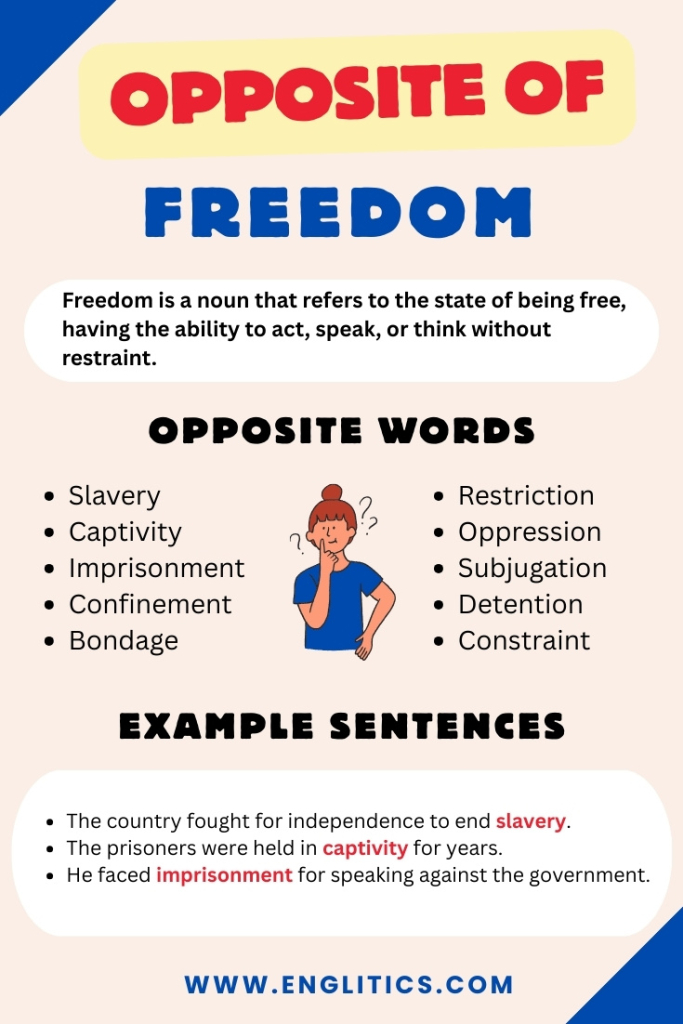
Antonyms for “freedom” include words like oppression, captivity, restraint, bondage, confinement, and restriction. These terms refer to conditions where personal choice, movement, or expression is limited or controlled by external forces.
Using the opposite of freedom allows you to describe situations involving control, limitation, or lack of autonomy—whether in political systems, personal rights, or emotional states. These antonyms are especially useful when discussing human rights, historical struggles, or settings where liberty is denied or withheld.
Definition of Freedom and Its Antonyms
Freedom, in its broadest sense, refers to the power or right to act, speak, or think as one wants without hindrance. It encompasses personal liberty, political independence, and the absence of undue external constraints. The concept of freedom is central to many philosophical and political ideologies, often associated with autonomy, self-determination, and individual rights.
Antonyms for freedom represent the opposite end of this spectrum. They describe states or conditions where individuals are subjected to external control, limitations, or deprivations of their autonomy. These antonyms can range from physical confinement to subtle forms of psychological or economic constraint. Understanding these antonyms requires recognizing the nuances of each term and the specific contexts in which they are used.
The classification of antonyms for freedom includes various categories, such as those denoting physical restraint (e.g., imprisonment), forced labor (e.g., slavery), political oppression (e.g., despotism), and economic dependence (e.g., reliance). Each of these carries its own specific connotations and reflects different aspects of the absence of freedom.
Structural Breakdown
Understanding the structure of antonyms involves examining how they negate or oppose the meaning of “freedom.” Grammatically, antonyms can be nouns (e.g., captivity), adjectives (e.g., dependent), or verbs (e.g., enslave). The choice of antonym depends on the specific aspect of freedom being contrasted.
For example, if we are discussing political freedom, antonyms like tyranny or dictatorship are more appropriate. If we are referring to personal liberty, terms like imprisonment or confinement might be more fitting. The structural pattern often involves prefixes or suffixes that reverse the meaning of a related word (e.g., independent vs. dependent).
Consider how the word “free” is modified to create antonyms. Adding prefixes such as ‘un-‘, ‘in-‘, or ‘dis-‘ can form antonyms: “unfree,” “imprisoned,” or “disenfranchised,” respectively.
Similarly, suffixes like ‘-ment’ or ‘-dom’ can be added to related words to create antonymous nouns: “enslavement” (from “enslave”) or “serfdom” (related to “serf”).
Opposite of Freedom
Captivity and Imprisonment
Captivity and imprisonment refer to the state of being held against one’s will, typically in a confined space. These terms emphasize physical restriction and the loss of mobility. Captivity often implies a more general state of confinement, while imprisonment usually denotes legal or formal detention.
For example, animals in a zoo are in captivity, while a person convicted of a crime is in imprisonment. Both terms represent a direct negation of physical freedom.
Servitude and Slavery
Servitude and slavery describe conditions of forced labor and lack of autonomy over one’s own life and work. Slavery is the most extreme form of servitude, involving ownership of one person by another. Servitude can also include indentured labor or other forms of compulsory service.
These terms highlight the deprivation of economic and personal freedom. A person in slavery has no rights and is treated as property. A person in servitude may have limited rights but is still subject to the control of another.
Oppression and Tyranny
Oppression and tyranny refer to the unjust or cruel exercise of power, often by a government or ruling authority. These terms emphasize the suppression of rights and freedoms through force or coercion. Tyranny is a more extreme form of oppression, typically involving absolute and arbitrary power.
These antonyms relate to political and social freedom. Citizens living under tyranny have no say in their government and are subject to the whims of the ruler. Those experiencing oppression may face systemic discrimination and denial of basic rights.
Restraint and Restriction
Restraint and restriction denote limitations or controls placed on one’s actions, choices, or expression. These terms can refer to both physical and non-physical constraints. Restraint often implies a deliberate act of control, while restriction can refer to a broader range of limitations.
These antonyms can apply to various aspects of freedom. A person on parole may face restrictions on their travel. A speaker might exercise restraint in their language to avoid causing offense.
Dependence and Reliance
Dependence and reliance refer to the state of needing someone or something else for support, assistance, or survival. While not always negative, excessive dependence can limit one’s autonomy and freedom of choice. These terms highlight the lack of self-sufficiency and the potential for external control.
These antonyms often relate to economic or emotional freedom. A person who is financially dependent on their parents may have limited control over their own decisions. A nation that is heavily reliant on foreign aid may be vulnerable to external pressure.
Examples of Antonyms in Sentences
To illustrate the usage of these antonyms, consider the following examples. These examples are categorized based on the type of antonym, showcasing their application in various contexts.
The following table presents examples of Captivity and Imprisonment in sentences:
| Antonym | Example Sentence |
|---|---|
| Captivity | The zoo’s mission is to provide a safe environment for animals rescued from captivity. |
| Captivity | After years in captivity, the rescued birds struggled to adapt to the wild. |
| Captivity | The documentary highlighted the cruelty of keeping marine mammals in captivity. |
| Imprisonment | His imprisonment was a result of his involvement in illegal activities. |
| Imprisonment | The judge sentenced him to five years of imprisonment for the crime. |
| Imprisonment | She fought for prison reform to improve the conditions of imprisonment. |
| Confinement | The solitary confinement drove him to the brink of despair. |
| Confinement | Her confinement to the small village made her long for the outside world. |
| Confinement | The bird’s confinement in the cage was a sad sight. |
| Detention | He was held in detention for questioning by the authorities. |
| Detention | The student received a detention for disruptive behavior in class. |
| Detention | Immigration detention centers have faced criticism for their conditions. |
| Incarceration | The high rate of incarceration is a major social problem. |
| Incarceration | His incarceration led to significant changes in his life. |
| Incarceration | The state’s prison system is struggling with overcrowding and incarceration rates. |
| Internment | During the war, many citizens were subjected to internment. |
| Internment | The internment camps held thousands of innocent people. |
| Internment | The history of internment is a dark chapter in the nation’s past. |
| Custody | The suspect was taken into custody by the police. |
| Custody | The child was placed in protective custody due to neglect. |
| Custody | He remained in police custody awaiting trial. |
| House arrest | He was sentenced to house arrest for his white-collar crime. |
| House arrest | Under house arrest, he was unable to leave his property. |
| House arrest | She served her sentence under strict house arrest conditions. |
This table illustrates how words like captivity, imprisonment, and confinement are used to describe the state of being held against one’s will, emphasizing the loss of physical freedom. The examples show different contexts, from animal welfare to legal consequences.
The following table presents examples of Servitude and Slavery in sentences:
| Antonym | Example Sentence |
|---|---|
| Servitude | Indentured servitude was a common practice in colonial times. |
| Servitude | He escaped the bonds of servitude and sought a better life. |
| Servitude | The contract bound him to years of unpaid servitude. |
| Slavery | The abolition of slavery was a landmark achievement in human rights. |
| Slavery | Millions suffered under the brutal system of slavery. |
| Slavery | The historical impact of slavery continues to affect society today. |
| Enslavement | The enslavement of entire populations is a crime against humanity. |
| Enslavement | They fought to end the enslavement and exploitation of workers. |
| Enslavement | The museum exhibit depicted the horrors of enslavement. |
| Bondage | He was freed from the bondage of debt and poverty. |
| Bondage | Spiritual bondage can be just as limiting as physical chains. |
| Bondage | The play explored themes of bondage and liberation. |
| Subjugation | The subjugation of the native people led to widespread suffering. |
| Subjugation | They resisted the subjugation of their culture and traditions. |
| Subjugation | The country’s subjugation by foreign powers lasted for decades. |
| Forced labor | The use of forced labor is illegal under international law. |
| Forced labor | Many industries have been accused of using forced labor in their supply chains. |
| Forced labor | The organization works to combat forced labor and human trafficking. |
| Oppression | Systemic oppression denied them equal opportunities. |
| Oppression | They rose up against the oppression of the ruling class. |
| Oppression | The history of oppression is a reminder of the importance of fighting for justice. |
This table presents examples of words like servitude, slavery, enslavement, and subjugation in sentences. These words describe conditions of forced labor and lack of autonomy, highlighting the deprivation of economic and personal freedom.
The following table presents examples of Oppression and Tyranny in sentences:
| Antonym | Example Sentence |
|---|---|
| Oppression | The people suffered under years of political oppression. |
| Oppression | They fought against the oppression of the ruling regime. |
| Oppression | The new laws aimed to end the systemic oppression of minorities. |
| Tyranny | The citizens rebelled against the tyranny of the dictator. |
| Tyranny | The country was freed from the tyranny of its former rulers. |
| Tyranny | The philosopher warned against the dangers of unchecked tyranny. |
| Despotism | The kingdom was plagued by the despotism of its cruel king. |
| Despotism | The people yearned to be free from the despotism of the government. |
| Despotism | Historical accounts describe the despotism and corruption of the empire. |
| Authoritarianism | The rise of authoritarianism threatened democratic values. |
| Authoritarianism | The government’s policies reflected a shift towards authoritarianism. |
| Authoritarianism | The country struggled to transition away from authoritarianism. |
| Dictatorship | The country was under the control of a military dictatorship. |
| Dictatorship | The dictatorship suppressed all forms of dissent. |
| Dictatorship | The people overthrew the dictatorship and established a democracy. |
| Totalitarianism | Totalitarianism seeks to control every aspect of citizens’ lives. |
| Totalitarianism | The regime imposed a system of totalitarianism on the country. |
| Totalitarianism | The dangers of totalitarianism were highlighted in the novel. |
| Autocracy | The kingdom was ruled by an autocracy, with all power vested in the monarch. |
| Autocracy | Under the autocracy, there was no room for political opposition. |
| Autocracy | The country’s transition from autocracy to democracy was a long and difficult process. |
This table presents examples of words like oppression, tyranny, despotism, and dictatorship in sentences. These words describe the unjust or cruel exercise of power, emphasizing the suppression of rights and freedoms through force or coercion.
The following table presents examples of Restraint and Restriction in sentences:
| Antonym | Example Sentence |
|---|---|
| Restraint | He showed great restraint in the face of provocation. |
| Restraint | The government imposed restraints on freedom of speech. |
| Restraint | The artist exercised restraint in her use of color, creating a subtle effect. |
| Restriction | There are restrictions on the use of mobile phones in the library. |
| Restriction | The new laws placed restrictions on immigration. |
| Restriction | The company faced restrictions on its exports due to trade agreements. |
| Limitation | She recognized the limitations of her knowledge and sought further education. |
| Limitation | The project suffered from budget limitations. |
| Limitation | Physical limitations prevented him from pursuing his dream. |
| Control | The government sought to exert greater control over the media. |
| Control | He lost control of the car on the icy road. |
| Control | The company maintained strict control over its operations. |
| Curb | The new regulations aimed to curb pollution levels. |
| Curb | He tried to curb his spending habits. |
| Curb | The police worked to curb the rise in crime. |
| Check | The government put a check on excessive corporate power. |
| Check | The audit served as a check on the company’s finances. |
| Check | Public opinion acted as a check on the politician’s ambitions. |
This table presents examples of words like restraint, restriction, limitation, and control in sentences. These words denote limitations or controls placed on one’s actions, choices, or expression.
The following table presents examples of Dependence and Reliance in sentences:
| Antonym | Example Sentence |
|---|---|
| Dependence | The country’s dependence on oil exports made it vulnerable to price fluctuations. |
| Dependence | Her dependence on alcohol led to serious health problems. |
| Dependence | The child’s dependence on his parents was gradually decreasing as he grew older. |
| Reliance | The company’s reliance on a single supplier was a risky strategy. |
| Reliance | The farmer’s reliance on rainfall made his crops vulnerable to drought. |
| Reliance | The project’s success was based on the team’s reliance on each other. |
| Subordination | The subordination of women in society has been a long-standing issue. |
| Subordination | The employee’s subordination to his manager was a condition of his employment. |
| Subordination | The subordination of individual interests to the needs of the group was emphasized. |
| Vulnerability | The country’s economic vulnerability made it susceptible to external shocks. |
| Vulnerability | The child’s vulnerability made him an easy target for bullies. |
| Vulnerability | The system’s vulnerability to cyber attacks was a major concern. |
| Subservience | He displayed a disturbing degree of subservience to his boss. |
| Subservience | The culture promoted subservience to authority. |
| Subservience | Her subservience was motivated by fear and a desire to please. |
This table presents examples of words like dependence, reliance, subordination, and vulnerability in sentences. These words refer to the state of needing someone or something else for support, assistance, or survival, highlighting the lack of self-sufficiency and the potential for external control.
Usage Rules and Considerations
When using antonyms for freedom, it is important to consider the context and the specific nuance you wish to convey. Some key rules and considerations include:
- Specificity: Choose the most specific antonym that accurately reflects the type of unfreedom being described. For example, use imprisonment when referring to physical confinement and oppression when referring to political suppression.
- Connotation: Be aware of the connotations associated with each antonym. Slavery carries a much stronger negative connotation than servitude, reflecting the extreme nature of the former.
- Formality: Consider the level of formality appropriate for your audience and purpose. Some antonyms (e.g., despotism) are more formal than others (e.g., restriction).
- Figurative Language: Antonyms for freedom can be used figuratively to describe non-physical constraints. For example, “He was a prisoner of his own fears” uses prisoner metaphorically to represent psychological confinement.
Common Mistakes
Common mistakes when using antonyms for freedom include:
- Overgeneralization: Using a general term when a more specific one is needed.
- Incorrect: The country suffered from a lack of freedom.
- Correct: The country suffered from political oppression.
- Misusing connotations: Using a term with unintended negative or positive connotations.
- Incorrect: She embraced her servitude to the company.
- Correct: She dedicated herself to her work at the company.
- Incorrect Part of Speech: Using the wrong part of speech (e.g., using an adjective when a noun is needed).
- Incorrect: The restrict of his movements was frustrating.
- Correct: The restriction of his movements was frustrating.
Practice Exercises
Test your understanding of antonyms for freedom with the following exercises. Choose the best antonym for “freedom” in each sentence.
Exercise 1: Fill in the Blanks
| Question | Answer |
|---|---|
| 1. The animals lived in ____ in the small cages. | captivity |
| 2. The dictator ruled with ____, suppressing all dissent. | tyranny |
| 3. His ____ to his parents limited his ability to make his own choices. | dependence |
| 4. The new laws imposed ____ on freedom of speech. | restrictions |
| 5. The ____ of the slaves was a dark period in history. | enslavement |
| 6. The suspect was held in police ____ awaiting trial. | custody |
| 7. The kingdom was plagued by the ____ of its cruel rulers. | despotism |
| 8. He was sentenced to ____ for his financial crimes. | imprisonment |
| 9. The company’s ____ on foreign markets made it vulnerable to trade wars. | reliance |
| 10. The government exerted strict ____ over the media. | control |
Exercise 2: Multiple Choice
| Question | Options | Answer |
|---|---|---|
| 1. Which of the following is an antonym for freedom related to physical confinement? | a) Reliance, b) Captivity, c) Oppression, d) Restraint | b) Captivity |
| 2. Which word describes the unjust exercise of power? | a) Dependence, b) Servitude, c) Tyranny, d) Restriction | c) Tyranny |
| 3. Which of these implies forced labor? | a) Restraint, b) Slavery, c) Reliance, d) Confinement | b) Slavery |
| 4. What term describes limitations on actions or choices? | a) Oppression, b) Dependence, c) Restriction, d) Captivity | c) Restriction |
| 5. Which word suggests a lack of self-sufficiency? | a) Tyranny, b) Dependence, c) Imprisonment, d) Subjugation | b) Dependence |
| 6. Which of the following describes a system of absolute rule? | a) Subservience, b) Despotism, c) Confinement, d) Limitation | b) Despotism |
| 7. Which word means the act of keeping someone in official detention? | a) Subjugation, b) House arrest, c) Detention, d) Control | c) Detention |
| 8. What term describes being under someone’s command or authority? | a) Reliance, b) Subordination, c) Incarceration, d) Restraint | b) Subordination |
| 9. Which word suggests a state of being easily harmed or attacked? | a) Vulnerability, b) Enslavement, c) Autocracy, d) Servitude | a) Vulnerability |
| 10. Which term describes the act of controlling or dominating someone? | a) Dependence, b) Subjugation, c) Restraint, d) Captivity | b) Subjugation |
Advanced Topics
For advanced learners, consider exploring the philosophical and political dimensions of freedom and its antonyms. Examine the works of thinkers like John Locke, Jean-Jacques Rousseau, and Isaiah Berlin, who have written extensively on the nature of liberty and the constraints on it.
Investigate the historical contexts in which different forms of unfreedom have arisen, such as slavery, colonialism, and totalitarianism. Furthermore, analyze how these concepts are portrayed in literature, art, and film.
Frequently Asked Questions (FAQ)
- What is the difference between servitude and slavery?Servitude is a general term for being under the control of another, often involving forced labor. Slavery is a specific and more extreme form of servitude where a person is owned as property. Slavery is a permanent and total loss of freedom, while servitude can be temporary or have some limitations.
- How does oppression differ from tyranny?Oppression refers to the unjust or cruel exercise of power, often involving systemic discrimination or denial of rights. Tyranny is a more extreme form of oppression, typically involving absolute and arbitrary rule by a single person or a small group. Tyranny always involves oppression, but oppression can exist without tyranny.
- Is dependence always a negative antonym for freedom?Not always. While excessive dependence can limit autonomy, some level of interdependence is a natural part of human relationships and societies. However, when dependence becomes involuntary or exploitative, it can be considered an antonym for freedom.
- Can restraint be a positive thing?Yes, restraint can be positive when it involves self-control or the responsible exercise of freedom. For example, exercising restraint in one’s spending or speech can be beneficial. However, when restraint is imposed externally and limits legitimate freedoms, it becomes an antonym for freedom.
- What are some examples of figurative uses of antonyms for freedom?Antonyms for freedom are often used metaphorically to describe non-physical constraints. For example, “He was a prisoner of his own fears” uses prisoner to represent psychological confinement. Similarly, “She was enslaved by her addiction” uses enslaved to describe the loss of control over one’s behavior.
- How do cultural contexts influence the understanding of freedom and its antonyms?Cultural contexts significantly shape the understanding of freedom and its antonyms. Different cultures may prioritize different aspects of freedom (e.g., individual vs. collective liberty) and may have varying views on what constitutes acceptable limitations on freedom. Historical experiences, religious beliefs, and social norms all play a role in shaping these understandings.
- What is the relationship between economic freedom and its antonyms?Economic freedom refers to the ability to engage in economic activities without undue interference from the government or other entities. Antonyms for economic freedom include economic oppression (e.g., through unfair taxation or regulations), economic dependence (e.g., on a single employer or industry), and economic slavery (e.g., through debt bondage). The absence of economic freedom can severely limit overall freedom and well-being.
- How can understanding antonyms for freedom enhance our communication skills?Understanding antonyms for freedom allows for more precise and nuanced communication. By choosing the most appropriate antonym, you can convey the specific type of unfreedom you are describing and avoid overgeneralizations. This can lead to clearer and more effective communication, both in writing and in speech.
Conclusion
Understanding the antonyms for freedom is crucial for a comprehensive grasp of the concept itself. By examining terms like captivity, servitude, oppression, restraint, and dependence, we gain a deeper appreciation for the multifaceted nature of freedom and the various ways it can be compromised or denied. This knowledge enhances our ability to communicate effectively and critically analyze social and political issues.
Mastering these antonyms requires careful attention to context, connotation, and usage rules. By avoiding common mistakes and practicing with exercises, learners can improve their vocabulary and develop a more nuanced understanding of the English language.
Ultimately, a strong command of antonyms for freedom empowers us to articulate our values and advocate for a more just and equitable world.