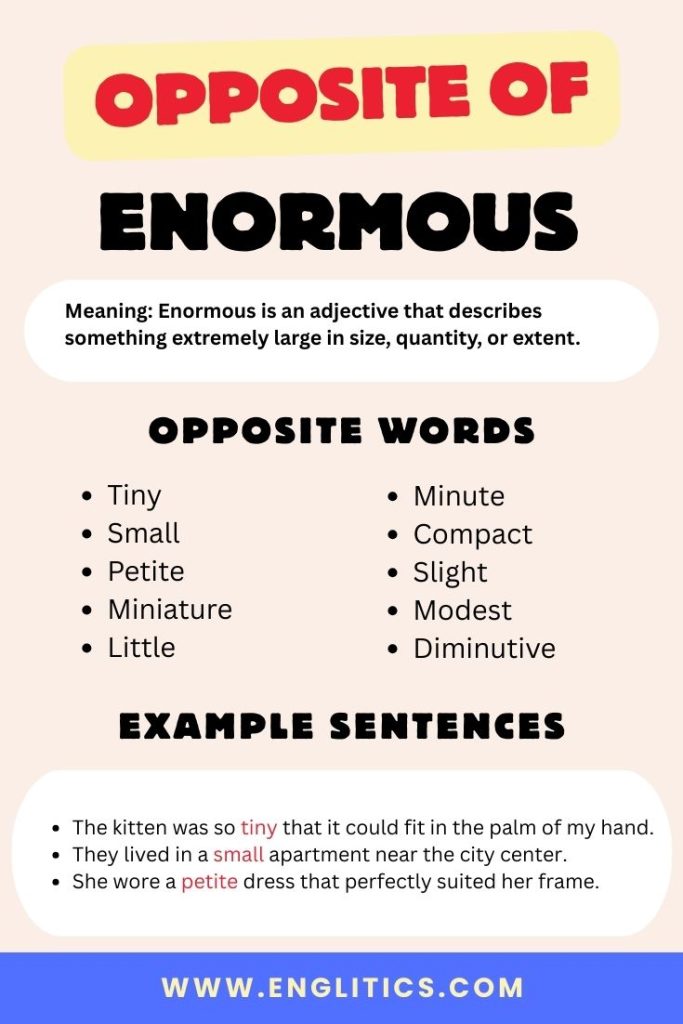
Opposite of enormous means something that is small, tiny, or not very large in size or amount. While “enormous” describes things that are huge, vast, or massive, its opposite refers to things that are much smaller or less impressive.
Antonyms for enormous include small, tiny, little, minute, or slight. For example, instead of lifting an enormous box, someone might carry a small package that’s easy to handle. These words help describe situations where size, quantity, or importance is much less. Using these antonyms can make your descriptions more accurate and help others better understand what you mean.
Definition of Enormous
The word “enormous” is an adjective that describes something exceptionally large in size, quantity, or degree. It implies a magnitude that is far beyond the ordinary or expected.
An enormous object is not just big; it is strikingly and impressively large. Similarly, an enormous amount is significantly greater than what is typical or reasonable.
The term is often used to emphasize the vastness or immensity of something, creating a strong impression in the mind of the listener or reader. Understanding the precise meaning of “enormous” is crucial for identifying its antonyms, as the opposite of something extremely large must necessarily be something extremely small or insignificant.
In terms of classification, “enormous” belongs to the category of descriptive adjectives. Its function in a sentence is to modify a noun, providing more information about its size, quantity, or extent.
The contexts in which “enormous” can be used are varied, ranging from describing physical objects (e.g., “an enormous building”) to abstract concepts (e.g., “an enormous amount of work”). The word can also convey a sense of awe, wonder, or even intimidation, depending on the context.
Structural Breakdown of “Enormous”
The word “enormous” is derived from the Latin word “enormis,” which means “out of the norm” or “irregular.” The prefix “e-” (or “ex-“) signifies “out of” or “away from,” while “norma” refers to a standard or rule. Therefore, “enormous” literally means something that deviates significantly from the standard or norm in terms of size or extent.
This etymological understanding helps to appreciate the word’s emphasis on exceeding typical boundaries.
Morphologically, “enormous” is a single-word adjective. It can be modified by adverbs to further refine its meaning, such as “absolutely enormous” or “truly enormous.” It can also be used in comparative and superlative forms, although these are less common.
For example, one might say “This building is more enormous than that one,” or “That is the most enormous tree I have ever seen.” However, due to the inherent sense of extreme size already present in “enormous,” such comparisons are often redundant.
Opposite of Enormous
Antonyms, or words with opposite meanings, can be classified into several types. Understanding these types helps in selecting the most appropriate antonym for a given context.
Here are the primary categories of antonyms:
- Complementary Antonyms: These antonyms represent mutually exclusive categories. One word implies the absence of the other. For example, “dead” and “alive” are complementary antonyms because something cannot be both dead and alive at the same time.
- Graded Antonyms: These antonyms represent points on a continuous spectrum. There are intermediate values between the two words. For example, “hot” and “cold” are graded antonyms because something can be warm, lukewarm, or cool.
- Relational Antonyms: These antonyms describe a relationship between two things or concepts. One word implies the existence of the other. For example, “teacher” and “student” are relational antonyms because a teacher cannot exist without a student, and vice versa.
- Reversives: These antonyms indicate movement in opposite directions. For example, “enter” and “exit” are reversives because they describe opposite actions.
When considering antonyms for “enormous,” graded antonyms are often the most relevant, as size exists on a continuous spectrum. However, depending on the context, other types of antonyms may also be appropriate.
For instance, in some situations, “enormous” might be contrasted with something “negligible,” which could be considered a complementary antonym in the sense that something is either significantly large or so small as to be insignificant.
Examples of Antonyms for Enormous
Several words can serve as antonyms for “enormous,” depending on the specific context and the degree of contrast desired. Here are some common antonyms, along with explanations and examples:
Tiny
“Tiny” describes something extremely small, often suggesting delicacy or fragility. It’s a strong contrast to “enormous,” emphasizing minimal size.
The following table provides examples of “tiny” used as an antonym for “enormous” in various contexts. Each example illustrates the stark contrast between the two words, highlighting the difference in scale and magnitude.
| Original Sentence (with “Enormous”) | Revised Sentence (with “Tiny”) |
|---|---|
| The enormous elephant lumbered through the jungle. | The tiny ant crawled along the jungle floor. |
| The city faced an enormous debt. | The village had a tiny surplus. |
| The company reported enormous profits. | The startup reported tiny gains. |
| The mountain cast an enormous shadow. | The pebble cast a tiny shadow. |
| The chef prepared an enormous meal for the banquet. | The child ate a tiny snack before bed. |
| The enormous wave crashed against the shore. | A tiny ripple disturbed the surface of the lake. |
| The museum displayed an enormous painting. | The artist created a tiny miniature. |
| The construction crew built an enormous skyscraper. | The child built a tiny house out of blocks. |
| The library contained an enormous collection of books. | The student had a tiny selection of reference materials. |
| The festival attracted an enormous crowd. | The meeting had a tiny attendance. |
| The asteroid was an enormous threat to Earth. | The meteoroid posed a tiny risk. |
| The company faced an enormous challenge. | The team overcame a tiny obstacle. |
| The project required an enormous amount of resources. | The task needed a tiny bit of effort. |
| The company made an enormous investment in research. | The individual made a tiny donation to charity. |
| The country had an enormous army. | The village had a tiny militia. |
| The corporation held an enormous share of the market. | The small business had a tiny slice of the pie. |
| The government implemented an enormous reform. | The community made a tiny adjustment. |
| The news reported an enormous disaster. | The local paper covered a tiny incident. |
| The athlete displayed enormous strength. | The child showed tiny signs of improvement. |
| The singer had an enormous range. | The speaker had a tiny voice. |
| The king ruled over an enormous empire. | The chief governed a tiny tribe. |
| The scientist made an enormous discovery. | The student made a tiny observation. |
| The company launched an enormous campaign. | The activist organized a tiny protest. |
| The country faced an enormous crisis. | The family dealt with a tiny problem. |
| The garden contained an enormous variety of flowers. | The pot held a tiny sprig of herbs. |
Small
“Small” is a general term for something less than average in size. It’s a common and versatile antonym for “enormous,” suitable for many contexts.
This table presents examples illustrating the use of “small” as an antonym for “enormous.” The sentences demonstrate how “small” contrasts with the idea of great size, providing a more moderate perspective.
| Original Sentence (with “Enormous”) | Revised Sentence (with “Small”) |
|---|---|
| The enormous dog bounded across the field. | The small dog trotted across the field. |
| The company suffered an enormous loss. | The company experienced a small setback. |
| The project required an enormous effort. | The project took a small amount of time. |
| The enormous building dominated the skyline. | The small cottage nestled in the valley. |
| The city had an enormous population. | The village had a small number of residents. |
| The company had an enormous budget. | The team had a small allowance for expenses. |
| The museum displayed an enormous artifact. | The gallery exhibited a small sculpture. |
| The corporation made an enormous donation. | The individual gave a small contribution. |
| The country faced an enormous crisis. | The community dealt with a small issue. |
| The garden contained an enormous variety of plants. | The window box held a small selection of herbs. |
| The company made an enormous profit. | The company earned a small return. |
| The chef prepared an enormous feast. | The cook made a small meal. |
| The lake stretched out an enormous distance. | The pond covered a small area. |
| The company had an enormous impact on the industry. | The startup had a small effect on the market. |
| The country faced an enormous threat. | The town dealt with a small risk. |
| The company made an enormous investment. | The individual made a small purchase. |
| The speaker had an enormous influence. | The writer had a small readership. |
| The team had an enormous advantage. | The player had a small edge. |
| The company had an enormous debt. | The individual had a small loan. |
| The city faced an enormous problem. | The family dealt with a small matter. |
| The storm caused an enormous amount of damage. | The breeze created a small disturbance. |
| The project required an enormous amount of time. | The task took a small amount of effort. |
| The company had an enormous workforce. | The business employed a small team. |
| The building had an enormous footprint. | The structure had a small foundation. |
| The company held an enormous market share. | The business controlled a small segment. |
Minute
“Minute” refers to something extremely small, often so small as to be almost imperceptible. It’s a more extreme antonym than “small,” suggesting insignificance.
The following table illustrates the use of “minute” as an antonym for “enormous.” The examples highlight the extreme contrast in size and significance between the two words, emphasizing the almost unnoticeable nature of something minute.
| Original Sentence (with “Enormous”) | Revised Sentence (with “Minute”) |
|---|---|
| The enormous crack ran across the wall. | A minute crack was barely visible on the surface. |
| The company faced an enormous challenge. | The team overcame a minute difficulty. |
| The project required an enormous amount of funding. | The task needed a minute investment. |
| The enormous star dominated the night sky. | A minute speck of light flickered in the distance. |
| The company reported an enormous increase in sales. | The business saw a minute rise in revenue. |
| The scientist made an enormous discovery. | The researcher made a minute observation. |
| The country faced an enormous crisis. | The community dealt with a minute inconvenience. |
| The company held an enormous share of the market. | The startup controlled a minute portion of the sales. |
| The athlete displayed enormous strength. | The child showed minute signs of progress. |
| The company suffered an enormous loss. | The business experienced a minute setback. |
| The project required an enormous amount of effort. | The task took a minute amount of time. |
| The enormous building towered over the city. | A minute structure was hidden from view. |
| The company had an enormous budget for marketing. | The team had a minute allowance for advertising. |
| The museum displayed an enormous sculpture. | The gallery exhibited a minute figurine. |
| The corporation made an enormous donation to the charity. | The individual gave a minute contribution to the cause. |
| The country faced an enormous threat from its enemies. | The town dealt with a minute risk of vandalism. |
| The company made an enormous investment in new technology. | The individual made a minute purchase of stock. |
| The politician had an enormous influence on the voters. | The activist had a minute impact on the election. |
| The team had an enormous advantage over their opponents. | The player had a minute edge over the competition. |
| The company had an enormous debt to pay off. | The individual had a minute loan to repay. |
| The city faced an enormous problem with traffic congestion. | The family dealt with a minute issue with their car. |
| The storm caused an enormous amount of damage to the coast. | The breeze created a minute disturbance in the garden. |
| The project required an enormous amount of resources to complete. | The task took a minute amount of energy to finish. |
| The company had an enormous workforce to manage. | The business employed a minute staff of interns. |
| The building had an enormous footprint on the land. | The structure had a minute foundation in the ground. |
Negligible
“Negligible” describes something so small or unimportant that it can be disregarded. It emphasizes the lack of significance or impact.
This table presents examples highlighting the use of “negligible” as an antonym for “enormous.” The sentences demonstrate how “negligible” contrasts with the idea of great impact, focusing on the insignificance or lack of importance of something.
| Original Sentence (with “Enormous”) | Revised Sentence (with “Negligible”) |
|---|---|
| The enormous impact of the policy change was evident. | The policy change had a negligible impact on the economy. |
| The company reported enormous profits this quarter. | The company reported negligible gains this quarter. |
| The project required an enormous amount of resources. | The project required a negligible amount of effort. |
| The enormous risk of the venture concerned investors. | The venture posed a negligible risk to the stakeholders. |
| The scientist made an enormous discovery in the field. | The researcher made a negligible finding during the study. |
| The company suffered an enormous loss due to the scandal. | The company suffered a negligible loss due to the oversight. |
| The country faced an enormous threat from the invading army. | The country faced a negligible threat from the small militia. |
| The politician had an enormous influence on the electorate. | The candidate had a negligible influence on the voters. |
| The company held an enormous share of the market. | The company held a negligible share of the market. |
| The athlete displayed enormous strength and endurance. | The participant showed negligible improvement over the course. |
| The storm caused an enormous amount of damage to the city. | The breeze caused a negligible amount of damage to the trees. |
| The company had an enormous debt to pay off. | The company had a negligible debt to manage. |
| The project had an enormous impact on the community. | The project had a negligible effect on the neighborhood. |
| The company had an enormous budget for research and development. | The company had a negligible budget for innovation. |
| The museum displayed an enormous collection of artifacts. | The museum displayed a negligible number of items. |
| The corporation made an enormous donation to the charity. | The corporation made a negligible contribution to the cause. |
| The company made an enormous investment in new technology. | The company made a negligible investment in outdated systems. |
| The team had an enormous advantage over their competitors. | The team had a negligible edge over their rivals. |
| The city faced an enormous problem with homelessness. | The city faced a negligible issue with petty crime. |
| The company had an enormous workforce to manage effectively. | The company had a negligible staff to oversee. |
| The building had an enormous footprint on the environment. | The building had a negligible impact on the ecosystem. |
| The product caused an enormous controversy among consumers. | The product caused a negligible stir among users. |
| The event generated an enormous amount of publicity. | The event generated a negligible amount of attention. |
| The company had an enormous amount of influence in the industry. | The company had a negligible amount of sway in the market. |
| The project created an enormous number of jobs in the area. | The project created a negligible number of positions in the region. |
Insignificant
“Insignificant” denotes something lacking importance, consequence, or value. It’s similar to “negligible” but can also apply to abstract concepts.
The following table provides examples of “insignificant” used as an antonym for “enormous.” These examples show how “insignificant” contrasts with the idea of great importance, focusing on the lack of value or consequence.
| Original Sentence (with “Enormous”) | Revised Sentence (with “Insignificant”) |
|---|---|
| The enormous decision changed the course of history. | The insignificant detail went unnoticed. |
| The company faced an enormous challenge to survive. | The company overcame an insignificant obstacle. |
| The project required an enormous amount of resources. | The project required an insignificant amount of funding. |
| The enormous impact of the event was felt worldwide. | The event had an insignificant effect on the local community. |
| The scientist made an enormous discovery in the lab. | The researcher made an insignificant observation in the field. |
| The company suffered an enormous loss due to the scandal. | The company suffered an insignificant setback due to the error. |
| The country faced an enormous threat from the enemy nation. | The country faced an insignificant risk from the minor group. |
| The politician had an enormous influence on the voters. | The candidate had an insignificant impact on the election. |
| The company held an enormous share of the market. | The company held an insignificant portion of the market. |
| The athlete displayed enormous talent and dedication. | The participant showed insignificant potential. |
| The storm caused an enormous amount of damage to the coast. | The breeze caused an insignificant amount of disruption to the trees. |
| The company had an enormous debt to pay off. | The company had an insignificant loan to manage. |
| The project had an enormous impact on the economy. | The project had an insignificant effect on the environment. |
| The company had an enormous budget for advertising. | The company had an insignificant allowance for promotion. |
| The museum displayed an enormous collection of artifacts. | The museum displayed an insignificant selection of items. |
| The corporation made an enormous donation to the charity. | The corporation made an insignificant contribution to the cause. |
| The company made an enormous investment in research. | The company made an insignificant investment in development. |
| The team had an enormous advantage over their rivals. | The team had an insignificant edge over their competitors. |
| The city faced an enormous problem with pollution. | The city faced an insignificant issue with litter. |
| The company had an enormous workforce to manage effectively. | The company had an insignificant staff to oversee. |
| The building had an enormous footprint on the land. | The building had an insignificant impact on the surroundings. |
| The product caused an enormous controversy among consumers. | The product caused an insignificant stir among users. |
| The event generated an enormous amount of publicity. | The event generated an insignificant amount of buzz. |
| The company had an enormous amount of influence in the industry. | The company had an insignificant amount of sway in the market. |
| The project created an enormous number of jobs in the region. | The project created an insignificant number of positions in the area. |
Limited
“Limited” suggests a restriction in size, quantity, or extent. It contrasts with the boundless nature of “enormous.”
The following table illustrates the use of “limited” as an antonym for “enormous.” The sentences demonstrate how “limited” contrasts with the idea of great abundance, focusing on the restricted or finite nature of something.
| Original Sentence (with “Enormous”) | Revised Sentence (with “Limited”) |
|---|---|
| The company had an enormous supply of raw materials. | The company had a limited supply of raw materials. |
| The project required an enormous amount of time. | The project had a limited timeframe for completion. |
| The city had an enormous budget for infrastructure. | The city had a limited budget for improvements. |
| The company faced an enormous challenge in expanding. | The company faced a limited set of options for growth. |
| The museum displayed an enormous collection of artifacts. | The museum displayed a limited selection of items. |
| The athlete showed enormous potential for success. | The athlete showed limited promise for improvement. |
| The country had an enormous coastline. | The country had a limited access to the sea. |
| The company had an enormous influence on the market. | The company had a limited impact on the industry. |
| The project had an enormous scope. | The project had a limited reach. |
| The company had an enormous workforce. | The company had a limited staff. |
| The country had an enormous army. | The country had a limited number of troops. |
| The company had an enormous amount of data. | The company had a limited amount of information. |
| The city had an enormous number of tourists. | The city had a limited number of visitors. |
| The company had an enormous range of products. | The company had a limited selection of items. |
| The project had an enormous budget. | The project had a limited amount of funding. |
| The athlete had an enormous amount of stamina. | The athlete had a limited amount of energy. |
| The company had an enormous network of contacts. | The company had a limited number of connections. |
| The city had an enormous area to cover. | The city had a limited space to work with. |
| The company had an enormous amount of resources. | The company had a limited amount of supplies. |
| The athlete had an enormous number of fans. | The athlete had a limited number of supporters. |
| The company had an enormous capacity for growth. | The company had a limited potential for expansion. |
| The project had an enormous impact on the environment. | The project had a limited effect on the ecosystem. |
| The company had an enormous amount of influence in the industry. | The company had a limited amount of sway in the market. |
| The project created an enormous number of jobs in the area. | The project created a limited number of positions in the region. |
| The company had an enormous amount of experience in the field. | The company had a limited amount of expertise in the area. |
Modest
“Modest” suggests a moderate or unassuming size, quantity, or degree. It implies a lack of excess or extravagance.
The following table illustrates the use of “modest” as an antonym for “enormous.” The sentences demonstrate how “modest” contrasts with the idea of great excess, focusing on the moderate or unassuming nature of something.
| Original Sentence (with “Enormous”) | Revised Sentence (with “Modest”) |
|---|---|
| The company reported enormous profits this year. | The company reported modest gains this year. |
| The project required an enormous amount of funding. | The project required a modest investment. |
| The city had an enormous budget for renovations. | The city had a modest budget for improvements. |
| The company faced an enormous challenge in the market. | The company faced a modest obstacle in the industry. |
| The museum displayed an enormous collection of artifacts. | The museum displayed a modest selection of items. |
| The athlete showed enormous potential for success. | The athlete showed modest promise for improvement. |
| The country had an enormous military force. | The country had a modest defense force. |
| The company had an enormous influence on the industry. | The company had a modest impact on the market. |
| The project had an enormous scope. | The project had a modest scale. |
| The company had an enormous workforce. | The company had a modest staff. |
| The country had an enormous amount of resources. | The country had a modest amount of supplies. |
| The city had an enormous number of residents. | The city had a modest population. |
| The company had an enormous range of products. | The company had a modest selection of items. |
| The athlete had an enormous amount of stamina. | The athlete had a modest amount of energy. |
| The company had an enormous network of contacts. | The company had a modest number of connections. |
| The city had an enormous area to govern. | The city had a modest region to oversee. |
| The athlete had an enormous number of fans. | The athlete had a modest number of supporters. |
| The company had an enormous capacity for innovation. | The company had a modest potential for creativity. |
| The project had an enormous impact on the environment. | The project had a modest effect on the ecosystem. |
| The company had an enormous amount of influence in the industry. | The company had a modest amount of sway in the market. |
| The project created an enormous number of jobs in the area. | The project created a modest number of positions in the region. |
| The company had an enormous amount of experience in the field. | The company had a modest amount of expertise in the area. |
| The athlete had an enormous advantage over competitors. | The athlete had a modest edge over opponents. |
| The company had an enormous debt to manage. | The company had a modest loan to handle. |
| The city had an enormous problem with traffic. | The city had a modest issue with congestion. |
Average
“Average” denotes a typical or normal size, quantity, or degree. It contrasts with the exceptional nature of “enormous.”
The following table illustrates the use of “average” as an antonym for “enormous.” The sentences demonstrate how “average” contrasts with the idea of great deviation from the norm, focusing on the typical or standard nature of something.
| Original Sentence (with “Enormous”) | Revised Sentence (with “Average”) | |
|---|---|---|
| The company reported enormous profits this year. | The company reported average earnings this year. | |
| The project required an enormous amount of funding. | The project required an average investment. | |
| The city had an enormous budget for public services. | The city had an average budget for amenities. | |
| The company faced an enormous challenge in the industry. | The company faced an average difficulty in the market. | |
| The museum displayed an enormous collection of artifacts. | The museum displayed | The museum displayed an average number of exhibits. |
| The athlete showed enormous potential for success. | The athlete showed average promise for improvement. | |
| The country had an enormous military force. | The country had an average defense force. | |
| The company had an enormous influence on the industry. | The company had an average impact on the market. | |
| The project had an enormous scope. | The project had an average scale. | |
| The company had an enormous workforce. | The company had an average staff. | |
| The country had an enormous amount of resources. | The country had an average amount of supplies. | |
| The city had an enormous number of residents. | The city had an average population. | |
| The company had an enormous range of products. | The company had an average selection of items. | |
| The athlete had an enormous amount of stamina. | The athlete had an average amount of energy. | |
| The company had an enormous network of contacts. | The company had an average number of connections. | |
| The city had an enormous area to govern. | The city had an average region to oversee. | |
| The athlete had an enormous number of fans. | The athlete had an average number of supporters. | |
| The company had an enormous capacity for innovation. | The company had an average potential for creativity. | |
| The project had an enormous impact on the environment. | The project had an average effect on the ecosystem. | |
| The company had an enormous amount of influence in the industry. | The company had an average amount of sway in the market. | |
| The project created an enormous number of jobs in the area. | The project created an average number of positions in the region. | |
| The company had an enormous amount of experience in the field. | The company had an average amount of expertise in the area. | |
| The athlete had an enormous advantage over competitors. | The athlete had an average edge over opponents. | |
| The company had an enormous debt to manage. | The company had an average loan to handle. | |
| The city had an enormous problem with traffic. | The city had an average issue with congestion. |
Usage Rules for Antonyms
Using antonyms effectively involves understanding the nuances of both the original word and its opposite. Here are some key rules to keep in mind when using antonyms for “enormous”:
- Context Matters: The best antonym will depend on the specific context. Consider what aspect of “enormous” you want to negate – size, quantity, impact, etc. For example, if you’re talking about physical size, “tiny” or “small” might be appropriate. If you’re talking about importance, “insignificant” or “negligible” might be better choices.
- Degree of Contrast: Antonyms can vary in the degree of contrast they provide. “Tiny” offers a stronger contrast than “small.” Choose an antonym that reflects the intended level of opposition.
- Avoid Redundancy: Be careful not to use antonyms in a way that creates redundancy or contradicts the rest of the sentence. For instance, saying “a tiny, enormous building” is contradictory and doesn’t make sense.
- Consider Connotations: Words have connotations, or emotional associations, that go beyond their literal meanings. Be aware of the connotations of both “enormous” and its antonyms. For example, “modest” can imply humility or restraint, while “average” can suggest mediocrity or lack of distinction.
- Maintain Parallel Structure: When using antonyms in comparisons or contrasts, maintain parallel structure for clarity and balance. For example, “The enormous building towered over the city, while the tiny cottage nestled in the valley.”
Common Mistakes
Even with a good understanding of antonyms, it’s easy to make mistakes. Here are some common pitfalls to avoid when using antonyms for “enormous”:
- Using the Wrong Antonym: Selecting an antonym that doesn’t fit the context is a frequent error. For example, using “limited” when you really mean “tiny” can change the meaning of your sentence.
- Creating Contradictions: As mentioned earlier, avoid using antonyms in a way that creates logical contradictions. “An enormously small amount” is nonsensical.
- Overusing Antonyms: While antonyms can be effective, overusing them can make your writing sound forced or unnatural. Use them judiciously, and vary your vocabulary.
- Ignoring Nuance: Failing to consider the subtle differences between antonyms can lead to imprecise language. Take the time to choose the most accurate antonym for your intended meaning.
- Misunderstanding the Original Word: A weak understanding of “enormous” itself can lead to incorrect antonym usage. Make sure you fully grasp the meaning of “enormous” before trying to find its opposite.
Practice Exercises
To solidify your understanding of antonyms for “enormous,” try these practice exercises. Fill in the blanks with the most appropriate antonym from the list provided:
Word Bank: tiny, small, minute, negligible, insignificant, limited, modest, average
- The company’s profits were a stark contrast to the enormous gains of its competitors.
- The project required a amount of effort, unlike the previous one that demanded enormous exertion.
- The city had a budget for the new park, compared to the enormous funds allocated for the stadium.
- The team faced a obstacle, unlike the enormous challenges they had overcome in the past.
- The museum displayed a collection of artifacts, a departure from its usual enormous exhibits.
- The athlete showed improvement, despite the enormous expectations placed upon them.
- The country had a coastline, unlike its neighbor with an enormous stretch of shoreline.
- The company had a influence on the market, compared to the enormous impact of the industry leader.
- The project had a reach, unlike the enormous scope of the previous initiative.
- The company had a staff, in contrast to the enormous workforce of the multinational corporation.
Answer Key:
- modest
- small
- limited
- insignificant
- modest
- minute
- limited
- negligible
- limited
- modest
Advanced Topics
For those looking to delve deeper into the nuances of antonyms and vocabulary enrichment, consider these advanced topics:
- Synonym and Antonym Relationships: Explore how synonyms and antonyms interact to create a comprehensive understanding of a word’s meaning.
- Figurative Language: Investigate how antonyms are used in metaphors, similes, and other figures of speech to create vivid imagery and convey complex ideas.
- Cross-Linguistic Analysis: Compare antonyms in different languages to gain insights into cultural differences and linguistic diversity.
- Thesaurus Usage: Learn how to effectively use a thesaurus to find the most appropriate antonym for a given context, considering both denotation and connotation.
- Vocabulary Building Strategies: Develop strategies for expanding your vocabulary through the study of roots, prefixes, and suffixes, as well as through extensive reading and writing.
FAQ
Are there any situations where “enormous” has no true antonym?
Yes, in some highly specific contexts, finding a perfect antonym for “enormous” can be challenging. This is often because “enormous” is used to emphasize a quality rather than strictly quantify a size or amount.
In such cases, you may need to rephrase the sentence to convey the opposite meaning.
Can an antonym for “enormous” also be a synonym for another word?
Absolutely. Language is interconnected, and words often have multiple meanings and relationships.
For example, “small” can be an antonym for “enormous” and a synonym for “little.”
How do I choose the best antonym for “enormous” in a formal writing context?
In formal writing, precision is key. Consider the specific aspect of “enormous” you want to contrast, and choose an antonym that is both accurate and stylistically appropriate.
“Negligible” and “insignificant” are often good choices in formal contexts.
Is it ever appropriate to use a phrase as an antonym for “enormous”?
Yes, sometimes a single word cannot capture the full opposite meaning of “enormous.” In such cases, a phrase can be used. For example, instead of saying “the opposite of an enormous success,” you might say “a complete failure.”
Conclusion
Mastering the antonyms of “enormous” is a valuable step in expanding your vocabulary and improving your communication skills. By understanding the nuances of words like “tiny,” “small,” “negligible,” and others, you can express a wider range of ideas with greater precision and clarity.
Remember to consider the context, degree of contrast, and connotations when choosing an antonym, and avoid common mistakes such as creating contradictions or overusing antonyms. With practice and attention to detail, you can effectively use antonyms to enhance your writing and speech.