Opposite of energetic means lacking energy, feeling tired, or being slow to act. While “energetic” describes someone full of life, active, and ready to go, its opposite shows low energy or little movement.
Antonyms for energetic include tired, sluggish, lazy, inactive, or weak. For example, instead of running around the playground full of energy, a person might sit quietly feeling tired and slow. These words are useful when talking about times someone doesn’t feel lively or active. Knowing these antonyms can help you describe how people act or feel more clearly.
Definition of Energetic and Its Antonyms
Energetic is an adjective describing someone or something full of energy, enthusiasm, and vitality. It implies a state of being active, vigorous, and capable of exerting power or force. Understanding the antonyms for “energetic” requires identifying words that represent the opposite qualities: lacking energy, enthusiasm, or vitality.
Antonyms, also known as opposites, are words with meanings that are contrary to each other. Antonyms for “energetic” include words like lethargic, lazy, tired, apathetic, and sluggish. These words describe states of inactivity, weariness, or indifference.
These antonyms can be classified based on the degree of opposition they express. Some antonyms, like “exhausted,” represent a complete absence of energy, while others, like “lackadaisical,” suggest a milder form of reduced activity.
The choice of antonym depends on the specific context and the nuance you want to convey.
Structural Breakdown: Word Formation
Understanding how words are formed can help in identifying and remembering antonyms. Several common prefixes and suffixes are used to create words with opposite meanings.
Prefixes: Prefixes like “un-,” “in-,” “im-,” “dis-,” and “a-” can negate the meaning of a word. For example:
- Unenthusiastic (not enthusiastic)
- Inactive (not active)
- Immobile (not mobile)
- Apathetic (without feeling or interest)
Suffixes: Suffixes can also play a role, although less directly. For instance, adding “-less” can indicate a lack of something, such as “restless” (not able to rest) which, in some contexts, might be considered an antonym of “energetic” because the restless person cannot settle down to use their energy effectively.
Root Words: Recognizing the root word can also help. For instance, the root “vig” in “vigorous” (energetic) is related to strength and activity. An antonym might involve a root suggesting weakness or inactivity.
Opposite of Energetic
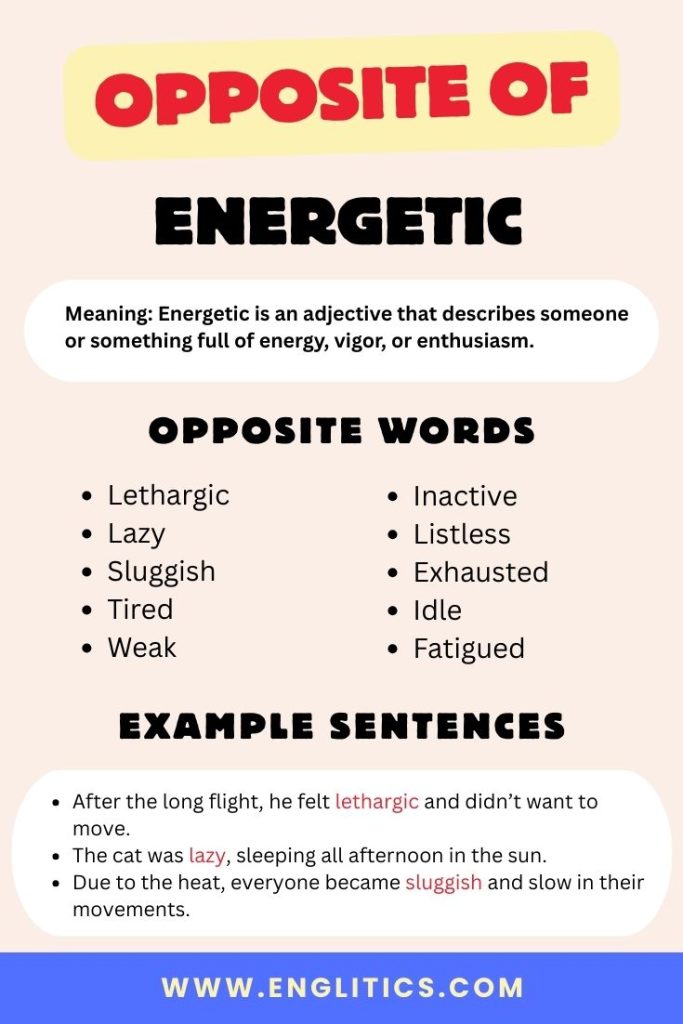
Antonyms for “energetic” can be categorized based on the aspect of energy they negate or contrast. These categories include physical, mental, and emotional states.
Physical State Antonyms
These antonyms describe a lack of physical energy or activity. They often relate to tiredness, weakness, or slowness.
- Tired: In need of rest or sleep; weary.
- Exhausted: Completely drained of energy.
- Fatigued: Feeling weary or tired due to exertion or illness.
- Lethargic: Affected by lethargy; sluggish and apathetic.
- Sluggish: Slow-moving or inactive.
- Inactive: Not engaging in physical activity.
- Immobile: Unable to move.
- Weak: Lacking physical strength or energy.
- Feeble: Frail and weak.
- Enervated: Drained of energy; weakened.
Mental State Antonyms
These antonyms describe a lack of mental energy, enthusiasm, or focus. They often relate to boredom, disinterest, or mental exhaustion.
- Apathetic: Showing or feeling no interest, enthusiasm, or concern.
- Listless: Lacking energy and enthusiasm.
- Indifferent: Having no particular interest or sympathy; unconcerned.
- Unenthusiastic: Not showing enthusiasm.
- Bored: Feeling weary because one is unoccupied or lacks interest in one’s current activity.
- Unmotivated: Lacking the desire or willingness to do something.
- Passive: Accepting or allowing what happens or what others do, without active response or resistance.
Emotional State Antonyms
These antonyms describe a lack of emotional energy or drive. They often relate to sadness, depression, or emotional detachment.
- Depressed: Feeling severe despondency and dejection.
- Despondent: In low spirits from loss of hope or courage.
- Dispirited: Having lost enthusiasm and hope; disheartened.
- Melancholy: A feeling of pensive sadness, typically with no obvious cause.
- Subdued: Quiet and rather reflective or depressed.
Examples of Antonyms in Sentences
The following tables provide examples of how these antonyms are used in sentences, illustrating their different nuances and contexts.
Table 1: Physical State Antonyms
This table provides examples of antonyms related to physical states, contrasting with the idea of being energetic.
| Antonym | Example Sentence |
|---|---|
| Tired | After a long day at work, she felt tired and just wanted to relax. |
| Exhausted | The marathon runner was exhausted after crossing the finish line. |
| Fatigued | The patient complained of feeling fatigued even after a full night’s sleep. |
| Lethargic | The heat made everyone feel lethargic and unwilling to move. |
| Sluggish | The economy has been sluggish for the past few months. |
| Inactive | An inactive lifestyle can lead to health problems. |
| Immobile | The accident left him immobile for several weeks. |
| Weak | After being sick, he felt incredibly weak. |
| Feeble | The old man’s voice was feeble, barely audible. |
| Enervated | The humid weather enervated her, making her feel drained. |
| Drained | She felt completely drained after dealing with the crisis. |
| Weary | The travelers were weary after their long journey. |
| Languid | The hot afternoon sun made her feel languid and dreamy. |
| Sedentary | A sedentary job can contribute to weight gain. |
| Motionless | The cat lay motionless, watching the birds outside. |
| Paralyzed | He was paralyzed with fear when he saw the snake. |
| Listless | She felt listless and unmotivated to do anything. |
| Drowsy | The medication made her feel drowsy. |
| Somnolent | The lecture was so boring that many students became somnolent. |
| Torpid | The turtle remained torpid during the winter months. |
| Stagnant | A stagnant lifestyle can lead to unhappiness. |
Table 2: Mental State Antonyms
This table focuses on antonyms that describe a lack of mental engagement or enthusiasm.
| Antonym | Example Sentence |
|---|---|
| Apathetic | Many young people are apathetic about politics. |
| Listless | She felt listless and had no desire to go out. |
| Indifferent | He was indifferent to the suffering of others. |
| Unenthusiastic | She was unenthusiastic about the proposed project. |
| Bored | The children were bored during the long car ride. |
| Unmotivated | He was unmotivated to study for the exam. |
| Passive | She took a passive role in the discussion. |
| Disinterested | The judge remained disinterested throughout the trial. |
| Complacent | We cannot afford to be complacent about our progress. |
| Lax | The security at the event was lax. |
| Unconcerned | He seemed unconcerned about the consequences of his actions. |
| Oblivious | She was oblivious to the danger around her. |
| Detached | He remained detached from the emotional turmoil. |
| Aloof | Her aloof demeanor made it difficult to approach her. |
| Reserved | He was a reserved person who rarely shared his feelings. |
| Unresponsive | The patient was unresponsive to the treatment. |
| Inert | The political system seemed inert and unable to change. |
| Stolid | His face remained stolid, revealing no emotion. |
| Dull | The meeting was dull and unproductive. |
| Insipid | The conversation was insipid and uninteresting. |
| Monotonous | The job was monotonous and repetitive. |
Table 3: Emotional State Antonyms
This table provides examples of antonyms related to emotional states, showing a lack of positive emotional energy.
| Antonym | Example Sentence |
|---|---|
| Depressed | She felt depressed after the breakup. |
| Despondent | He was despondent about his future prospects. |
| Dispirited | The team was dispirited after losing the game. |
| Melancholy | A melancholy mood hung over the town. |
| Subdued | The party was subdued after the bad news. |
| Downcast | She looked downcast after failing the exam. |
| Glum | He wore a glum expression all day. |
| Sullen | The teenager was sullen and uncooperative. |
| Pessimistic | He had a pessimistic outlook on life. |
| Dejected | The candidate was dejected after losing the election. |
| Heartbroken | She was heartbroken after the betrayal. |
| Miserable | He felt miserable in his current job. |
| Wretched | She felt wretched after the argument. |
| Forlorn | The abandoned puppy looked forlorn. |
| Somber | The atmosphere was somber at the funeral. |
| Grief-stricken | The family was grief-stricken after the loss. |
| Dejected | The team was dejected after a tough loss. |
| Disheartened | They were disheartened by the lack of progress. |
| Crestfallen | He was crestfallen when he didn’t get the promotion. |
| Lamenting | She was lamenting the loss of her friend. |
| Mournful | The music had a mournful quality. |
Usage Rules and Considerations
When choosing an antonym for “energetic,” consider the specific context and the nuance you want to convey. Here are some usage rules and considerations:
- Specificity: Choose an antonym that accurately reflects the degree of opposition. For example, “exhausted” implies a greater lack of energy than “tired.”
- Context: Consider the situation and the subject being described. “Lethargic” might be appropriate for describing someone’s behavior on a hot day, while “depressed” suggests a more serious emotional state.
- Connotation: Be aware of the connotations of different words. Some antonyms may have negative connotations, while others are more neutral. For instance, “lazy” has a negative connotation, while “inactive” is more neutral.
- Formal vs. Informal: Some antonyms are more appropriate for formal writing or speaking, while others are better suited for informal contexts. “Enervated” is more formal than “tired.”
Common Mistakes to Avoid
Here are some common mistakes to avoid when using antonyms for “energetic”:
Incorrect: She was energetic, so she felt depressed.
Correct: She was *not* energetic, so she felt depressed.
Explanation: “Depressed” is an antonym related to emotional state, contrasting with energetic. The original sentence implies a contradiction.
Incorrect: He was energetic, but he was also lethargic.
Correct: He was *not* energetic, but he was lethargic.
Explanation: “Lethargic” is an antonym related to physical state. The original sentence presents contradictory information.
Incorrect: She is energetic and unmotivated.
Correct: She is *not* energetic and is unmotivated.
Explanation: “Unmotivated” is an antonym related to mental state. The original sentence presents contradictory information.
Incorrect: He was energetic, yet he was indifferent.
Correct: He was *not* energetic, and he was indifferent.
Explanation: “Indifferent” is an antonym related to mental state. The original sentence presents contradictory information.
Incorrect: She is energetic, however, she is apathetic.
Correct: She is *not* energetic; however, she is apathetic.
Explanation: “Apathetic” is an antonym related to mental state. The original sentence presents contradictory information.
Practice Exercises
Test your understanding with these practice exercises. Choose the best antonym for “energetic” to complete each sentence.
Exercise 1: Fill in the Blanks
Choose the most appropriate antonym from the list to complete each sentence:
(lethargic, apathetic, tired, indifferent, exhausted, sluggish, unenthusiastic, depressed, inactive, weak)
| Question | Answer |
|---|---|
| 1. After running the marathon, he felt __________. | exhausted |
| 2. The hot weather made her feel __________ and unwilling to move. | lethargic |
| 3. He was __________ about the project and showed no interest. | unenthusiastic |
| 4. She felt __________ and had no desire to go out. | depressed |
| 5. An __________ lifestyle can lead to health problems. | inactive |
| 6. He was __________ to the suffering of others and showed no concern. | indifferent |
| 7. After a long day at work, she felt __________ and just wanted to rest. | tired |
| 8. The economy has been __________ for the past few months. | sluggish |
| 9. He was __________ and showed no emotion. | apathetic |
| 10. After the illness, he was very __________. | weak |
Exercise 2: Multiple Choice
Choose the best antonym for “energetic” from the options provided.
| Question | Options | Answer |
|---|---|---|
| 1. Which word is the closest antonym for “energetic”? | (a) vibrant (b) lazy (c) lively (d) active | (b) lazy |
| 2. Which of the following describes someone lacking enthusiasm? | (a) zealous (b) apathetic (c) dynamic (d) spirited | (b) apathetic |
| 3. Which word suggests a state of being drained of energy? | (a) invigorated (b) refreshed (c) exhausted (d) animated | (c) exhausted |
| 4. Which of these words implies a lack of physical activity? | (a) vigorous (b) inactive (c) robust (d) sprightly | (b) inactive |
| 5. Which word describes someone who is slow-moving and sluggish? | (a) nimble (b) sluggish (c) brisk (d) agile | (b) sluggish |
| 6. Which word suggests a feeling of weariness or tiredness? | (a) refreshed (b) rested (c) fatigued (d) lively | (c) fatigued |
| 7. Which of the following describes someone who is indifferent and unconcerned? | (a) enthusiastic (b) caring (c) indifferent (d) passionate | (c) indifferent |
| 8. Which word implies a lack of motivation or desire? | (a) driven (b) unmotivated (c) ambitious (d) eager | (b) unmotivated |
| 9. Which of these words describes someone who is quiet and subdued? | (a) boisterous (b) vivacious (c) subdued (d) animated | (c) subdued |
| 10. Which word suggests a feeling of low spirits and despondency? | (a) joyful (b) despondent (c) elated (d) cheerful | (b) despondent |
Advanced Topics: Nuances and Connotations
At an advanced level, understanding the nuances and connotations of antonyms becomes crucial for precise communication. Some antonyms may have subtle differences in meaning or carry different emotional weights.
For example, “lazy” and “idle” both suggest a lack of activity, but “lazy” often carries a more negative judgment, implying a deliberate avoidance of work, while “idle” can simply mean not being actively engaged at the moment.
Consider the context and the intended audience when choosing an antonym. In formal writing, “enervated” might be more appropriate than “tired,” while in casual conversation, “worn out” might be more suitable.
Furthermore, explore the etymology of words to gain a deeper understanding of their meanings and connotations. Knowing the origins of words can help you appreciate the subtle differences between seemingly similar antonyms.
Frequently Asked Questions
Here are some frequently asked questions about antonyms for “energetic”:
Q1: What is the difference between “tired” and “exhausted”?
A: “Tired” implies a general need for rest or sleep, while “exhausted” suggests a complete depletion of energy, often after significant exertion. “Exhausted” is a stronger, more intense version of “tired.”
Q2: Is “lazy” a good antonym for “energetic”?
A: Yes, “lazy” is a valid antonym for “energetic,” but it carries a negative connotation, implying a deliberate avoidance of work or activity. It’s suitable when you want to convey a judgmental tone.
Q3: How does “apathetic” differ from “indifferent”?
A: “Apathetic” suggests a lack of interest or concern, often stemming from a deeper emotional detachment. “Indifferent” implies a lack of preference or sympathy, but not necessarily a lack of emotion. Apathetic is a stronger, more profound lack of feeling.
Q4: Can “calm” be considered an antonym for “energetic”?
A: In some contexts, yes. While “calm” doesn’t directly negate energy, it describes a state of tranquility and stillness that contrasts with the active and vigorous nature of being energetic. It depends on the specific situation.
Q5: What’s a formal antonym for “energetic”?
A: “Enervated” is a more formal antonym, suggesting a state of being drained of energy or vitality. It’s often used in academic or professional writing.
Q6: How can I improve my understanding of antonyms in general?
A: Read widely, use a thesaurus regularly, and pay attention to the context in which words are used. Practice using antonyms in your own writing and speaking to solidify your understanding. Consider using flashcards or language learning apps to expand your vocabulary.
Q7: Is “sedentary” an antonym for energetic?
A: Yes, “sedentary” can be considered an antonym for energetic, especially when describing a lifestyle. A sedentary lifestyle involves a lot of sitting and very little exercise or physical activity, which is the opposite of an energetic lifestyle.
Q8: Can ‘unmotivated’ be an antonym for energetic?
A: Yes, “unmotivated” can be an antonym for “energetic,” especially when referring to someone’s drive and enthusiasm. While “energetic” implies a proactive and enthusiastic approach, “unmotivated” suggests a lack of desire or willingness to exert effort.
Conclusion
Mastering antonyms for “energetic” is essential for enhancing your vocabulary and improving your ability to express nuanced meanings. By understanding the different categories of antonyms—physical, mental, and emotional—you can choose the most appropriate word to convey the specific shade of meaning you intend.
Remember to consider the context, connotation, and level of formality when selecting an antonym.
Continue to practice using these antonyms in your writing and speaking to solidify your understanding. Pay attention to how native speakers use these words and seek out opportunities to expand your vocabulary.
With consistent effort, you can significantly improve your command of the English language and communicate with greater precision and clarity. Remember that language learning is a continuous process, and every new word you learn brings you closer to fluency.