Antonyms for “hinder” include words like help, assist, facilitate, support, and promote. These words describe actions that make progress easier, remove obstacles, or contribute positively toward achieving a goal.
Understanding the opposite of hinder allows you to describe situations where efforts are advanced rather than blocked. Whether you’re writing about teamwork, technology, personal growth, or problem-solving, these antonyms help you clearly express forward movement, encouragement, or cooperation in contrast to delay or obstruction.
Defining ‘Hinder’ and Its Antonyms
‘Hinder’, in its essence, means to impede, obstruct, or delay the progress of someone or something. It suggests creating difficulties that prevent smooth advancement or achievement. The word can function as a verb, describing the action of obstructing or delaying.
Understanding the antonyms of ‘hinder’ requires identifying words that signify the opposite: actions or states that promote, assist, or facilitate progress. These antonyms generally fall into categories of support, advancement, and enablement. The antonyms can include words like assist, facilitate, promote, aid, help, expedite, advance, further, support, and encourage. Each of these words carries a slightly different nuance, indicating various ways of fostering positive progress.
For instance, ‘assist’ implies providing direct help to someone, while ‘facilitate’ suggests making a process easier. ‘Promote’ indicates actively supporting or advocating for something’s advancement.
The choice of antonym depends on the specific context and the intended meaning.
Structural Breakdown of Antonyms
The antonyms of ‘hinder’ can be analyzed based on their grammatical structure and how they function within sentences. Most of these antonyms are verbs, mirroring the verb form of ‘hinder.’ However, some can also function as nouns, representing the act of helping or the assistance provided.
Understanding the structure allows for correct usage in various sentence constructions. For example, verbs like ‘assist’ and ‘facilitate’ can be used in transitive and intransitive constructions, depending on whether they take a direct object.
Noun forms like ‘assistance’ and ‘aid’ often function as objects of prepositions or as subjects in sentences.
Here is a breakdown of some common antonyms and their structural usage:
- Assist (verb): To give support or aid to. Example: “The doctor assisted the patient.”
- Facilitate (verb): To make an action or process easier. Example: “The new software facilitated data analysis.”
- Promote (verb): To actively support or encourage the growth or progress of something. Example: “The company promotes employee development.”
- Aid (verb/noun): To help or support (verb); help or support (noun). Example: “They aided the refugees.” / “Humanitarian aid was provided.”
- Help (verb/noun): To give assistance (verb); assistance given (noun). Example: “Can I help you?” / “Thank you for your help.”
Opposite of Hinder
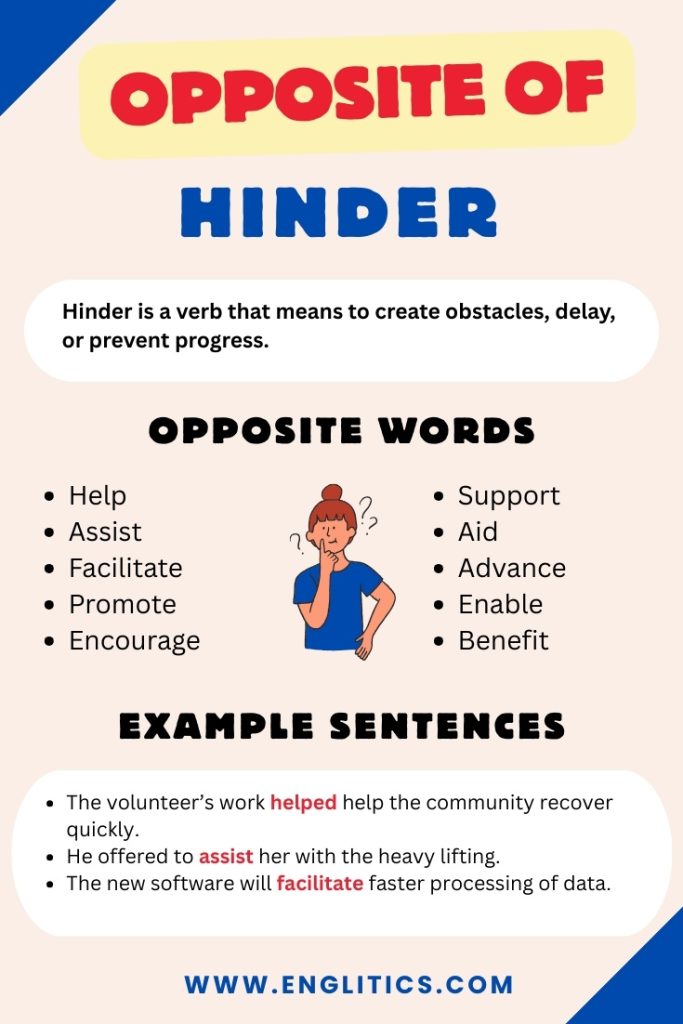
Antonyms for ‘hinder’ can be categorized based on the specific type of support or advancement they imply. This categorization helps in choosing the most appropriate word for a given context.
Direct Assistance
These antonyms imply direct involvement in helping someone or something overcome an obstacle. Examples include:
- Assist: Providing direct support or aid.
- Help: Giving assistance to someone in need.
- Aid: Offering support or resources to overcome difficulties.
Facilitation
These antonyms suggest making a process or action easier without necessarily providing direct help. They focus on removing obstacles and creating a smoother path.
- Facilitate: Making something easier or more likely to happen.
- Expedite: Speeding up a process or action.
- Ease: Reducing difficulty or effort.
Promotion and Encouragement
These antonyms involve actively supporting or advocating for the advancement of something. They focus on fostering growth and progress.
- Promote: Actively supporting or encouraging the growth or progress of something.
- Advance: Moving something forward or improving its position.
- Further: Helping something to progress or develop.
- Encourage: Giving someone confidence or support to do something.
Enabling
These antonyms suggest providing the means or opportunity for something to happen. They focus on empowering and equipping.
- Enable: Giving someone or something the authority or means to do something.
- Empower: Giving someone the power or authority to do something.
Examples of Antonyms in Use
Understanding how to use antonyms of ‘hinder’ in context is essential for effective communication. The following examples illustrate the use of various antonyms in different scenarios.
Table 1: Antonyms of ‘Hinder’ – Direct Assistance
This table provides example sentences showcasing the use of ‘assist,’ ‘help,’ and ‘aid’ as antonyms of ‘hinder,’ focusing on direct support.
| Antonym | Example Sentence |
|---|---|
| Assist | The nurse assisted the patient with walking after surgery. |
| Assist | Our team will assist you in setting up the new software. |
| Assist | The volunteer assisted the elderly woman across the street. |
| Assist | The search engine assists users in finding relevant information quickly. |
| Assist | The tutor assisted the student with their homework. |
| Help | I will help you carry your groceries. |
| Help | The therapist helped the client overcome their anxiety. |
| Help | The new app helps users manage their finances. |
| Help | The teacher helped the student understand the complex concept. |
| Help | The charity helped the victims of the natural disaster. |
| Aid | The organization provided aid to the refugees. |
| Aid | The government offered financial aid to small businesses. |
| Aid | The doctor used medical aid to stabilize the patient. |
| Aid | The firefighters provided aid to the people trapped in the building. |
| Aid | The international community sent aid to the earthquake-stricken country. |
| Assist | The software assisted in automating the data entry process. |
| Help | Volunteers help clean up the beach every weekend. |
| Aid | The new training program aided employees in improving their skills. |
| Assist | The GPS system assists drivers in navigating unfamiliar routes. |
| Help | The mentorship program helped the young entrepreneur succeed. |
| Aid | The scholarship aided the student in pursuing higher education. |
| Assist | The new regulations are designed to assist small businesses. |
| Help | The community garden helps provide fresh produce to local families. |
| Aid | The grant aided the research team in making significant discoveries. |
Table 2: Antonyms of ‘Hinder’ – Facilitation
This table illustrates the use of ‘facilitate,’ ‘expedite,’ and ‘ease’ as antonyms, emphasizing making processes smoother and faster.
| Antonym | Example Sentence |
|---|---|
| Facilitate | The mediator facilitated the negotiation between the two parties. |
| Facilitate | The new software facilitated the data analysis process. |
| Facilitate | The open communication policy facilitated better teamwork. |
| Facilitate | The online platform facilitated remote learning for students. |
| Facilitate | The revised guidelines facilitated a more efficient workflow. |
| Expedite | The new system will expedite the processing of orders. |
| Expedite | The manager decided to expedite the project to meet the deadline. |
| Expedite | The airport added more staff to expedite the security checks. |
| Expedite | The government took steps to expedite the approval process. |
| Expedite | The new technology helped expedite the research process. |
| Ease | The medication helped to ease the patient’s pain. |
| Ease | The new regulations will ease the burden on small businesses. |
| Ease | The therapist helped the patient to ease their anxiety. |
| Ease | The new route will ease traffic congestion in the city. |
| Ease | The updated software will ease the user’s workload. |
| Facilitate | Online banking facilitates easy transactions. |
| Expedite | Priority boarding expedites the boarding process for some passengers. |
| Ease | Regular exercise can ease stress. |
| Facilitate | The new bridge facilitates trade between the two regions. |
| Expedite | A good resume can expedite the job search. |
| Ease | The ergonomic design eases strain on the back. |
| Facilitate | Having a mentor can facilitate career growth. |
| Expedite | Automation expedites manufacturing processes. |
| Ease | A good night’s sleep can ease headaches. |
Table 3: Antonyms of ‘Hinder’ – Promotion and Encouragement
This table demonstrates the usage of ‘promote,’ ‘advance,’ ‘further,’ and ‘encourage,’ focusing on fostering growth and advancement.
| Antonym | Example Sentence |
|---|---|
| Promote | The company aims to promote sustainable practices. |
| Promote | The school organizes events to promote cultural awareness. |
| Promote | The government launched a campaign to promote healthy eating habits. |
| Promote | The manager decided to promote the employee based on their performance. |
| Promote | The new law aims to promote economic growth in the region. |
| Advance | The scientist made a significant advance in cancer research. |
| Advance | The army planned to advance towards the enemy’s position. |
| Advance | The company invested in new technology to advance its capabilities. |
| Advance | The student studied hard to advance their knowledge. |
| Advance | The project helped to advance the understanding of climate change. |
| Further | The research will further our understanding of the disease. |
| Further | The investment will further the development of renewable energy. |
| Further | The collaboration will further the goals of both organizations. |
| Further | The training program will further the skills of the employees. |
| Further | The discussion will further our understanding of the issue. |
| Encourage | The teacher tried to encourage the students to participate in class. |
| Encourage | The parents encouraged their children to pursue their dreams. |
| Encourage | The coach encouraged the team to keep practicing. |
| Encourage | The mentor encouraged the mentee to take on new challenges. |
| Encourage | The community encouraged residents to volunteer their time. |
| Promote | Advertisements promote the sales of new products. |
| Advance | Technology continues to advance at a rapid pace. |
| Further | Studying abroad can further one’s career prospects. |
| Encourage | Positive feedback can encourage employees to improve their performance. |
Table 4: Antonyms of ‘Hinder’ – Enabling
This table shows how ‘enable’ and ’empower’ are used as antonyms, focusing on providing means or opportunities.
| Antonym | Example Sentence |
|---|---|
| Enable | The new software will enable users to create professional-looking documents. |
| Enable | The loan will enable the company to expand its operations. |
| Enable | The new law will enable citizens to access government information more easily. |
| Enable | The scholarship will enable the student to attend university. |
| Enable | The new technology will enable doctors to diagnose diseases more accurately. |
| Empower | The organization aims to empower women in developing countries. |
| Empower | The training program will empower employees to take on leadership roles. |
| Empower | The government is working to empower local communities. |
| Empower | The mentorship program will empower young people to achieve their goals. |
| Empower | The new policies will empower consumers to make informed choices. |
| Enable | A good education can enable individuals to achieve their full potential. |
| Empower | Access to information can empower citizens to participate in democracy. |
| Enable | Technological advancements enable us to communicate globally. |
| Empower | Financial independence can empower individuals to make their own decisions. |
Usage Rules for Antonyms of ‘Hinder’
Using antonyms of ‘hinder’ correctly involves understanding their specific nuances and the contexts in which they are most appropriate. Here are some key rules to consider:
- Choose the right level of formality: Some antonyms, like ‘aid,’ are more formal than ‘help.’ Select the word that aligns with the tone of your writing or speech.
- Consider the object of the action: The choice of antonym depends on what is being helped or advanced. ‘Facilitate’ is used for processes, while ‘assist’ is used for people or tasks.
- Pay attention to connotations: Each antonym carries slightly different connotations. ‘Promote’ implies advocacy, while ‘enable’ suggests providing means.
Example:
- Incorrect: “The new policy hindered economic growth.”
- Correct: “The new policy promoted economic growth.”
Here’s how to apply these rules in practice:
- Formal vs. Informal: Use “assist” in formal reports, while “help” is suitable for casual conversations.
- Object Consideration: “Facilitate the process” is correct, not “assist the process.”
- Connotation Awareness: “Promote a cause” implies active support, whereas “help a cause” is more general.
Common Mistakes to Avoid
Several common mistakes can occur when using antonyms of ‘hinder.’ Being aware of these errors can help you avoid them in your own writing and speech.
- Misusing ‘facilitate’ for direct assistance: ‘Facilitate’ is often incorrectly used when ‘assist’ or ‘help’ would be more appropriate.
- Using ‘promote’ in a general sense of helping: ‘Promote’ implies active advocacy, not just general support.
- Incorrectly using noun forms as verbs: Confusing ‘aid’ (noun) and ‘aid’ (verb) can lead to grammatical errors.
Examples of Incorrect vs. Correct Usage:
| Incorrect | Correct | Explanation |
|---|---|---|
| “The teacher facilitated the student with their homework.” | “The teacher assisted the student with their homework.” | ‘Facilitate’ is used for processes, not direct help to individuals. |
| “The company helped the new product in the market.” | “The company promoted the new product in the market.” | ‘Promote’ is more appropriate for actively supporting a product’s success. |
| “They will aid the project’s success.” | “They will aid in the project’s success.” | Correct usage of “aid” as a verb, which often requires a preposition. |
| “The new law enabled to the people.” | “The new law enabled the people.” | ‘Enable’ does not require the preposition ‘to’. |
Practice Exercises
Test your understanding of the antonyms of ‘hinder’ with these practice exercises. Choose the best antonym to complete each sentence.
Exercise 1: Fill in the Blanks
Choose the best word from the options provided to complete the sentences in a way that conveys the opposite of ‘hinder’.
| Question | Options | Answer |
|---|---|---|
| 1. The new technology will _______ the efficiency of the production process. | (a) hinder, (b) facilitate, (c) obstruct | (b) facilitate |
| 2. The volunteers _______ the victims of the flood with food and shelter. | (a) impede, (b) aid, (c) delay | (b) aid |
| 3. The company is working to _______ sustainable development in the region. | (a) block, (b) promote, (c) inhibit | (b) promote |
| 4. The government is taking steps to _______ economic growth. | (a) impede, (b) advance, (c) deter | (b) advance |
| 5. The scholarship _______ the student to pursue higher education. | (a) prevent, (b) enable, (c) restrict | (b) enable |
| 6. The therapist _______ the patient in overcoming their anxiety. | (a) complicate, (b) help, (c) obstruct | (b) help |
| 7. The new policy will _______ small businesses by reducing their tax burden. | (a) burden, (b) ease, (c) complicate | (b) ease |
| 8. The mentor _______ the mentee to take on new challenges. | (a) discourage, (b) encourage, (c) deter | (b) encourage |
| 9. The new system will _______ the processing of customer orders. | (a) slow, (b) expedite, (c) impede | (b) expedite |
| 10. The training program will _______ the skills of the employees. | (a) diminish, (b) further, (c) restrict | (b) further |
Exercise 2: Sentence Transformation
Rewrite the following sentences, replacing the word ‘hinder’ with an appropriate antonym.
| Original Sentence | Rewritten Sentence |
|---|---|
| 1. The heavy rain hindered the progress of the construction project. | 1. The heavy rain delayed the progress of the construction project. / The clear weather facilitated the progress of the construction project. |
| 2. The lack of funding hindered the research efforts. | 2. The lack of funding slowed the research efforts. / Increased funding advanced the research efforts. |
| 3. Bureaucracy can hinder innovation. | 3. Streamlined processes can foster innovation. |
| 4. The complicated regulations hindered small businesses. | 4. Simplified regulations aided small businesses. |
| 5. The constant interruptions hindered my concentration. | 5. The quiet environment helped my concentration. |
| 6. The old equipment hindered our productivity. | 6. The new equipment improved our productivity. |
| 7. The negative attitude of the team hindered our success. | 7. The positive attitude of the team helped our success. |
| 8. The traffic jam hindered our arrival. | 8. The clear road expedited our arrival. |
| 9. The outdated software hindered our efficiency. | 9. The updated software enhanced our efficiency. |
| 10. The strict rules hindered creativity. | 10. The flexible guidelines encouraged creativity. |
Advanced Topics
For advanced learners, understanding the nuances and subtle differences between antonyms of ‘hinder’ can significantly enhance their writing and communication skills. Specifically, exploring the context-dependent usage and idiomatic expressions involving these antonyms provides a deeper understanding.
Context-Dependent Usage
The choice of antonym often depends on the specific context. For example, in a business setting, “promote” might be used to describe marketing efforts, while “facilitate” might refer to streamlining internal processes.
In a medical context, “aid” might refer to providing medical assistance, while “help” might refer to providing emotional support.
Idiomatic Expressions
Several idiomatic expressions incorporate antonyms of ‘hinder.’ For example:
- Give a helping hand: To assist someone in need.
- Smooth the way: To facilitate a process or action.
- Further one’s career: To advance or promote one’s professional goals.
These expressions add color and depth to language, but they should be used appropriately to avoid sounding unnatural or forced.
Frequently Asked Questions
Here are some frequently asked questions about the antonyms of ‘hinder’:
- What is the best antonym for ‘hinder’ in a formal context?In a formal context, ‘assist,’ ‘facilitate,’ or ‘promote’ are generally good choices. They convey a sense of professionalism and precision.
- How does ‘facilitate’ differ from ‘assist’?‘Facilitate’ means to make something easier, while ‘assist’ means to provide direct help. ‘Facilitate’ focuses on processes, while ‘assist’ focuses on people or tasks.
- When should I use ‘enable’ instead of ‘help’?Use ‘enable’ when you mean to give someone the means or authority to do something. ‘Help’ is more general and implies providing assistance.
- Is ‘aid’ a verb or a noun?‘Aid’ can be both a verb and a noun. As a verb, it means to help or support. As a noun, it means help or support.
- Can ‘promote’ be used in a negative context?While ‘promote’ generally has a positive connotation, it can be used in a neutral or even negative context if the thing being promoted is itself negative. For example, “The advertisement promoted unhealthy eating habits.”
- What are some common synonyms for ‘hinder’?Some common synonyms for ‘hinder’ include impede, obstruct, delay, hamper, and inhibit.
- How can I improve my vocabulary of antonyms for ‘hinder’?Read widely, use a thesaurus, and practice using new words in your writing and speech. Pay attention to the context in which different antonyms are used.
- Are there any subtle differences between ‘encourage’ and ‘promote’?‘Encourage’ typically refers to giving someone confidence or support to do something, often on a personal level. ‘Promote’ usually refers to actively supporting or advocating for the growth or progress of something, often on a larger scale, like a cause or organization.
Conclusion
Mastering the antonyms of ‘hinder’ is an essential step in expanding your vocabulary and enhancing your ability to communicate effectively. By understanding the nuances of words like ‘assist,’ ‘facilitate,’ ‘promote,’ and ‘enable,’ you can express ideas of progress, support, and advancement with greater precision.
Remember to consider the context, level of formality, and connotations of each word to choose the most appropriate antonym for a given situation.
Continual practice and exposure to diverse texts will further solidify your understanding and usage of these words. Don’t hesitate to use online resources, dictionaries, and thesauruses to explore the rich landscape of English vocabulary.
By incorporating these tools and strategies into your learning process, you can confidently navigate the complexities of language and express yourself with clarity and eloquence. Keep practicing and exploring, and you’ll find your communication skills continually improving.