Perspective refers to a point of view—a way of seeing or understanding something based on your experiences, beliefs, or position. It helps shape how we interpret situations, solve problems, or relate to others. But what happens when there’s no viewpoint, or when someone lacks understanding or context? That’s where the opposite of perspective comes in.
Antonyms for perspective include words like ignorance, narrow-mindedness, bias, misunderstanding, and shortsightedness. These words describe a lack of insight, limited thinking, or failure to see the bigger picture. In this post, you’ll learn how to use these opposite words to describe unclear thinking or rigid viewpoints in a more precise and thoughtful way.
Definition of “Perspective”
Perspective, in its broadest sense, refers to a particular way of considering something; it’s a point of view or attitude toward a situation or event. It encompasses how we interpret and understand the world around us, influenced by our experiences, beliefs, and values. Perspective can be individual, reflecting personal biases and insights, or collective, representing a shared understanding among a group or culture.
Understanding perspective is crucial in communication because it highlights the fact that different people can view the same situation in vastly different ways. Recognizing these diverse viewpoints allows for more empathetic and effective interactions.
The word “perspective” can function as a noun, describing a viewpoint or outlook. It can also be used adjectivally, as in “perspective drawing,” referring to a technique in art.
In discussions of ethics, social issues, and personal relationships, understanding diverse perspectives is essential for fostering tolerance and resolving conflicts.
Structural Breakdown of “Perspective”
The word “perspective” originates from the Latin word perspicere, meaning “to look through” or “to see clearly.” This etymological root hints at the core meaning of the word: the ability to see and understand something from a particular vantage point.
Structurally, “perspective” is a noun, and its meaning is often enriched by the context in which it is used. For example, “a historical perspective” implies understanding events within the context of their time, while “a personal perspective” suggests an individual’s unique interpretation.
The word can be modified by adjectives to further refine its meaning. For instance, “a narrow perspective” suggests a limited or restricted viewpoint, while “a global perspective” implies a broader, more inclusive understanding.
Types of Perspective
Perspective manifests in various forms, each influencing how we perceive and interact with the world. Here are some key types:
Personal Perspective
This is an individual’s unique viewpoint, shaped by their personal experiences, beliefs, and values. It is subjective and can vary greatly from person to person.
Historical Perspective
This involves understanding events within the context of their time, considering the social, political, and cultural factors that influenced them. It requires empathy and a willingness to see the past through the eyes of those who lived it.
Cultural Perspective
This refers to the shared beliefs, values, and customs of a particular group or society. It influences how members of that group interpret the world and interact with others.
Ethical Perspective
This involves considering the moral implications of actions and decisions. Different ethical frameworks, such as utilitarianism or deontology, can lead to different ethical perspectives.
Economic Perspective
This focuses on the financial aspects of a situation, considering factors such as costs, benefits, and market forces. It is often used in business and policy-making.
Political Perspective
This relates to the ideologies and power structures that influence society. Different political perspectives can lead to conflicting views on issues such as government regulation, social welfare, and international relations.
Opposite of Perspective
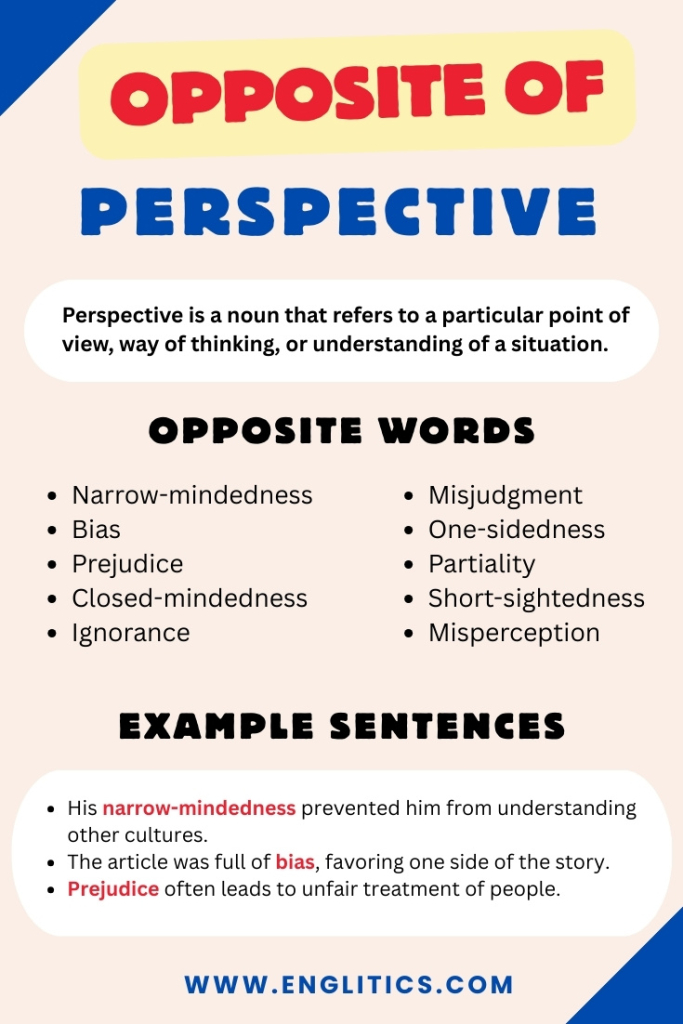
While “perspective” emphasizes a particular viewpoint, its antonyms often highlight the absence of a defined viewpoint, an attempt to eliminate personal bias, or a limitation in understanding. Here’s a breakdown of some key antonyms:
- Objectivity: Striving for impartiality and focusing on facts rather than feelings or opinions.
- Subjectivity: Relying on personal feelings, tastes, and opinions.
- Bias: A prejudice in favor of or against one thing, person, or group compared with another, usually in a way that’s considered to be unfair.
- Impartiality: Equal treatment of all views and facts, without any personal leaning.
- Tunnel Vision: A narrow point of view resulting from or as if from looking through a tunnel.
- Broad-Mindedness: Having or showing tolerance of opposing opinions.
Objectivity
Objectivity is the quality of being objective. It emphasizes impartiality, fairness, and a focus on facts rather than personal feelings or opinions. In contrast to perspective, which acknowledges the influence of individual viewpoints, objectivity strives for a detached and unbiased assessment.
In journalism, science, and law, objectivity is considered a virtue. Journalists are encouraged to report facts without injecting their own opinions, scientists aim to conduct experiments and analyze data without bias, and judges are expected to make decisions based on the law, not personal feelings.
While complete objectivity is often considered an ideal, striving for it can help to minimize bias and ensure fairness. However, it’s important to recognize that everyone has a perspective, and even attempts to be objective can be influenced by unconscious biases.
Subjectivity
Subjectivity is the quality of being based on or influenced by personal feelings, tastes, or opinions. It stands in direct contrast to objectivity, which emphasizes impartiality and factual accuracy. While perspective acknowledges the influence of individual viewpoints, subjectivity highlights the dominance of personal experience and interpretation.
In art, literature, and personal relationships, subjectivity is often valued. Artists express their inner feelings and experiences through their work, writers create characters and narratives that reflect their own perspectives, and individuals form bonds based on shared values and emotional connections.
However, in contexts that require fairness and accuracy, such as journalism, science, and law, subjectivity can be problematic. Relying on personal feelings or opinions can lead to bias, inaccuracy, and unfairness.
Bias
Bias represents a leaning or prejudice in favor of or against one thing, person, or group compared with another, usually in a way that’s considered to be unfair. Unlike perspective, which is a general viewpoint, bias is a skewed perspective that prevents objective judgment.
Bias can manifest in various forms, including confirmation bias (seeking out information that confirms existing beliefs), implicit bias (unconscious prejudices), and group bias (favoring one’s own group over others). Recognizing and addressing bias is crucial for promoting fairness, equality, and understanding.
In research, bias can distort results and lead to inaccurate conclusions. In media, bias can shape public opinion and influence political discourse.
In personal relationships, bias can lead to misunderstandings and conflict.
Impartiality
Impartiality is the principle of equal treatment of all views and facts, without any personal leaning. It is a cornerstone of justice, fairness, and ethical decision-making. In contrast to perspective, which acknowledges individual viewpoints, impartiality strives for a neutral and unbiased assessment.
Judges, referees, and mediators are expected to be impartial in their decision-making. They must consider all sides of an issue fairly and base their judgments on evidence and reason, not personal feelings or biases.
Achieving complete impartiality is often difficult, as everyone has their own perspectives and biases. However, striving for impartiality can help to minimize bias and ensure fairness.
This involves being aware of one’s own biases, actively seeking out diverse perspectives, and being willing to change one’s mind in light of new evidence.
Tunnel Vision
Tunnel vision is a narrow point of view resulting from or as if from looking through a tunnel. It describes a situation where someone is so focused on one aspect of a problem or situation that they fail to see the bigger picture or consider alternative perspectives. This is a direct antonym to having a broad perspective.
Tunnel vision can be caused by stress, pressure, or a lack of information. It can lead to poor decision-making, missed opportunities, and an inability to adapt to changing circumstances.
To avoid tunnel vision, it’s important to step back and consider the broader context. This involves seeking out diverse perspectives, challenging assumptions, and being open to new information.
Broad-Mindedness
Broad-mindedness is the quality of having or showing tolerance of opposing opinions. It involves being open to new ideas and perspectives, even if they differ from one’s own. This contrasts with a narrow perspective, which is limited and inflexible.
Broad-mindedness is essential for effective communication, collaboration, and problem-solving. It allows individuals to understand different viewpoints, appreciate diverse cultures, and find common ground.
Cultivating broad-mindedness involves actively seeking out diverse perspectives, challenging one’s own assumptions, and being willing to change one’s mind in light of new evidence. It also requires empathy, compassion, and a genuine interest in understanding others.
Examples of Antonyms in Sentences
The following tables provide examples of how these antonyms of “perspective” are used in sentences, demonstrating their contrasting meanings.
Objectivity vs. Perspective
This table illustrates how “objectivity” and “perspective” are used in sentences, highlighting the contrast between striving for unbiased facts and acknowledging individual viewpoints.
| Sentence with Objectivity | Sentence with Perspective |
|---|---|
| The journalist aimed for objectivity in her reporting, presenting facts without bias. | From her perspective, the new policy seemed unfair. |
| Scientific research requires objectivity to ensure accurate results. | The historian offered a unique perspective on the events of the war. |
| The judge was praised for his objectivity in the courtroom. | Each character in the novel offers a different perspective on the central conflict. |
| Objectivity is crucial when evaluating evidence in a criminal trial. | Understanding the cultural perspective is essential for effective communication. |
| The analyst tried to maintain objectivity when assessing the company’s performance. | From an economic perspective, the project was deemed unsustainable. |
| The scientist approached the experiment with complete objectivity. | Her perspective on the matter was shaped by her personal experiences. |
| Objectivity in journalism ensures unbiased reporting of events. | The artist’s perspective is reflected in the unique style of his paintings. |
| The reviewer attempted to provide an objective assessment of the film. | From a philosophical perspective, the question of free will is complex. |
| Objectivity is paramount in the evaluation of academic research. | His perspective on the issue was influenced by his political beliefs. |
| The auditor maintained objectivity while examining the financial records. | Understanding the patient’s perspective is crucial for effective medical care. |
| The report strived for objectivity, avoiding any subjective opinions. | From a legal perspective, the contract was deemed valid. |
| The referee’s objectivity was questioned after several controversial calls. | Her perspective on the situation was different from everyone else’s. |
| Objectivity is a key principle in the scientific method. | The author presented multiple perspectives on the same event. |
| The data was analyzed with complete objectivity. | From a historical perspective, the event was a turning point. |
| The evaluation process was designed to ensure objectivity. | Understanding the child’s perspective is important for effective parenting. |
| The goal was to present the information with utmost objectivity. | The film offered a fresh perspective on the classic story. |
| The analysis was performed with strict objectivity and attention to detail. | From a business perspective, the merger made perfect sense. |
| The judge demonstrated remarkable objectivity throughout the trial. | His perspective was shaped by his years of experience in the field. |
| The scientist’s objectivity was never in question. | The documentary explored the issue from various perspectives. |
| The committee valued objectivity above all else. | From the artist’s perspective, the world was a canvas. |
| Objectivity is essential for making fair decisions. | The book offered a new perspective on the historical figure. |
| The review board demanded complete objectivity. | From a personal perspective, the journey was transformative. |
| The findings were presented with scientific objectivity. | The debate highlighted different perspectives on the policy. |
| Objectivity is a cornerstone of ethical journalism. | Her perspective was influenced by her cultural background. |
| The assessment required a high degree of objectivity. | The project aimed to capture the perspective of the local community. |
Subjectivity vs. Perspective
This table shows how “subjectivity” and “perspective” are used in sentences, emphasizing the contrast between personal feelings and a general viewpoint.
| Sentence with Subjectivity | Sentence with Perspective |
|---|---|
| The art critic’s review was filled with subjectivity, reflecting his personal tastes. | From my perspective, the movie was a masterpiece. |
| The grading system was criticized for its inherent subjectivity. | The historian offered a different perspective on the causes of the war. |
| Subjectivity can make it difficult to reach a consensus. | Each member of the team had a unique perspective to contribute. |
| The evaluation was based more on subjectivity than on objective criteria. | Understanding the other person’s perspective is key to resolving conflicts. |
| Her argument was dismissed as purely subjectivity. | From a managerial perspective, the decision was necessary. |
| The value of art is often a matter of subjectivity. | His perspective was shaped by his upbringing in a rural area. |
| The decision was influenced by personal feelings and subjectivity. | The book provided a fresh perspective on the historical event. |
| The assessment lacked objectivity and was based on subjectivity. | From a scientific perspective, the results were inconclusive. |
| The review was criticized for its subjectivity and lack of evidence. | Her perspective was different from everyone else’s in the room. |
| Subjectivity plays a significant role in artistic expression. | The film explored the issue from multiple perspectives. |
| The debate was fueled by personal opinions and subjectivity. | From a global perspective, the problem is even more severe. |
| His judgment was clouded by subjectivity and emotional bias. | Understanding the customer’s perspective is crucial for business success. |
| The evaluation process relied heavily on subjectivity. | From a parent’s perspective, the safety of their children is paramount. |
| Subjectivity can lead to inconsistencies in grading. | The article presented the issue from various perspectives to provide a balanced view. |
| The taste of food is largely a matter of subjectivity. | From a medical perspective, the treatment was effective. |
| The decision was based on personal preference and subjectivity. | The documentary offered a unique perspective on the cultural phenomenon. |
| Her views were dismissed as nothing more than subjectivity. | From an environmental perspective, the project was unsustainable. |
| Subjectivity is acceptable in art, but not in scientific research. | His perspective on the matter was influenced by his professional background. |
| The critic’s subjectivity was evident in every sentence of the review. | The negotiation required understanding the perspective of both parties. |
| The evaluation process was too heavily influenced by subjectivity. | From a strategic perspective, the move made perfect sense. |
| Subjectivity can sometimes hinder fair and balanced judgment. | The book explored the historical event from various perspectives. |
| His opinions were often dismissed due to their obvious subjectivity. | From a long-term perspective, the investment was a wise choice. |
| The assessment was deemed unreliable because of its high degree of subjectivity. | The project aimed to capture the perspective of the local community. |
| While subjectivity has its place, it shouldn’t dominate decision-making. | Her perspective was refreshing and offered a new way of looking at the problem. |
| The debate highlighted the difficulty of separating fact from subjectivity. | From the artist’s perspective, every object had a story to tell. |
Bias vs. Perspective
This table demonstrates the usage of “bias” and “perspective” in sentences, highlighting the difference between a skewed viewpoint and a general viewpoint.
| Sentence with Bias | Sentence with Perspective |
|---|---|
| The news report showed a clear bias in favor of one political party. | From my perspective, the new law is beneficial for the country. |
| The study was criticized for its bias towards a particular outcome. | The historian provided a unique perspective on the historical events. |
| Bias can lead to unfair treatment of individuals. | Each member of the team brought a different perspective to the project. |
| The judge was accused of showing bias in his rulings. | Understanding the other person’s perspective can help resolve conflicts. |
| Her bias against immigrants was evident in her comments. | From a business perspective, the merger was a strategic move. |
| The survey results were skewed due to sampling bias. | His perspective was shaped by his experiences growing up in poverty. |
| The advertisement contained a subtle bias towards a certain brand. | The book offered a refreshing perspective on the well-known story. |
| The evaluation process was designed to minimize bias. | From a scientific perspective, the experiment was a success. |
| His arguments were dismissed due to his obvious bias. | Her perspective was different from everyone else’s in the group. |
| Bias can prevent people from seeing the truth. | The film explored the issue from multiple perspectives to give a comprehensive view. |
| Unconscious bias can affect our decisions without us realizing it. | From a global perspective, the problem is even more urgent and widespread. |
| The report was criticized for its bias and lack of objectivity. | Understanding the customer’s perspective is crucial for developing effective marketing strategies. |
| Her bias towards traditional methods hindered innovation. | From a parent’s perspective, the most important thing is their child’s well-being. |
| The investigation was compromised by political bias. | The article presented the issue from various perspectives to provide a balanced understanding. |
| The company was accused of racial bias in its hiring practices. | From a medical perspective, the new treatment showed promising results. |
| The commentary was full of bias and lacked factual accuracy. | The documentary offered a unique perspective on the cultural movement. |
| His bias against new technology was evident in his reluctance to adopt it. | From an environmental perspective, the project was unsustainable and harmful. |
| The journalist was criticized for allowing personal bias to influence his reporting. | His perspective on the matter was influenced by his years of experience in the industry. |
| The committee aimed to eliminate bias from the decision-making process. | The negotiation required understanding the perspective of all stakeholders involved. |
| The results were questioned due to the potential for interviewer bias. | From a strategic perspective, the decision was a calculated risk. |
| The policy was seen as discriminatory due to its inherent bias. | The book explored the historical event from various perspectives to provide a comprehensive analysis. |
| The assessment was unfair because it was based on personal bias rather than objective criteria. | From a long-term perspective, the investment was a prudent and well-considered choice. |
| The study controlled for confounding variables to minimize bias. | The project aimed to capture the perspective of the local community and amplify their voices. |
| The speaker’s bias was clear from the outset of the presentation. | Her perspective was refreshing and offered a new and insightful way of looking at the problem. |
| The review was rejected due to its overt bias and lack of supporting evidence. | From the artist’s perspective, every brushstroke contributed to the overall narrative. |
Usage Rules for Antonyms of Perspective
Understanding the nuances of these antonyms is key to using them correctly. Here are some guidelines:
- Objectivity is best used when emphasizing impartiality and a focus on facts. For instance, “The judge approached the case with complete objectivity.”
- Subjectivity is appropriate when highlighting personal feelings, tastes, or opinions. For example, “The art critic’s review was marked by subjectivity.”
- Bias should be used when describing a prejudice or leaning that prevents fair judgment. For instance, “The report was criticized for its bias towards one side of the issue.”
- Impartiality is appropriate when describing equal and fair treatment of all sides. For example, “The mediator demonstrated impartiality throughout the negotiation.”
- Tunnel Vision is used to describe a narrow and limited focus on one aspect of something. For example, “The manager suffered from tunnel vision, failing to see the broader implications.”
- Broad-mindedness is best used to describe having or showing tolerance of opposing opinions. For example, “The successful leader demonstrated broad-mindedness and welcomed diverse opinions.”
Common Mistakes When Using Antonyms of Perspective
Here are some common mistakes to avoid when using antonyms of “perspective”:
| Incorrect | Correct | Explanation |
|---|---|---|
| “He showed great perspective in his subjective report.” | “He showed great subjectivity in his report.” | “Perspective” and “subjectivity” are often confused. “Subjectivity” is more appropriate when personal feelings are involved. |
| “The objective judge was biased towards the defendant.” | “The judge was biased towards the defendant.” | “Objectivity” and “bias” are contradictory. A judge cannot be both objective and biased. |
| “The impartial study had a clear perspective in favor of the new policy.” | “The study had a clear perspective in favor of the new policy.” | “Impartiality” and “perspective” can be confused. “Impartiality” emphasizes fairness without leaning. |
| “She had a tunnel vision view of the situation, allowing her to see all aspects.” | “She had a tunnel vision view of the situation, preventing her from seeing the broader picture.” | “Tunnel vision” implies a narrow focus that limits understanding, not enhances it. |
| “He was narrow-minded and showed great broad-mindedness.” | “He was broad-minded and showed great tolerance.” | “Broad-mindedness” implies being open to different opinions. “Narrow-minded” is the opposite. |
Practice Exercises
Test your understanding of the antonyms of “perspective” with these exercises.
Exercise 1: Fill in the Blanks
Choose the best word from the list (Objectivity, Subjectivity, Bias, Impartiality, Tunnel Vision, Broad-Mindedness) to complete each sentence.
| Question | Answer |
|---|---|
| 1. The scientist tried to maintain __________ in his research, avoiding personal opinions. | Objectivity |
| 2. The art critic’s review was full of __________, reflecting his personal tastes and preferences. | Subjectivity |
| 3. The report was criticized for its __________ towards one particular political party. | Bias |
| 4. The judge was known for his __________ in the courtroom, treating all parties fairly. | Impartiality |
| 5. His __________ prevented him from seeing the potential benefits of the new strategy. | Tunnel Vision |
| 6. Her __________ allowed her to consider different viewpoints and find common ground. | Broad-Mindedness |
| 7. The journalist strived for __________ in reporting the facts, setting aside personal beliefs. | Objectivity |
| 8. The evaluation was tainted by __________, based on personal feelings rather than objective criteria. | Subjectivity |
| 9. The investigation was compromised by __________ due to the investigator’s personal connections. | Bias |
| 10. The mediator ensured __________ by giving each side equal time to present their case. | Impartiality |
Exercise 2: Multiple Choice
Choose the best antonym for “perspective” in each sentence.
| Question | Options | Answer |
|---|---|---|
| 1. The scientist approached the experiment with ______. | a) bias b) objectivity c) perspective d) subjectivity | b) objectivity |
| 2. The art critic’s review was characterized by ______. | a) impartiality b) objectivity c) subjectivity d) broad mindedness | c) subjectivity |
| 3. The report was criticized for its ______ towards one side of the issue. | a) impartiality b) bias c) objectivity d) perspective | b) bias |
| 4. The judge was praised for his ______ in handling the case. | a) subjectivity b) bias c) impartiality d) tunnel vision | c) impartiality |
| 5. His ______ prevented him from seeing the bigger picture. | a) broad mindedness b) objectivity c) tunnel vision d) perspective | c) tunnel vision |
| 6. Her ______ allowed her to appreciate different cultures and viewpoints. | a) subjectivity b) bias c) tunnel vision d) broad mindedness | d) broad mindedness |
| 7. The journalist aimed to present the facts with _______. | a) subjectivity b) bias c) objectivity d) tunnel vision | c) objectivity |
| 8. The evaluation was based more on ______ than on objective criteria. | a) objectivity b) impartiality c) bias d) subjectivity | d) subjectivity |
| 9. The investigation was compromised by ______ due to personal connections. | a) impartiality b) objectivity c) bias d) broad mindedness | c) bias |
| 10. The mediator ensured ______ by allowing each side to present their case. | a) subjectivity b) tunnel vision c) impartiality d) bias | c) impartiality |
Advanced Topics: Nuances and Context
The antonyms of “perspective” are not always mutually exclusive. In some cases, they can overlap or coexist.
For example, a person may strive for objectivity but still be influenced by unconscious biases. Similarly, someone may have a broad perspective but still hold certain subjective beliefs.
The meaning of these antonyms can also vary depending on the context. In scientific research, objectivity is highly valued, while in artistic expression, subjectivity is often embraced.
Understanding these nuances and contextual variations is crucial for using these words accurately and effectively.
Furthermore, the concept of “perspective-taking” is an important skill in communication and empathy. It involves actively trying to understand another person’s viewpoint, even if it differs from one’s own.
This requires a willingness to set aside one’s own biases and subjective beliefs, and to appreciate the validity of different perspectives.
Frequently Asked Questions (FAQ)
- What is the difference between objectivity and impartiality?Objectivity refers to the quality of being objective, meaning based on facts rather than personal feelings or opinions. Impartiality refers to the principle of treating all views and facts equally, without any personal leaning. While both concepts emphasize fairness and lack of bias, objectivity focuses on the nature of the information itself, while impartiality focuses on the way that information is handled.
- How can I avoid bias in my writing?Avoiding bias requires awareness and conscious effort. Start by recognizing your own biases and assumptions. Seek out diverse perspectives and challenge your own beliefs. Use neutral language and avoid making generalizations. Cite credible sources and present evidence fairly. Have your writing reviewed by others to identify potential biases.
- Is it possible to be completely objective?Complete objectivity is often considered an ideal, as everyone has their own perspectives and experiences that can influence their perceptions. However, striving for objectivity can help to minimize bias and ensure fairness. This involves being aware of one’s own biases, actively seeking out diverse perspectives, and being willing to change one’s mind in light of new evidence.
- What is tunnel vision, and how can I overcome it?Tunnel vision is a narrow point of view resulting from being overly focused on one
aspect of a situation, ignoring other important factors. It can be overcome by actively seeking out diverse perspectives, challenging your own assumptions, and being open to new information. Engage in activities that broaden your horizons, such as reading different viewpoints, traveling, and talking to people from different backgrounds.
Conclusion
Understanding the antonyms of “perspective”—objectivity, subjectivity, bias, impartiality, tunnel vision, and broad-mindedness—is crucial for effective communication, critical thinking, and fostering empathy. Each of these concepts highlights different aspects of how we perceive and interpret the world.
By recognizing the nuances of these terms and using them appropriately, we can express ourselves with greater precision and clarity.
Whether you are a student, writer, or simply someone interested in improving your communication skills, mastering the antonyms of “perspective” will enhance your ability to articulate contrasting viewpoints, recognize biases, and foster more comprehensive understanding. This knowledge empowers you to engage in more meaningful conversations, make more informed decisions, and build stronger relationships.