Selfish describes someone who only thinks about themselves—putting their own needs, wants, or comfort first, even if it hurts others. It’s often seen as a negative trait, especially in relationships or teamwork. But when someone shows care for others and puts people first, the opposite of selfish describes them better.
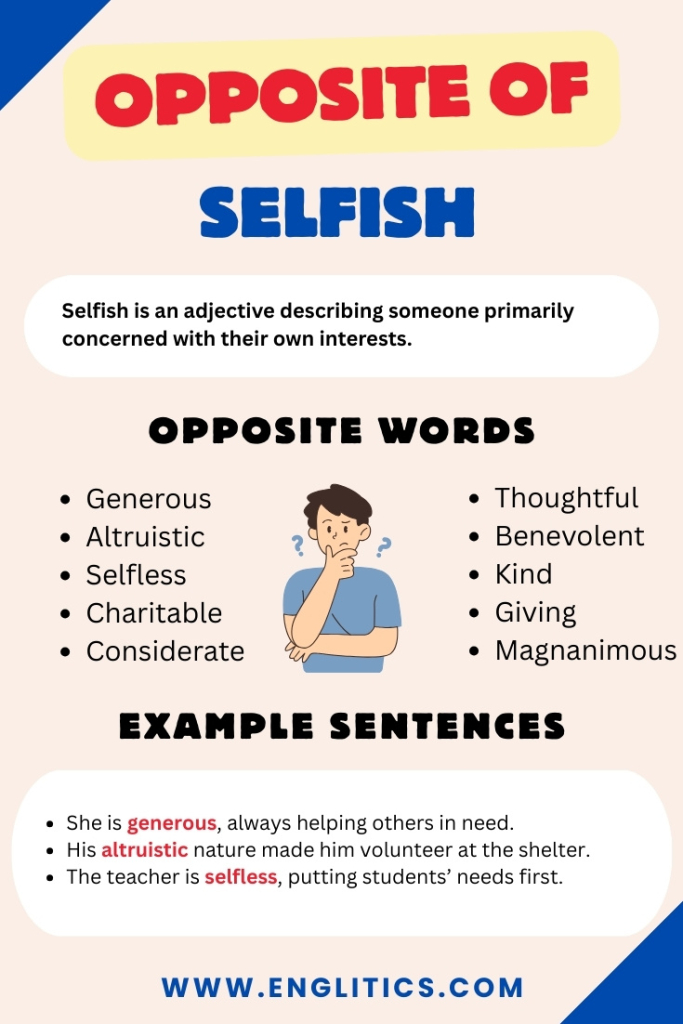
Antonyms for selfish include words like generous, selfless, kind, thoughtful, and giving. These words show a person who helps others, shares what they have, or considers others’ feelings before their own. In this post, you’ll learn how to use these opposite words with real examples that make the meanings easy to understand.
Table of Contents
- Introduction
- Defining ‘Selfish’
- Structural Breakdown of ‘Selfish’ and Its Antonyms
- Types of Antonyms for ‘Selfish’
- Examples of Antonyms in Use
- Usage Rules and Considerations
- Common Mistakes to Avoid
- Practice Exercises
- Advanced Topics: Nuances and Context
- Frequently Asked Questions
- Conclusion
Defining ‘Selfish’
Selfish, in its simplest form, means being primarily concerned with one’s own personal profit or pleasure. It implies a lack of consideration for others and a tendency to prioritize one’s own needs and desires above those of others. This can manifest in various ways, from hoarding resources to disregarding the feelings of those around you. The term carries a negative connotation, suggesting a moral failing or a lack of empathy.
From a grammatical perspective, ‘selfish’ is an adjective. It modifies nouns, describing the qualities or characteristics of a person, action, or thing.
For example, “a selfish decision,” “a selfish person,” or “selfish behavior.” The word is derived from the noun ‘self,’ highlighting the focus on the individual. Understanding the core meaning of ‘selfish’ is essential for grasping the nuances of its antonyms.
Structural Breakdown of ‘Selfish’ and Its Antonyms
The word ‘selfish’ is relatively straightforward in its structure. It consists of the root word ‘self’ and the suffix ‘-ish,’ which often indicates a characteristic or quality.
Analyzing the structure of its antonyms can offer insights into their meanings and usage. Many antonyms are formed by using prefixes that negate the idea of self-interest or suffixes that emphasize caring for others.
For example, the antonym ‘selfless’ also contains the root ‘self,’ but it is combined with the suffix ‘-less,’ indicating the absence of self-interest. Similarly, ‘altruistic’ comes from the root ‘alter,’ meaning other, highlighting a focus on the well-being of others.
Examining the etymology and structural components of these words can aid in memorization and comprehension.
Types of Antonyms for ‘Selfish’
There isn’t one single perfect antonym for ‘selfish,’ as the best choice depends on the specific context and the nuance you want to convey. Here are some of the most common and useful antonyms, categorized by their specific shades of meaning:
Altruistic
Altruistic means showing a selfless concern for the well-being of others; acting out of a desire to help others rather than oneself. It often involves putting the needs of others before one’s own, even at a personal cost.
Selfless
Selfless means concerned more with the needs and wishes of others than with one’s own. It emphasizes the absence of self-centeredness and a willingness to sacrifice personal gain for the benefit of others.
Generous
Generous means showing a readiness to give more of something, as money or time, than is strictly necessary or expected. It implies a willingness to share resources and be benevolent in one’s actions.
Compassionate
Compassionate means feeling or showing sympathy and concern for others. It involves understanding and sharing the suffering of others and being motivated to alleviate their pain.
Benevolent
Benevolent means well meaning and kindly. It suggests a desire to do good and to promote the happiness and well-being of others.
Charitable
Charitable means giving money or help to those in need. It specifically refers to acts of giving and assistance, often to organizations or individuals who are less fortunate.
Philanthropic
Philanthropic means seeking to promote the welfare of others, especially by donating money to good causes. It is a broader term than ‘charitable’ and often involves large-scale efforts to improve society.
Examples of Antonyms in Use
To fully understand the usage of these antonyms, let’s examine them in context. The following tables provide diverse examples to illustrate how each word can be used to convey different aspects of selflessness and concern for others.
Altruistic Examples
The following table presents examples of how the word “altruistic” is used in sentences. Notice the emphasis on selfless actions and concern for others’ well-being.
| Sentence | Explanation |
|---|---|
| Her altruistic nature led her to volunteer at the homeless shelter every weekend. | This highlights her selfless dedication to helping those in need. |
| The doctor’s altruistic actions saved countless lives during the epidemic. | This emphasizes the doctor’s selflessness in prioritizing patient care. |
| The altruistic donor gave millions to support cancer research. | This shows a selfless act of providing resources for a greater cause. |
| His altruistic decision to donate his kidney saved his brother’s life. | This illustrates a significant personal sacrifice for the benefit of another. |
| The organization’s mission is to promote altruistic behavior in young people. | This focuses on encouraging selfless actions and concern for others. |
| She was praised for her altruistic efforts in the community. | Highlights the positive recognition of her selfless contributions. |
| The study explored the psychological roots of altruistic tendencies. | Focuses on the underlying reasons behind selfless behaviors. |
| Altruistic leadership is essential for creating a positive work environment. | Emphasizes the importance of leaders prioritizing the needs of their team. |
| The firefighter’s altruistic rescue saved the family from the burning building. | Illustrates a heroic act of selflessness in a dangerous situation. |
| The altruistic monk dedicated his life to serving the poor. | Highlights a lifelong commitment to selfless service. |
| The company encourages altruistic behavior through its volunteer programs. | Shows how organizations can promote selfless actions among employees. |
| Her altruistic heart always led her to help those in need. | Emphasizes her natural inclination to be selfless. |
| The altruistic project aimed to provide clean water to remote villages. | Illustrates a selfless initiative to improve the lives of others. |
| He is known for his altruistic contributions to the local community. | Highlights his reputation for selfless giving and support. |
| The altruistic act of donating blood can save lives. | Emphasizes the life-saving potential of a selfless action. |
| She was inspired by the altruistic stories she read in the newspaper. | Shows how selfless acts can inspire others. |
| The altruistic volunteer spent countless hours tutoring underprivileged children. | Illustrates a selfless dedication to helping those in need. |
| The altruistic leader always put the needs of his people first. | Highlights the importance of selflessness in leadership. |
| His altruistic nature made him a beloved member of the community. | Shows how selflessness can lead to positive social connections. |
| The altruistic program provided free healthcare to low-income families. | Illustrates a selfless initiative to improve access to healthcare. |
| She is admired for her altruistic spirit and unwavering dedication to helping others. | Emphasizes her consistent and selfless commitment. |
| The foundation was built on the principles of altruistic giving and community support. | Highlights the selfless foundation of the organization. |
| He approached every situation with an altruistic mindset, always considering others’ needs. | Illustrates a consistent pattern of selfless thinking. |
Selfless Examples
The following table provides examples of how “selfless” is used in sentences. Note the emphasis on putting others’ needs before one’s own and the absence of self-centeredness.
| Sentence | Explanation |
|---|---|
| Her selfless dedication to her family was truly admirable. | This highlights her willingness to prioritize her family’s needs. |
| The soldier’s selfless act of bravery saved his comrades. | This emphasizes the soldier’s courage in putting others before himself. |
| She made a selfless sacrifice by giving up her career to care for her ailing mother. | This illustrates a significant personal sacrifice for the well-being of another. |
| His selfless service to the community earned him widespread respect. | This shows his dedication to helping others without expecting personal gain. |
| The volunteer’s selfless efforts made a significant difference in the lives of the refugees. | This highlights the impact of her dedication to assisting those in need. |
| She is known for her selfless acts of kindness and generosity. | Emphasizes her reputation for helping others without expecting anything in return. |
| The organization relies on the selfless contributions of its volunteers. | Highlights the importance of volunteers’ dedication to the organization’s mission. |
| He displayed selfless courage in the face of danger. | Illustrates bravery without regard for personal safety. |
| Her selfless love and support were a constant source of strength for her family. | Emphasizes the unwavering support and care she provides. |
| The nurse’s selfless care and compassion comforted the patients. | Highlights the importance of empathy and dedication in healthcare. |
| She made a selfless decision to donate her time to the local soup kitchen. | Shows her commitment to helping those in need. |
| His selfless actions inspired others to volunteer their time as well. | Illustrates how one person’s dedication can motivate others. |
| The selfless gift of organ donation saves lives. | Emphasizes the life-saving impact of selfless giving. |
| She is a selfless leader who always puts the needs of her team first. | Highlights her dedication to prioritizing the well-being of her team members. |
| The selfless act of donating blood can make a significant difference in someone’s life. | Emphasizes the positive impact of a selfless action. |
| She is admired for her selfless dedication to helping animals in need. | Highlights her commitment to animal welfare. |
| His selfless nature made him a valuable asset to the community. | Shows how his selflessness benefits the community as a whole. |
| The selfless efforts of the rescue team saved countless lives during the disaster. | Illustrates the impact of selfless actions in a crisis. |
| She is a selfless caregiver who provides unwavering support to her patients. | Highlights her dedication to providing compassionate care. |
| His selfless actions served as an inspiration to others. | Emphasizes his role as a positive influence. |
| The organization relies on the selfless dedication of its volunteers. | Highlights the critical role of volunteers in the organization’s success. |
| She is known for her selfless commitment to environmental conservation. | Emphasizes her dedication to protecting the environment. |
| His selfless leadership helped the team overcome numerous challenges. | Illustrates the positive impact of selflessness in leadership. |
Generous Examples
The table below shows examples of sentences using “generous.” The emphasis is on the willingness to give more than necessary.
| Sentence | Explanation |
|---|---|
| She was generous with her time, always willing to help others. | This highlights her willingness to share her time and effort. |
| The company made a generous donation to the local charity. | This emphasizes the act of giving a substantial amount of money. |
| He was generous with his praise, always encouraging his colleagues. | This illustrates his willingness to give positive feedback and support. |
| The host was incredibly generous, providing us with everything we needed. | This shows the host’s willingness to go above and beyond to accommodate guests. |
| She was generous in sharing her knowledge and expertise with others. | This highlights her willingness to share her skills and insights. |
| He is known for his generous spirit and willingness to help those in need. | Emphasizes his reputation for giving and supporting others. |
| The foundation provides generous grants to support educational initiatives. | Highlights the organization’s commitment to funding education. |
| She was generous with her compliments, always making others feel appreciated. | Illustrates her ability to uplift and encourage others. |
| His generous offer of assistance was greatly appreciated. | Emphasizes the value of his willingness to help. |
| The company is known for its generous employee benefits package. | Highlights the company’s commitment to providing excellent compensation. |
| She made a generous contribution to the museum’s fundraising campaign. | Shows her financial support for the arts. |
| His generous hospitality made us feel welcome and comfortable. | Illustrates his ability to create a warm and inviting atmosphere. |
| The generous donation helped the organization expand its services. | Emphasizes the positive impact of financial support. |
| She is a generous mentor who provides guidance and support to her mentees. | Highlights her dedication to helping others succeed. |
| The generous gift allowed the school to purchase new equipment. | Emphasizes the positive impact of the gift on the school’s resources. |
| She is admired for her generous heart and unwavering support for her friends. | Highlights her consistent kindness and care. |
| His generous offer to help with the project was greatly appreciated. | Shows his willingness to contribute his time and effort. |
| The generous scholarship allowed her to pursue her dreams of higher education. | Illustrates the transformative impact of financial assistance. |
| She is a generous host who always makes sure her guests are comfortable. | Highlights her dedication to providing excellent hospitality. |
| His generous actions made a significant difference in the lives of many. | Emphasizes the positive impact of his giving and support. |
| The company is known for its generous charitable contributions. | Highlights the company’s commitment to supporting various causes. |
| She is admired for her generous spirit and her willingness to share what she has with others. | Emphasizes her consistent giving and caring nature. |
| His generous support helped the organization achieve its goals. | Illustrates the positive impact of his contributions. |
Compassionate Examples
The following table presents examples of sentences with “compassionate.” The emphasis is on feeling and showing sympathy and concern.
| Sentence | Explanation |
|---|---|
| The nurse showed compassionate care to her patients. | Highlights the empathy and understanding in her nursing. |
| He was a compassionate leader, always listening to his employees’ concerns. | Emphasizes his empathy and concern for his team. |
| She had a compassionate heart and always tried to help those in need. | Illustrates her deep empathy and willingness to assist others. |
| The organization provides compassionate support to families dealing with loss. | Highlights the empathy and understanding they offer. |
| He approached the situation with a compassionate understanding of the other person’s feelings. | Emphasizes his ability to empathize and understand others’ emotions. |
| She is known for her compassionate nature and her unwavering support for others. | Highlights her consistent empathy and care. |
| The compassionate doctor always took the time to listen to her patients’ concerns. | Emphasizes the importance of empathy in healthcare. |
| He showed compassionate concern for the victims of the natural disaster. | Illustrates his empathy and willingness to help those affected. |
| The compassionate teacher understood the challenges faced by her students. | Emphasizes the importance of empathy in education. |
| She is a compassionate advocate for animal rights. | Highlights her empathy and concern for animals. |
| He responded with compassionate words of comfort and support. | Shows his ability to provide empathy and reassurance. |
| Her compassionate actions made a significant difference in the lives of many. | Emphasizes the positive impact of her empathy and care. |
| The organization provides compassionate care to individuals with disabilities. | Highlights the empathy and understanding they offer. |
| He is a compassionate listener who always provides a safe space for others. | Emphasizes his ability to create an empathetic and supportive environment. |
| She approached the situation with a compassionate understanding of the other person’s perspective. | Illustrates her ability to empathize and understand different viewpoints. |
| He is admired for his compassionate heart and his unwavering commitment to helping others. | Highlights his consistent empathy and dedication. |
| The compassionate social worker provided support to families in crisis. | Emphasizes the importance of empathy in social work. |
| She responded with compassionate gestures of kindness and support. | Shows her ability to express empathy and care through actions. |
| His compassionate nature made him a valuable asset to the community. | Highlights the positive impact of his empathy and care. |
| The organization provides compassionate housing to homeless individuals. | Highlights the empathy and understanding they offer. |
| He offered a compassionate ear to those who needed someone to talk to. | Shows his willingness to listen empathetically to others. |
| She is known for her compassionate approach to solving problems. | Emphasizes the importance of empathy in finding solutions. |
| His compassionate leadership style inspired his team to achieve great things. | Illustrates the positive impact of empathy in leadership. |
Benevolent Examples
The table below shows examples of how “benevolent” is used in sentences. The key is the sense of being well-meaning and kindly.
| Sentence | Explanation |
|---|---|
| The benevolent king ruled his people with fairness and compassion. | Highlights the king’s kindness and just governance. |
| The company’s benevolent policies supported its employees’ well-being. | Emphasizes the company’s commitment to employee welfare. |
| She was a benevolent benefactor, supporting numerous charitable causes. | Illustrates her generosity in supporting various organizations. |
| The organization’s mission is to promote benevolent actions in the community. | Highlights the focus on encouraging kindness and good deeds. |
| He was a benevolent mentor, guiding and supporting his students. | Emphasizes his kindness and support in helping his students. |
| She is known for her benevolent nature and her unwavering support for others. | Highlights her consistent kindness and care. |
| The benevolent dictator implemented policies that benefited the entire population. | Illustrates a ruler who uses power for the good of the people. |
| He approached every situation with a benevolent intention. | Emphasizes his desire to do good in all circumstances. |
| The benevolent organization provides assistance to those in need. | Highlights the organization’s mission to help others. |
| She is a benevolent leader who always puts the needs of her team first. | Emphasizes her dedication to prioritizing her team’s well-being. |
| His benevolent actions made a significant difference in the lives of many. | Emphasizes the positive impact of his kindness and good deeds. |
| The company is known for its benevolent contributions to the community. | Highlights the company’s commitment to supporting local initiatives. |
| She is admired for her benevolent spirit and her willingness to help those less fortunate. | Emphasizes her consistent kindness and generosity. |
| His benevolent support helped the organization achieve its goals. | Illustrates the positive impact of his kindness and assistance. |
| The benevolent program provided free healthcare to low-income families. | Highlights the organization’s commitment to improving access to healthcare. |
| She is a benevolent caregiver who provides unwavering support to her patients. | Emphasizes her dedication to providing compassionate care. |
| His benevolent leadership style inspired his team to work together. | Illustrates the positive impact of kindness and support in leadership. |
| The benevolent fund provided financial assistance to families in need. | Highlights the organization’s commitment to providing support. |
| She approached the situation with a benevolent understanding of the other person’s perspective. | Illustrates her ability to empathize and understand different viewpoints. |
| He is known for his benevolent spirit and his unwavering dedication to helping others. | Highlights his consistent kindness and commitment. |
| The benevolent organization provides shelter to homeless individuals. | Highlights the organization’s mission to provide a safe haven. |
| She is a benevolent mentor who guides and supports her mentees. | Emphasizes her kindness and support in helping others succeed. |
| His benevolent nature made him a valuable asset to the community. | Shows how his kindness benefits the community as a whole. |
Charitable Examples
The following table provides examples of “charitable” in sentences. Note the focus on giving to those in need.
| Sentence | Explanation |
|---|---|
| The foundation is a charitable organization that supports children’s education. | Highlights the organization’s mission to support education. |
| She made a charitable donation to the local food bank. | Emphasizes her act of giving to help those in need of food. |
| The company encourages its employees to participate in charitable activities. | Highlights the company’s support for giving back to the community. |
| He is a charitable individual, always willing to help those less fortunate. | Emphasizes his willingness to assist those in need. |
| The organization provides charitable assistance to families in crisis. | Highlights the support they offer to families facing difficult situations. |
| She is known for her charitable contributions to various causes. | Emphasizes her ongoing support for different organizations. |
| The charitable event raised money for cancer research. | Highlights the purpose of the event: to support medical research. |
| He donated his time to a charitable organization that helps the homeless. | Emphasizes his willingness to volunteer his time for a good cause. |
| The charitable trust provides grants to support community projects. | Highlights the organization’s mission to fund local initiatives. |
| She is a charitable person who always puts others before herself. | Emphasizes her selflessness and willingness to help others. |
| He is actively involved in several charitable organizations. | Shows his commitment to supporting various causes. |
| The charitable campaign aims to raise awareness about poverty. | Emphasizes the goal of increasing understanding of poverty. |
| She made a charitable bequest in her will to support animal welfare. | Highlights her long-term commitment to animal welfare. |
| He is a charitable donor who consistently supports local charities. | Emphasizes his ongoing financial support for community organizations. |
| The charitable foundation provides scholarships to underprivileged students. | Highlights the organization’s commitment to supporting education. |
| She is admired for her charitable spirit and her unwavering dedication to helping others. | Highlights her consistent giving and care. |
| He is a charitable leader who inspires others to give back to the community. | Emphasizes his role as a positive influence in encouraging giving. |
| The charitable project aims to provide clean water to remote villages. | Highlights the goal of improving access to clean water. |
| She is a charitable volunteer who spends countless hours helping those in need. | Emphasizes her dedication to volunteering her time and effort. |
| He is known for his charitable actions and his commitment to social justice. | Highlights his actions and his focus on fairness and equality. |
| The charitable event was a huge success, raising thousands of dollars for the cause. | Emphasizes the positive outcome of the event. |
| She is a charitable advocate for children’s rights. | Highlights her commitment to protecting and supporting children. |
| His charitable efforts have made a significant impact on the community. | Illustrates the positive impact of his giving and support. |
Philanthropic Examples
The table below shows examples of how “philanthropic” is used in sentences. The focus is on promoting the welfare of others, especially through financial donations.
>
| Sentence | Explanation |
|---|---|
| The billionaire is known for his philanthropic contributions to education. | Highlights his significant financial support for education. |
| She established a philanthropic foundation to support environmental conservation. | Emphasizes her commitment to protecting the environment through funding. |
| The company has a philanthropic arm that donates to various charities. | Highlights the company’s commitment to giving back to the community. |
| He is a philanthropic leader, using his wealth to address social problems. | Emphasizes his use of resources to solve societal issues. |
| The organization’s philanthropic efforts have improved the lives of many. | Highlights the positive impact of their giving and support. |
| She is known for her philanthropic activities and her support for the arts. | Emphasizes her ongoing support for different artistic organizations. |
| The philanthropic event raised millions of dollars for medical research. | Highlights the purpose of the event: to fund medical research. |
| He donated his fortune to a philanthropic organization that helps the poor. | Emphasizes his act of giving his wealth to assist those in need. |
| The philanthropic trust provides grants to support scientific research. | Highlights the organization’s mission to fund scientific advancements. |
| She is a philanthropic individual who always seeks to improve society. | Emphasizes her commitment to making a positive impact on society. |
| He is actively involved in several philanthropic initiatives. | Shows his commitment to supporting various social causes. |
| The philanthropic campaign aims to raise awareness about global poverty. | Emphasizes the goal of increasing understanding of poverty worldwide. |
| She made a philanthropic gift to the university to establish a new scholarship fund. | Highlights her support for education through financial giving. |
| He is a philanthropic investor who supports socially responsible companies. | Emphasizes his commitment to investing in businesses that benefit society. |
| The philanthropic foundation provides funding for environmental conservation projects. | Highlights the organization’s commitment to protecting the environment. |
| She is admired for her philanthropic spirit and her unwavering dedication to helping others. | Highlights her consistent giving and care. |
| He is a philanthropic innovator who develops solutions to address global challenges. | Emphasizes his use of innovation to solve societal problems. |
| The philanthropic project aims to provide access to clean water in developing countries. | Highlights the goal of improving access to essential resources. |
| She is a philanthropic advocate for human rights. | Emphasizes her commitment to protecting and promoting human rights. |
| He is known for his philanthropic efforts and his commitment to social justice. | Highlights his actions and his focus on fairness and equality. |
| The philanthropic organization focuses on supporting sustainable development initiatives. | Emphasizes the organization’s commitment to long-term, positive change. |
| She is a philanthropic leader who inspires others to give back to the community. | Highlights her role as a positive influence in encouraging giving. |
| His philanthropic contributions have made a lasting impact on society. | Illustrates the significant and enduring effects of his giving and support. |
Usage Rules and Considerations
When choosing the right antonym for ‘selfish,’ consider the specific context and the shade of meaning you want to convey. Here are some guidelines:
- Altruistic: Use this when you want to emphasize a selfless concern for others, often involving personal sacrifice.
- Selfless: Use this when you want to highlight the absence of self-centeredness and a willingness to put others’ needs first.
- Generous: Use this when you want to emphasize a willingness to share resources, time, or praise.
- Compassionate: Use this when you want to highlight empathy and concern for others’ suffering.
- Benevolent: Use this when you want to emphasize kindness and a desire to do good.
- Charitable: Use this when you specifically refer to acts of giving money or help to those in need.
- Philanthropic: Use this when you want to emphasize large-scale efforts to promote the welfare of others, often through financial donations.
Also, pay attention to the connotations of each word. For example, ‘altruistic’ can sometimes imply a saintly or unrealistic level of selflessness, while ‘generous’ might simply refer to a willingness to share material possessions.
Choose the word that best fits the situation and accurately reflects the person’s motivations.
Common Mistakes to Avoid
Using antonyms incorrectly can lead to miscommunication and weaken your writing. Here are some common mistakes to avoid:
- Using ‘selfish’ and its antonyms interchangeably: Each antonym has a specific meaning and should be used in the appropriate context.
- Overusing one antonym: Vary your vocabulary by using different antonyms to convey different shades of meaning.
- Misunderstanding the connotations: Be aware of the subtle differences in meaning and emotional associations of each word.
- Ignoring the context: Always consider the situation and the person’s motivations when choosing an antonym.
- Using antonyms that don’t fit the situation: For example, using ‘charitable’ to describe someone who is simply kind, but doesn’t donate money.
By being mindful of these potential pitfalls, you can use antonyms effectively and enhance the clarity and precision of your communication.
Practice Exercises
To reinforce your understanding of the antonyms for ‘selfish,’ try these exercises:
Exercise 1: Fill in the Blanks
Choose the best antonym for ‘selfish’ to complete each sentence:
- Despite his own financial struggles, he was always __________, sharing what little he had with others. (generous / altruistic)
- Her __________ nature led her to volunteer at the local orphanage every week. (compassionate / benevolent)
- The __________ donor gave millions to support cancer research. (charitable / philanthropic)
- His __________ act of donating his kidney saved his brother’s life. (selfless / altruistic)
- She is known for her __________ spirit and her willingness to help those in need. (benevolent / compassionate)
Answers:
- generous
- compassionate
- philanthropic
- selfless
- benevolent
Exercise 2: Sentence Transformation
Rewrite each sentence using an antonym of ‘selfish’ to convey the opposite meaning:
- The CEO made a selfish decision that benefited only himself.
- He hoarded all the resources for himself and his team.
- She was only concerned with her own needs and desires.
- His actions were driven by pure self-interest.
- They ignored the suffering of others to achieve their goals.
Possible Answers:
- The CEO made an altruistic decision that benefited the entire company.
- He generously shared the resources with all the teams.
- She was always concerned with the needs and desires of others.
- His actions were driven by pure compassion for others.
- They showed compassion for the suffering of others and helped them achieve their goals.
Advanced Topics: Nuances and Context
The effective use of antonyms goes beyond simply knowing their definitions. Understanding the nuances and context in which they are used is crucial for conveying the intended meaning.
Here are some advanced considerations:
- Cultural Context: Different cultures may have varying perceptions of selfishness and its antonyms. What is considered ‘generous’ in one culture may be seen as ‘normal’ in another.
- Situational Context: The appropriate antonym can change depending on the situation. For example, in a business context, ‘generous’ might refer to offering competitive salaries and benefits, while in a personal context, it might refer to giving gifts or providing support.
- Emotional Tone: Antonyms can evoke different emotional responses. ‘Compassionate’ and ‘benevolent’ often carry a warmer, more empathetic tone than ‘altruistic’ or ‘selfless,’ which can sometimes sound detached or idealized.
- Motivation: Understanding the underlying motivations behind an action is key to choosing the right antonym. Is the person acting out of genuine concern for others, or are there other factors at play, such as a desire for recognition or a sense of duty?
By considering these factors, you can use antonyms with greater precision and sophistication, enriching your communication and deepening your understanding of human behavior.
Frequently Asked Questions
Is there one single perfect antonym for ‘selfish’?
No, the best antonym depends on the specific context and the nuance you want to convey. ‘Altruistic,’ ‘selfless,’ ‘generous,’ ‘compassionate,’ ‘benevolent,’ ‘charitable,’ and ‘philanthropic’ all represent different aspects of the opposite of selfishness.
Can ‘altruistic’ and ‘selfless’ be used interchangeably?
While they are similar, ‘altruistic’ often implies a more active and intentional effort to help others, sometimes involving personal sacrifice. ‘Selfless’ simply means lacking self-centeredness and putting others’ needs first.
What is the difference between ‘charitable’ and ‘philanthropic’?
‘Charitable’ specifically refers to acts of giving money or help to those in need, while ‘philanthropic’ is a broader term that often involves large-scale efforts to improve society, typically through financial donations.
How can I improve my vocabulary of antonyms for ‘selfish’?
Read widely, pay attention to how different words are used in context, and practice using new words in your own writing and speech. Use a thesaurus to explore synonyms and antonyms, and consider the nuances of each word before using it.
Conclusion
Understanding the antonyms for ‘selfish’ is essential for expressing a wide range of positive human qualities and behaviors. By mastering the nuances of words like ‘altruistic,’ ‘selfless,’ ‘generous,’ ‘compassionate,’ ‘benevolent,’ ‘charitable,’ and ‘philanthropic,’ you can communicate more effectively and enrich your understanding of human motivations.
Remember to consider the context, connotations, and specific meanings of each word when choosing the right antonym. With practice and attention to detail, you can use these words with confidence and precision, enhancing your vocabulary and improving your communication skills.