The opposite of phenomenon is something ordinary, unnoticed, or lacking in significance. While a phenomenon refers to an unusual, impressive, or remarkable event or fact, its opposites describe things that are common or unremarkable.
Antonyms for phenomenon include words like normality, commonplace, routine, regularity, and banality. These words are useful when referring to everyday occurrences that don’t stand out or attract attention. In this article, you’ll learn how to use these opposite words in context, with examples to help you understand their meaning.
Definition of Phenomenon
A phenomenon is an observable fact or event, especially one whose cause or explanation is in question. It can also refer to a remarkable person, thing, or event. The term originates from the Greek word “phainomenon,” meaning “that which appears.” Phenomena are often associated with novelty, surprise, or deviation from the norm, prompting curiosity and investigation.
Nature of Phenomena
Phenomena can be natural occurrences like rainbows, eclipses, or volcanic eruptions. They can also be social, cultural, or scientific events, such as the rise of a particular fashion trend, the discovery of a new species, or the emergence of a specific political movement.
What distinguishes a phenomenon is its perceived unusualness or significance, making it worthy of attention and analysis. It is something that stands out from the ordinary course of events.
Contexts of Use
The word “phenomenon” is used across various disciplines, including science, philosophy, sociology, and psychology. In science, it refers to observable events that can be studied and explained through experimentation and observation.
In philosophy, it often relates to the nature of experience and perception. In social sciences, it describes widespread social behaviors or trends.
Understanding its diverse applications is essential for grasping its full meaning and implications.
Opposite of Phenomenon
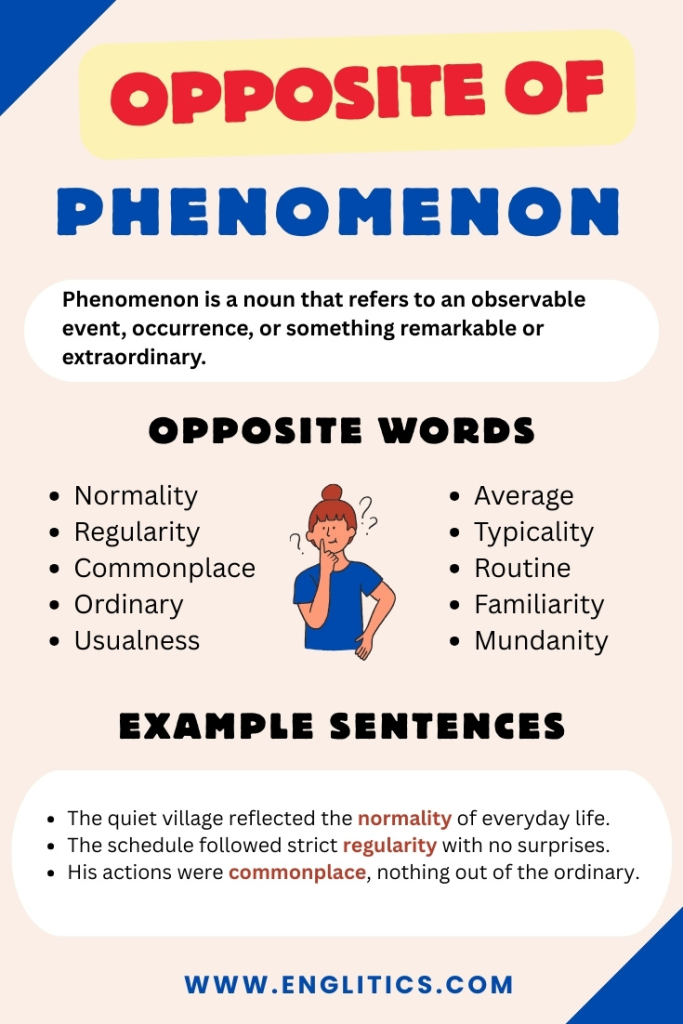
Finding direct antonyms for “phenomenon” is challenging because the word encompasses a broad range of meanings. The opposite of a phenomenon depends heavily on the specific context in which it is used.
However, several words and concepts can represent the absence of a phenomenon or its qualities of being unusual, remarkable, or unexplained. These include terms like “nonexistence,” “normality,” “regularity,” “predictability,” “commonplace,” “natural law,” and “absence.” Each of these words captures a different aspect of what a phenomenon is *not*.
Nonexistence
Definition and Nuances
Nonexistence refers to the state of not existing or not being present. This is perhaps the most direct opposite of a phenomenon, as a phenomenon, by definition, is something that exists and is observable. Nonexistence implies a complete lack of being, countering the very essence of what constitutes a phenomenon. It represents the absence of any observable event or fact.
Examples of Nonexistence
Consider the following examples to understand how “nonexistence” functions as an antonym for “phenomenon”:
| Context | Phenomenon | Antonym: Nonexistence |
|---|---|---|
| Scientific Discovery | The discovery of a new element. | The element’s nonexistence before its discovery. |
| Mythical Creatures | Sightings of the Loch Ness Monster. | The Loch Ness Monster’s probable nonexistence. |
| Medical Breakthrough | The emergence of a cure for a previously incurable disease. | The cure’s nonexistence prior to its development. |
| Technological Innovation | The invention of the smartphone. | The smartphone’s nonexistence before its invention. |
| Social Trend | The sudden popularity of a new fashion trend. | The fashion trend’s nonexistence before it became popular. |
| Economic Event | A sudden stock market crash. | The stock market crash’s nonexistence before it occurred. |
| Environmental Event | The appearance of a new species in an ecosystem. | The species’ nonexistence in that ecosystem prior to its arrival. |
| Political Event | The rise of a new political party. | The political party’s nonexistence before its formation. |
| Artistic Creation | The creation of a groundbreaking piece of art. | The artwork’s nonexistence before its creation. |
| Literary Work | The publication of a bestselling novel. | The novel’s nonexistence before it was written and published. |
| Historical Event | The fall of the Berlin Wall. | The fall of the Berlin Wall’s nonexistence before 1989. |
| Geological Event | The eruption of a dormant volcano. | The volcanic eruption’s nonexistence prior to the event. |
| Astronomical Event | The discovery of a new planet. | The planet’s nonexistence in our knowledge before its discovery. |
| Biological Event | The mutation leading to a new genetic trait. | The trait’s nonexistence before the mutation occurred. |
| Psychological Event | The emergence of a newly identified mental disorder. | The disorder’s nonexistence in diagnostic manuals before its identification. |
| Mathematical Concept | The proof of a previously unproven theorem. | The theorem’s nonexistence as a proven fact before the proof. |
| Linguistic Development | The introduction of a new word into a language. | The word’s nonexistence in the language before its adoption. |
| Culinary Innovation | The creation of a new dish or culinary technique. | The dish’s nonexistence before its invention. |
| Architectural Innovation | The construction of a building with a novel design. | The building’s nonexistence before its construction. |
| Musical Innovation | The creation of a new musical genre. | The genre’s nonexistence before its creation. |
| Educational Practice | The implementation of a new teaching method. | The teaching method’s nonexistence before its implementation. |
| Business Strategy | The introduction of a groundbreaking business model. | The business model’s nonexistence before its implementation. |
| Legal Precedent | The establishment of a new legal principle. | The legal principle’s nonexistence before its establishment. |
| Philosophical Idea | The formulation of a new philosophical concept. | The philosophical concept’s nonexistence before its formulation. |
Normality
Definition and Nuances
Normality refers to the state of being usual, typical, or expected. It stands in contrast to the unusual or remarkable nature of a phenomenon. When something is considered normal, it blends into the background of everyday occurrences, lacking the distinctive quality that defines a phenomenon. It represents the absence of surprise or deviation from the expected course of events.
Examples of Normality
The following examples illustrate how “normality” can be considered an antonym for “phenomenon”:
| Context | Phenomenon | Antonym: Normality |
|---|---|---|
| Weather Patterns | An unprecedented heatwave. | Normal seasonal temperature fluctuations. |
| Social Behavior | A sudden outbreak of mass hysteria. | Normal social interactions and customs. |
| Economic Trends | A sudden and unexpected economic boom. | Normal, steady economic growth. |
| Medical Conditions | The sudden appearance of a rare disease. | Normal health and absence of disease. |
| Technological Function | A revolutionary technological breakthrough. | The normal functioning of existing technology. |
| Environmental Conditions | An extremely rare solar eclipse. | Normal daylight hours. |
| Academic Performance | A student achieving a perfect score on an exceptionally difficult exam. | A student achieving average or expected grades. |
| Artistic Expression | A piece of art that sparks a global controversy. | Art that evokes typical emotional responses. |
| Culinary Arts | A dish containing an extraordinary ingredient. | A dish made with common ingredients. |
| Musical Composition | A song that becomes an unexpected global sensation. | A song that receives standard airplay. |
| Literary Achievement | A novel that wins multiple prestigious awards. | A novel that receives average reviews. |
| Sports Performance | A record-breaking athletic performance. | An athlete performing at their usual level. |
| Political Events | A landslide election victory. | A closely contested election. |
| Legal Cases | A landmark court decision that changes legal precedent. | A routine court case following established laws. |
| Scientific Research | A study that overturns established scientific theories. | A study that confirms existing scientific knowledge. |
| Business Operations | A company experiencing explosive, unprecedented growth. | A company maintaining stable, predictable growth. |
| Social Movements | A radical social movement that dramatically alters societal norms. | A gradual, incremental change in societal norms. |
| Educational Systems | An educational program that produces unusually high success rates. | An educational program with average success rates. |
| Architectural Designs | A building with a strikingly innovative and unique design. | A building with a conventional, familiar design. |
| Personal Experiences | An individual undergoing an exceptionally transformative experience. | An individual experiencing everyday routines. |
| Technological Advancements | A technology that revolutionizes an entire industry. | A technology that offers minor improvements. |
| Environmental Processes | A sudden and catastrophic natural disaster. | Normal, gradual geological processes. |
| Linguistic Changes | The rapid adoption of a new slang term. | The slow, gradual evolution of language. |
Regularity
Definition and Nuances
Regularity implies a consistent pattern or occurrence, often following a predictable schedule or sequence. This contrasts with the sporadic or unexpected nature of many phenomena. When something exhibits regularity, it loses the element of surprise and becomes part of the established order, making it less likely to be considered a phenomenon. This denotes events that are commonplace and expected.
Examples of Regularity
Here are examples demonstrating how “regularity” serves as an antonym for “phenomenon”:
| Context | Phenomenon | Antonym: Regularity |
|---|---|---|
| Celestial Events | A comet appearing unexpectedly in the night sky. | The regular orbit of the Earth around the sun. |
| Biological Processes | A sudden genetic mutation leading to a new species. | The regular cell division in living organisms. |
| Weather Patterns | An unprecedented hurricane season. | The regular cycle of seasons. |
| Social Events | A spontaneous protest erupting in response to a political event. | The regular occurrence of annual festivals. |
| Economic Activities | A stock market crash that defies all predictions. | The regular payment of salaries. |
| Technological Operations | A sudden and inexplicable system failure. | The regular software updates on a computer. |
| Physical Processes | A sudden earthquake in a previously stable region. | The regular cycle of tides. |
| Human Behavior | A sudden and unexpected act of heroism. | The regular routine of daily commutes. |
| Natural Events | The sudden appearance of bioluminescence in a lake. | The regular cycle of day and night. |
| Scientific Experiments | An experimental result that contradicts established theories. | The regular observation of expected results in an experiment. |
| Medical Symptoms | The sudden onset of a rare and unexplained illness. | The regular heartbeat of a healthy individual. |
| Legal Procedures | A legal verdict that sets an unexpected precedent. | The regular process of a court trial. |
| Educational Activities | A student suddenly demonstrating extraordinary talent in a specific subject. | The regular schedule of classes and homework. |
| Business Operations | A company experiencing a sudden, unexpected surge in sales. | The regular quarterly financial reports of a company. |
| Artistic Creations | A piece of art that causes an unexpected global sensation. | The regular production of artwork in a specific style. |
| Musical Performances | A musician improvising an entirely new and unexpected melody. | The regular performance of a classical symphony. |
| Literary Publications | A novel that introduces an entirely new genre of literature. | The regular publication of a monthly magazine. |
| Sports Competitions | An athlete breaking a world record by a significant margin. | The regular schedule of games in a sports league. |
| Architectural Designs | A building constructed with entirely new and unexpected materials. | The regular construction of houses using traditional materials. |
| Culinary Creations | A chef creating a dish with an entirely unexpected combination of flavors. | The regular preparation of a traditional meal. |
| Technological Innovations | A device that suddenly revolutionizes an entire industry. | The regular upgrades of software on a computer. |
| Social Trends | A sudden and unexpected shift in popular opinion. | The regular observation of consistent social behavior. |
| Philosophical Ideas | A philosophical concept that challenges all established beliefs. | The regular study of classical philosophical texts. |
Predictability
Definition and Nuances
Predictability refers to the ability to anticipate or foresee something with a reasonable degree of certainty. A key characteristic of a phenomenon is its often unexpected nature. Therefore, when an event is predictable, it loses the element of surprise and is less likely to be considered a phenomenon. The opposite of something that is unpredictable and unusual.
Examples of Predictability
The examples below show how “predictability” can function as an antonym for “phenomenon”:
| Context | Phenomenon | Antonym: Predictability |
|---|---|---|
| Weather Events | A sudden, unexpected tornado outbreak. | The predictable pattern of monsoon seasons. |
| Economic Trends | A sudden and unforeseen stock market crash. | The predictable growth of a stable economy. |
| Scientific Experiments | An experiment yielding completely unexpected results. | An experiment with highly predictable outcomes. |
| Technological Failures | A sudden and unexplainable system-wide outage. | The predictable maintenance schedule of a server. |
| Natural Disasters | An earthquake occurring in a region with no prior seismic activity. | The predictable eruption of a well-monitored volcano. |
| Social Behavior | A sudden and widespread panic in a crowd. | The predictable response to a fire alarm. |
| Political Events | A sudden and unexpected coup d’état. | The predictable results of a well-conducted election poll. |
| Medical Conditions | The sudden appearance of a previously unknown disease. | The predictable progression of the common cold. |
| Animal Behavior | The sudden and unexplained migration of a large animal population. | The predictable hibernation patterns of bears. |
| Plant Growth | The sudden appearance of an invasive species in a new environment. | The predictable growth rate of a tree species in its native habitat. |
| Artistic Creations | A piece of art that evokes a completely unexpected emotional response. | Art created using tried-and-true techniques. |
| Musical Performances | A musician who suddenly improvises an entirely new musical style. | A musician playing a well-rehearsed piece. |
| Literary Works | A novel that introduces an entirely new narrative structure. | A novel following a predictable plot line. |
| Sports Events | An underdog team unexpectedly winning a championship. | The predictable victory of a highly favored team. |
| Legal Proceedings | A court case that results in an entirely unanticipated verdict. | A court proceeding with a predictable outcome based on established precedent. |
| Educational Outcomes | A student suddenly demonstrating exceptional aptitude in a previously challenging subject. | A student achieving predictable results based on their study habits. |
| Business Ventures | A company experiencing entirely unexpected and explosive growth. | A business growing at a predictable rate based on market analysis. |
| Scientific Discoveries | A scientific experiment that yields entirely contradictory results. | A scientific experiment that confirms existing theories. |
| Technological Innovations | A new technology that has unforeseen consequences. | A technology with predictable applications and effects. |
| Social Trends | A sudden and unpredictable shift in social norms. | The predictable evolution of language over time. |
| Philosophical Arguments | A philosophical idea that challenges all existing assumptions. | A philosophical argument based on established principles. |
| Historical Events | A sudden and unexpected revolution. | The predictable transfer of power following an election. |
| Personal Relationships | A sudden and unexpected falling out between close friends. | The predictable stages of a long-term relationship. |
Commonplace
Definition and Nuances
Commonplace refers to something that is ordinary, unremarkable, and frequently encountered. It lacks the novelty or uniqueness that characterizes a phenomenon. A commonplace event is something that happens regularly and does not attract special attention or curiosity, setting it apart from the unusual or striking nature of a phenomenon. This is the idea of being mundane or ordinary.
Examples of Commonplace
Below are examples illustrating how “commonplace” acts as an antonym for “phenomenon”:
| Context | Phenomenon | Antonym: Commonplace |
|---|---|---|
| Daily Events | Witnessing a meteor shower. | Brushing your teeth every morning. |
| Natural Occurrences | Seeing the Northern Lights. | The sun rising in the east. |
| Social Interactions | A flash mob appearing in a public space. | Saying “hello” to a neighbor. |
| Technological Advancements | The invention of artificial intelligence. | Using a smartphone for basic communication. |
| Artistic Creations | A painting that sells for millions of dollars. | A mass-produced print. |
| Musical Performances | Attending a concert by a world-renowned musician. | Listening to the radio. |
| Literary Works | Reading a book that wins the Pulitzer Prize. | Reading a daily newspaper. |
| Sports Achievements | Watching an athlete break a world record. | Going for a daily jog. |
| Culinary Experiences | Eating at a Michelin-starred restaurant. | Making a sandwich at home. |
| Travel Experiences | Visiting a remote and exotic location. | Driving to work. |
| Scientific Discoveries | Discovering a new species of animal. | Conducting routine lab tests. |
| Medical Breakthroughs | Finding a cure for cancer. | Administering a flu shot. |
| Historical Events | The fall of the Berlin Wall. | A regular election cycle. |
| Political Decisions | A landmark Supreme Court ruling. | Passing a routine bill in Congress. |
| Economic Trends | A major stock market crash. | A steady rate of inflation. |
| Educational Achievements | Earning a PhD from a prestigious university. | Completing high school. |
| Business Ventures | Launching a wildly successful startup company. | Working a 9-to-5 job. |
| Personal Achievements | Climbing Mount Everest. | Walking the dog. |
| Technological Innovations | Developing a self-driving car. | Using a GPS to navigate. |
| Social Movements | A revolution that overthrows a government. | Voting in an election. |
| Philosophical Ideas | Formulating a groundbreaking philosophical theory. | Reading a popular self-help book. |
Natural Law
Definition and Nuances
Natural law refers to a principle or body of laws derived from nature and regarded as universally binding on all human actions. Phenomena often defy easy explanation or appear to contradict established understanding. Natural law, by contrast, represents the underlying order and predictability of the universe. This represents the order of nature.
Examples of Natural Law
The following examples illustrate how “natural law” functions as an antonym for “phenomenon”:
| Context | Phenomenon | Antonym: Natural Law |
|---|---|---|
| Physics | Quantum entanglement defying classical physics. | Newton’s law of universal gravitation. |
| Biology | Spontaneous generation of life (disproven). | The laws of Mendelian genetics. |
| Chemistry | An element behaving contrary to its predicted properties. | The periodic table of elements. |
| Meteorology | A rogue wave appearing out of nowhere. | The water cycle. |
| Astronomy | A black hole warping spacetime. | Kepler’s laws of planetary motion. |
| Geology | The sudden appearance of a new island. | The rock cycle. |
| Ecology | A species evolving at an unprecedented rate. | The food chain. |
| Medicine | A patient spontaneously recovering from a terminal illness. | The body’s immune response. |
| Psychology | A person exhibiting savant-like abilities. | The stages of cognitive development. |
| Sociology | A sudden and unexpected social movement. | The principles of social stratification. |
| Economics | A market crash defying all economic models. | The law of supply and demand. |
| Mathematics | A seemingly unsolvable mathematical paradox. | The Pythagorean theorem. |
| Computer Science | An AI program exhibiting consciousness. | Boolean algebra. |
| Engineering | A structure defying the laws of physics and remaining stable. | The principles of thermodynamics. |
| Art | A work of art that transcends all cultural boundaries. | The golden ratio. |
| Music | A piece of music that evokes a universal emotional response. | The harmonic series. |
| Literature | A story that resonates with all readers regardless of background. | The narrative arc. |
| Philosophy | A philosophical argument that challenges all fundamental beliefs. | The principles of logic. |
Absence
Definition and Nuances
Absence denotes the state of being away or not present. When a phenomenon is absent, it simply isn’t occurring or observable. This is a straightforward opposite, representing the lack of any event or occurrence that could be classified as a phenomenon. It signifies the non-occurrence of something that could potentially be observed.
Examples of Absence
Here are examples illustrating how “absence” can be an antonym for “phenomenon”:
| Context | Phenomenon | Antonym: Absence |
|---|---|---|
| Weather | A tornado touching down in a city center. | Absence of any severe weather. |
| Disease | An epidemic spreading rapidly through a population. | Absence of disease. |
| Conflict | A war breaking out between two nations. | Absence of conflict. |
| Innovation | A groundbreaking invention revolutionizing an industry. | Absence of innovation. |
| Social Unrest | A widespread protest movement sweeping the country. | Absence of social unrest. |
| Economic Boom | A period of rapid and sustained economic growth. | Absence of economic growth. |
| Environmental Event | A volcanic eruption spewing ash into the atmosphere. | Absence of volcanic activity. |
| Scientific Discovery | The discovery of a new fundamental particle. | Absence of new discoveries. |
| Artistic Expression | A piece of art sparking a global controversy. | Absence of artistic expression. |
| Technological Advancement | The development of artificial general intelligence. | Absence of technological advancement. |
| Political Change | A peaceful revolution overthrowing a dictatorship. | Absence of political change. |
| Natural Disaster | An earthquake devastating a major city. | Absence of natural disasters. |
| Personal Achievement | An individual achieving a remarkable feat of athleticism. | Absence of remarkable achievements. |
| Musical Performance | A concert that captivates a global audience. | Absence of musical performance. |
| Literary Work | A novel that wins multiple prestigious awards. | Absence of literary work. |
| Legal Precedent | A court case establishing a new legal principle. | Absence of new legal precedents. |
| Philosophical Idea | A philosophical concept challenging fundamental beliefs. | Absence of new philosophical ideas. |
Usage Rules and Considerations
When selecting an antonym for “phenomenon,” it is crucial to consider the specific context in which the word is used. The intended meaning of “phenomenon” can vary, so the antonym should directly contradict that specific meaning.
For instance, if “phenomenon” refers to an unusual event, “normality” or “regularity” might be appropriate antonyms. If it refers to something whose cause is unknown, “predictability” or “natural law” might be more suitable.
Always ensure the chosen antonym creates a clear and logical contrast.
Pay attention to the nuances of each potential antonym. “Nonexistence” is a strong, absolute opposite, implying a complete lack of being.
“Absence” suggests that something is not present but could potentially exist. “Normality” and “commonplace” emphasize the lack of uniqueness, while “regularity” and “predictability” focus on the absence of surprise.
The best choice will depend on the precise shade of meaning you wish to convey.
Common Mistakes
One common mistake is to choose an antonym that is too broad or general. For example, using “ordinary” as an antonym for “phenomenon” might be accurate in some contexts, but it lacks the precision of “normality
” or “regularity” when referring to events that are typically unusual.
Another mistake is failing to consider the specific aspect of the phenomenon being discussed. Using “nonexistence” as an antonym might be technically correct but less informative than “predictability” when the key aspect of the phenomenon is its unexpectedness.
Always ensure the chosen antonym directly addresses the core characteristic you are contrasting.
Practice Exercises
Test your understanding of antonyms for “phenomenon” with these exercises. For each sentence, choose the best antonym from the provided options.
1. The sudden rise in the popularity of vintage clothing was a cultural __________, contrasting with the __________ of fast fashion.
Options: (a) phenomenon, regularity (b) phenomenon, commonplace (c) normality, phenomenon (d) regularity, phenomenon
Answer: (b) phenomenon, commonplace
2. The __________ of the Loch Ness Monster stands in stark contrast to its persistent __________, despite numerous searches.
Options: (a) normality, phenomenon (b) phenomenon, nonexistence (c) regularity, absence (d) nonexistence, phenomenon
Answer: (b) phenomenon, nonexistence
3. While the scientist hoped for a groundbreaking discovery, the experiment yielded only __________, highlighting the need for a new approach.
Options: (a) predictability (b) phenomenon (c) regularity (d) absence
Answer: (a) predictability
4. The __________ of major earthquakes in this region is reassuring, compared to areas where such events are a devastating __________.
Options: (a) absence, phenomenon (b) normality, regularity (c) regularity, phenomenon (d) phenomenon, absence
Answer: (a) absence, phenomenon
5. The __________ of the seasons provides a sense of comfort, contrasting with the unpredictable __________ of extreme weather events.
Options: (a) phenomenon, regularity (b) normality, absence (c) absence, phenomenon (d) regularity, phenomenon
Answer: (d) regularity, phenomenon
Advanced Topics
For more advanced learners, consider exploring the philosophical implications of phenomena and their antonyms. Delve into the concept of “noumenon,” which, in Kantian philosophy, refers to things as they are in themselves, unknowable to us, in contrast to phenomena, which are appearances.
Research the role of perception in defining what constitutes a phenomenon and how different perspectives can alter our understanding of what is considered normal, regular, or predictable. Explore the relationship between phenomena and scientific revolutions, where paradigm shifts often involve re-evaluating what was once considered commonplace.
FAQ
Q: Can “nothing” be considered an antonym for “phenomenon?”
A: While “nothing” is a very general term for nonexistence, it can be considered an antonym in the most absolute sense. However, “nonexistence” is more precise as it directly implies the lack of being of something that could potentially exist or be observed.
Q: Is “common sense” an antonym for “phenomenon?”
A: Not directly, but in some contexts, it can be related. “Common sense” implies an understanding based on everyday experience and knowledge, contrasting with a phenomenon that might defy such understanding or be outside the realm of typical experience.
Q: How do cultural differences affect what is considered a phenomenon?
A: Cultural differences significantly influence what is considered a phenomenon. What is unusual or remarkable in one culture might be commonplace in another.
Social norms, traditions, and beliefs shape our perception of events, determining whether they stand out as phenomena or blend into the background of everyday life.
Conclusion
Understanding the antonyms for “phenomenon” enriches your vocabulary and improves your ability to communicate with precision and nuance. By considering the various aspects of what a phenomenon is *not*, you gain a deeper appreciation for its meaning and significance.
Whether you choose “nonexistence,” “normality,” “regularity,” “predictability,” “commonplace,” “natural law,” or “absence,” remember to select the antonym that best fits the specific context and the intended meaning. This exploration not only expands your linguistic skills but also enhances your critical thinking and analytical abilities.