The opposite of venture is to stay safe, avoid risks, or hold back from taking action. While venture means stepping into something new, risky, or uncertain—like starting a business or exploring the unknown—its opposites reflect caution and hesitation.
Antonyms for venture include words like avoid, hesitate, retreat, withdraw, and stay. These words are useful when describing people who choose not to take chances or prefer familiar ground over bold moves. In this article, you’ll see how these opposite words are used in real-life examples, from decision-making to everyday conversations.
Definition of “Venture”
The word “venture” carries a multifaceted meaning, generally referring to an undertaking involving uncertainty, risk, or danger. It can be used as a noun or a verb, each with slightly different connotations.
As a noun, “venture” signifies a risky or daring journey or undertaking. It often implies the possibility of both success and failure, with the potential for significant gain or loss. For example, “Starting a new business is a risky venture.”
As a verb, “venture” means to dare to do something or go somewhere that may be dangerous or unpleasant. It can also mean to offer something, such as an opinion or idea, tentatively. For example, “I ventured out into the storm” or “She ventured a suggestion.”
The core concept behind “venture” is the willingness to step outside one’s comfort zone and embrace the unknown, despite the potential negative consequences. Understanding this inherent risk is essential to grasping its antonyms.
Structural Breakdown of “Venture”
The word “venture” originates from the Old French word “aventure,” which in turn comes from the Latin “adventura,” meaning “that which is to happen.” This etymological root highlights the element of chance and unpredictability associated with the word.
Grammatically, “venture” can function as both a transitive and intransitive verb. As a transitive verb, it takes a direct object (e.g., “He ventured his opinion”).
As an intransitive verb, it does not (e.g., “They ventured into the forest”).
The noun form of “venture” is typically used to describe the undertaking itself, while the verb form describes the act of undertaking it. The word’s versatility allows it to be used in a wide range of contexts, from business and finance to personal adventures and intellectual pursuits.
Opposite of Venture
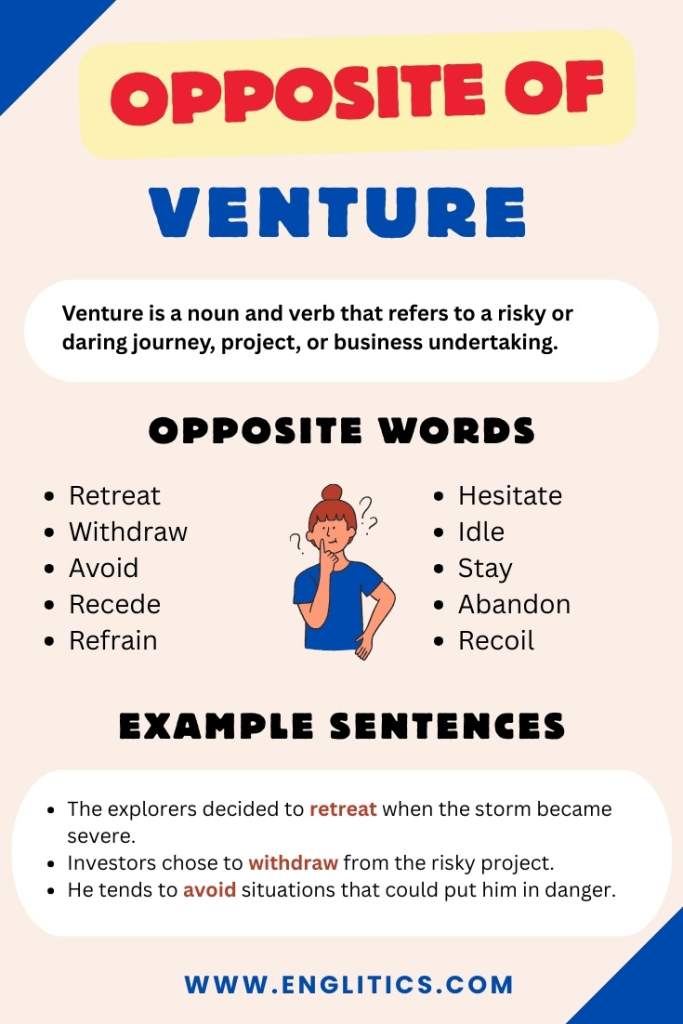
The antonyms of “venture” can be categorized based on the different aspects of risk and uncertainty they negate. These categories include caution, security, retreat, and failure.
Caution and Hesitation
This category encompasses words that suggest a careful and considered approach, avoiding unnecessary risks. Antonyms in this category emphasize prudence and forethought.
Security and Safety
This category focuses on words that highlight the absence of risk and the presence of protection. These antonyms emphasize stability, reliability, and freedom from danger.
Retreat and Withdrawal
This category includes words that describe the act of backing away from a potentially risky situation. These antonyms emphasize avoidance and the abandonment of an undertaking.
Failure and Inaction
This category encompasses words that suggest a lack of success or a refusal to act. These antonyms emphasize the opposite of initiative and accomplishment.
Examples of Antonyms in Sentences
To fully understand the nuances of the antonyms of “venture,” it’s crucial to see them in context. The following tables provide examples of each category in sentences, demonstrating how they contrast with the meaning of “venture.”
Caution and Hesitation Examples
The following table provides examples of words related to caution and hesitation, showing how they contrast with the meaning of “venture.” Each sentence highlights a situation where careful consideration and risk aversion are prioritized over bold action.
| Antonym | Example Sentence |
|---|---|
| Caution | He proceeded with caution, carefully analyzing each step before making a move, unlike a reckless venture. |
| Prudence | Prudence dictated that they wait for better weather conditions before attempting the climb, a decision contrary to a hasty venture. |
| Circumspection | Her circumspection in financial matters prevented her from investing in the speculative venture. |
| Hesitation | After a moment of hesitation, she decided not to jump off the cliff, unlike those who eagerly venture into the unknown. |
| Wariness | His wariness of strangers kept him from trusting the seemingly friendly venture capitalist. |
| Deliberation | After much deliberation, the committee decided against funding the risky venture. |
| Foresight | Her foresight allowed her to anticipate the potential problems with the venture and avoid them. |
| Carefulness | The technician’s carefulness ensured that the experiment was conducted safely, unlike a haphazard venture. |
| Discretion | Discretion led him to keep his opinions to himself, rather than venturing into a controversial discussion. |
| Prudishness | Her prudishness prevented her from venturing into the world of modern art. |
| Timidity | His timidity kept him from venturing to speak up in the meeting. |
| Reluctance | Her reluctance to try new things was the opposite of a spirit ready to venture. |
| Aversion | His aversion to risk made him unsuitable for any kind of venture capital. |
| Apprehension | She felt apprehension about the project, rather than eagerly venturing forward. |
| Doubt | He was filled with doubt, preventing him from venturing into the new business. |
| Distrust | His distrust of the company kept him from venturing into a partnership. |
| Skepticism | Her skepticism about the plan stopped her from venturing any resources. |
| Suspicion | His suspicion towards the offer made him reluctant to venture any further. |
| Vigilance | Their vigilance in monitoring the situation was the opposite of blindly venturing forward. |
| Watchfulness | Her watchfulness over her investments was a stark contrast to a reckless venture. |
| Conservatism | His conservatism in financial matters kept him from venturing into high-risk investments. |
| Moderation | He approached the task with moderation, avoiding the extremes of a hasty venture. |
| Restraint | Her restraint in expressing her opinions kept her from venturing into arguments. |
| Inhibition | His inhibition to try new foods was the opposite of a culinary venture. |
| Shyness | Her shyness prevented her from venturing onto the stage. |
| Bashfulness | His bashfulness kept him from venturing to ask her out. |
Security and Safety Examples
This table demonstrates antonyms related to security and safety. The sentences highlight situations where protection and stability are paramount, contrasting with the uncertain nature of a “venture.”
| Antonym | Example Sentence |
|---|---|
| Security | He valued the security of his stable job over the uncertainty of a new venture. |
| Safety | The hikers prioritized safety by staying on the marked trails, avoiding any risky venture into the unknown. |
| Protection | The insurance policy offered protection against financial losses, a safeguard against a failed venture. |
| Certainty | She preferred the certainty of a fixed income to the unpredictable nature of a business venture. |
| Assurance | The warranty provided assurance that the product would be repaired or replaced, minimizing the risk of a venture. |
| Stability | He sought stability in his career, avoiding the volatile world of entrepreneurial ventures. |
| Reliability | The old car offered reliability, a contrast to the uncertain venture of buying a new, untested model. |
| Dependability | Her dependability made her a valuable asset, someone who provided reassurance rather than initiating risky ventures. |
| Safeguard | The company implemented a safeguard to prevent data breaches, ensuring a secure environment rather than a vulnerable venture. |
| Defense | The strong defense system protected the city from attack, providing a sense of security rather than a risky venture into war. |
| Harbor | The city’s harbor provided a safe haven for boats, a place of refuge rather than a dangerous venture out to sea. |
| Refuge | The old house was a refuge for the weary traveler, a place of rest rather than a challenging venture into the wilderness. |
| Sanctuary | The church was a sanctuary for the troubled soul, offering peace and comfort rather than a turbulent venture into the unknown. |
| Preservation | Their focus was on preservation of the environment, avoiding any ventures that could cause harm. |
| Conservation | The organization’s mission was conservation, protecting natural resources rather than exploiting them through risky ventures. |
| Fortification | The fortification of the castle made it impenetrable, providing security rather than inviting a risky venture. |
| Reinforcement | The reinforcement of the bridge ensured its stability, avoiding the potential for a dangerous collapse, unlike an unsafe venture. |
| Support | The family provided support for each other, creating a stable foundation rather than embarking on solitary ventures. |
| Foundation | The strong foundation of the building ensured its longevity, a contrast to the unstable nature of a speculative venture. |
| Base | The military base provided a secure location for operations, a place of safety rather than a dangerous venture into enemy territory. |
| Bulwark | The seawall acted as a bulwark against the storm, protecting the city from the destructive forces of nature, unlike a vulnerable venture. |
| Custody | The children were placed in the custody of their grandparents, ensuring their safety and well-being, rather than being subjected to a risky venture. |
| Guardianship | Under the guardianship of her aunt, she felt secure and protected, avoiding the need to venture out on her own. |
| Shelter | The cave provided shelter from the storm, a place of safety rather than a dangerous venture into the open. |
| Haven | The library was a haven for book lovers, a place of quiet contemplation rather than a chaotic venture into the outside world. |
Retreat and Withdrawal Examples
The following table provides examples of words related to retreat and withdrawal, showing how they contrast with the meaning of “venture.” Each sentence highlights a situation where avoiding risk or abandoning an undertaking takes precedence.
| Antonym | Example Sentence |
|---|---|
| Retreat | Faced with overwhelming opposition, the army decided to retreat, abandoning their venture into enemy territory. |
| Withdrawal | After careful consideration, the company announced the withdrawal of its investment in the risky venture. |
| Recession | Due to the economic recession, many businesses were forced to scale back their ventures. |
| Regression | The project experienced a regression, moving backward instead of venturing forward. |
| Resignation | He submitted his resignation, effectively ending his venture with the company. |
| Abandonment | The abandonment of the ship was a necessary precaution, ending the ill-fated venture. |
| Relinquishment | The relinquishment of his claim marked the end of his venture to acquire the land. |
| Cessation | The cessation of hostilities brought an end to the military venture. |
| Termination | The termination of the contract signaled the end of the business venture. |
| Discontinuation | The discontinuation of the program was a result of its lack of success as a venture. |
| Departure | His sudden departure from the team signaled the end of his involvement in the venture. |
| Evacuation | The evacuation of the city was necessary to avoid further casualties, abandoning the venture to defend it. |
| Flight | Their flight from the scene was an act of self-preservation, abandoning the venture they had started. |
| Evasion | His evasion of the question suggested he was avoiding a risky venture. |
| Escape | Their escape from the prison was a daring act, but it also meant abandoning the original venture they were imprisoned for. |
| Backtracking | Backtracking on their initial plans, they decided to avoid the risky venture altogether. |
| Cancellation | The cancellation of the event was a necessary precaution due to the impending storm, halting the venture. |
| Abrogation | The abrogation of the treaty ended the joint venture between the two nations. |
| Revocation | The revocation of his license put an end to his venture as a lawyer. |
| Nullification | The nullification of the agreement rendered the venture invalid. |
| Repeal | The repeal of the law effectively ended the government’s venture into that sector. |
| Reversal | The reversal of the decision meant that the project would no longer be pursued as a venture. |
| Recantation | His recantation of his earlier statements marked the end of his venture into political activism. |
| Retraction | The retraction of the article meant that the author was no longer venturing into that controversial topic. |
| Withdraw | After careful consideration, he decided to withdraw his application, abandoning his venture into the new career. |
Failure and Inaction Examples
This table showcases antonyms related to failure and inaction, contrasting with the proactive and potentially successful nature of a “venture.” The sentences highlight situations where success is absent, or action is avoided altogether.
| Antonym | Example Sentence |
|---|---|
| Failure | The business failure was a devastating blow after investing so much in the venture. |
| Inaction | His inaction allowed the opportunity to pass, a stark contrast to someone who would venture boldly. |
| Defeat | The team suffered a crushing defeat, ending their venture to win the championship. |
| Collapse | The market collapse led to the failure of numerous financial ventures. |
| Stagnation | The company’s stagnation was a result of its unwillingness to venture into new markets. |
| Idleness | His idleness prevented him from achieving anything, the opposite of someone actively pursuing a venture. |
| Passivity | Her passivity in the face of injustice was a contrast to those who venture to speak out. |
| Inactivity | His inactivity during the crisis allowed the situation to worsen, unlike someone who would venture to take charge. |
| Incompetence | The project’s incompetence led to its ultimate failure as a venture. |
| Ineptitude | His ineptitude in handling the situation caused the venture to fall apart. |
| Impotence | Their impotence to solve the problem highlighted the futility of the venture. |
| Inability | His inability to adapt to the changing circumstances led to the venture’s demise. |
| Incapacity | Her incapacity to lead the team resulted in the failure of the venture. |
| Deficiency | The deficiency in planning caused the venture to fail. |
| Shortcoming | The project’s main shortcoming was a lack of funding, leading to the failure of the venture. |
| Flaw | A critical flaw in the design caused the venture to collapse. |
| Imperfectness | The imperfectness of the system led to the failure of the venture. |
| Futility | The futility of the effort became apparent, making the venture seem pointless. |
| Worthlessness | The worthlessness of the investment became clear after the venture failed. |
| Insignificance | The insignificance of the results made the venture seem like a waste of time. |
| Unproductiveness | The unproductiveness of the land made farming it a failed venture. |
| Sterility | The sterility of the soil prevented any crops from growing, making the venture fruitless. |
| Barrenness | The barrenness of the desert made it impossible to sustain any life, rendering any venture there futile. |
| Fruitlessness | The fruitlessness of the search became apparent after weeks of searching, ending the venture. |
| Abort | They had to abort the mission due to unforeseen circumstances, ending the venture prematurely. |
Usage Rules for Antonyms of “Venture”
When using antonyms of “venture,” it’s crucial to consider the specific context and the intended meaning. The choice of antonym should accurately reflect the opposite of the risk, uncertainty, or daring associated with the original word.
- Caution vs. Security: Use “caution” when emphasizing a deliberate avoidance of risk, and “security” when highlighting the presence of protection or stability.
- Retreat vs. Failure: Use “retreat” when describing the act of backing away from a risk, and “failure” when emphasizing the lack of success.
- Context is Key: Pay close attention to the surrounding words and phrases to ensure that the antonym accurately conveys the intended meaning.
For example, instead of saying “He didn’t venture,” you could say “He exercised caution” or “He sought security,” depending on the specific situation you want to describe. Choosing the right antonym will make your writing more precise and impactful.
Common Mistakes When Using Antonyms
One common mistake is using a synonym instead of an antonym. For example, using “experiment” instead of “caution” when trying to convey the opposite of “venture.” Another mistake is choosing an antonym that doesn’t fit the context.
For instance, using “failure” when you mean “retreat.”
Here are some examples of correct and incorrect usage:
| Incorrect | Correct | Explanation |
|---|---|---|
| He ventured to stay home. | He chose to stay home for security. | “Security” better conveys the opposite of taking a risk. |
| She ventured caution. | She exercised caution. | “Exercised caution” is the correct phrase. |
| They ventured defeat. | They suffered defeat. | “Suffered defeat” is the correct phrasing, showing a lack of success. |
| He ventured retreat. | He ordered a retreat. | “Ordered a retreat” accurately describes the act of backing away. |
Always double-check your antonym choices to ensure they accurately reflect the intended meaning and fit the context of your sentence.
Practice Exercises
Test your understanding of the antonyms of “venture” with the following exercises. Fill in the blanks with the most appropriate antonym from the word bank provided.
Word Bank: caution, security, retreat, failure, prudence, stability, inaction, withdrawal
| Question | Answer |
|---|---|
| 1. Instead of taking a risky _____, they opted for a more conservative approach. | venture |
| 2. His ______ in the face of danger was admirable, a stark contrast to someone who would venture recklessly. | caution |
| 3. The company prioritized ______ over potential profits, avoiding any speculative ventures. | security |
| 4. Seeing the approaching storm, they made the difficult decision to ______. | retreat |
| 5. The project ended in complete ______, despite their initial high hopes for the venture. | failure |
| 6. ______ dictated that they wait for more favorable market conditions before launching the new product. | Prudence |
| 7. He valued the ______ of his long-term investments over the potential gains of a risky venture. | stability |
| 8. His ______ allowed the opportunity to pass him by, the opposite of seizing the moment with a bold venture. | inaction |
| 9. The ______ of funding forced them to abandon the ambitious venture. | withdrawal |
| 10. Instead of a daring venture, she showed ____, carefully considering the risks before proceeding. | caution |
Exercise 2: Choose the best antonym for “venture” in the following sentences.
| Question | Options | Answer |
|---|---|---|
| 1. Instead of venturing into the unknown, he preferred the ______ of his routine. | a) chaos b) security c) adventure | b) security |
| 2. Faced with mounting losses, they decided to ______ from the project. | a) persist b) retreat c) advance | b) retreat |
| 3. The ______ of the business was a harsh lesson after their initial enthusiasm for the venture. | a) success b) failure c) growth | b) failure |
| 4. She approached the situation with ______, carefully weighing the pros and cons before acting. | a) recklessness b) caution c) impulsivity | b) caution |
| 5. Instead of a risky venture, he sought ______, investing in government bonds. | a) volatility b) stability c) uncertainty | b) stability |
| 6. His ______ prevented him from taking any chances, unlike someone who would venture boldly. | a) initiative b) inaction c) enthusiasm | b) inaction |
| 7. The ______ of support forced them to abandon the ambitious venture. | a) influx b) withdrawal c) provision | b) withdrawal |
| 8. Instead of a daring venture, she displayed ______, carefully considering the potential consequences. | a) recklessness b) caution c) impulsivity | b) caution |
| 9. She valued the ______ of her long-term investments, avoiding any speculative ventures. | a) risk b) security c) uncertainty | b) security |
| 10. His ______ allowed the opportunity to pass him by, unlike someone actively pursuing a venture. | a) determination b) action c) passivity | c) passivity |
Advanced Topics: Nuances and Context
The choice of antonym for “venture” can be highly nuanced and context-dependent. Consider the specific connotations of “venture” that you want to negate.
Are you emphasizing the risk, the uncertainty, or the daring aspect? The most appropriate antonym will depend on this focus.
For example, if you want to emphasize the lack of risk, “security” or “safety” might be the best choice. If you want to emphasize the avoidance of action, “inaction” or “passivity” might be more appropriate.
Understanding these subtle differences will allow you to use antonyms with greater precision and effectiveness.
Furthermore, the level of formality can also influence your choice of antonym. In a formal context, words like “prudence” and “circumspection” might be more suitable, while in an informal context, words like “caution” and “wariness” might be preferred.
Frequently Asked Questions
- What is the difference between “caution” and “prudence” as antonyms of “venture”?“Caution” implies a general awareness of potential danger, while “prudence” suggests a more thoughtful and considered approach to avoiding risk. “Prudence” often involves careful planning and foresight, while “caution” can be a more instinctive reaction.
- When is it appropriate to use “retreat” as an antonym of “venture”?“Retreat” is appropriate when describing the act of backing away from a potentially risky situation or abandoning an undertaking due to unforeseen circumstances or overwhelming opposition. It implies a strategic withdrawal rather than a complete failure.
- How does “inaction” differ from “failure” as an antonym of “venture”?“Inaction” refers to the absence of action or initiative, while “failure” implies a lack of success despite effort. “Inaction” suggests a missed opportunity, while “failure” indicates a negative outcome.
- Can “security” be used in all contexts as an antonym of “venture”?While “security” is a common antonym of “venture,” it is not always appropriate. It is best used when emphasizing the presence of protection, stability, or freedom from danger. In contexts where the focus is on avoiding action, “caution” or “inaction” might be more suitable.
- Are there any situations where “venture” doesn’t have a direct antonym?Yes, in some contexts, “venture” may not have a single, perfect antonym. In these cases, it may be necessary to use a phrase or combination of words to convey the opposite meaning. For example, instead of a single word, you might say “avoiding all risks and uncertainties.”
- Is “safety” always the best antonym for “venture”?No, while “safety” is a good antonym for “venture” when discussing physical danger or security, it might not be the most appropriate in other contexts. For example, when discussing financial ventures, “stability” or “security” might be more precise. In intellectual or creative ventures, “conformity” or “conventionality” might be better antonyms to highlight the lack of risk-taking or originality.
- How do cultural differences affect the understanding of “venture” and its antonyms?Cultural attitudes toward risk-taking can influence the perception of “venture” and its antonyms. In some cultures, risk-taking is highly valued, while in others, caution and security are more emphasized. This can affect the connotations associated with both “venture” and its antonyms, making it important to be aware of cultural context when using these words.
- What are some less common but still valid antonyms for “venture”?Some less common antonyms for “venture” include “complacency,” “stasis,” “acquiescence,” and “submission.” These words emphasize a lack of initiative, a state of inactivity, or a willingness to accept things as they are, rather than taking risks or challenging the status quo.
Conclusion
Mastering the antonyms of “venture” is a valuable step towards expanding your English vocabulary and improving your communication skills. By understanding the nuances of words like caution, security, retreat, and failure, you can express a wider range of meanings and convey your ideas with greater precision.
Remember to consider the context and intended meaning when choosing an antonym, and practice using these words in your writing and speaking.
The ability to articulate the opposite of “venture” not only enhances your vocabulary but also sharpens your critical thinking. Recognizing the spectrum of choices – from bold action to careful deliberation – allows for more informed decision-making and a deeper understanding of the situations we encounter.
Continue to explore the rich landscape of the English language, and you will find endless opportunities to refine your skills and express yourself with confidence.