Slander refers to false and damaging spoken statements made to harm someone’s reputation. It’s rooted in deceit, malice, and verbal attacks. But when the goal is honesty, praise, or respectful speech, the opposite of slander becomes relevant. Antonyms for slander help express truthfulness, integrity, and positive communication.
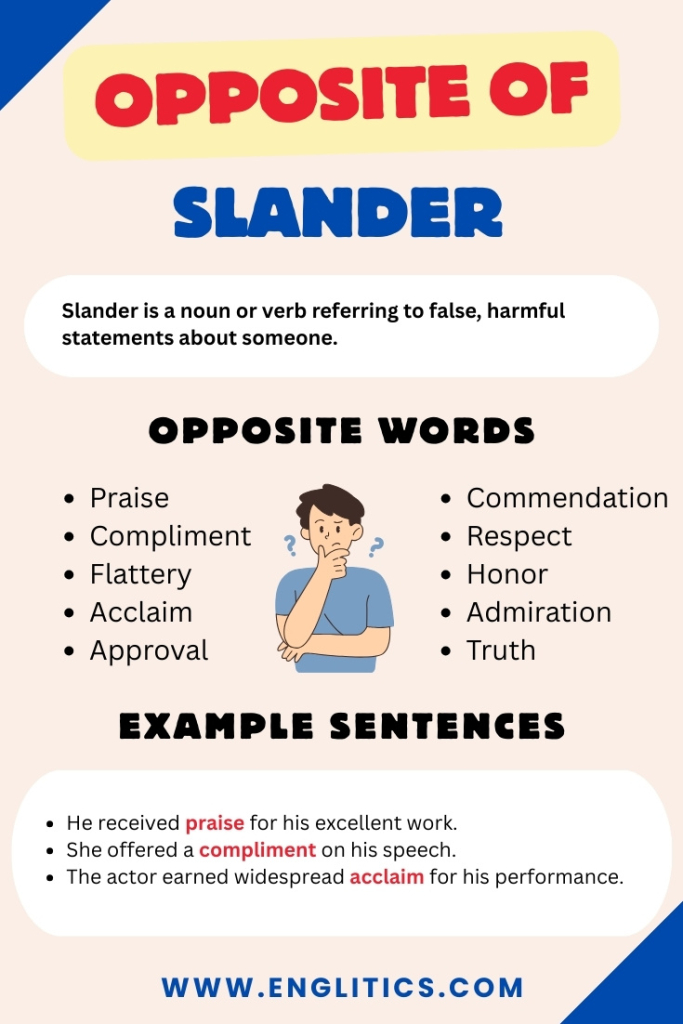
The opposite of slander includes words like praise, compliment, honor, truth, and defend. While praise and compliment uplift others, truth and defend focus on integrity and protection from false claims. These antonyms are useful in legal, social, and personal contexts where character and credibility matter.
Table of Contents
- Introduction
- Definition of Slander
- Structural Breakdown of Slander
- Types of Antonyms for Slander
- Examples of Antonyms for Slander
- Usage Rules for Antonyms of Slander
- Common Mistakes in Using Antonyms of Slander
- Practice Exercises
- Advanced Topics: Nuances and Context
- FAQ: Frequently Asked Questions
- Conclusion
Definition of Slander
Slander is a legal term referring to the oral communication of false and defamatory statements that harm a person’s reputation. It is a form of defamation, which also includes libel (written defamation). The key elements of slander are that the statement must be false, communicated to a third party, and cause harm to the person being spoken about. Slander often involves malicious intent, aiming to damage the target’s standing in the community, profession, or personal life.
Understanding what constitutes slander is crucial before exploring its antonyms. The legal definition often varies by jurisdiction, but the core principle remains the same: it’s about untrue statements that damage someone’s reputation.
It is important to note that truth is an absolute defense against a claim of slander. If a statement, even if damaging, is true, it cannot be considered slander.
Structural Breakdown of Slander
The structure of a slanderous statement typically involves a subject (the person being slandered), a verb (the slanderous statement itself), and an audience (the person or people hearing the statement). The statement must be presented as a fact, not an opinion, and it must be demonstrably false.
The damage caused by the statement is a crucial element for a successful slander claim.
The legal framework surrounding slander focuses on intent, publication, and harm. Intent refers to the speaker’s state of mind—whether they knew the statement was false or acted with reckless disregard for the truth. Publication means the statement was communicated to at least one other person. Harm refers to the actual damage caused to the victim’s reputation, which can include loss of business, social standing, or emotional distress.
Types of Antonyms for Slander
Antonyms for slander can be categorized into several types, each representing a different aspect of truth, honesty, and reputation protection.
Truthfulness and Accuracy
These antonyms focus on the factual correctness of statements. They emphasize the absence of falsehood and the presence of verifiable information.
These include words like “truth,” “accuracy,” “veracity,” and “factuality.”
Praise and Commendation
These antonyms involve positive statements about someone’s character or actions, the opposite of damaging someone’s reputation. Examples include “compliment,” “acclaim,” “commendation,” and “eulogy.”
Protection and Defense
These antonyms refer to actions taken to safeguard someone’s reputation or defend them against false accusations. Examples include “vindication,” “exoneration,” “rehabilitation,” and “defense.”
Honesty and Integrity
These antonyms highlight moral qualities that counteract the malicious intent behind slander. Examples include “integrity,” “honesty,” “candor,” and “sincerity.”
Examples of Antonyms for Slander
To fully understand the antonyms of slander, it’s essential to see them in context. The following tables provide examples of how these antonyms can be used in sentences, demonstrating their contrasting meaning to slander.
Examples of Truthfulness and Accuracy
This table illustrates how antonyms related to truthfulness and accuracy directly oppose the nature of slander, which is based on falsehoods.
| Slanderous Statement | Antonym Example |
|---|---|
| “John is a thief who stole money from the company.” | “The truth is that John was framed and the money was never missing.” |
| “She’s incompetent and always makes mistakes.” | “The accuracy of her work is impeccable; she’s known for her attention to detail.” |
| “He’s a liar and cannot be trusted.” | “His veracity is unquestionable; he always tells the truth.” |
| “They falsified the documents to cover up their crimes.” | “The factuality of the report was confirmed by independent auditors.” |
| “She is known for spreading rumors and gossip.” | “She is known for her commitment to truth and factual reporting.” |
| “He is a cheat and a fraud.” | “He always operates with accuracy and transparency.” |
| “They distorted the facts to mislead the public.” | “They presented the information with complete veracity.” |
| “She deliberately misrepresented the situation.” | “She ensured the factuality of her statements before speaking.” |
| “He fabricated evidence to incriminate his rival.” | “He presented the truth, supported by solid evidence.” |
| “She engaged in deceptive practices to gain an advantage.” | “She maintained accuracy in all her dealings.” |
| “He spread misinformation to discredit his opponent.” | “He focused on presenting the veracity of his own accomplishments.” |
| “She twisted the facts to suit her agenda.” | “She relied on the factuality of the evidence to support her claims.” |
| “He concocted a false narrative to ruin her reputation.” | “He dedicated himself to uncovering the truth.” |
| “She embellished the story to make it more sensational.” | “She adhered strictly to accuracy in her reporting.” |
| “He exaggerated the flaws in the product to discourage sales.” | “He objectively assessed the product with complete veracity.” |
| “She manipulated the data to achieve the desired outcome.” | “She ensured the factuality of the data before drawing conclusions.” |
| “He created a false impression to deceive investors.” | “He presented the truth about the investment risks.” |
| “She misrepresented her qualifications to secure the job.” | “She provided an accurate account of her skills and experience.” |
| “He twisted the words of his critics to make them sound unreasonable.” | “He quoted his critics with complete veracity.” |
| “She fabricated a scandal to undermine his campaign.” | “She focused on delivering the truth about her own policies.” |
| “He spread lies about her personal life to damage her credibility.” | “He maintained accuracy in all public statements, avoiding personal attacks.” |
| “She distorted the historical record to support her political views.” | “She relied on the veracity of historical evidence to make her case.” |
| “He invented a conspiracy theory to explain the event.” | “He based his explanation on the factuality of the available information.” |
Examples of Praise and Commendation
This table shows how positive statements and commendations counteract the negative impact of slander by highlighting positive qualities and achievements.
| Slanderous Statement | Antonym Example |
|---|---|
| “He’s lazy and never contributes to the team.” | “We compliment John on his hard work and dedication.” |
| “She’s a terrible leader who makes poor decisions.” | “The team acclaims her leadership skills and strategic vision.” |
| “He’s dishonest and cannot be trusted.” | “We offer our commendation for his integrity and ethical behavior.” |
| “She was a failure and never achieved anything significant.” | “Her eulogy highlighted her many accomplishments and positive impact.” |
| “He’s a disgrace to the profession.” | “He deserves praise for his contributions to the field.” |
| “She’s incompetent and unreliable.” | “We commend her competence and dependability.” |
| “He’s a failure as a parent.” | “He is acclaimed for his dedication to his children.” |
| “She’s a bad influence on others.” | “She is praised for her positive impact on the community.” |
| “He’s a poor performer who doesn’t meet expectations.” | “He receives commendation for consistently exceeding expectations.” |
| “She’s a disappointment to her family.” | “Her family offers praise for her achievements and character.” |
| “He’s a burden to society.” | “He is acclaimed for his contributions to society.” |
| “She’s a negative force in the workplace.” | “She receives commendation for her positive attitude and teamwork.” |
| “He’s a useless member of the community.” | “He is praised for his active involvement in community service.” |
| “She’s a hindrance to progress.” | “She is acclaimed for her innovative ideas and forward-thinking approach.” |
| “He’s a liability to the company.” | “He is commended for his reliability and commitment to the company’s success.” |
| “She’s a source of constant problems.” | “She is praised for her problem-solving skills and positive attitude.” |
| “He’s a drain on resources.” | “He is acclaimed for his efficient use of resources and cost-saving measures.” |
| “She’s a cause of conflict.” | “She receives commendation for her conflict-resolution skills and ability to mediate disputes.” |
| “He’s a source of embarrassment.” | “He is praised for his professionalism and dignified behavior.” |
| “She’s a constant source of stress.” | “She is acclaimed for her calming presence and ability to handle stressful situations.” |
| “He’s a roadblock to success.” | “He receives commendation for his ability to overcome obstacles and achieve success.” |
| “She’s a threat to the organization.” | “She is praised for her loyalty and commitment to the organization’s goals.” |
| “He’s a risk to the project.” | “He is acclaimed for his careful planning and risk-management skills.” |
| “She’s a danger to the public.” | “She is praised for her dedication to public safety and service.” |
Examples of Protection and Defense
This table illustrates how actions taken to protect or defend someone against false accusations serve as antonyms to slander.
| Slanderous Statement | Antonym Example |
|---|---|
| “He embezzled funds from the charity.” | “The investigation led to his vindication; he was innocent.” |
| “She was guilty of the crime.” | “She was completely exonerated after new evidence surfaced.” |
| “His reputation is ruined forever.” | “He underwent a period of rehabilitation and regained public trust.” |
| “No one believes his side of the story.” | “His lawyer provided a strong defense, proving his innocence.” |
| “He is a convicted criminal.” | “He achieved vindication after the charges were dropped.” |
| “She is a known liar.” | “She was exonerated from the accusations after presenting irrefutable evidence.” |
| “His career is over.” | “He underwent rehabilitation and returned to his profession with renewed respect.” |
| “She is a disgrace to her family.” | “Her family mounted a vigorous defense against the false claims.” |
| “He is a danger to society.” | “He was vindicated after proving the accusations were unfounded.” |
| “She is a threat to the community.” | “She was exonerated by the court after presenting a solid alibi.” |
| “His name is mud.” | “He focused on rehabilitation to restore his tarnished image.” |
| “She is an outcast.” | “She found support from friends who provided a steadfast defense against her detractors.” |
| “He is a pariah.” | “He achieved vindication after years of fighting to clear his name.” |
| “She is a social leper.” | “She was exonerated when the true culprit was identified.” |
| “His reputation is irreparable.” | “He focused on rehabilitation through community service and positive actions.” |
| “She is a black sheep.” | “She received a strong defense from her family and close associates.” |
| “He is a persona non grata.” | “He was vindicated after the truth emerged and his accusers were exposed.” |
| “She is an embarrassment to the organization.” | “She was exonerated after an internal investigation cleared her of any wrongdoing.” |
| “His credibility is shattered.” | “He focused on rehabilitation by demonstrating his commitment to ethical behavior.” |
| “She is a source of shame.” | “She received a strong defense from her colleagues and supporters.” |
| “He is a social outcast.” | “He achieved vindication through legal proceedings and public support.” |
| “She is a scandal waiting to happen.” | “She was exonerated after the alleged scandal was proven to be a hoax.” |
| “His integrity is compromised.” | “He underwent rehabilitation by consistently demonstrating his commitment to honesty.” |
| “She is a liability to the team.” | “She received a robust defense from her teammates and superiors.” |
Examples of Honesty and Integrity
This table illustrates how demonstrating honesty and integrity directly opposes the malicious intent and deceitfulness inherent in slander.
| Slanderous Statement | Antonym Example |
|---|---|
| “He’s a corrupt politician who takes bribes.” | “His integrity is beyond reproach; he always acts ethically.” |
| “She’s deceitful and manipulates people.” | “Her honesty is her defining characteristic; she’s always truthful.” |
| “He’s insincere and only cares about himself.” | “His candor is refreshing; he speaks his mind openly and honestly.” |
| “She’s fake and putting on an act.” | “Her sincerity is evident in everything she does; she’s genuine.” |
| “He’s a dishonest businessman who cheats his customers.” | “He is known for his unwavering integrity in all business dealings.” |
| “She is a manipulative colleague who backstabs her coworkers.” | “She is admired for her honesty and straightforward communication.” |
| “He’s an insincere friend who betrays confidences.” | “He is valued for his candor and trustworthy nature.” |
| “She is a fake personality who pretends to be someone she’s not.” | “She is appreciated for her sincerity and authenticity.” |
| “He’s a corrupt official who abuses his power.” | “He is respected for his unwavering integrity and ethical leadership.” |
| “She is a deceitful politician who makes false promises.” | “She is trusted for her honesty and commitment to truth.” |
| “He’s an insincere advocate who only cares about personal gain.” | “He is admired for his candor and genuine concern for others.” |
| “She is a fake philanthropist who seeks attention.” | “She is appreciated for her sincerity and selfless contributions.” |
| “He’s a dishonest lawyer who exploits loopholes.” | “He is known for his unwavering integrity and ethical practice.” |
| “She is a manipulative negotiator who uses dirty tricks.” | “She is admired for her honesty and fair dealings.” |
| “He’s an insincere advisor who gives biased advice.” | “He is valued for his candor and impartial guidance.” |
| “She is a fake artist who plagiarizes others’ work.” | “She is appreciated for her sincerity and original creations.” |
| “He’s a corrupt judge who accepts bribes.” | “He is known for his unwavering integrity and impartial judgments.” |
| “She is a deceitful journalist who fabricates stories.” | “She is trusted for her honesty and commitment to factual reporting.” |
| “He’s an insincere preacher who preaches hypocrisy.” | “He is admired for his candor and genuine faith.” |
| “She is a fake activist who seeks fame.” | “She is appreciated for her sincerity and selfless dedication.” |
| “He’s a dishonest scientist who falsifies data.” | “He is known for his unwavering integrity and rigorous methodology.” |
| “She is a manipulative manager who pits employees against each other.” | “She is admired for her honesty and transparent leadership.” |
| “He’s an insincere mentor who exploits his mentees.” | “He is valued for his candor and genuine support.” |
| “She is a fake friend who gossips behind your back.” | “She is appreciated for her sincerity and loyalty.” |
Usage Rules for Antonyms of Slander
Using antonyms of slander effectively requires understanding their specific connotations and contexts. Here are some key usage rules:
- Truth vs. Accuracy: “Truth” often refers to a broader concept of overall correctness, while “accuracy” implies precision and attention to detail. Use “truth” when disputing a general falsehood and “accuracy” when addressing specific factual errors.
- Praise vs. Commendation: “Praise” is a more general expression of approval, while “commendation” often implies formal recognition or official approval.
- Vindication vs. Exoneration: “Vindication” implies proving someone right or justified, while “exoneration” specifically means clearing someone of blame or guilt.
- Honesty vs. Integrity: “Honesty” refers to telling the truth, while “integrity” implies a broader moral uprightness and adherence to ethical principles.
It’s important to consider the audience and the situation when choosing the most appropriate antonym. A formal setting may call for more precise and formal language, while an informal setting may allow for more general terms.
Common Mistakes in Using Antonyms of Slander
Even with a good understanding of the definitions, it’s easy to make mistakes when using antonyms of slander. Here are some common errors and how to avoid them:
| Incorrect Usage | Correct Usage | Explanation |
|---|---|---|
| “He was accused of theft, but the truth exonerated him.” | “He was accused of theft, but the evidence exonerated him.” | “Truth” is an abstract concept; evidence is what leads to exoneration. |
| “She received commendation for her honesty.” | “She received praise for her honesty.” | “Commendation” is more formal and usually involves official recognition. “Praise” is a more general expression of approval. |
| “The accuracy vindicated him.” | “The accurate report vindicated him.” | “Accuracy” is a quality; a report or statement that is accurate can lead to vindication. |
| “His integrity told the truth.” | “His integrity compelled him to tell the truth.” | “Integrity” is a moral quality; it doesn’t “tell” but rather influences behavior. |
| “They slandered her, but she responded with candor.” | “They slandered her, but she defended herself with candor.” | “Candor” means being open and honest, but it doesn’t directly counter slander. A defense, delivered with candor, would be a more fitting response. |
| “He was slandered, so he offered a compliment.” | “He was slandered, but he sought legal vindication.” | Offering a compliment doesn’t address the damage caused by slander. Seeking vindication is a direct response to clear his name. |
| “The slander was inaccurate, so it was praise.” | “The statement refuted the slander with accuracy, offering a form of defense.” | Inaccuracy doesn’t automatically equate to praise. Instead, providing accurate information can counteract the slander. |
Practice Exercises
Test your understanding of the antonyms of slander with these practice exercises. Choose the best antonym for slander in each sentence.
Exercise 1: Fill in the Blanks
Choose the best word from the list to complete each sentence: truth, praise, exoneration, honesty, accuracy.
| Question | Answer |
|---|---|
| 1. Despite the rumors, the investigation revealed the ________ of his claims. | truth |
| 2. She received ________ for her outstanding performance and dedication. | praise |
| 3. After presenting new evidence, he achieved ________ and was cleared of all charges. | exoneration |
| 4. His ________ and integrity made him a respected leader in the community. | honesty |
| 5. The report was praised for its ________ and attention to detail. | accuracy |
| 6. The journalist was committed to reporting the ________, no matter the consequences. | truth |
| 7. The employee received ________ for his innovative ideas and contributions to the company. | praise |
| 8. The defendant sought ________ through the appeals process to clear his name. | exoneration |
| 9. Her reputation was built on a foundation of ________ and ethical behavior. | honesty |
| 10. The auditor ensured the ________ of the financial statements before submitting them. | accuracy |
Exercise 2: Multiple Choice
Select the best antonym for slander in each sentence.
| Question | Answer |
|---|---|
1. The politician was falsely accused of corruption, but the ______ of the investigation cleared his name.
| B. Truth |
2. Instead of spreading rumors, she chose to offer ______ for his hard work.
| B. Praise |
3. Despite the accusations, the new evidence led to his ______.
| B. Exoneration |
4. His ______ and moral principles guided his decisions.
| B. Honesty |
5. The report was lauded for its ______ and thorough research.
| B. Accuracy |
6. The investigation aimed to uncover the ______, regardless of the consequences.
| B. Truth |
7. The company gave ______ to employees who demonstrated exceptional performance.
| B. Praise |
8. The court granted him ______ after the prosecution’s case fell apart.
| B. Exoneration |
9. Her ______ was evident in her transparent and ethical dealings.
| B. Honesty |
10. The data was checked for ______ to ensure the validity of the study.
| B. Accuracy |
Advanced Topics: Nuances and Context
The antonyms of slander can have subtle differences in meaning and usage depending on the context. For instance, “rectification” is another antonym, specifically referring to the correction of false information. “Rehabilitation,” often used in legal contexts, refers to restoring someone’s reputation after it has been damaged. Legal defense strategies against slander often involve proving the truth of the statements or demonstrating a lack of malicious intent.
The concept of “fair comment” is also relevant. In many jurisdictions, statements of opinion, even if critical, are protected from slander claims if they are based on facts and made without malice.
Understanding these nuances is crucial for advanced learners to use these antonyms effectively and appropriately.
FAQ: Frequently Asked Questions
Here are some frequently asked questions about the antonyms of slander:
- What is the best single-word antonym for slander?The best single-word antonym is arguably “truth,” as slander is inherently based on falsehoods. However, the most appropriate antonym depends on the specific context.
- How does “vindication” differ from “exoneration”?“Vindication” means proving that someone’s actions or beliefs were justified, while “exoneration” specifically means clearing someone of blame or guilt. Exoneration is often used in legal contexts.
- Can positive statements be considered antonyms of slander?Yes, positive statements, such as praise and commendation, can be considered antonyms of slander because they directly counteract the negative impact of slander on someone’s reputation.
- Is “honesty” a direct antonym of slander?While “honesty” is related, it’s more accurately an antonym of the deceit or falsehood that underlies slander. Slander involves spreading untrue statements, so honesty, as the opposite of deceit, works as an antonym.
- How important is context when choosing an antonym for slander?Context is extremely important. The best antonym will depend on what aspect of slander you are trying to negate. Are you focusing on the falsehood, the damage to reputation, or the malicious intent? The context will guide your choice.
- What role does evidence play in countering slander?Evidence is crucial in countering slander. Presenting factual evidence that disproves the slanderous statements is a primary defense against such claims. This evidence supports the “truth” and can lead to vindication or exoneration.
- How does “rehabilitation” function as an antonym for slander?“Rehabilitation” refers to the process of restoring someone’s reputation after it has been damaged by slander or other means. It’s an antonym in the sense that it aims to reverse the negative effects of slander.
- Can silence be an antonym for slander?In some cases, yes. Refusing to repeat or spread a slanderous statement can be seen as an antonym, as it prevents further damage to the person’s reputation. However, it’s a passive form of opposition compared to actively defending or vindicating the person.
Conclusion
Understanding the antonyms of slander is essential for effective communication and a commitment to truth and fairness. Words like truth, accuracy, praise, commendation, vindication, exoneration, honesty, and integrity all represent different facets of opposing slander and protecting reputation. By mastering these terms and their usage, you can articulate your values more precisely and contribute to a more ethical and just society.
Remember that the best antonym to use depends on the specific context and the aspect of slander you are trying to address. Continued practice and attention to detail will help you confidently and accurately use these powerful words.