Shame is a powerful emotion tied to guilt, embarrassment, or the feeling of having done something wrong. But when you’re describing a lack of that emotional response or even a contrasting attitude, antonyms for shame come into play. These words help express feelings of pride, confidence, or boldness—especially when someone feels no regret for their actions.
The opposite of shame includes words like pride, confidence, honor, and shamelessness. While some convey positive self-worth (pride, honor), others reflect a disregard for social judgment (shamelessness). Choosing the right antonym depends on the context—whether you’re highlighting moral integrity or simply a lack of embarrassment.
Defining Shame and Its Antonyms
Shame is a painful emotion caused by the belief that one is flawed, inadequate, or unworthy of love and belonging. It often arises from a perceived violation of social norms, personal values, or moral principles. Shame can manifest as feelings of humiliation, disgrace, and self-contempt. It’s a deeply personal experience that can significantly impact self-esteem and relationships.
Antonyms for shame, on the other hand, represent the opposite end of the emotional spectrum. They encompass feelings of pride, honor, self-respect, and worthiness. These antonyms reflect a positive self-image and a sense of belonging and acceptance. Understanding these contrasting emotions is essential for fostering a healthy sense of self and navigating social interactions effectively.
The antonyms of shame can be broadly classified into several categories, each representing a different facet of positive self-perception. These categories include feelings related to self-worth, social acceptance, moral integrity, and personal strength.
By exploring these categories, we can gain a more nuanced understanding of what it means to be free from shame and to embrace a life of confidence and self-acceptance.
Structural Breakdown of Antonyms
Antonyms, by definition, are words that have opposite meanings. In the context of shame, antonyms can be nouns, adjectives, or verbs, each contributing a different perspective to the concept. Nouns, such as pride or honor, represent the state of being opposite to shame. Adjectives, like proud or honorable, describe qualities that counteract the feelings of shame. Verbs, such as exalt or vindicate, indicate actions that actively remove or overcome shame.
The structural relationship between shame and its antonyms is based on semantic opposition. This means that the meanings of the words are fundamentally incompatible.
For example, the meaning of “shameful” implies a violation of standards, while the meaning of “honorable” implies adherence to those standards. This direct opposition creates a clear distinction between the two concepts.
Consider the root words and affixes used in related terms. For instance, adding the prefix “un-” or “dis-” to words associated with shame (e.g., “undisgraced,” “unashamed”) can create antonyms. Similarly, understanding the etymology of words like “honor” (from Latin honor, meaning esteem or dignity) can shed light on their inherent opposition to the concept of shame. Analyzing these structural elements enhances our comprehension of the antonyms’ meanings and their relationship to shame.
Opposite of Shame
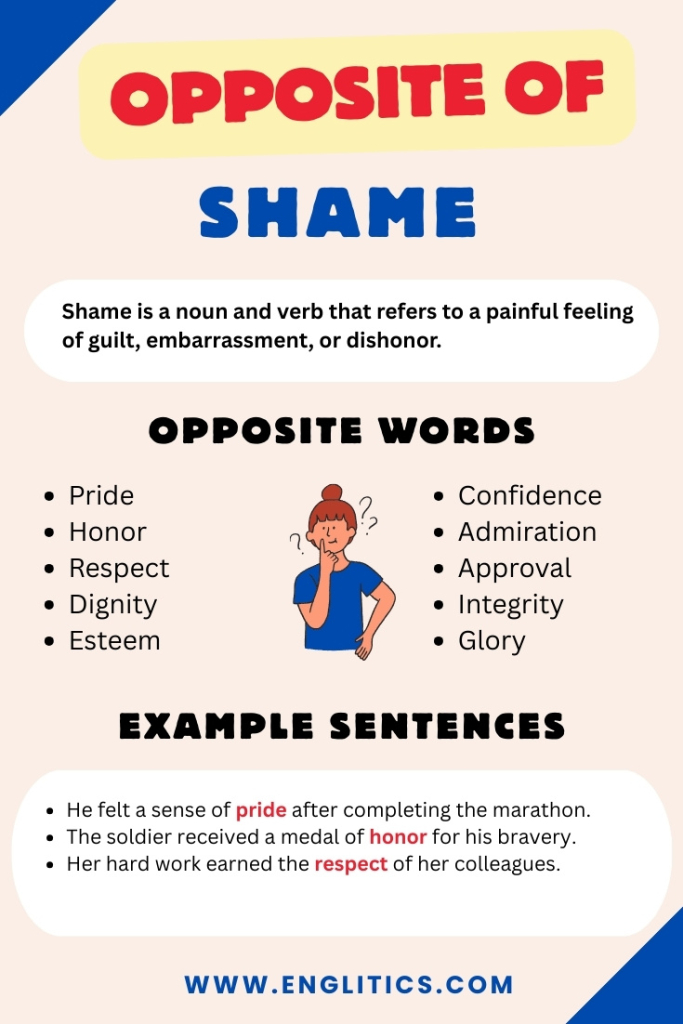
The antonyms of shame can be grouped into several categories, each highlighting a different aspect of positive self-perception. Understanding these categories allows for a more nuanced and precise use of language when discussing feelings of pride, worthiness, and honor.
Pride and Honor
Pride and honor represent a sense of satisfaction and self-respect derived from one’s achievements, qualities, or affiliations. Pride can be personal, reflecting satisfaction in one’s own accomplishments, or collective, reflecting satisfaction in the achievements of a group. Honor, on the other hand, is more closely tied to moral integrity and adherence to a code of conduct. It signifies a reputation for honesty, fairness, and respect.
These terms stand in stark contrast to shame, which arises from a perceived failure to meet personal or social standards. While shame diminishes self-worth, pride and honor elevate it, fostering a positive self-image and a sense of accomplishment.
Worthiness and Self-Esteem
Worthiness and self-esteem are fundamental to a healthy sense of self. Worthiness refers to the belief that one is inherently valuable and deserving of love, respect, and happiness. Self-esteem is the overall evaluation of one’s own worth, encompassing feelings of competence, confidence, and self-acceptance.
These concepts directly oppose the feelings of inadequacy and self-loathing associated with shame. When individuals feel worthy and possess high self-esteem, they are less susceptible to the negative impact of shame and more likely to embrace their strengths and accomplishments.
Respect and Admiration
Respect and admiration are external validations of one’s worth and character. Respect is earned through consistent ethical behavior and consideration for others. Admiration is inspired by exceptional qualities, achievements, or skills. These external validations contribute to a positive self-image and counteract the isolating effects of shame.
While shame often leads to feelings of isolation and rejection, respect and admiration foster a sense of belonging and acceptance. These positive social interactions reinforce self-worth and create a supportive environment for personal growth.
Courage and Fearlessness
Courage and fearlessness represent the ability to face challenges and overcome adversity, even in the face of fear or uncertainty. Courage involves acting in accordance with one’s values, despite the potential for negative consequences. Fearlessness is a state of being uninhibited by fear, allowing for bold and decisive action.
Shame can be a paralyzing emotion, preventing individuals from taking risks or pursuing their goals. Courage and fearlessness, on the other hand, empower individuals to overcome their fears and embrace new opportunities.
These qualities are essential for personal growth and resilience.
Innocence and Purity
Innocence and purity represent a state of being free from guilt, wrongdoing, or moral compromise. Innocence can refer to a lack of knowledge or experience, while purity implies a state of moral cleanliness. These qualities are often associated with youth and virtue.
Shame often arises from a perceived violation of moral principles or social norms. Innocence and purity, by contrast, represent adherence to these standards.
These qualities foster a sense of peace and self-acceptance, shielding individuals from the negative impact of shame.
Examples of Antonyms in Context
The following tables provide examples of antonyms for shame used in various contexts. These examples illustrate the nuanced meanings of these words and their ability to convey a wide range of positive emotions and states of being.
This table focuses on the antonyms related to pride and honor, highlighting how these words can be used to express a sense of accomplishment, self-respect, and moral integrity.
| Shame-Related Context | Antonym (Pride/Honor) | Example Sentence |
|---|---|---|
| Feeling disgraced after a public failure | Pride | Despite the initial setback, she felt pride in her effort and determination. |
| Experiencing humiliation due to a mistake | Honor | He acted with honor, immediately taking responsibility for the error. |
| Feeling unworthy of recognition | Pride | She accepted the award with pride, acknowledging the hard work of her team. |
| Suffering from a damaged reputation | Honor | His unwavering commitment to justice restored his honor in the community. |
| Feeling ashamed of one’s background | Pride | He spoke with pride about his family’s history and traditions. |
| Being embarrassed by a lack of achievement | Honor | She maintained her honor by refusing to compromise her values for success. |
| Feeling guilty about a past action | Pride | He took pride in the positive changes he had made in his life since then. |
| Experiencing disgrace due to dishonesty | Honor | Her honor remained intact, as she had always been known for her integrity. |
| Feeling disgraced after a public failure | Pride | Despite the initial setback, she felt pride in her effort and determination. |
| Experiencing humiliation due to a mistake | Honor | He acted with honor, immediately taking responsibility for the error. |
| Feeling unworthy of recognition | Pride | She accepted the award with pride, acknowledging the hard work of her team. |
| Suffering from a damaged reputation | Honor | His unwavering commitment to justice restored his honor in the community. |
| Feeling ashamed of one’s background | Pride | He spoke with pride about his family’s history and traditions. |
| Being embarrassed by a lack of achievement | Honor | She maintained her honor by refusing to compromise her values for success. |
| Feeling guilty about a past action | Pride | He took pride in the positive changes he had made in his life since then. |
| Experiencing disgrace due to dishonesty | Honor | Her honor remained intact, as she had always been known for her integrity. |
| Feeling disgraced after a public failure | Pride | Despite the initial setback, she felt pride in her effort and determination. |
| Experiencing humiliation due to a mistake | Honor | He acted with honor, immediately taking responsibility for the error. |
| Feeling unworthy of recognition | Pride | She accepted the award with pride, acknowledging the hard work of her team. |
| Suffering from a damaged reputation | Honor | His unwavering commitment to justice restored his honor in the community. |
| Feeling ashamed of one’s background | Pride | He spoke with pride about his family’s history and traditions. |
This table illustrates the use of antonyms related to worthiness and self-esteem, demonstrating how these words can express a sense of value, confidence, and self-acceptance.
| Shame-Related Context | Antonym (Worthiness/Self-Esteem) | Example Sentence |
|---|---|---|
| Feeling inadequate and unimportant | Worthiness | She began to recognize her own worthiness and inherent value. |
| Experiencing low self-confidence | Self-Esteem | Therapy helped him build his self-esteem and overcome his insecurities. |
| Feeling undeserving of love and affection | Worthiness | She realized she was worthy of love and began to prioritize her own needs. |
| Suffering from a negative self-image | Self-Esteem | Positive affirmations helped her improve her self-esteem and body image. |
| Feeling ashamed of one’s imperfections | Worthiness | He embraced his flaws and recognized his worthiness despite them. |
| Feeling inadequate and unimportant | Worthiness | She began to recognize her own worthiness and inherent value. |
| Experiencing low self-confidence | Self-Esteem | Therapy helped him build his self-esteem and overcome his insecurities. |
| Feeling undeserving of love and affection | Worthiness | She realized she was worthy of love and began to prioritize her own needs. |
| Suffering from a negative self-image | Self-Esteem | Positive affirmations helped her improve her self-esteem and body image. |
| Feeling ashamed of one’s imperfections | Worthiness | He embraced his flaws and recognized his worthiness despite them. |
| Feeling inadequate and unimportant | Worthiness | She began to recognize her own worthiness and inherent value. |
| Experiencing low self-confidence | Self-Esteem | Therapy helped him build his self-esteem and overcome his insecurities. |
| Feeling undeserving of love and affection | Worthiness | She realized she was worthy of love and began to prioritize her own needs. |
| Suffering from a negative self-image | Self-Esteem | Positive affirmations helped her improve her self-esteem and body image. |
| Feeling ashamed of one’s imperfections | Worthiness | He embraced his flaws and recognized his worthiness despite them. |
| Feeling inadequate and unimportant | Worthiness | She began to recognize her own worthiness and inherent value. |
| Experiencing low self-confidence | Self-Esteem | Therapy helped him build his self-esteem and overcome his insecurities. |
| Feeling undeserving of love and affection | Worthiness | She realized she was worthy of love and began to prioritize her own needs. |
| Suffering from a negative self-image | Self-Esteem | Positive affirmations helped her improve her self-esteem and body image. |
| Feeling ashamed of one’s imperfections | Worthiness | He embraced his flaws and recognized his worthiness despite them. |
This table focuses on antonyms related to respect and admiration, illustrating how these words can express positive social regard and recognition of one’s qualities or achievements.
| Shame-Related Context | Antonym (Respect/Admiration) | Example Sentence |
|---|---|---|
| Feeling ostracized and disliked | Respect | He earned the respect of his colleagues through his dedication and hard work. |
| Experiencing social rejection | Admiration | Her courage and resilience inspired admiration from everyone who knew her. |
| Feeling ignored and unappreciated | Respect | The community showed their respect for the elders by listening to their wisdom. |
| Suffering from a lack of recognition | Admiration | Her artistic talent garnered admiration from critics and audiences alike. |
| Feeling ashamed of one’s social status | Respect | He gained respect by treating everyone with kindness and equality, regardless of their background. |
| Feeling ostracized and disliked | Respect | He earned the respect of his colleagues through his dedication and hard work. |
| Experiencing social rejection | Admiration | Her courage and resilience inspired admiration from everyone who knew her. |
| Feeling ignored and unappreciated | Respect | The community showed their respect for the elders by listening to their wisdom. |
| Suffering from a lack of recognition | Admiration | Her artistic talent garnered admiration from critics and audiences alike. |
| Feeling ashamed of one’s social status | Respect | He gained respect by treating everyone with kindness and equality, regardless of their background. |
| Feeling ostracized and disliked | Respect | He earned the respect of his colleagues through his dedication and hard work. |
| Experiencing social rejection | Admiration | Her courage and resilience inspired admiration from everyone who knew her. |
| Feeling ignored and unappreciated | Respect | The community showed their respect for the elders by listening to their wisdom. |
| Suffering from a lack of recognition | Admiration | Her artistic talent garnered admiration from critics and audiences alike. |
| Feeling ashamed of one’s social status | Respect | He gained respect by treating everyone with kindness and equality, regardless of their background. |
| Feeling ostracized and disliked | Respect | He earned the respect of his colleagues through his dedication and hard work. |
| Experiencing social rejection | Admiration | Her courage and resilience inspired admiration from everyone who knew her. |
| Feeling ignored and unappreciated | Respect | The community showed their respect for the elders by listening to their wisdom. |
| Suffering from a lack of recognition | Admiration | Her artistic talent garnered admiration from critics and audiences alike. |
| Feeling ashamed of one’s social status | Respect | He gained respect by treating everyone with kindness and equality, regardless of their background. |
This table illustrates antonyms related to courage and fearlessness, showcasing how these words can express the ability to face challenges and overcome adversity.
| Shame-Related Context | Antonym (Courage/Fearlessness) | Example Sentence |
|---|---|---|
| Feeling paralyzed by fear | Courage | It took immense courage to speak out against injustice. |
| Avoiding challenges due to insecurity | Fearlessness | Her fearlessness allowed her to pursue her dreams without hesitation. |
| Feeling ashamed of one’s vulnerability | Courage | He showed courage by sharing his personal struggles with others. |
| Being afraid to take risks | Fearlessness | Her fearlessness in the face of danger saved many lives. |
| Feeling ashamed of past failures | Courage | She found the courage to learn from her mistakes and move forward. |
| Feeling paralyzed by fear | Courage | It took immense courage to speak out against injustice. |
| Avoiding challenges due to insecurity | Fearlessness | Her fearlessness allowed her to pursue her dreams without hesitation. |
| Feeling ashamed of one’s vulnerability | Courage | He showed courage by sharing his personal struggles with others. |
| Being afraid to take risks | Fearlessness | Her fearlessness in the face of danger saved many lives. |
| Feeling ashamed of past failures | Courage | She found the courage to learn from her mistakes and move forward. |
| Feeling paralyzed by fear | Courage | It took immense courage to speak out against injustice. |
| Avoiding challenges due to insecurity | Fearlessness | Her fearlessness allowed her to pursue her dreams without hesitation. |
| Feeling ashamed of one’s vulnerability | Courage | He showed courage by sharing his personal struggles with others. |
| Being afraid to take risks | Fearlessness | Her fearlessness in the face of danger saved many lives. |
| Feeling ashamed of past failures | Courage | She found the courage to learn from her mistakes and move forward. |
| Feeling paralyzed by fear | Courage | It took immense courage to speak out against injustice. |
| Avoiding challenges due to insecurity | Fearlessness | Her fearlessness allowed her to pursue her dreams without hesitation. |
| Feeling ashamed of one’s vulnerability | Courage | He showed courage by sharing his personal struggles with others. |
| Being afraid to take risks | Fearlessness | Her fearlessness in the face of danger saved many lives. |
| Feeling ashamed of past failures | Courage | She found the courage to learn from her mistakes and move forward. |
This table provides examples of antonyms related to innocence and purity, showcasing how these words can express freedom from guilt and moral compromise.
| Shame-Related Context | Antonym (Innocence/Purity) | Example Sentence |
|---|---|---|
| Feeling guilty about a past transgression | Innocence | He longed for the innocence of his childhood, before he had made mistakes. |
| Experiencing moral corruption | Purity | She strived to maintain the purity of her intentions in all her actions. |
| Feeling ashamed of one’s actions | Innocence | He pleaded his innocence, claiming he had been wrongly accused. |
| Being tainted by scandal | Purity | The organization worked to restore its purity after the corruption was exposed. |
| Feeling ashamed of one’s past mistakes | Innocence | She sought to regain her innocence by dedicating her life to helping others. |
| Feeling guilty about a past transgression | Innocence | He longed for the innocence of his childhood, before he had made mistakes. |
| Experiencing moral corruption | Purity | She strived to maintain the purity of her intentions in all her actions. |
| Feeling ashamed of one’s actions | Innocence | He pleaded his innocence, claiming he had been wrongly accused. |
| Being tainted by scandal | Purity | The organization worked to restore its purity after the corruption was exposed. |
| Feeling ashamed of one’s past mistakes | Innocence | She sought to regain her innocence by dedicating her life to helping others. |
| Feeling guilty about a past transgression | Innocence | He longed for the innocence of his childhood, before he had made mistakes. |
| Experiencing moral corruption | Purity | She strived to maintain the purity of her intentions in all her actions. |
| Feeling ashamed of one’s actions | Innocence | He pleaded his innocence, claiming he had been wrongly accused. |
| Being tainted by scandal | Purity | The organization worked to restore its purity after the corruption was exposed. |
| Feeling ashamed of one’s past mistakes | Innocence | She sought to regain her innocence by dedicating her life to helping others. |
| Feeling guilty about a past transgression | Innocence | He longed for the innocence of his childhood, before he had made mistakes. |
| Experiencing moral corruption | Purity | She strived to maintain the purity of her intentions in all her actions. |
| Feeling ashamed of one’s actions | Innocence | He pleaded his innocence, claiming he had been wrongly accused. |
| Being tainted by scandal | Purity | The organization worked to restore its purity after the corruption was exposed. |
| Feeling ashamed of one’s past mistakes | Innocence | She sought to regain her innocence by dedicating her life to helping others. |
Usage Rules and Considerations
When using antonyms for shame, it is crucial to consider the specific context and intended meaning. The choice of antonym should accurately reflect the positive emotion or state of being that you wish to convey.
For example, while “pride” and “honor” are both antonyms for shame, they have distinct connotations. “Pride” emphasizes personal satisfaction, while “honor” emphasizes moral integrity.
Pay attention to the connotations of different words. Some antonyms may have additional meanings or associations that could alter the tone of your writing.
For example, “smugness” can be considered a negative form of pride, implying an excessive or unwarranted sense of self-satisfaction.
Consider the level of formality required in your writing. Some antonyms, such as “exaltation” or “veneration,” may be more appropriate for formal contexts, while others, such as “confidence” or “self-respect,” may be suitable for both formal and informal settings.
Common Mistakes to Avoid
One common mistake is using antonyms that are too general or imprecise. For example, using “happiness” as an antonym for shame may not accurately capture the specific emotion you wish to convey.
It’s important to choose an antonym that directly addresses the underlying cause of the shame, such as a lack of self-worth or a violation of moral principles.
Another mistake is using antonyms that have negative connotations. For example, using “arrogance” as an antonym for shame is incorrect, as arrogance implies an excessive and unwarranted sense of self-importance.
It’s crucial to choose antonyms that reflect positive emotions and states of being.
A third mistake is using antonyms that are grammatically incorrect. Ensure that the antonym you choose fits grammatically within the sentence.
For example, using a noun where an adjective is required can lead to awkward or nonsensical sentences.
Here are some examples of common mistakes and their corrections:
| Incorrect | Correct | Explanation |
|---|---|---|
| He felt happiness after failing the exam. | He felt pride in his effort, even though he failed the exam. | “Happiness” is too general; “pride” better reflects a positive feeling despite failure. |
| She displayed arrogance instead of feeling shame. | She displayed confidence instead of feeling shame. | “Arrogance” has a negative connotation; “confidence” is a more appropriate antonym. |
| He had honor for his actions. | He acted honorably. | “Honor” is a noun; “honorably” is an adverb that correctly modifies the verb “acted.” |
Practice Exercises
Complete the following sentences by filling in the blank with an appropriate antonym for shame from the list provided. Choose the word that best fits the context of the sentence.
Word List: Pride, Worthiness, Respect, Courage, Innocence
| Question | Answer |
|---|---|
| 1. After overcoming numerous obstacles, she felt a deep sense of ________ in her accomplishments. | Pride |
| 2. He realized that he was ________ of love and began to prioritize his own well-being. | Worthiness |
| 3. The community showed their ________ for the elders by honoring their contributions. | Respect |
| 4. It took immense ________ to speak out against injustice, even when facing threats. | Courage |
| 5. He longed for the ________ of his youth, before he had made any mistakes. | Innocence |
| 6. Despite the criticism, she maintained her ________ and stood by her principles. | Courage |
| 7. She finally understood her own ________ and stopped seeking validation from others. | Worthiness |
| 8. The soldiers were filled with ________ as they marched into battle, ready to defend their country. | Courage |
| 9. The artist felt ________ in his ability to create beautiful works of art, despite facing rejection. | Pride |
| 10. The witness testified with ________, knowing that it was the right thing to do. | Courage |
Rewrite the following sentences, replacing the underlined phrase with an antonym for shame. Choose the word that best fits the context of the sentence.
Word List: Honor, Self-Esteem, Admiration, Fearlessness, Purity
| Question | Answer |
|---|---|
| 1. Despite facing adversity, he maintained his good reputation. | Despite facing adversity, he maintained his honor. |
| 2. Therapy helped her build her confidence and overcome her insecurities. | Therapy helped her build her self-esteem and overcome her insecurities. |
| 3. Her bravery and resilience inspired high regard from everyone who knew her. | Her bravery and resilience inspired admiration from everyone who knew her. |
| 4. She faced the challenge with a lack of fear, ready to take on any obstacle. | She faced the challenge with fearlessness, ready to take on any obstacle. |
| 5. He strived to maintain the moral cleanliness of his intentions in all his actions. | He strived to maintain the purity of his intentions in all his actions. |
| 6. Despite the difficult circumstances, she acted with integrity. | Despite the difficult circumstances, she acted with honor. |
| 7. His paintings evoked astonishment and respect from the art community. | His paintings evoked admiration from the art community. |
| 8. The knight was known for his bravery in battle. | The knight was known for his fearlessness in battle. |