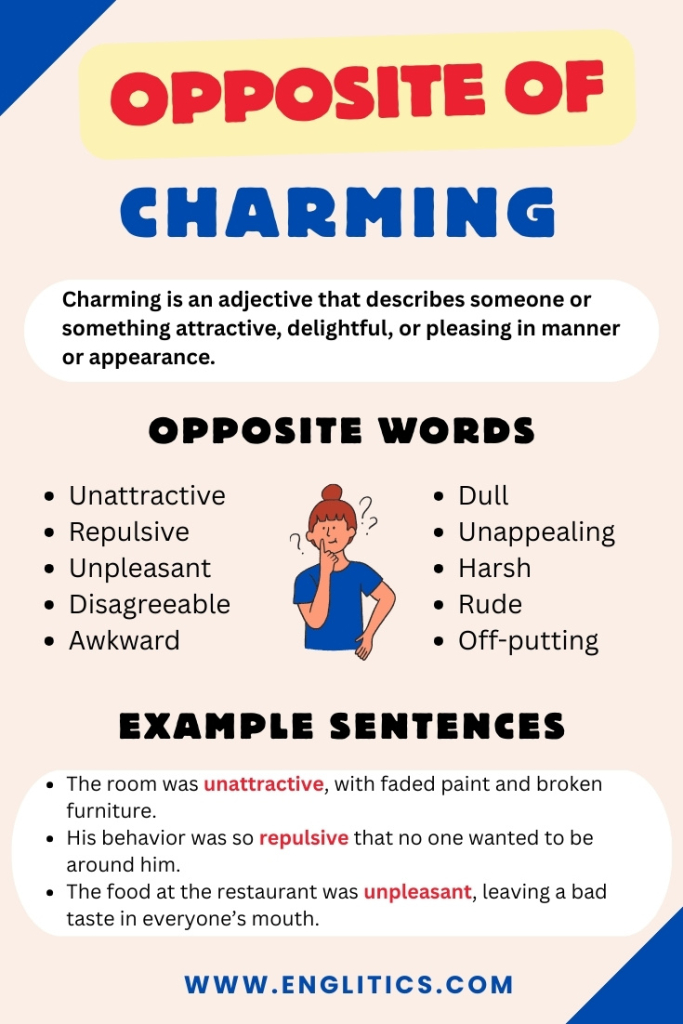
Charming describes someone or something that is pleasant, attractive, or delightful in a way that draws others in. However, when you’re aiming to describe the opposite of charming, you might want to convey traits that are off-putting, unpleasant, or even abrasive. Antonyms for charming help paint a clearer picture of behaviors or qualities that repel rather than attract.
The opposite of charming includes words like repulsive, unpleasant, awkward, rude, and offensive. While rude and offensive focus on poor manners or behavior, repulsive and unpleasant describe an overall negative impression. These antonyms are especially helpful in character descriptions, social interactions, or reviews where charm is clearly missing.
Defining “Charming” and Its Importance
The word “charming” describes someone or something that is pleasing, attractive, and delightful. It often implies an ability to attract or influence others in a positive way.
Charm can stem from physical attractiveness, personality traits, or a combination of both. Understanding the nuances of “charming” helps us appreciate the complexity of human interactions and aesthetic appeal.
The importance of understanding “charming” lies in its frequent use in everyday language and literature. It is often used to describe people, places, and things that evoke positive emotions.
Recognizing the qualities that constitute charm allows us to better understand the impact of these entities on our feelings and perceptions. For example, a “charming” village might possess quaint architecture and friendly residents, while a “charming” person might be witty, kind, and engaging.
This ability to discern and appreciate charm enhances our social and aesthetic experiences.
Furthermore, the concept of “charm” is culturally influenced. What one culture considers charming might differ significantly from another.
Therefore, understanding the context in which “charming” is used is crucial for accurate interpretation. This cultural awareness enhances our ability to communicate effectively across different backgrounds and appreciate the diversity of human values and preferences.
Structural Breakdown of Antonyms
Antonyms are words that have opposite meanings. They are essential for expressing contrast and providing a balanced perspective in language.
Understanding the structural relationships between words and their antonyms can enhance vocabulary acquisition and improve communication skills. There are different types of antonyms, each with its unique structural characteristics.
The structural breakdown of antonyms involves understanding prefixes, suffixes, and root words. Many antonyms are formed by adding prefixes such as “un-,” “in-,” “dis-,” “im-,” and “non-” to a word.
For example, “happy” becomes “unhappy.” Other antonyms are formed by using entirely different words that convey the opposite meaning. For instance, the antonym of “hot” is “cold.” Recognizing these structural patterns can facilitate the identification and understanding of antonyms.
Moreover, the context in which a word is used can influence its antonym. Some words have multiple meanings, and their antonyms may vary depending on the specific sense in which they are used.
For example, the antonym of “light” (in weight) is “heavy,” while the antonym of “light” (in color) is “dark.” Therefore, a thorough understanding of word meanings and their contexts is crucial for accurate antonym usage.
Opposite of Charming
Antonyms can be classified into three main types: complementary, gradable, and relational. Each type represents a different kind of opposition in meaning, and understanding these distinctions can help you use antonyms more effectively.
Complementary Antonyms
Complementary antonyms are pairs of words where the presence of one implies the absence of the other. There is no middle ground between them. Examples include “alive” and “dead,” “on” and “off,” and “true” and “false.” In each case, something is either one or the other; there is no possibility of being both or neither.
Gradable Antonyms
Gradable antonyms represent opposite ends of a spectrum. They allow for degrees of comparison and can be modified by adverbs like “very,” “slightly,” or “extremely.” Examples include “hot” and “cold,” “big” and “small,” and “happy” and “sad.” These words can be placed on a scale, and something can be more or less of one quality compared to the other.
Relational Antonyms
Relational antonyms are pairs of words that describe a relationship from opposite perspectives. The existence of one implies the existence of the other. Examples include “teacher” and “student,” “parent” and “child,” and “buy” and “sell.” These words describe roles or actions that are inherently linked but represent opposite sides of a transaction or relationship.
Examples of Antonyms for “Charming”
The word “charming” has many antonyms, each with its own specific nuance. Understanding these antonyms allows for a more precise description of the absence of charm.
Here are some examples, categorized for clarity.
Unpleasant
“Unpleasant” describes something that is not enjoyable or agreeable. It is a general term that can apply to various situations, people, or things that evoke negative feelings.
This antonym covers a broad range of negative qualities, making it a versatile choice.
The following table presents examples of how “unpleasant” can be used as an antonym for “charming” in different contexts. Each example illustrates a situation where the absence of charm is described using “unpleasant.”
| Sentence | Explanation |
|---|---|
| The atmosphere in the room was quite unpleasant. | Describes a negative ambiance. |
| He had an unpleasant personality that repelled people. | Highlights a disagreeable character. |
| The food had an unpleasant taste. | Indicates a negative sensory experience. |
| The job interview was an unpleasant experience. | Describes a negative professional interaction. |
| She found the task to be extremely unpleasant. | Emphasizes the disagreeableness of a task. |
| The news was unpleasant and unsettling. | Highlights the negative impact of information. |
| The weather was particularly unpleasant that day. | Describes unfavorable weather conditions. |
| His behavior was consistently unpleasant. | Indicates a pattern of negative conduct. |
| The smell in the laboratory was intensely unpleasant. | Describes a strong negative olfactory experience. |
| The meeting turned into an unpleasant confrontation. | Highlights a negative interpersonal conflict. |
| The conversation took an unpleasant turn. | Indicates a shift towards a negative topic. |
| The room had an unpleasant, musty odor. | Describes a specific type of disagreeable smell. |
| She received an unpleasant surprise. | Highlights the negative nature of an unexpected event. |
| The journey was long and unpleasant. | Describes a negative travel experience. |
| The noise from the construction site was unpleasant. | Indicates a negative auditory experience. |
| His comments were deliberately unpleasant. | Highlights intentional negativity in speech. |
| The medicine had an unpleasant aftertaste. | Describes a negative gustatory experience. |
| The situation became increasingly unpleasant. | Indicates a worsening of negative circumstances. |
| He had to deal with an unpleasant customer. | Describes a negative interaction in a service context. |
| The experience left an unpleasant memory. | Highlights the lasting negative impact of an event. |
| The atmosphere at the funeral was deeply unpleasant. | Describes a sorrowful and somber setting. |
| The task of cleaning the attic was extremely unpleasant. | Emphasizes the difficulty and disagreeableness of a chore. |
| The political debate turned into an unpleasant exchange of insults. | Highlights the negativity and aggression in a political discussion. |
| The feeling of being watched was intensely unpleasant. | Describes the discomfort of being observed. |
| The thought of returning to that place was unpleasant. | Indicates a negative anticipation of a future event. |
Repulsive
“Repulsive” describes something that is intensely disgusting or offensive. It evokes a strong feeling of aversion or revulsion.
This antonym is stronger than “unpleasant” and implies a deeper level of negativity.
The following table provides examples of how “repulsive” can be used as an antonym for “charming.” Each example illustrates a situation where something evokes a strong feeling of disgust or aversion, contrasting sharply with the qualities of charm.
| Sentence | Explanation |
|---|---|
| The sight of the decaying carcass was repulsive. | Describes a visually disgusting scene. |
| His behavior was utterly repulsive. | Highlights extremely offensive conduct. |
| The smell of the garbage was repulsive. | Indicates a strongly disgusting odor. |
| She found the idea of eating insects repulsive. | Describes a strong aversion to a particular food. |
| The movie contained scenes that were deeply repulsive. | Highlights the offensive content of a film. |
| His personal habits were repulsive to those around him. | Describes habits that cause disgust. |
| The thought of betrayal was repulsive to her. | Indicates a strong moral aversion. |
| The politician’s actions were seen as morally repulsive. | Describes actions that are ethically disgusting. |
| The texture of the food was repulsive. | Indicates a disgusting tactile experience. |
| The disease had repulsive symptoms. | Describes symptoms that are physically disgusting. |
| The living conditions in the slum were repulsive. | Highlights the disgusting state of living conditions. |
| His attitude towards women was repulsive. | Describes an offensive and disgusting attitude. |
| The crime scene was filled with repulsive details. | Highlights the disgusting aspects of a crime scene. |
| The dictator’s policies were repulsive to the international community. | Describes policies that cause international disgust. |
| The sight of the polluted river was repulsive. | Indicates a visually disgusting environmental issue. |
| His arrogance and condescension were repulsive. | Highlights personality traits that cause disgust. |
| The special effects in the horror movie were designed to be repulsive. | Describes the intention to create disgust through visual effects. |
| The idea of exploiting vulnerable people is repulsive. | Indicates a strong moral aversion to exploitation. |
| The way he treated his employees was repulsive. | Describes an offensive and disgusting treatment of employees. |
| The thought of living in such squalor was repulsive. | Highlights the disgust associated with living in squalor. |
| The details of the surgical procedure were repulsive to the audience. | Describes how graphic details can be disgusting. |
| Her constant complaining and negativity were repulsive to her friends. | Indicates that negative behavior can be disgusting. |
| The display of wealth and excess was repulsive, given the poverty around them. | Highlights the moral disgust caused by excessive wealth in poverty. |
| The propaganda used by the regime was repulsive and manipulative. | Describes the disgust caused by manipulative propaganda. |
| The practice of animal cruelty is universally repulsive. | Indicates a widespread disgust towards animal cruelty. |
Offensive
“Offensive” describes something that causes displeasure or resentment; it is likely to insult or affront. This antonym focuses on the potential to hurt or upset others, either intentionally or unintentionally.
It is milder than “repulsive” but still carries a strong negative connotation.
This table shows how “offensive” can be used as an antonym for “charming.” The examples illustrate situations where something is likely to cause displeasure or resentment, contrasting with the pleasing and delightful nature of charm.
| Sentence | Explanation |
|---|---|
| His comments were deeply offensive to many people. | Highlights the insulting nature of remarks. |
| The joke was offensive and in poor taste. | Describes a joke that is insulting and inappropriate. |
| She found his behavior to be highly offensive. | Indicates that conduct caused displeasure. |
| The advertisement was considered offensive by several groups. | Describes an advertisement that caused offense. |
| His language was offensive and disrespectful. | Highlights the insulting nature of speech. |
| The movie contained several offensive scenes. | Describes scenes that are likely to cause offense. |
| His actions were offensive to the community. | Indicates that actions caused community displeasure. |
| The politician’s statements were widely regarded as offensive. | Describes statements that caused widespread insult. |
| The cartoon was seen as offensive to certain cultures. | Highlights the potential for cultural offense. |
| The book contained offensive stereotypes. | Describes stereotypes that are likely to cause offense. |
| His remarks were offensive and uncalled for. | Indicates that remarks were unnecessary and insulting. |
| The display was considered offensive by religious groups. | Describes a display that caused religious offense. |
| The song’s lyrics were offensive and provocative. | Highlights the insulting and provocative nature of lyrics. |
| His treatment of his employees was offensive and unacceptable. | Describes treatment that caused displeasure and was unacceptable. |
| The play contained offensive content that triggered protests. | Indicates content that caused protests due to its insulting nature. |
| His constant interruptions were offensive to the speaker. | Highlights interruptions that caused displeasure. |
| The article contained offensive generalizations about a certain group. | Describes generalizations that were insulting. |
| His comments were offensive, especially considering the circumstances. | Indicates that comments were particularly insulting given the context. |
| The comedian’s jokes were often offensive and controversial. | Describes jokes that frequently caused offense and controversy. |
| The use of that term is considered offensive in many contexts. | Highlights that a term is generally considered insulting. |
| Her remarks were unintentionally offensive, but she apologized immediately. | Describes unintentional offense and a subsequent apology. |
| The painting was seen as offensive because of its depiction of cultural symbols. | Indicates how artistic depictions can cause cultural offense. |
| His offensive behavior led to his expulsion from the club. | Describes how offensive conduct resulted in expulsion. |
| The email contained offensive language, resulting in a disciplinary action. | Highlights how offensive language can lead to disciplinary measures. |
| The film was criticized for its offensive portrayal of historical events. | Describes criticism for an insulting depiction of historical events. |
Boorish
“Boorish” describes someone who is rude, ill-mannered, and lacking in social graces. This antonym focuses on a lack of refinement and politeness, contrasting sharply with the sophistication and grace associated with charm.
A boorish person is often insensitive to the feelings of others.
The following table provides examples of how “boorish” can be used as an antonym for “charming.” Each example illustrates a situation where someone lacks social graces and exhibits rude behavior, contrasting with the polite and refined qualities of charm.
| Sentence | Explanation |
|---|---|
| His boorish behavior at the dinner party embarrassed everyone. | Highlights rude behavior at a social event. |
| She found his boorish manners completely off-putting. | Describes manners that are rude and unattractive. |
| His boorish remarks offended the guests. | Indicates rude remarks that caused offense. |
| The politician’s boorish conduct was criticized by the media. | Describes rude conduct that faced media criticism. |
| His boorish attitude made him unpopular. | Highlights an attitude that caused unpopularity. |
| The waiter’s boorish service ruined the dining experience. | Describes rude service that spoiled an experience. |
| His boorish jokes fell flat. | Indicates that rude jokes were not well-received. |
| The newcomer’s boorish behavior alienated the group. | Describes behavior that caused alienation. |
| His boorish comments showed a lack of respect. | Highlights comments that indicated disrespect. |
| The host was appalled by the guest’s boorish behavior. | Describes a host’s reaction to rude behavior. |
| His boorish table manners were shocking. | Indicates that table manners were shockingly rude. |
| The audience was offended by the comedian’s boorish performance. | Describes a performance that caused audience offense. |
| His boorish attempts at flirting were unsuccessful. | Highlights flirting attempts that were rude and ineffective. |
| The manager’s boorish treatment of employees was unacceptable. | Describes unacceptable and rude treatment. |
| His boorish interruptions made the meeting unproductive. | Indicates that rude interruptions hindered productivity. |
| The speaker’s boorish tone alienated the listeners. | Describes a tone that caused alienation. |
| His boorish behavior at the art gallery was out of place. | Highlights rude behavior in an inappropriate setting. |
| The boorish customer was asked to leave the restaurant. | Describes a customer whose rude behavior led to expulsion. |
| His boorish remarks revealed his ignorance. | Indicates that rude remarks revealed ignorance. |
| The boorish driver cut off the other cars. | Describes rude driving behavior. |
| His boorish attitude towards women was appalling. | Highlights an attitude that was appallingly rude. |
| The boorish politician insulted his opponents. | Describes a politician who used rude insults. |
| His boorish behavior at the wedding reception was unforgettable. | Highlights rude behavior at a memorable event. |
| The boorish tourist offended the local residents. | Describes a tourist whose rude behavior caused offense. |
| His boorish manners were a stark contrast to his sophisticated surroundings. | Indicates that rude manners stood out in a refined setting. |
Awkward
“Awkward” describes something that is lacking grace or ease; it is clumsy or uncomfortable. This antonym focuses on a lack of smoothness and poise, contrasting with the effortless grace associated with charm.
An awkward situation or person often causes discomfort.
This table shows how “awkward” can be used as an antonym for “charming.” The examples illustrate situations where there is a lack of grace or ease, creating discomfort and contrasting with the smooth and pleasing qualities of charm.
| Sentence | Explanation |
|---|---|
| The silence in the room was awkward. | Highlights an uncomfortable silence. |
| He felt awkward at the party because he didn’t know anyone. | Describes feeling uncomfortable in a social setting. |
| The handshake was awkward and clumsy. | Indicates a clumsy and uncomfortable greeting. |
| She gave an awkward smile. | Describes a smile that lacks sincerity and ease. |
| The situation was awkward and embarrassing. | Highlights a situation that caused embarrassment and discomfort. |
| He made an awkward attempt to start a conversation. | Describes an unsuccessful and uncomfortable attempt. |
| The dance was awkward and uncoordinated. | Indicates a dance that lacked grace and coordination. |
| She felt awkward accepting the compliment. | Describes feeling uncomfortable receiving praise. |
| The meeting was awkward after the argument. | Highlights the discomfort following a conflict. |
| His awkward posture made him look uncomfortable. | Describes a posture that lacked ease and grace. |
| The first date was awkward and strained. | Indicates a date that was uncomfortable and tense. |
| The presentation was awkward and disorganized. | Describes a presentation that lacked smoothness and structure. |
| He felt awkward wearing the formal attire. | Highlights feeling uncomfortable in formal clothing. |
| The interaction was awkward and forced. | Describes an interaction that lacked naturalness. |
| She gave an awkward laugh. | Indicates a laugh that sounded unnatural and uncomfortable. |
| The transition between topics was awkward. | Describes a transition that lacked smoothness. |
| He felt awkward asking for help. | Highlights feeling uncomfortable requesting assistance. |
| The silence after the joke was awkward. | Indicates an uncomfortable silence following a joke. |
| Her attempt to comfort him was awkward. | Describes an attempt that lacked empathy and grace. |
| The situation became increasingly awkward. | Highlights a situation that progressively became more uncomfortable. |
| His awkward movements made it difficult for him to navigate the crowded room. | Describes how clumsiness can hinder movement in a crowded space. |
| The politician’s awkward response to the question raised suspicions. | Indicates that an uncomfortable response can create doubt. |
| The attempt to reconcile after the argument was awkward and unsuccessful. | Describes a failed and uncomfortable reconciliation attempt. |
| Her awkward attempt to pronounce the foreign word made everyone chuckle. | Highlights how difficulty with pronunciation can lead to an awkward moment. |
| The atmosphere at the reunion was awkward due to past conflicts. | Describes how unresolved issues can create discomfort at a gathering. |
Usage Rules: When to Use Each Antonym
Choosing the right antonym for “charming” depends on the specific context and the nuance you want to convey. “Unpleasant” is a general term suitable for describing anything that is not enjoyable.
“Repulsive” is used for things that evoke strong disgust. “Offensive” describes things that are likely to insult or upset others.
“Boorish” is used for people who lack social graces and are rude. “Awkward” describes things that lack grace or ease and cause discomfort.
Consider the specific qualities you want to emphasize when selecting an antonym. If you want to highlight a lack of enjoyment, use “unpleasant.” If you want to emphasize disgust, use “repulsive.” If you want to emphasize the potential to cause offense, use “offensive.” If you want to emphasize a lack of social graces, use “boorish.” If you want to emphasize a lack of ease and grace, use “awkward.”
Understanding these distinctions will help you choose the most appropriate antonym for “charming” in any given situation, allowing you to communicate your ideas more precisely and effectively. Pay attention to the connotations of each word and consider the overall tone you want to create in your writing or speech.
Common Mistakes to Avoid
One common mistake is using antonyms interchangeably without considering their specific nuances. For example, using “repulsive” when “unpleasant” would be more appropriate, or vice versa.
Another common mistake is misinterpreting the context and choosing an antonym that does not accurately reflect the intended meaning.
To avoid these mistakes, always consider the specific qualities you want to emphasize and choose the antonym that best captures those qualities. Pay attention to the connotations of each word and use a dictionary or thesaurus to clarify their meanings.
Practice using antonyms in different contexts to improve your understanding and usage.
Here are some examples of common mistakes and how to correct them:
| Incorrect | Correct | Explanation |
|---|---|---|
| The party was repulsive, I didn’t enjoy it. | The party was unpleasant, I didn’t enjoy it. | “Repulsive” implies strong disgust, while “unpleasant” simply means not enjoyable. |
| His behavior was awkward, it offended everyone. | His behavior was offensive, it offended everyone. | “Offensive” describes behavior that causes displeasure, while “awkward” describes a lack of grace. |
| She found his manners unpleasant, he was so rude. | She found his manners boorish, he was so rude. | “Boorish” specifically describes rude and ill-mannered behavior, while “unpleasant” is more general. |
| The silence was offensive, it made me uncomfortable. | The silence was awkward, it made me uncomfortable. | “Awkward” describes a lack of ease and comfort, while “offensive” implies insult or displeasure. |
| The food was boorish, it tasted terrible. | The food was unpleasant, it tasted terrible. | “Unpleasant” is more appropriate for describing the taste of food, while “boorish” is used for behavior. |
Practice Exercises
Test your understanding of antonyms for “charming” with these exercises. Choose the best antonym for “charming” in each sentence.
Exercise 1:
| Question | Options | Answer |
|---|---|---|
| 1. The atmosphere in the room was anything but __________. | a) charming b) pleasant c) unpleasant d) delightful | c) unpleasant |
| 2. His __________ behavior at the dinner party was embarrassing. | a) charming b) boorish c) delightful d) pleasant | b) boorish |
| 3. The smell coming from the garbage was __________. | a) charming b) delightful c) repulsive d) pleasant | c) repulsive |
| 4. Her remarks were considered highly __________. | a) charming b) delightful c) pleasant d) offensive | d) offensive |
| 5. The silence during the meeting was quite __________. | a) charming b) awkward c) delightful d) pleasant | b) awkward |
| 6. The movie had a(n) __________ scene that made me want to leave. | a) charming b) delightful c) repulsive d) pleasant | c) repulsive |
| 7. He made a(n) __________ attempt to impress her, but it failed miserably. | a) charming b) delightful c) awkward d) pleasant | c) awkward |
| 8. The politician’s speech was __________, causing many people to protest. | a) charming b) delightful c) pleasant d) offensive | d) offensive |
| 9. The service at the restaurant was __________, and we left without ordering. | a) charming b) delightful c) boorish d) pleasant | c) boorish |
| 10. The weather was __________ and rainy all week. | a) charming b) delightful c) pleasant d) unpleasant | d) unpleasant |
Exercise 2:
Fill in the blanks with the most appropriate antonym for “charming” from the list: unpleasant, repulsive, offensive, boorish, awkward.
- The __________ smell of the sewer made her gag. (repulsive)
- His __________ behavior at the opera made him a social outcast. (boorish)
- The __________ silence after his joke made everyone uncomfortable. (awkward)
- The __________ comments made by the speaker caused several people to leave the room. (offensive)
- The __________ task of cleaning the attic was something she dreaded. (unpleasant)
- The __________ sight of the accident scene was traumatizing. (repulsive)
- His __________ attempt to dance ended in him tripping over his own feet. (awkward)
- The __________ attitude of the manager led to numerous complaints from the staff. (boorish)
- The __________ news about the company’s financial situation worried investors. (unpleasant)
- Her __________ remarks about his appearance were hurtful and unnecessary. (offensive)
Advanced Topics: Nuances and Connotations
Exploring the nuances and connotations of antonyms for “charming” involves understanding the subtle differences in meaning and the emotional associations they evoke. Some antonyms may have stronger negative connotations than others, and the choice of antonym can significantly impact the overall tone of your writing or speech.
For example, “repulsive” carries a much stronger negative connotation than “unpleasant,” suggesting a deep sense of disgust or aversion. “Offensive” focuses on the potential to cause hurt or displeasure, while “boorish” emphasizes a lack of social graces.
“Awkward” suggests a lack of ease and grace, often causing discomfort. Understanding these subtle differences allows you to choose the most precise and effective antonym for “charming” in any given situation.
Additionally, consider the cultural context in which the antonym is used. Some words may have different connotations in different cultures, and it is important to be aware of these differences to avoid miscommunication or offense.
By carefully considering the nuances and connotations of antonyms, you can enhance your communication skills and express your ideas with greater precision and sensitivity.
Frequently Asked Questions
- What is the difference between “unpleasant” and “repulsive”?“Unpleasant” is a general term for something not enjoyable, while “repulsive” implies strong disgust or aversion. “Repulsive” is a much stronger term.
- When should I use “offensive” instead of “boorish”?Use “offensive” when something is likely to insult or upset others. Use “boorish” when someone lacks social graces and is rude.
- How can I improve my vocabulary of antonyms?Read widely, use a dictionary and thesaurus, and
practice using antonyms in your writing and speech. The more you expose yourself to different words and their opposites, the better you will become at using them effectively.
- Are there any situations where “charming” can have a negative connotation?Yes, “charming” can sometimes be used sarcastically to imply insincerity or manipulation. For example, “He was being charming, but I knew he just wanted something from me.”
- How do I choose the best antonym for “charming” in a specific context?Consider the specific qualities you want to emphasize and choose the antonym that best captures those qualities. Think about the overall tone you want to create and the emotional associations you want to evoke.
Conclusion
Mastering antonyms for “charming” is a valuable skill that can significantly enhance your vocabulary and communication abilities. By understanding the nuances and connotations of words like “unpleasant,” “repulsive,” “offensive,” “boorish,” and “awkward,” you can express a wider range of ideas and emotions with greater precision and effectiveness.
Remember to consider the context and the specific qualities you want to emphasize when choosing an antonym.
Continue to practice using antonyms in your writing and speech, and don’t be afraid to experiment with different words to find the perfect fit. With dedication and effort, you can unlock the power of opposites and elevate your language skills to new heights.
This expanded vocabulary will not only help you communicate more effectively but also allow you to appreciate the richness and complexity of the English language.