When someone is serious, they’re focused, thoughtful, or not joking around. It can describe a person, a conversation, or even a problem that’s important and not to be taken lightly. But sometimes, things are fun, silly, or relaxed instead—and that’s when the opposite of serious fits better.
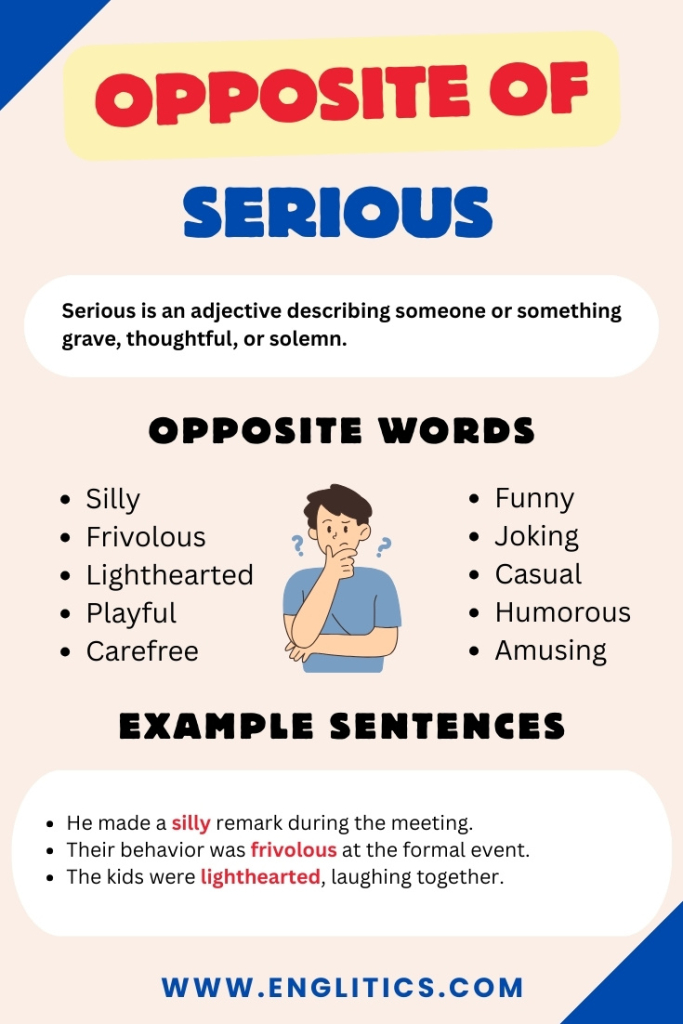
Antonyms for serious include words like playful, funny, lighthearted, carefree, and silly. These words are used to describe moods or people that are more relaxed or full of humor. In this post, you’ll learn how to use these opposite words in real situations, with examples to help you understand what each one means.
Definition of “Serious”
The word “serious” is an adjective that describes something or someone characterized by deep thought, gravity, or earnestness. It implies a lack of humor or frivolity and often suggests a focus on important or significant matters.
“Serious” can also indicate something that poses a threat or danger.
In essence, “serious” conveys a sense of weightiness, importance, and a lack of levity. Understanding this core meaning is crucial for identifying and using its antonyms effectively.
Structural Breakdown of Opposite of Serious
The word “serious” is an adjective, typically used to modify nouns. Its structure is relatively simple, with the root word “serious” and no common prefixes or suffixes that drastically alter its meaning.
Understanding its grammatical function as an adjective is essential for using its antonyms correctly.
Antonyms, on the other hand, can also be adjectives, adverbs, or even nouns, depending on the context. For example, the antonym of “serious” as an adjective might be “humorous,” “frivolous,” or “lighthearted,” all of which are also adjectives.
However, in some contexts, a noun like “jest” or “joke” could function as an antonym.
Types of Opposite of Serious
The antonyms of “serious” can be categorized based on the specific nuance they convey. Here are some common categories:
Humorous
These antonyms emphasize the presence of comedy, laughter, or amusement. They suggest a situation or person is funny or entertaining rather than grave or solemn.
Frivolous
These antonyms imply a lack of seriousness due to silliness, triviality, or a lack of purpose. They suggest a focus on unimportant or superficial matters.
Lighthearted
These antonyms suggest a cheerful, carefree, and optimistic attitude. They indicate a lack of worry or concern and a tendency to find joy in simple things.
Trivial
These antonyms highlight the unimportance or insignificance of something. They suggest that a matter is not worth serious consideration or concern.
Playful
These antonyms describe a person or situation characterized by fun, games, and a lack of formality. They suggest a light and engaging atmosphere.
Jocular
These antonyms indicate a fondness for joking or a habit of being humorous. They suggest a cheerful and witty demeanor.
Facetious
These antonyms describe a humorous or sarcastic manner, often used inappropriately or at inopportune moments. They suggest a lack of seriousness that can be perceived as disrespectful or insensitive.
Antonyms Serious in Sentences
The following tables provide examples of antonyms for “serious” used in various sentence contexts. Each table focuses on a different category of antonyms, illustrating how these words can be used to convey different shades of meaning.
Table 1: Humorous Antonyms
This table showcases examples of how words like “funny,” “comical,” and “amusing” can be used as antonyms for “serious,” highlighting the presence of humor.
| Original Sentence (Serious) | Sentence with Humorous Antonym |
|---|---|
| The meeting was incredibly serious and focused on budget cuts. | The meeting was incredibly funny, filled with jokes about the budget cuts. |
| He gave a serious speech about the importance of hard work. | He gave a comical speech, making everyone laugh about the importance of hard work. |
| The situation was serious, with potential job losses looming. | The situation was amusing in a dark way, despite the potential job losses looming. |
| She had a serious expression on her face during the presentation. | She had a humorous expression on her face during the presentation, making everyone smile. |
| The news report was serious and alarming. | The news report was surprisingly funny, despite the alarming content. |
| He approached the task with a serious demeanor. | He approached the task with a comical demeanor, wearing a silly hat. |
| The play was a serious drama about family conflict. | The play was a funny parody of a serious drama about family conflict. |
| She took her studies very seriously. | She approached her studies in a humorous way, making learning fun. |
| The judge delivered a serious verdict. | The judge delivered a surprisingly comical verdict, leaving the courtroom in stitches. |
| The lecture was serious and academic. | The lecture was amusing and engaging, filled with witty anecdotes. |
| The debate was serious and intense. | The debate turned comical when they started making silly arguments. |
| He was a serious and reserved individual. | He was a jokester, always making people laugh. |
| The consequences were serious. | The consequences were played off as a joke. |
| The discussion was serious in tone. | The discussion took a humorous turn when someone told a funny story. |
| The doctor had a serious look on his face. | The doctor’s comical bedside manner put the patient at ease. |
| The incident was treated with utmost seriousness. | The incident was handled with a light-hearted approach to avoid panic. |
| The movie was a serious drama. | The movie was a comedy that had the audience roaring with laughter. |
| He always had a serious outlook on life. | He always had a humorous take on life, always finding the funny side. |
| The matter was handled with due seriousness. | The matter was dealt with a funny disposition to make everyone relaxed. |
| The book was a serious critique of modern society. | The book was a satire of modern society, filled with dark humor. |
| This is a serious matter. | This is a laughing stock for everyone. |
| He gave a serious presentation. | He gave a hilarious presentation. |
| The play had a serious tone. | The play was a lighthearted comedy. |
| She was a serious student. | She was a funny and engaging student. |
Table 2: Frivolous Antonyms
This table illustrates how words like “silly,” “trivial,” and “flippant” can contrast with “serious,” emphasizing a lack of importance or purpose.
| Original Sentence (Serious) | Sentence with Frivolous Antonym |
|---|---|
| The committee discussed the serious implications of the new policy. | The committee discussed the trivial implications of the new policy. |
| He had a serious concern about the company’s future. | He had a silly concern about the company’s future, worrying about the color of the office walls. |
| She gave a serious response to the difficult question. | She gave a flippant response to the difficult question, avoiding the real issue. |
| The matter was treated with serious consideration. | The matter was treated with frivolous disregard. |
| He had a serious look on his face. | He had a silly grin on his face. |
| The consequences were serious and far-reaching. | The consequences were trivial and easily ignored. |
| The discussion was serious and focused. | The discussion was frivolous and wandered aimlessly. |
| She took her responsibilities very seriously. | She treated her responsibilities in a careless manner. |
| The judge listened to the testimony with a serious expression. | The judge listened to the testimony with a distracted expression. |
| The news was serious and required immediate action. | The news was insignificant and could be ignored. |
| The debate was serious and engaging. | The debate was pointless and a waste of time. |
| He was a serious and dedicated worker. | He was a slacker, always avoiding work. |
| The situation was serious and required careful planning. | The situation was unimportant. |
| The meeting had a serious agenda. | The meeting had a lighthearted agenda. |
| The teacher had a serious approach. | The teacher had a flippant approach. |
| The incident was treated with utmost seriousness. | The incident was treated with a careless attitude. |
| The movie was a serious drama. | The movie was a silly comedy. |
| He always had a serious outlook on life. | He always had a carefree and unconcerned take on life. |
| The matter was handled with due seriousness. | The matter was handled with indifference. |
| The book was a serious critique of modern society. | The book was a light read without any real substance. |
| This is a serious matter. | This is a triviality. |
| He gave a serious presentation. | He gave a lighthearted presentation. |
| The play had a serious tone. | The play was a light and airy comedy. |
| She was a serious student. | She was a careless student. |
Table 3: Lighthearted Antonyms
This table demonstrates how words like “cheerful,” “carefree,” and “optimistic” can contrast with “serious,” emphasizing a positive and untroubled attitude.
| Original Sentence (Serious) | Sentence with Lighthearted Antonym |
|---|---|
| The atmosphere was serious and tense. | The atmosphere was cheerful and relaxed. |
| He had a serious expression of concern. | He had a carefree expression. |
| She approached the challenge with serious determination. | She approached the challenge with lighthearted enthusiasm. |
| The meeting felt serious and somber. | The meeting felt jovial and friendly. |
| He had a serious demeanor. | He had a cheerful demeanor. |
| The consequences were serious. | The consequences were viewed with optimism. |
| The discussion was serious. | The discussion became lighthearted. |
| She took her studies very seriously. | She approached her studies with a carefree attitude. |
| The judge delivered a serious verdict. | The judge delivered a lighthearted verdict. |
| The news was serious and concerning. | The news was delivered with a positive spin. |
| The debate was serious. | The debate was playful. |
| He was a serious person. | He was a happy-go-lucky person. |
| The situation was serious. | The situation was handled with a lighthearted approach. |
| The meeting was serious. | The meeting was lighthearted. |
| The teacher was serious. | The teacher was cheerful. |
| The incident was serious. | The incident was taken lightly. |
| The movie was serious. | The movie was lighthearted. |
| He was serious about life. | He was carefree about life. |
| The matter was handled with seriousness. | The matter was handled lightly. |
| The book was serious. | The book was lighthearted. |
| This is a serious problem. | This is a minor problem. |
| He gave a serious presentation. | He gave a lighthearted presentation. |
| The play had a serious tone. | The play had a lighthearted tone. |
| She was a serious student. | She was a happy-go-lucky student. |
Table 4: Trivial Antonyms
This table provides examples of how words like “insignificant,” “minor,” and “petty” can be used as antonyms for “serious,” emphasizing the lack of importance of a situation.
| Original Sentence (Serious) | Sentence with Trivial Antonym |
|---|---|
| The consequences of his actions were serious. | The consequences of his actions were insignificant. |
| The problem was serious and required immediate attention. | The problem was minor and could be dealt with later. |
| The argument was serious and threatened to end their friendship. | The argument was petty and quickly forgotten. |
| The mistake had serious repercussions for the project. | The mistake had negligible repercussions for the project. |
| He had a serious complaint about the service. | He had a trivial complaint about the service. |
| The matter was of serious concern to the community. | The matter was of little concern to the community. |
| The issue was serious and needed to be addressed promptly. | The issue was unimportant and could be ignored. |
| She faced serious challenges in her career. | She faced minor challenges in her career. |
| The disease posed a serious threat to public health. | The disease posed a minimal threat to public health. |
| He suffered serious injuries in the accident. | He suffered minor injuries in the accident. |
| The security breach was a serious matter. | The security breach was a trivial matter. |
| The financial losses were serious. | The financial losses were insignificant. |
| The charges against him were serious. | The charges against him were petty. |
| The impact of the change was serious. | The impact of the change was trivial. |
| The teacher gave a serious warning. | The teacher gave a minor warning. |
| The incident was treated with utmost seriousness. | The incident was treated as a minor issue. |
| The movie was a serious commentary. | The movie was a trivial entertainment. |
| He was serious about his goals. | His goals were petty. |
| The matter was handled with seriousness. | The matter was handled as a triviality. |
| The book was a serious analysis. | The book was a superficial analysis. |
| This is a serious situation. | This is a minor situation. |
| He gave a serious explanation. | He gave a brief explanation. |
| The play had a serious theme. | The play had a trivial theme. |
| She was a serious competitor. | She was a minor competitor. |
Table 5: Playful Antonyms
This table exemplifies how words such as “fun,” “frolicsome,” and “mischievous” can be used as antonyms for “serious,” emphasizing the presence of enjoyment and lighthearted behavior.
| Original Sentence (Serious) | Sentence with Playful Antonym |
|---|---|
| The meeting was serious and focused on the agenda. | The meeting was fun and involved team-building games. |
| He approached the task with a serious and determined attitude. | He approached the task with a playful and creative attitude. |
| The children were serious and quiet during the lesson. | The children were frolicsome and energetic during the lesson. |
| She maintained a serious expression throughout the performance. | She had a mischievous grin throughout the performance. |
| The game was serious and competitive. | The game was fun and collaborative. |
| He took his responsibilities seriously. | He approached his responsibilities with a playful attitude. |
| The ceremony was serious and formal. | The ceremony was fun and informal. |
| The discussion was serious and intense. | The discussion was lighthearted and playful. |
| The consequences were serious. | The consequences were treated playfully. |
| The movie was serious and thought-provoking. | The movie was fun and entertaining. |
| The atmosphere was serious and tense. | The atmosphere was playful and relaxed. |
| The exercise was serious and challenging. | The exercise was fun and engaging. |
| The project was serious. | The project was playful. |
| The teacher was serious. | The teacher was playful. |
| The incident was serious. | The incident was playful. |
| The movie was serious. | The movie was playful. |
| He was serious about his work. | He was playful about his work. |
| The matter was handled with seriousness. | The matter was handled with playfulness. |
| The book was serious. | The book was playful. |
| This is a serious job. | This is a fun job. |
| He gave a serious answer. | He gave a playful answer. |
| The play had a serious theme. | The play had a playful theme. |
| She was a serious player. | She was a playful player. |
Usage Rules and Considerations
When using antonyms of “serious,” it’s crucial to consider the context and the specific nuance you want to convey. The choice of antonym depends on what aspect of “serious” you want to negate – its gravity, its importance, or its lack of humor.
For example, if you want to emphasize the presence of humor, use antonyms like “funny,” “comical,” or “amusing.” If you want to highlight a lack of importance, use antonyms like “trivial,” “insignificant,” or “minor.” If you want to suggest a cheerful attitude, use antonyms like “lighthearted,” “carefree,” or “optimistic.”
Be mindful of the connotations of each antonym. “Facetious,” for example, can imply a lack of respect, while “frivolous” can suggest a lack of purpose.
Choose the antonym that best reflects the intended meaning and tone.
Common Mistakes to Avoid
A common mistake is using an antonym that doesn’t quite fit the context. For instance, using “trivial” when you really mean “humorous” can change the meaning of the sentence significantly.
Another mistake is using an antonym with unintended negative connotations.
Here are some examples of common mistakes and how to correct them:
| Incorrect Sentence | Correct Sentence | Explanation |
|---|---|---|
| The meeting was serious, but then it became trivial. | The meeting was serious, but then it became humorous. | “Trivial” suggests unimportance, while “humorous” suggests the presence of comedy. |
| He was a serious student, but now he’s frivolous. | He was a serious student, but now he’s carefree. | “Frivolous” can imply a lack of purpose, while “carefree” suggests a relaxed attitude. |
| The situation was serious, so we responded playfully. | The situation was serious, so we responded cautiously. | “Playfully” can be inappropriate in a serious situation; “cautiously” is a more suitable response. |
| He was serious, so he started to be jocular. | He was serious, so he started to be friendly. | “Jocular” implies a fondness for joking which may not be the right context, while “friendly” is more suitable. |
| The teacher was serious, so the class became unimportant. | The teacher was serious, so the class became lighthearted. | “Unimportant” implies that the class is not needed, “lighthearted” is more suitable. |
Practice Exercises
Test your understanding of antonyms for “serious” with these exercises. Choose the best antonym for “serious” in each sentence.
Exercise 1: Multiple Choice
- The discussion was serious, but then it turned __________.
- grave
- solemn
- humorous
- earnest
- She had a serious expression, but now she looks __________.
- somber
- cheerful
- intense
- thoughtful
- The matter was treated with serious consideration, but now it’s considered __________.
- important
- significant
- trivial
- critical
- He approached the task with a serious attitude, but now he’s being __________.
- earnest
- playful
- solemn
- grave
- The consequences were serious, but they turned out to be __________.
- significant
- insignificant
- critical
- grave
- The meeting was serious, but it then became __________.
- somber
- lighthearted
- grave
- intense
- She faced serious challenges, but she remained __________.
- grave
- optimistic
- solemn
- earnest
- He had a serious demeanor, but now he’s acting __________.
- thoughtful
- facetious
- intense
- somber
- The news was serious, but the reporter delivered it in a __________ tone.
- grave
- jocular
- intense
- somber
- The play was serious, but the actors added __________ moments.
- grave
- comical
- intense
- somber
Exercise 2: Fill in the Blanks
Fill in the blanks with an appropriate antonym of “serious” from the list below.
(trivial, lighthearted, humorous, playful, carefree)
- The discussion was initially serious, but it soon became quite __________. (humorous)
- She approached the project with a __________ attitude, enjoying every step of the way. (playful)
- The consequences seemed serious at first, but they turned out to be __________. (trivial)
- He had a serious demeanor, but after the vacation, he became more __________. (carefree)
- The meeting was serious and tense, but the facilitator introduced a __________ activity to ease the tension. (lighthearted)
- The situation was serious, but he chose to make a __________ remark. (humorous)
- The task was approached with a __________ attitude. (playful)
- The challenges were initially seen as serious, but were actually __________. (trivial)
- The teacher was initially serious, but became more __________. (carefree)
- The movie was initially serious, but became __________. (lighthearted)
Advanced Topics
For advanced learners, exploring the nuances of antonyms in different contexts can be a rewarding challenge. Consider how cultural factors, idiomatic expressions, and figurative language can influence the choice and interpretation of antonyms.
For example, sarcasm often involves using words in a way that conveys the opposite of their literal meaning. Understanding the context and tone is crucial for interpreting sarcastic statements correctly.
Also, explore how the antonyms of “serious” can be used in literature and poetry to create contrast, irony, and other rhetorical effects.
Consider the use of litotes, a figure of speech that employs an understatement by using double negatives. For example, saying “He is not serious” can be a subtle way of implying that someone is quite humorous or lighthearted, depending on the context.
Frequently Asked Questions (FAQ)
What is the difference between “humorous” and “facetious” as antonyms of “serious?”
“Humorous” implies genuine amusement and a desire to entertain, while “facetious” suggests a joking manner that can be inappropriate or disrespectful. “Humorous” aims to bring joy, while “facetious” can sometimes offend or undermine the seriousness of a situation.
How do I choose the right antonym for “serious” in a given sentence?
Consider the context and the specific aspect of “serious” you want to negate. Do you want to emphasize the presence of humor, the lack of importance, or a cheerful attitude? Choose the antonym that best reflects the intended meaning and tone.
Can a word have multiple antonyms?
Yes, many words have multiple antonyms, each with slightly different nuances. The best antonym to use depends on the specific context and the shade of meaning you want to convey.
Are there any situations where it’s inappropriate to use an antonym of “serious?”
Yes, in situations that require gravity, respect, or empathy, using an antonym of “serious” can be insensitive or disrespectful. It’s important to consider the emotional context and the potential impact of your words.
How can I improve my understanding of antonyms in general?
Read widely, pay attention to the way words are used in different contexts, and actively look for antonyms when you encounter new words. Use a thesaurus to explore different options and consider their nuances.
What is the difference between lighthearted and carefree?
Lighthearted suggests a generally cheerful and optimistic disposition, focusing on finding joy in everyday situations and not dwelling on negativity. Carefree implies a lack of worries or responsibilities, often suggesting a life free from serious concerns or burdens. While both convey a lack of seriousness, lighthearted emphasizes a positive outlook, while carefree emphasizes a lack of burdens.
How can I avoid using an antonym of “serious” incorrectly?
Always consider the context, tone, and potential impact of your words. If you’re unsure whether an antonym is appropriate, consult a dictionary or thesaurus, or ask for feedback from a trusted source.
What are some other ways to express the opposite of “serious” without using direct antonyms?
You can use phrases like “taking it easy,” “not taking things too seriously,” or “having a good time.” You can also use figurative language, such as metaphors or similes, to create a contrast with seriousness.
Conclusion
Mastering the antonyms of “serious” is an essential step in expanding your vocabulary and refining your communication skills. By understanding the different categories of antonyms and their nuances, you can express a wider range of attitudes,
situations, and behaviors with precision and clarity.
Whether you’re aiming to add humor, downplay importance, or convey a lighthearted spirit, the right antonym can make all the difference. Keep practicing, exploring new contexts, and refining your understanding of these words to become a more effective and nuanced communicator.