Creative describes the ability to produce original ideas, think imaginatively, or approach problems with innovation. But when someone lacks imagination, sticks to convention, or avoids new ideas, the opposite of creative better applies. Antonyms for creative help capture dullness, rigidity, or lack of inspiration.
The opposite of creative includes words like unimaginative, unoriginal, conventional, predictable, and uninspired. While unimaginative highlights a lack of new thinking, conventional points to adherence to tradition. These antonyms are useful when discussing art, problem-solving, or mindset in contexts where innovation is expected but missing.
Table of Contents
- Introduction
- Definition of “Creative”
- Structural Breakdown of “Creative”
- Overview of Antonyms for “Creative”
- Types of Antonyms
- Examples of Antonyms for “Creative”
- Usage Rules for Antonyms of “Creative”
- Common Mistakes
- Practice Exercises
- Advanced Topics
- FAQ
- Conclusion
Definition of “Creative”
The word “creative” is an adjective that describes the ability to generate or use original and unusual ideas. It signifies inventiveness, imagination, and the capacity to produce something novel or artistic.
A creative person or work displays originality and the power to bring new things into being.
In essence, “creative” implies a departure from the ordinary and a capacity for innovation. It is often associated with problem-solving, artistic expression, and the development of new technologies or concepts.
Creativity is a highly valued trait in various fields, including the arts, sciences, and business.
Classification: Adjective
Function: To describe someone or something possessing originality and inventiveness.
Contexts: Art, design, writing, problem-solving, innovation, and any field where original ideas are valued.
Structural Breakdown of “Creative”
The word “creative” is derived from the verb “create,” which comes from the Latin word creare, meaning “to bring forth, create, produce.” The suffix “-ive” is added to “create” to form the adjective “creative,” indicating a tendency or capacity to perform the action of creating.
The structure of the word reflects its meaning: the root “create” conveys the act of bringing something into existence, while the suffix “-ive” emphasizes the inherent quality or ability to do so. Thus, “creative” describes someone or something that possesses the qualities associated with creation.
Understanding the etymology and structural components of “creative” can provide deeper insight into its meaning and usage. Recognizing the link to the verb “create” reinforces the idea of originality and bringing something new into the world.
Overview of Antonyms for “Creative”
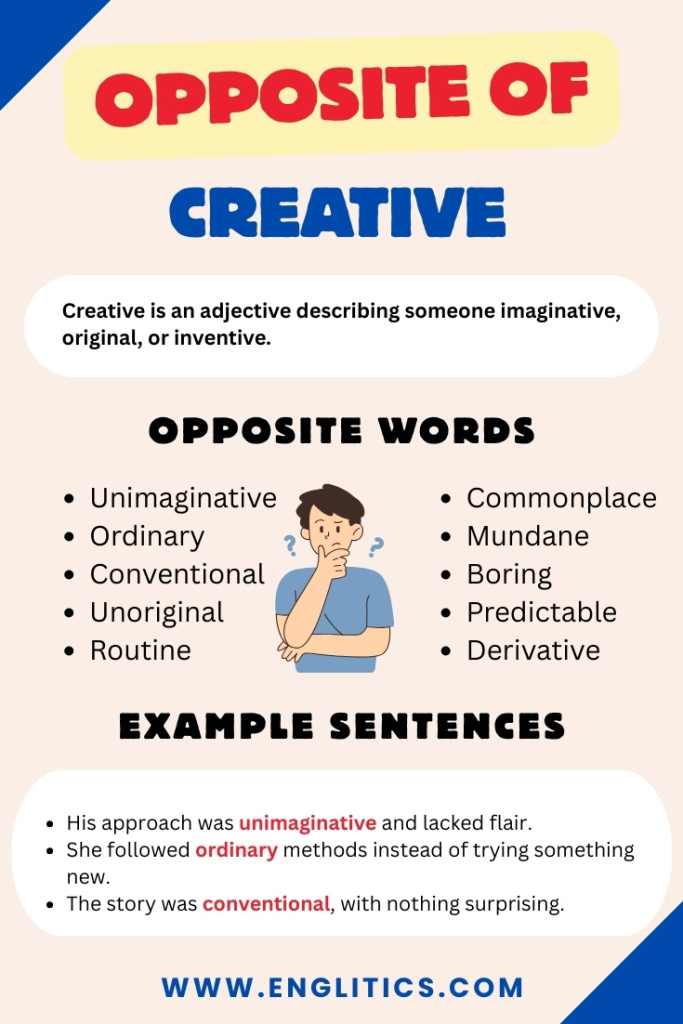
Antonyms for “creative” are words that convey the opposite of originality, inventiveness, and imagination. These words describe things that are commonplace, predictable, or lacking in innovation.
Understanding these antonyms is essential for expressing the absence of creativity and for making nuanced distinctions in language.
Common antonyms for “creative” include unimaginative, unoriginal, banal, mundane, routine, conventional, derivative, and sterile. Each of these words carries a slightly different connotation, allowing for precise communication depending on the specific context.
By exploring these antonyms, we can better understand the spectrum of possibilities between originality and commonplace existence. This understanding enriches our vocabulary and enhances our ability to articulate subtle differences in meaning.
Types of Antonyms
Antonyms can be classified into several types, each representing a different kind of opposition in meaning. Understanding these classifications can help in selecting the most appropriate antonym for “creative” in a given context.
Complementary Antonyms
Complementary antonyms are pairs of words where the absence of one implies the presence of the other. However, in the case of “creative,” there isn’t a single perfect complementary antonym in the strictest sense.
Something that isn’t creative can be described by various terms depending on *why* it isn’t creative. For example, something can be “unimaginative” (lacking imagination), “unoriginal” (lacking novelty), or “destructive” (actively opposing creativity).
The best fit depends on the specific context.
Gradable Antonyms
Gradable antonyms represent opposite ends of a spectrum. Many antonyms for “creative” fall into this category.
For example, “creative” and “unimaginative” are gradable antonyms because something can be more or less creative or imaginative. Other examples include “banal” and “inspired,” where varying degrees of originality exist between the two extremes.
Relational Antonyms
Relational antonyms describe a relationship where one word implies the other in reverse. These are less directly applicable to “creative” but can be relevant in certain contexts.
For instance, while “creator” and “destroyer” aren’t direct antonyms of “creative,” they represent opposing actions that relate to the concept of creation.
Examples of Antonyms for “Creative”
To fully understand the nuances of antonyms for “creative,” it’s essential to examine them in context. The following sections provide examples of how each antonym can be used in sentences and different scenarios.
Unimaginative
“Unimaginative” describes something lacking in imagination or originality. It suggests a failure to generate new or interesting ideas.
The table below provides 30 examples of how “unimaginative” can be used in sentences.
| Sentence |
|---|
| The presentation was unimaginative and failed to capture the audience’s attention. |
| His unimaginative approach to problem-solving yielded no innovative solutions. |
| The architect’s design was criticized for being unimaginative and lacking originality. |
| Her unimaginative writing style made the novel dull and predictable. |
| The company’s marketing campaign was unimaginative and failed to generate interest. |
| The child’s drawing, while neat, was somewhat unimaginative. |
| His unimaginative choice of career surprised everyone who knew his artistic talents. |
| The recipe was unimaginative, using only the most basic ingredients. |
| The party decorations were unimaginative and lacked any festive flair. |
| Her unimaginative response to the challenge showed a lack of resourcefulness. |
| The film’s plot was unimaginative, relying on tired clichés. |
| His unimaginative use of color made the painting appear lifeless. |
| The school’s curriculum was criticized for being unimaginative and stifling creativity. |
| Her unimaginative fashion sense made her blend into the background. |
| The politician’s speech was unimaginative, offering no new ideas. |
| The game’s design was unimaginative, failing to innovate in any meaningful way. |
| His unimaginative solution to the problem was the first one everyone thought of. |
| The restaurant’s menu was unimaginative, offering the same dishes as every other place in town. |
| Her unimaginative approach to decorating made the house feel sterile and unwelcoming. |
| The company’s innovation pipeline was dry, filled with unimaginative product ideas. |
| The project proposal was deemed too unimaginative to warrant funding. |
| His unimaginative gift choice revealed a lack of personal connection. |
| The unimaginative layout of the office space hindered collaboration. |
| Her unimaginative excuse for being late was met with skepticism. |
| The unimaginative marketing strategy failed to resonate with the target audience. |
| His unimaginative approach to teaching bored the students. |
| The unimaginative design of the website made it difficult to navigate. |
| Her unimaginative response to the job interview questions cost her the position. |
| The unimaginative use of resources led to inefficiencies and wasted time. |
| John’s unimaginative ideas for the party made it a complete bore. |
Unoriginal
“Unoriginal” means lacking novelty or inventiveness; copied or derived from something else.
The table below provides 30 examples of how “unoriginal” can be used in sentences.
| Sentence |
|---|
| The song was criticized for being unoriginal and sounding like countless others. |
| His unoriginal ideas were quickly dismissed by the team. |
| The artist’s work was considered unoriginal, lacking any unique style. |
| Her unoriginal approach to the problem yielded no new insights. |
| The company’s product was unoriginal and offered nothing new to the market. |
| The essay was unoriginal, simply regurgitating information from other sources. |
| His unoriginal presentation failed to impress the board. |
| The band’s music was unoriginal, borrowing heavily from other artists. |
| Her unoriginal fashion choices made her look like everyone else. |
| The film’s plot was unoriginal, following a predictable formula. |
| The design was unoriginal, lacking any innovative features. |
| His unoriginal contribution to the project was of little value. |
| The book was unoriginal, rehashing familiar themes and characters. |
| Her unoriginal ideas for the party were met with disappointment. |
| The play was unoriginal, offering nothing new to the audience. |
| The company’s marketing strategy was unoriginal, failing to stand out from the competition. |
| His unoriginal approach to leadership yielded stagnant results. |
| The restaurant’s menu was unoriginal, offering the same dishes as every other place in town. |
| Her unoriginal decorating style made the house look generic. |
| The company’s innovation pipeline was dry, filled with unoriginal product ideas. |
| The project proposal was deemed too unoriginal to warrant funding. |
| His unoriginal gift choice showed a lack of thoughtfulness. |
| The unoriginal layout of the office space hindered collaboration. |
| Her unoriginal excuse for being late was met with disbelief. |
| The unoriginal advertising campaign failed to attract new customers. |
| His unoriginal teaching methods failed to engage the students. |
| The unoriginal design of the website made it unappealing to users. |
| Her unoriginal response to the interview questions cost her the job. |
| The unoriginal use of resources led to inefficiencies and waste. |
| The movie’s plot was so unoriginal that I could predict every scene. |
Banal
“Banal” describes something so lacking in originality as to be obvious and boring.
The table below provides 30 examples of how “banal” can be used in sentences.
| Sentence |
|---|
| The movie’s plot was banal and predictable. |
| His conversation was filled with banal observations about the weather. |
| The song’s lyrics were banal and lacked any emotional depth. |
| Her writing style was banal, making the story uninteresting. |
| The conference speaker delivered a banal presentation that bored the audience. |
| The painting was banal, lacking any artistic merit. |
| His ideas were banal and offered nothing new to the discussion. |
| The restaurant’s decor was banal and uninspired. |
| Her fashion choices were banal, making her blend into the crowd. |
| The politician’s speech was filled with banal platitudes. |
| The advertisement was banal and failed to capture attention. |
| His jokes were banal and elicited no laughter. |
| The book’s plot was banal and predictable. |
| Her small talk was banal and unengaging. |
| The company’s marketing campaign was banal and ineffective. |
| His approach to management was banal, leading to stagnation. |
| The party was banal, with nothing to distinguish it from others. |
| Her compliments were banal and insincere. |
| The design of the website was banal and outdated. |
| His advice was banal, offering no real solutions. |
| The TV show’s premise was banal and quickly lost its appeal. |
| Her attempts at humor were banal and fell flat. |
| The office decor was banal, creating an uninspiring work environment. |
| His apologies were banal and lacked sincerity. |
| The product’s features were banal and offered nothing new. |
| Her attempts at leadership were banal, failing to motivate the team. |
| The event was banal, offering no memorable experiences. |
| His gestures of affection were banal and unromantic. |
| The game’s mechanics were banal, making it uninteresting to play. |
| The gift was so banal I couldn’t even pretend to be excited. |
Mundane
“Mundane” means lacking interest or excitement; dull.
The table below provides 30 examples of how “mundane” can be used in sentences.
| Sentence |
|---|
| His job consisted of mundane tasks like filing and data entry. |
| The novel described the mundane details of everyday life. |
| Her routine was mundane, with the same activities every day. |
| The meeting was filled with mundane discussions about office supplies. |
| The movie portrayed the mundane existence of a suburban family. |
| His life felt mundane, lacking any excitement or adventure. |
| The conversation was mundane, focusing on trivial matters. |
| Her writing style was mundane, making the story unengaging. |
| The presentation was mundane and failed to capture the audience’s attention. |
| The artwork was mundane, lacking any artistic expression. |
| His ideas were mundane and did not offer any innovation. |
| The restaurant’s atmosphere was mundane and uninviting. |
| Her fashion choices were mundane, making her blend into the crowd. |
| The politician’s speech was filled with mundane promises. |
| The advertisement was mundane and failed to attract customers. |
| His jokes were mundane and elicited no laughter. |
| The book’s plot was mundane and predictable. |
| Her small talk was mundane and boring. |
| The company’s marketing campaign was mundane and ineffective. |
| His approach to management was mundane, leading to stagnation. |
| The party was mundane, with nothing to distinguish it from others. |
| Her compliments were mundane and insincere. |
| The design of the website was mundane and outdated. |
| His advice was mundane, offering no real solutions. |
| The TV show’s premise was mundane and quickly lost its appeal. |
| Her attempts at humor were mundane and fell flat. |
| The office decor was mundane, creating an uninspiring work environment. |
| His apologies were mundane and lacked sincerity. |
| The product’s features were mundane and offered nothing new. |
| The chores around the house were quite mundane and tedious. |
Routine
“Routine” describes something done or occurring regularly or according to a fixed procedure.
The table below provides 30 examples of how “routine” can be used in sentences.
| Sentence |
|---|
| The job had become routine, with the same tasks every day. |
| Her daily routine included waking up at 6 AM and going for a run. |
| The medical checkup was a routine procedure. |
| His routine commute to work was always the same. |
| The company followed a routine process for handling customer complaints. |
| The soldier’s routine duties included guarding the base. |
| The pilot performed a routine pre-flight check. |
| The teacher followed a routine lesson plan. |
| Her routine exercise regimen kept her in good shape. |
| The factory workers performed routine tasks on the assembly line. |
| The software update was a routine maintenance task. |
| His routine behavior was predictable and unchanging. |
| The police officer conducted a routine traffic stop. |
| The librarian followed a routine for shelving books. |
| Her routine morning coffee was essential to start her day. |
| The accountant performed routine audits of the company’s finances. |
| The gardener followed a routine schedule for watering plants. |
| His routine response to stress was to take a walk. |
| The technician performed routine maintenance on the equipment. |
| Her routine evening ritual included reading before bed. |
| The security guard made routine patrols of the building. |
| His routine diet consisted of the same meals every week. |
| The cleaning staff followed a routine schedule for tidying the office. |
| Her routine phone call to her mother was a daily occurrence. |
| The data backup was a routine procedure performed every night. |
| His routine approach to problem-solving was methodical. |
| The chef followed a routine recipe for the restaurant’s signature dish. |
| Her routine visit to the gym was a regular part of her week. |
| The inspector performed a routine check of the safety equipment. |
| The process became so routine that everyone did it without thinking. |
Conventional
“Conventional” describes something based on or in accordance with what is generally done or believed.
The table below provides 30 examples of how “conventional” can be used in sentences.
| Sentence |
|---|
| The artist’s style was conventional and lacked originality. |
| His ideas were conventional and offered nothing new to the discussion. |
| The company followed a conventional approach to marketing. |
| Her fashion choices were conventional, adhering to traditional styles. |
| The politician’s speech was filled with conventional rhetoric. |
| The wedding was a conventional affair with traditional vows. |
| His behavior was conventional, following societal norms. |
| The book’s plot was conventional and predictable. |
| Her small talk was conventional and polite. |
| The company’s business practices were conventional and conservative. |
| His approach to management was conventional, favoring traditional methods. |
| The party was conventional, with standard decorations and music. |
| Her compliments were conventional and polite. |
| The design of the website was conventional and user-friendly. |
| His advice was conventional, offering standard solutions. |
| The TV show’s format was conventional and familiar. |
| Her attempts at humor were conventional and mild. |
| The office decor was conventional, creating a professional environment. |
| His apologies were conventional and expected. |
| The product’s features were conventional and reliable. |
| The architect chose a conventional design for the new office building. |
| Her conventional beliefs were challenged by her travels. |
| The conventional wisdom suggested investing in real estate. |
| His conventional upbringing shaped his conservative views. |
| The conventional approach to problem-solving didn’t work in this case. |
| Her conventional career path led to a stable but unexciting life. |
| The conventional classroom setup encouraged passive learning. |
| His conventional ideas about marriage were outdated. |
| The conventional method of cooking rice was simple and reliable. |
| The conventional way to greet someone is with a handshake. |
Derivative
“Derivative” describes something imitative of the work of another person, and usually disapproved of for that reason.
The table below provides 30 examples of how “derivative” can be used in sentences.
| Sentence |
|---|
| The artist’s work was derivative, clearly influenced by Van Gogh. |
| His ideas were derivative, simply rehashing old concepts. |
| The company’s product was derivative, lacking any original features. |
| Her writing style was derivative, imitating famous authors. |
| The film’s plot was derivative, borrowing heavily from other movies. |
| The design was derivative, copying elements from popular trends. |
| His music was derivative, sounding like countless other bands. |
| The play was derivative, lacking any unique voice. |
| Her fashion choices were derivative, following trends without originality. |
| The advertisement was derivative, copying successful campaigns. |
| His jokes were derivative, retelling old stories. |
| The book’s plot was derivative, rehashing familiar themes. |
| Her small talk was derivative, repeating common phrases. |
| The company’s marketing campaign was derivative and uninspired. |
| His approach to management was derivative, imitating successful leaders. |
| The party was derivative, copying themes from other events. |
| Her compliments were derivative, echoing common praise. |
| The design of the website was derivative and unoriginal. |
| His advice was derivative, repeating well-known wisdom. |
| The TV show’s format was derivative and predictable. |
| The architect’s design was considered derivative, lacking innovation. |
| Her derivative arguments failed to sway the jury. |
| The derivative nature of the research raised concerns about its validity. |
| His derivative approach to composing music stifled his creativity. |
| The derivative product offered no real advantage over its competitors. |
| Her derivative style of leadership lacked authenticity. |
| The derivative content on the website failed to attract visitors. |
| His derivative ideas were quickly dismissed by his colleagues. |
| The derivative nature of the artwork disappointed the critics. |
| The derivative arguments used in the debate were unconvincing. |
Sterile
“Sterile” describes something lacking in originality, imagination, or emotional content; uninspiring or unproductive.
The table below provides 30 examples of how “sterile” can be used in sentences.
| Sentence |
|---|
| The office environment was sterile and uninspiring. |
| The artist’s work was sterile, lacking emotion and originality. |
| His ideas were sterile, offering no innovation or creativity. |
| The company’s marketing campaign was sterile and ineffective. |
| Her writing style was sterile, making the story unengaging. |
| The film’s plot was sterile, lacking any emotional depth. |
| The design was sterile, lacking warmth and personality. |
| His music was sterile, sounding mechanical and lifeless. |
| The play was sterile, failing to connect with the audience. |
| Her fashion choices were sterile, lacking any personal flair. |
| The advertisement was sterile, failing to capture attention. |
| His jokes were sterile and elicited no laughter. |
| The book’s plot was sterile and predictable. |
| Her small talk was sterile and unengaging. |
| The company’s business practices were sterile and inflexible. |
| His approach to management was sterile, stifling creativity. |
| The party was sterile, lacking atmosphere and fun. |
| Her compliments were sterile and insincere. |
| The design of the website was sterile and uninviting. |
| His advice was sterile, offering no real solutions. |
| The presentation was sterile and failed to inspire the team. |
| Her sterile approach to problem-solving yielded no innovative results. |
| The sterile environment of the laboratory stifled creativity. |
| His sterile personality made it difficult to connect with him. |
| The sterile atmosphere of the meeting discouraged open communication. |
| Her sterile teaching methods failed to engage the students. |
| The sterile design of the product made it unappealing to consumers. |
| His sterile approach to leadership led to low morale. |
| The sterile content on the website failed to attract visitors. |
| The sterile nature of the debate made it uninteresting to follow. |
Understanding the nuances of when and how to use antonyms for “creative” is essential for effective communication. Here are some guidelines to ensure you use these words accurately and appropriately.
Consider the Context
The most suitable antonym for “creative” depends heavily on the context. For example, “unimaginative” might be appropriate when discussing a lack of inventive ideas, while “routine” might be better suited for describing a process that lacks innovation.
Correct: The project was unimaginative, lacking any new ideas.
Correct: The process had become routine, with no room for creativity.
Avoid Overlap
Some antonyms may seem interchangeable but carry different connotations. Be mindful of the subtle differences between words like “banal,” “mundane,” and “sterile” to choose the most precise term.
Correct: The conversation was banal, filled with predictable small talk.
Correct: The office environment was sterile, lacking any inspiration.
Use Antonyms to Emphasize Meaning
Antonyms can be powerful tools for emphasizing the absence of creativity. By contrasting a lack of originality with the expectation of it, you can create a stronger impact.
Correct: Despite the company’s reputation for innovation, their latest product was surprisingly unoriginal.
Common Mistakes
Even with a good understanding of antonyms, it’s easy to make mistakes in their usage. Here are some common pitfalls to avoid when using antonyms for “creative.”
Incorrectly Interchanging Antonyms
Using antonyms interchangeably without considering their specific meanings can lead to confusion. For instance, using “mundane” when you really mean “banal” can dilute your message.
Incorrect: The party was mundane, filled with predictable small talk.
Correct: The party was banal, filled with predictable small talk.
Overusing Negative Language
Relying too heavily on negative language can make your writing sound critical or pessimistic. Strive for a balanced approach by using antonyms judiciously.
Incorrect: Everything about the project was unimaginative, unoriginal, and sterile.
Correct: The project lacked originality and felt somewhat sterile.
Misunderstanding Connotations
Failing to recognize the connotations of different antonyms can lead to inappropriate word choices. For example, “derivative” implies imitation and may not be suitable if you simply mean “unoriginal.”
Incorrect: The artist’s style was derivative, even though he had never seen similar work.
Correct: The artist’s style was unoriginal, lacking a unique flair.
Practice Exercises
To solidify your understanding of antonyms for “creative,” try these practice exercises. Fill in the blanks with the most appropriate antonym from the list provided.
Word List: unimaginative, unoriginal, banal, mundane, routine, conventional, derivative, sterile
- The presentation was so __________ that the audience quickly lost interest.
- His __________ approach to problem-solving failed to produce any innovative solutions.
- The company’s new product was criticized for being __________ and lacking any unique features.
- Her daily __________ consisted of the same tasks, day in and day out.
- The artist’s work was considered __________ because it closely resembled the style of famous painters.
- The office environment was __________ and lacked any inspiring elements.
- The politician’s speech was filled with __________ platitudes that failed to resonate with voters.
- The movie’s plot was __________ and predictable, offering nothing new to viewers.
Answers:
- banal
- unimaginative
- unoriginal
- routine
- derivative
- sterile
- conventional
- mundane
Advanced Topics
For those looking to delve deeper into the concept of antonyms for “creative,” here are some advanced topics to explore.
The Role of Context in Meaning
Explore how the context in which a word is used can significantly alter its meaning and the appropriateness of its antonyms. Consider how cultural, social, and historical factors can influence the perception of creativity and its opposites.
The Subjectivity of Creativity
Discuss the subjective nature of creativity and how different individuals or groups may have varying definitions of what constitutes originality and innovation. This subjectivity can impact the choice of antonyms and their perceived accuracy.
The Relationship Between Creativity and Destruction
Examine the complex relationship between creativity and destruction. Consider how acts of destruction can sometimes pave the way for new creative endeavors, and how the antonyms for “creative” might apply in such scenarios.
FAQ
Are there any perfect antonyms for “creative”?
No single word serves as a perfect antonym for “creative” in all contexts. The best choice depends on the specific nuance you want to convey, such as a lack of imagination, originality, or inspiration.
Can “destructive” be considered an antonym for “creative”?
While not a direct antonym, “destructive” can be seen as an opposite force to creativity. Creativity is about building and innovating, while destruction is about tearing down.
However, the relationship is complex, as destruction can sometimes lead to new forms of creativity.
How do I choose the right antonym for “creative” in my writing?
Consider the specific aspect of creativity you want to negate. Are you referring to a lack of imagination (“unimaginative”), originality (“unoriginal”), or inspiration (“sterile”)?
Choose the word that most closely aligns with your intended meaning.
Is it possible for something to be both creative and conventional?
Yes, it is possible. Something can be creative within a conventional framework.
For example, a chef might create a new dish using conventional cooking techniques, or an artist might use traditional materials in an innovative way.
Conclusion
Understanding antonyms for “creative” is essential for precise and nuanced communication. By exploring words like “unimaginative,” “unoriginal,” “banal,” “mundane,” “routine,” “conventional,” “derivative,” and “sterile,” you can effectively describe situations, ideas, or individuals that lack originality and inventiveness.
Remember to consider the context, avoid overuse of negative language, and recognize the subtle differences between these terms to enhance your linguistic precision. With practice, you’ll be able to articulate the absence of creativity with clarity and confidence.