The opposite of skeptical is someone who trusts easily, believes quickly, or accepts things without doubt. While skeptical means questioning or not easily convinced, its opposites show openness and willingness to believe.
Antonyms for skeptical include words like trusting, gullible, believing, confident, and accepting. These words are often used to describe people who take things at face value or have strong faith in others. In this article, you’ll learn how to use these opposite words with clear examples and everyday contexts.
Definition of Skeptical
Skeptical, in its simplest form, means having doubts or reservations about something. It implies a questioning attitude, where one is not easily convinced or persuaded. A skeptical person requires evidence or logical reasoning before accepting a claim or idea as true. The term is derived from the Greek word “skeptikos,” referring to a school of philosophy that questioned the possibility of certain knowledge.
In everyday language, being skeptical can range from mild doubt to outright disbelief. A skeptical individual might express their reservations through questions, counter-arguments, or simply by withholding their agreement.
It’s important to note that skepticism is not necessarily negative; it can be a valuable tool for critical thinking and evaluating information objectively.
The level of skepticism can vary depending on the context and the individual’s personality. Some people are naturally more skeptical than others, while others may become skeptical in specific situations where they perceive a lack of credibility or trustworthiness.
Structural Breakdown of Skeptical
“Skeptical” is an adjective, meaning it modifies a noun or pronoun to describe a quality or characteristic. Its structure is relatively straightforward, derived from the noun “skeptic.” Here’s a breakdown:
- Root Word: Skeptic (noun): A person inclined to question or doubt accepted opinions.
- Suffix: -al (adjective suffix): Transforms the noun into an adjective.
Understanding the structural components helps in recognizing and remembering the meaning of “skeptical.” The adjective form allows it to be used in various sentence structures to describe someone’s attitude or disposition.
For example:
- “She was skeptical of his promises.” (Skeptical modifies “she,” describing her attitude.)
- “The audience remained skeptical despite the presentation.” (Skeptical describes the audience’s state.)
The word “skeptical” functions primarily as a descriptive adjective, conveying a sense of doubt or questioning. It is often used to indicate a lack of immediate acceptance or belief.
Opposite of Skeptical
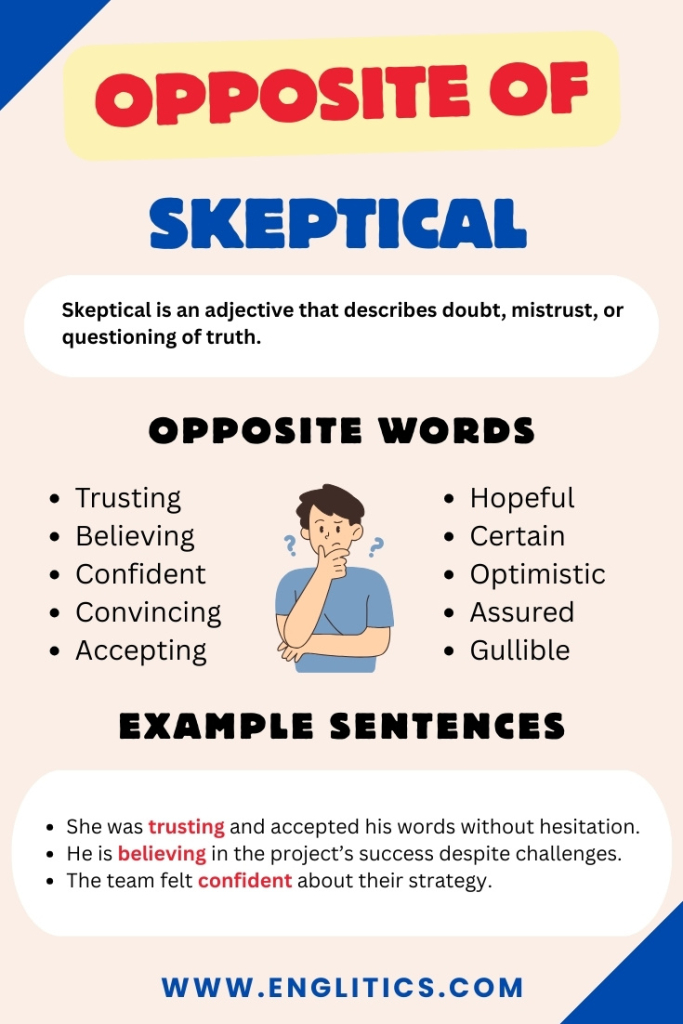
Antonyms for “skeptical” can be categorized based on the degree of certainty or belief they express. These categories help to provide a nuanced understanding of the different ways to convey the opposite of doubt.
1. Belief and Certainty
These antonyms indicate a strong conviction or confidence in something. They suggest a lack of doubt and a firm acceptance of an idea or claim.
2. Trust and Faith
These antonyms emphasize the act of believing in someone or something without necessarily requiring concrete proof. They imply a sense of reliance and confidence in the honesty or reliability of the subject.
3. Naivety and Gullibility
These antonyms suggest an uncritical acceptance of information or claims, often to the point of being easily deceived. They represent the opposite extreme of skepticism, where doubt is entirely absent.
4. Optimism and Hopefulness
These antonyms focus on a positive outlook or expectation, often involving a belief that things will turn out well. They imply a lack of skepticism towards future outcomes.
Examples of Antonyms in Sentences
The following tables provide examples of antonyms for “skeptical” used in various sentences, categorized by the types discussed above. Each table contains 20-30 examples to illustrate the different contexts and nuances of these antonyms.
Table 1: Belief and Certainty
This table showcases antonyms that express strong belief and certainty, indicating a firm conviction and lack of doubt.
| Sentence with “Skeptical” | Sentence with Antonym (Belief/Certainty) |
|---|---|
| She was skeptical of his claims about winning the lottery. | She was certain of his claims about winning the award. |
| The scientists remained skeptical of the new theory. | The scientists were convinced of the new theory. |
| He was skeptical that the project would succeed. | He was confident that the project would succeed. |
| They were skeptical of the politician’s promises. | They were assured of the politician’s commitment. |
| I am skeptical about the truth of the story. | I am positive about the truth of the story. |
| The investors were skeptical of the startup’s potential. | The investors were firm in their belief in the startup’s potential. |
| She approached the situation with a skeptical attitude. | She approached the situation with a believing attitude. |
| The team was skeptical of the new strategy’s effectiveness. | The team was sure of the new strategy’s effectiveness. |
| He remained skeptical even after seeing the evidence. | He remained certain even after the initial setback. |
| They expressed skeptical views about the economic forecast. | They expressed confident views about the economic forecast. |
| The journalist was skeptical of the official statement. | The journalist was certain of the official’s honesty. |
| I was skeptical about the possibility of rain. | I was convinced about the possibility of sunshine. |
| She was skeptical of the doctor’s diagnosis. | She was confident in the doctor’s expertise. |
| The audience was skeptical of the magician’s trick. | The audience was amazed by the magician’s trick. |
| He was skeptical that they could finish on time. | He was certain that they could finish ahead of schedule. |
| They were skeptical about the long-term benefits. | They were assured of the long-term advantages. |
| I am skeptical of his intentions. | I am confident in his good intentions. |
| The board was skeptical of the proposed merger. | The board was convinced the merger was beneficial. |
| She was skeptical about the effectiveness of the treatment. | She was confident about the effectiveness of the treatment. |
| The voters were skeptical of the candidate’s promises. | The voters were assured of the candidate’s integrity. |
| He was skeptical of the online reviews. | He was certain the online reviews were accurate. |
| They were skeptical of the government’s report. | They were convinced the government’s report was truthful. |
| I was skeptical about the feasibility of the plan. | I was confident about the feasibility of the plan. |
Table 2: Trust and Faith
This table illustrates antonyms that convey trust and faith, suggesting a belief in someone or something without requiring absolute proof.
| Sentence with “Skeptical” | Sentence with Antonym (Trust/Faith) |
|---|---|
| She was skeptical of his motives. | She trusted his motives implicitly. |
| He was skeptical of the stranger’s offer. | He had faith in the stranger’s good intentions. |
| They were skeptical of the company’s claims. | They believed the company’s claims wholeheartedly. |
| I am skeptical about his ability to deliver. | I have confidence in his ability to deliver. |
| The followers were skeptical of the guru’s teachings. | The followers had faith in the guru’s teachings. |
| She was skeptical of his honesty. | She trusted him completely. |
| He was skeptical of the system’s fairness. | He had faith in the system’s integrity. |
| They were skeptical of the witness’s testimony. | They believed the witness’s testimony without question. |
| I am skeptical about his commitment to the cause. | I have confidence in his commitment to the cause. |
| The patient was skeptical of the new treatment. | The patient had faith in the new treatment’s potential. |
| She was skeptical of his explanation. | She trusted his explanation without hesitation. |
| He was skeptical of the government’s policies. | He had faith in the government’s leadership. |
| They were skeptical of the project’s timeline. | They believed in the project’s feasibility. |
| I am skeptical of his leadership skills. | I have confidence in his leadership skills. |
| The community was skeptical of the developer’s promises. | The community had faith in the developer’s vision. |
| She was skeptical of his friendship. | She trusted his friendship implicitly. |
| He was skeptical of the organization’s motives. | He had faith in the organization’s purpose. |
| They were skeptical of the artist’s vision. | They believed in the artist’s talent. |
| I am skeptical of his business acumen. | I have confidence in his business acumen. |
| The team was skeptical of the coach’s strategy. | The team had faith in the coach’s guidance. |
| She was skeptical of his intentions. | She trusted his intentions were honorable. |
| He was skeptical of the source of information. | He had faith in the source’s reliability. |
| They were skeptical of the potential outcome. | They believed in the possibility of success. |
Table 3: Naivety and Gullibility
This table presents antonyms that express naivety and gullibility, representing an uncritical acceptance of information, sometimes leading to being easily deceived.
| Sentence with “Skeptical” | Sentence with Antonym (Naivety/Gullibility) |
|---|---|
| She was skeptical of the email scam. | She naively fell for the email scam. |
| He was skeptical of the get-rich-quick scheme. | He gullibly invested in the get-rich-quick scheme. |
| They were skeptical of the fake news story. | They credulously believed the fake news story. |
| I am skeptical of his unbelievable story. | I ingenuously accepted his unbelievable story. |
| The experienced investor was skeptical of the pitch. | The novice investor uncritically embraced the pitch. |
| She was skeptical of the street vendor’s claims. | She trustingly bought the street vendor’s product. |
| He was skeptical of the fortune teller’s predictions. | He naively believed the fortune teller’s predictions. |
| They were skeptical of the politician’s empty promises. | They gullibly supported the politician’s empty promises. |
| I am skeptical of the online advertisement. | I credulously clicked on the online advertisement. |
| The wise man was skeptical of the flattery. | The fool uncritically accepted the flattery. |
| She was skeptical of the door-to-door salesman. | She trustingly invited the door-to-door salesman inside. |
| He was skeptical of the miracle cure. | He naively hoped for the miracle cure to work. |
| They were skeptical of the exaggerated testimonials. | They gullibly relied on the exaggerated testimonials. |
| I am skeptical of the urban legend. | I credulously spread the urban legend. |
| The detective was skeptical of the suspect’s alibi. | The officer uncritically accepted the suspect’s alibi. |
| She was skeptical of the anonymous tip. | She trustingly acted on the anonymous tip. |
| He was skeptical of the chain letter’s promises. | He naively forwarded the chain letter. |
| They were skeptical of the conspiracy theory. | They gullibly promoted the conspiracy theory. |
| I am skeptical of the tall tale. | I credulously listened to the tall tale. |
| The judge was skeptical of the witness’s account. | The jury uncritically accepted the witness’s account. |
| She was skeptical of the free offer. | She trustingly provided her personal information for the free offer. |
| He was skeptical of the sales pitch. | He naively signed up for the service after the sales pitch. |
| They were skeptical of the online survey’s results. | They gullibly believed the online survey’s claims. |
Table 4: Optimism and Hopefulness
This table features antonyms that express optimism and hopefulness, indicating a positive outlook and expectation, often lacking skepticism about future outcomes.
| Sentence with “Skeptical” | Sentence with Antonym (Optimism/Hopefulness) |
|---|---|
| She was skeptical about the chances of recovery. | She was optimistic about the chances of recovery. |
| He was skeptical that the project would be completed on time. | He was hopeful that the project would be completed on time. |
| They were skeptical of the peace talks’ success. | They were sanguine about the peace talks’ success. |
| I am skeptical of the company’s future prospects. | I am bullish about the company’s future prospects. |
| The team was skeptical of winning the championship. | The team was confident about winning the championship. |
| She was skeptical of finding a solution to the problem. | She was hopeful of finding a solution to the problem. |
| He was skeptical of the weather improving. | He was optimistic that the weather would improve. |
| They were skeptical of the negotiation’s outcome. | They were positive about the negotiation’s outcome. |
| I am skeptical of the possibility of a breakthrough. | I am hopeful for the possibility of a breakthrough. |
| The community was skeptical of the city’s revitalization. | The community was optimistic about the city’s revitalization. |
| She was skeptical of his return. | She was hopeful that he would return. |
| He was skeptical of the market’s recovery. | He was optimistic about the market’s recovery. |
| They were skeptical of the new policy’s impact. | They were positive that new policy would impact. |
| I am skeptical of things getting better. | I am hopeful of things getting better. |
| The fans were skeptical of the team’s performance. | The fans were optimistic about the team’s performance. |
| She was skeptical of a positive change. | She was hopeful of a positive change. |
| He was skeptical of the program’s benefits. | He was optimistic about the program’s benefits. |
| They were skeptical of the peace agreement. | They were confident about the peace agreement. |
| I am skeptical of the project’s success. | I am hopeful of the project’s success. |
| The students were skeptical of the test results. | The students were optimistic about the test results. |
| She was skeptical of his support. | She was hopeful he would always support her. |
| He was skeptical of a positive outcome. | He was optimistic about the potential outcome. |
| They were skeptical of the relationship lasting. | They were hopeful the relationship would last. |
Usage Rules for Antonyms of Skeptical
Using antonyms correctly requires an understanding of the nuances and contexts in which they are appropriate. Here are some general rules for using antonyms of “skeptical”:
- Context is Key: The best antonym depends on what aspect of skepticism you want to negate. If you want to emphasize belief, use “certain” or “convinced.” If you want to highlight trust, use “trusting” or “believing.”
- Avoid Overgeneralization: “Trusting” and “naive” are not always interchangeable. “Trusting” implies a reasonable level of faith, while “naive” suggests a lack of critical thinking.
- Consider the Degree: Some antonyms express a stronger degree of certainty than others. “Certain” is stronger than “hopeful,” for example.
- Be Aware of Connotations: Some antonyms have negative connotations. “Gullible” suggests a lack of intelligence or discernment.
Example:
Incorrect: “She was skeptical of the offer, so she was gullible.”
Correct: “She was skeptical of the offer, but he was gullible and accepted it immediately.”
In the incorrect example, “gullible” doesn’t logically follow “skeptical.” The correct example clarifies that someone else’s gullibility contrasts with her skepticism.
Common Mistakes When Using Antonyms of Skeptical
Several common mistakes can occur when using antonyms of “skeptical.” Being aware of these pitfalls can help you avoid errors and communicate more effectively.
- Confusing “Trusting” with “Naive”: “Trusting” implies a reasonable belief, while “naive” suggests a lack of critical judgment.
- Using “Certain” When “Hopeful” is More Appropriate: “Certain” implies a strong conviction, whereas “hopeful” conveys a desire for a positive outcome without absolute assurance.
- Overusing “Believing” as a General Antonym: While “believing” is a valid antonym, it can be too broad. Choose a more specific antonym that reflects the context, such as “trusting,” “convinced,” or “certain.”
- Ignoring the Negative Connotations of “Gullible”: “Gullible” often carries a negative connotation, implying a lack of intelligence. Use it carefully and consider alternatives like “trusting” or “credulous” if the negative connotation is not intended.
Examples of Incorrect vs. Correct Usage:
| Incorrect | Correct | Explanation |
|---|---|---|
| He was skeptical, so he was very gullible. | He was skeptical, but his friend was very gullible. | “Gullible” doesn’t logically follow skepticism for the same person. |
| She was skeptical of the weather, so she was certain it would rain. | She was skeptical of the weather, but she was hopeful it would be sunny. | “Hopeful” is a better antonym in this context, as it expresses a desire for a positive outcome. |
| He was skeptical of the story, so he was believing. | He was skeptical of the story, so he was trusting of the storyteller. | “Trusting” is more specific, highlighting the faith in the storyteller rather than just general belief. |
Practice Exercises
Test your understanding of the antonyms of “skeptical” with these practice exercises. Choose the best antonym to complete each sentence.
Exercise 1: Fill in the Blanks
Choose the best word from the list below to complete each sentence. (Words: certain, trusting, naive, optimistic, convinced)
| Question | Answer |
|---|---|
| 1. She was skeptical of his promises, but I was ________ that he would deliver. | certain |
| 2. He was skeptical of the stranger’s offer, but she was ________ and accepted it immediately. | trusting |
| 3. They were skeptical of the new policy, but the government was ________ it would improve the economy. | convinced |
| 4. I am skeptical that we will finish on time, but my boss is ________ that we can do it. | optimistic |
| 5. She was skeptical of the email scam, but he was ________ enough to fall for it. | naive |
| 6. The audience was skeptical of the speaker’s claims, but I was ______ he was telling the truth. | convinced |
| 7. He was skeptical of the advertisement, but his son was ______ and wanted to buy the product. | trusting |
| 8. The team was skeptical of their chances of winning, but the coach was ______ they would succeed. | optimistic |
| 9. She was skeptical of the long-term benefits, but the consultant was ______ the investment would pay off. | certain |
| 10. He was skeptical of the website’s security, but she was ______ and entered her credit card information anyway. | naive |
Exercise 2: Multiple Choice
Choose the best antonym for “skeptical” in each sentence.
| Question | Options | Answer |
|---|---|---|
| 1. Because she was skeptical of his intentions, she was not ________ of his motives. | a) doubtful b) certain c) unsure d) wary | b) certain |
| 2. He was skeptical of the project’s success, but I remained ________. | a) pessimistic b) hopeful c) cynical d) dubious | b) hopeful |
| 3. They were skeptical of the company’s claims, but the investors were ________. | a) suspicious b) trusting c) doubtful d) hesitant | b) trusting |
| 4. I am skeptical of his ability to deliver; I am not ________ he can do it. | a) uncertain b) convinced c) hesitant d) dubious | b) convinced |
| 5. She was skeptical of the sales pitch, but her friend was ________ and bought the product. | a) cynical b) naive c) doubtful d) wary | b) naive |
| 6. Due to their skepticism of the evidence, they weren’t _______. | a) believing b) doubting c) questioning d) unsure | a) believing |
| 7. The CEO was skeptical of the data, but the board was _____. | a) dubious b) wary c) assured d) hesitant | c) assured |
| 8. I was skeptical of the outcome, while he was quite _____. | a) pessimistic b) cynical c) optimistic d) doubtful | c) optimistic |
| 9. They were skeptical of the proposal, but the manager was _____. | a) wary b) hesitant c) trusting d) unsure | c) trusting |
| 10. The community was skeptical, but the leader was _____. | a) doubtful b) dubious c) convinced d) uncertain | c) convinced |
Advanced Topics
For advanced learners, exploring the philosophical implications of skepticism and its antonyms can provide a deeper understanding of their usage and significance. Skepticism, as a philosophical stance, questions the possibility of attaining certain knowledge.
Exploring the nuances of belief, trust, and certainty in different philosophical frameworks can enhance your command of these concepts.
Consider the concept of “fideism,” which emphasizes the importance of faith over reason in certain domains. Understanding fideism can shed light on situations where “faith” or “belief” might be more appropriate antonyms for “skeptical” than “certainty” or “conviction.”
Furthermore, examining the role of skepticism in scientific inquiry can provide valuable insights. While scientists are often skeptical of new claims until they are supported by evidence, they also maintain a degree of openness to new possibilities.
This balance between skepticism and openness is crucial for scientific progress.
Frequently Asked Questions
- What is the primary meaning of “skeptical”?
The primary meaning of “skeptical” is having doubts or reservations about something; not easily convinced without evidence or logical reasoning. - Is “skeptical” always a negative trait?
No, “skeptical” is not always negative. It can be a valuable tool for critical thinking and evaluating information objectively, helping to avoid accepting false or misleading claims. - What is the difference between “trusting” and “naive”?
“Trusting” implies a reasonable level of faith or belief in someone or something, while “naive” suggests an uncritical acceptance of information or claims, often to the point of being easily deceived. - When is it appropriate to use “hopeful” as an antonym for “skeptical”?
“Hopeful” is appropriate when you want to express a positive outlook or expectation, often involving a belief that things will turn out well, without necessarily having absolute certainty. - Can “certain” and “convinced” be used interchangeably as antonyms for “skeptical”?
While both “certain” and “convinced” express a strong belief, “certain” implies an unwavering conviction, while “convinced” suggests that one has been persuaded by evidence or reasoning. They can often be used interchangeably, but “convinced” is more appropriate when the belief is a result of persuasion. - How does the context influence the choice of antonym for “skeptical”?
The context is crucial in determining the most appropriate antonym. If the focus is on belief, “certain” or “convinced” might be best. If the emphasis is on faith, “trusting” or “believing” might be more suitable. If the situation involves a positive outlook, “hopeful” or “optimistic” could be the best choice. - What are some common situations where skepticism is beneficial?
Skepticism is beneficial in situations where there is a risk of being deceived or manipulated, such as evaluating marketing claims, assessing the credibility of sources, and making important decisions based on information. - How can I improve my ability to use antonyms of “skeptical” effectively?
To improve your usage of antonyms of “skeptical,” practice using them in different contexts, pay attention to the nuances of each word, and seek feedback from others on your writing and speaking. Reading widely and expanding your vocabulary will also help.
Conclusion
Mastering the antonyms of “skeptical” is an essential step in enhancing your vocabulary and improving your ability to express nuanced opinions and beliefs. By understanding the different categories of antonyms, such as belief, trust, naivety, and optimism, you can choose the most appropriate word to convey your intended meaning with precision.
Remember that context is key when selecting an antonym. Consider the specific situation and the aspect of skepticism you want to negate.
Avoid common mistakes like confusing “trusting” with “naive” or overusing “believing” as a general antonym. Practice using these antonyms in various sentences and seek feedback to refine your usage.
By incorporating these strategies into your learning, you can confidently express a wide range of attitudes and beliefs, enhancing your communication skills and deepening your understanding of the English language. Keep practicing and exploring new words to continue expanding your vocabulary and linguistic abilities.