The Opposite of Ample points to something limited, scarce, or insufficient. While “ample” suggests more than enough space, time, or quantity, its opposite highlights a shortage or a tight constraint.
Antonyms for Ample include scarce, meager, and insufficient. For example, instead of having ample time to finish homework, a student with a meager schedule might rush. A scarce food supply may not meet everyone’s needs. If resources are insufficient, plans or goals may fall short.
Whether you’re a student, writer, or language enthusiast, this comprehensive guide will equip you with the knowledge to use these words effectively.
Introduction
A rich vocabulary is essential for effective communication. Knowing the nuances of words and their opposites allows you to express yourself with clarity and precision.
This article focuses on exploring the antonyms of “ample,” a word often used to describe abundance or plenty. By understanding the words that stand in contrast to “ample,” you can better articulate situations where resources are limited, quantities are insufficient, or scarcity prevails.
This exploration will enhance your ability to convey complex ideas and improve your overall language proficiency. Whether you’re preparing for an exam, writing a report, or simply looking to expand your vocabulary, this guide will provide valuable insights and practical exercises.
Definition of “Ample”
The word “ample” is an adjective that describes something as being more than enough, plentiful, or abundant. It implies that there is a sufficient or even generous supply of something.
“Ample” can refer to both tangible and intangible things, such as “ample food,” “ample time,” or “ample opportunities.” It suggests a state of having enough and often more than what is strictly necessary.
The Merriam-Webster dictionary defines “ample” as “generously sufficient to satisfy a requirement” or “more than adequate.” The Oxford English Dictionary defines it as “enough or more than enough; plentiful.” These definitions highlight the core meaning of abundance and sufficiency that is central to the word’s usage. In essence, “ample” conveys the idea of having a surplus or a comfortable amount of something.
Structural Breakdown
The word “ample” originates from the Latin word “amplus,” which means large, spacious, or abundant. This Latin root provides insight into the word’s fundamental meaning of spaciousness and plenty.
Understanding the etymology of “ample” can help you remember its definition and use it more effectively. The word has maintained its core meaning throughout its evolution, consistently referring to a state of abundance or sufficiency.
Structurally, “ample” is an adjective, meaning it modifies nouns. It can be used in various sentence structures to describe the quantity, size, or extent of something.
For example, you might say, “The garden provided an ample harvest this year,” where “ample” modifies the noun “harvest.” Alternatively, you could say, “There is ample room in the car,” where “ample” modifies the noun “room.” Its grammatical function is to provide additional information about the noun it modifies, indicating that there is more than enough of it.
Types and Categories of Antonyms
Antonyms of “ample” can be categorized based on the specific nuance they convey. These categories include antonyms related to scarcity, limited quantity, and insufficiency.
Each category offers a slightly different perspective on the opposite of abundance, allowing for more precise expression.
Antonyms Related to Scarcity
Antonyms in this category emphasize the idea of something being rare or difficult to find. They suggest that the available amount is significantly less than what is needed or desired.
Words like “scarce,” “rare,” and “deficient” fall into this category. These terms highlight the lack of availability and the potential challenges associated with obtaining the resource in question.
For example, “Water was scarce during the drought” illustrates the dire situation caused by the lack of water.
Antonyms Related to Limited Quantity
This category includes words that indicate the presence of something in a restricted or finite amount. Words like “limited,” “restricted,” and “finite” suggest that the quantity is not abundant and may be subject to constraints.
These terms often imply that the available amount is enough for some purposes but not necessarily for all. For example, “The number of tickets available was limited” indicates that there were only a certain number of tickets available, potentially creating competition for them.
Antonyms Related to Insufficiency
These antonyms focus on the idea of something not being enough to meet a particular need or requirement. Words like “insufficient,” “inadequate,” and “meager” suggest that the available amount is less than what is necessary or desired.
These terms often carry a negative connotation, implying that the lack of abundance has a detrimental effect. For example, “The funding was insufficient to complete the project” highlights the problem of not having enough money to finish the task.
Opposite of Ample
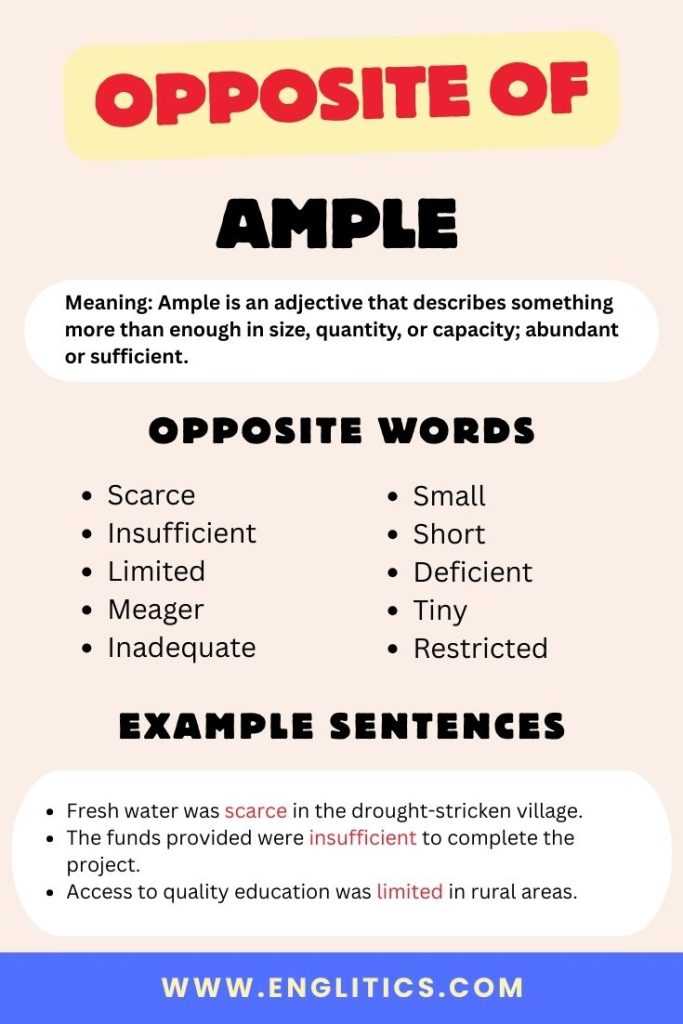
To illustrate the usage of antonyms for “ample,” we’ll provide examples in each category. These examples will demonstrate how these words can be used in different contexts to express the opposite of abundance.
Examples Using Antonyms Related to Scarcity
The following table provides examples of using antonyms related to scarcity in sentences. Each example demonstrates how the antonym is used to convey the idea of something being rare or difficult to find.
| Antonym | Example Sentence |
|---|---|
| Scarce | During the drought, water was scarce, and people had to conserve every drop. |
| Rare | Genuine kindness is a rare commodity in today’s competitive world. |
| Deficient | The soil was deficient in nutrients, resulting in a poor harvest. |
| Wanting | The performance was wanting in enthusiasm and energy. |
| Lacking | The recipe was lacking a key ingredient, so the dish didn’t turn out as expected. |
| Limited | Job opportunities were limited in the small town. |
| Restricted | Access to the area was restricted due to the ongoing investigation. |
| Tight | The budget was tight, so we had to cut back on expenses. |
| Dearth | There is a dearth of skilled workers in this industry. |
| Paucity | The paucity of evidence made it difficult to prove the case. |
| Exiguous | The amount of rainfall this year has been exiguous. |
| Insufficient | The funds were insufficient to complete the project. |
| Inadequate | The training was inadequate for the complex tasks ahead. |
| Meager | The refugees survived on a meager ration of food. |
| Skimpy | The portion sizes at the restaurant were disappointingly skimpy. |
| Minimal | The effort put in by the team was minimal. |
| Sparse | The vegetation was sparse in the desert region. |
| Scant | There was scant evidence to support the claim. |
| Reduced | The number of employees was reduced due to budget cuts. |
| Atypical | The number of people exhibiting those symptoms was atypical for the region. |
| Singular | The number of people exhibiting those symptoms was singular for the region. |
| Isolated | The number of people exhibiting those symptoms was isolated for the region. |
| Modest | The company reported a modest profit this quarter. |
| Miniature | The garden was miniature, hardly enough room to grow anything. |
| Minute | The amount of time we had to complete the task was minute. |
Examples Using Antonyms Related to Limited Quantity
The following table provides examples of using antonyms related to limited quantity in sentences. Each example demonstrates how the antonym is used to convey the idea of something being available in a restricted amount.
| Antonym | Example Sentence |
|---|---|
| Limited | The number of tickets available was limited, so you should book early. |
| Restricted | Access to the construction site was restricted to authorized personnel. |
| Finite | We have a finite amount of resources, so we need to use them wisely. |
| Measured | The ingredients were carefully measured to ensure the recipe’s success. |
| Calculated | The risks were carefully calculated before proceeding with the investment. |
| Fixed | The budget for the project was fixed and could not be exceeded. |
| Defined | The project’s scope was clearly defined from the outset. |
| Bounded | The land was bounded by a river on one side and a forest on the other. |
| Specified | The requirements for the job were clearly specified in the job description. |
| Circumscribed | His authority was circumscribed by the company’s policies. |
| Controlled | The spread of the virus was controlled through strict quarantine measures. |
| Regulated | The industry is heavily regulated to protect consumers. |
| Curtailed | Our vacation was curtailed due to unforeseen circumstances. |
| Abbreviated | The presentation was abbreviated due to time constraints. |
| Condensed | The report was condensed into a brief summary. |
| Precise | The measurements were precise to ensure accuracy. |
| Exact | The time of the meeting was set at an exact time. |
| Particular | There were particular reasons why the project was delayed. |
| Individual | Each individual received a personalized gift. |
| Singular | Each singular item was carefully inspected. |
| Lone | Only a lone tree stood in the field. |
| Odd | An odd number of seats remained. |
| Seldom | His visits were seldom. |
| Rarely | His visits were rarely. |
| Erratic | The supply of power was erratic. |
| Variable | The supply of power was variable. |
Examples Using Antonyms Related to Insufficiency
The following table provides examples of using antonyms related to insufficiency in sentences. Each example demonstrates how the antonym is used to convey the idea of something not being enough to meet a particular need.
| Antonym | Example Sentence |
|---|---|
| Insufficient | The funding was insufficient to cover all the expenses. |
| Inadequate | The training provided was inadequate for the complexity of the task. |
| Meager | The refugees had to survive on a meager amount of food. |
| Deficient | His diet was deficient in essential vitamins and minerals. |
| Inappreciable | The change in temperature was inappreciable. |
| Skimpy | The portions served at the restaurant were disappointingly skimpy. |
| Minimal | The effort put in by the team was minimal, leading to poor results. |
| Lacking | The report was lacking in detail and analysis. |
| Wanting | The performance was wanting in energy and enthusiasm. |
| Short | We were short on time, so we had to rush through the presentation. |
| Poor | The quality of the product was poor, leading to customer complaints. |
| Weak | The economy was weak, resulting in high unemployment rates. |
| Feeble | His attempts to defend himself were feeble and unconvincing. |
| Fragile | The agreement between the two countries was fragile and easily broken. |
| Unsound | The foundation of the building was unsound, posing a safety risk. |
| Emaciated | The stray dog was found emaciated and in desperate need of food. |
| Thin | The soup was thin and watery, lacking substance. |
| Spare | The furniture was spare and functional, with no unnecessary frills. |
| Barren | The landscape was barren and desolate, with no signs of life. |
| Vacant | The house was vacant and abandoned. |
| Shallow | The lake was shallow. |
| Petty | His concerns were petty. |
| Trivial | His concerns were trivial. |
| Insignificant | His concerns were insignificant. |
| Negligible | His concerns were negligible. |
Usage Rules for Antonyms of “Ample”
When using antonyms of “ample,” it’s essential to consider the context and the specific nuance you want to convey. Each antonym carries a slightly different meaning, and choosing the right word can significantly impact the clarity and accuracy of your communication.
For example, if you want to emphasize the rarity of something, “scarce” or “rare” would be more appropriate than “insufficient.” If you want to highlight that something is not enough to meet a particular need, “insufficient” or “inadequate” would be more suitable. Similarly, if you want to indicate that something is available in a restricted amount, “limited” or “restricted” would be the best choice.
Pay attention to the connotations of each word and select the one that best fits the intended meaning.
Additionally, be aware of the grammatical rules governing the use of adjectives. Antonyms of “ample,” being adjectives, should be placed before the noun they modify or after a linking verb.
For instance, you can say “scarce resources” or “the resources are scarce.” Ensure that the adjective agrees in number and gender with the noun it modifies, if applicable in the language you are using.
Common Mistakes When Using Antonyms of “Ample”
One common mistake is using antonyms of “ample” interchangeably without considering their subtle differences in meaning. For example, using “insufficient” when “scarce” is more appropriate, or vice versa.
This can lead to confusion and miscommunication.
Another common mistake is using the wrong grammatical form of the antonym. For example, using an adjective as a noun or vice versa.
Always ensure that you are using the correct part of speech and that it agrees with the rest of the sentence.
Here are some examples of common mistakes and their corrections:
| Incorrect | Correct | Explanation |
|---|---|---|
| The food was scarce, so we felt insufficient. | The food was scarce, so we felt hungry. | “Insufficient” doesn’t directly relate to feeling hungry due to scarcity. |
| The limited of time made it difficult. | The limited amount of time made it difficult. | “Limited” is an adjective and needs a noun to modify, such as “amount.” |
| Insufficiently, we had funds. | Insufficiently, we had funds. OR We had insufficient funds. | “Insufficiently” is an adverb, but the sentence needs an adjective to describe “funds.” |
Practice Exercises
Test your understanding of the antonyms of “ample” with the following exercises. Choose the most appropriate antonym from the options provided to complete each sentence.
Exercise 1:
| Question | Options | Answer |
|---|---|---|
| Due to the drought, water was extremely _____. | a) ample, b) scarce, c) sufficient, d) adequate | b) scarce |
| The _____ amount of evidence made it difficult to convict the suspect. | a) ample, b) limited, c) abundant, d) plentiful | b) limited |
| The _____ funding meant that the project could not be completed. | a) ample, b) insufficient, c) generous, d) bountiful | b) insufficient |
| His knowledge of the subject was _____, leading to many errors. | a) ample, b) inadequate, c) extensive, d) copious | b) inadequate |
| The _____ portions at the restaurant left us feeling hungry. | a) ample, b) skimpy, c) generous, d) abundant | b) skimpy |
| The number of available scholarships was quite _____. | a) ample, b) restricted, c) numerous, d) copious | b) restricted |
| The soil was _____ in nutrients, hindering the growth of the plants. | a) ample, b) deficient, c) rich, d) abundant | b) deficient |
| The _____ amount of rainfall led to a severe drought. | a) ample, b) scarce, c) abundant, d) plentiful | b) scarce |
| The _____ resources forced the company to downsize its operations. | a) ample, b) limited, c) extensive, d) generous | b) limited |
| The _____ supply of medical equipment hampered the relief efforts. | a) ample, b) insufficient, c) abundant, d) plentiful | b) insufficient |
Exercise 2:
Fill in the blanks with the most appropriate antonym of “ample” from the list: scarce, limited, insufficient, inadequate, skimpy.
- Due to budget cuts, the resources available to the department were _____.
- The _____ amount of time we had to complete the project made it extremely challenging.
- The _____ portions served at the cafeteria left many students feeling unsatisfied.
- The training provided to the new recruits was _____, leaving them unprepared for the job.
- During the economic crisis, jobs were _____ and difficult to find.
Answers:
- limited
- insufficient
- skimpy
- inadequate
- scarce
Advanced Topics
For advanced learners, exploring the nuances of antonyms in different contexts and literary devices can be beneficial. Consider how antonyms are used in rhetoric to create contrast and emphasize certain points.
For example, the use of antithesis, where contrasting ideas are presented in parallel structure, can be a powerful tool for persuasion.
Additionally, delve into the philosophical implications of antonyms. Explore how the concept of opposites is used in various philosophical systems to understand the nature of reality and the relationship between different concepts.
For example, the concept of yin and yang in Taoism emphasizes the complementary nature of opposites.
Finally, investigate the use of antonyms in different languages. Compare how different languages express the opposite of “ample” and consider the cultural implications of these differences.
This can provide valuable insights into the diversity of human thought and expression.
Frequently Asked Questions
- What is the importance of learning antonyms?Learning antonyms is crucial for expanding your vocabulary, improving your communication skills, and enhancing your understanding of language nuances. It allows you to express contrasting ideas with precision and clarity.
- How do I choose the right antonym for “ample” in a given context?Consider the specific nuance you want to convey. If you want to emphasize rarity, use “scarce” or “rare.” If you want to highlight insufficiency, use “insufficient” or “inadequate.” If you want to indicate a restricted amount, use “limited” or “restricted.”
- Can “few” be considered an antonym of “ample”?Yes, “few” can be considered an antonym of “ample,” especially when referring to countable items. While “ample” suggests a large or more than sufficient quantity, “few” indicates a small number, often implying that the number is less than expected or desired.
- Are there any situations where “ample” has no direct antonym?In some contexts, finding a single, perfect antonym for “ample” can be challenging. The best antonym depends on the specific aspect of “ample” you want to negate. For example, if “ample” refers to size, “small” might be an appropriate antonym. If it refers to quantity, “scarce” or “limited” might be better choices.
- How can I improve my vocabulary of antonyms?Read widely, use a dictionary and thesaurus regularly, and practice using new words in your writing and speaking. Pay attention to the context in which words are used and make note of their antonyms.
- Is “deficient” a good antonym for “ample”?“Deficient” is a good antonym for “ample” when referring to a lack of something essential or necessary. For example, if a diet is “deficient” in vitamins, it means it does not have an “ample” supply of those nutrients.
- How does understanding antonyms help in writing?Understanding antonyms allows you to create more vivid and nuanced descriptions, add depth to your writing, and express contrasting ideas effectively. It also helps you avoid repetition and choose the most precise word for a particular context.
- What is the difference between “scarce” and “insufficient” as antonyms of “ample”?“Scarce” emphasizes the rarity or limited availability of something, while “insufficient” focuses on the fact that something is not enough to meet a particular need or requirement. For example, water can be “scarce” during a drought, and funding can be “insufficient” to complete a project.
Conclusion
Mastering the antonyms of “ample” is a valuable step in expanding your English vocabulary and enhancing your communication skills. By understanding the nuances of words like “scarce,” “limited,” and “insufficient,” you can express contrasting ideas with precision and clarity.
Remember to consider the context and the specific meaning you want to convey when choosing an antonym. Practice using these words in your writing and speaking to solidify your understanding and improve your overall language proficiency.
Continue to explore the world of words and their opposites, and you will find your ability to communicate effectively growing stronger every day.
The journey to expand one’s vocabulary is a continuous process. By actively seeking out new words and their opposites, and by consistently practicing their usage, learners can significantly enhance their ability to articulate their thoughts and ideas.
Keep exploring, keep learning, and keep practicing!