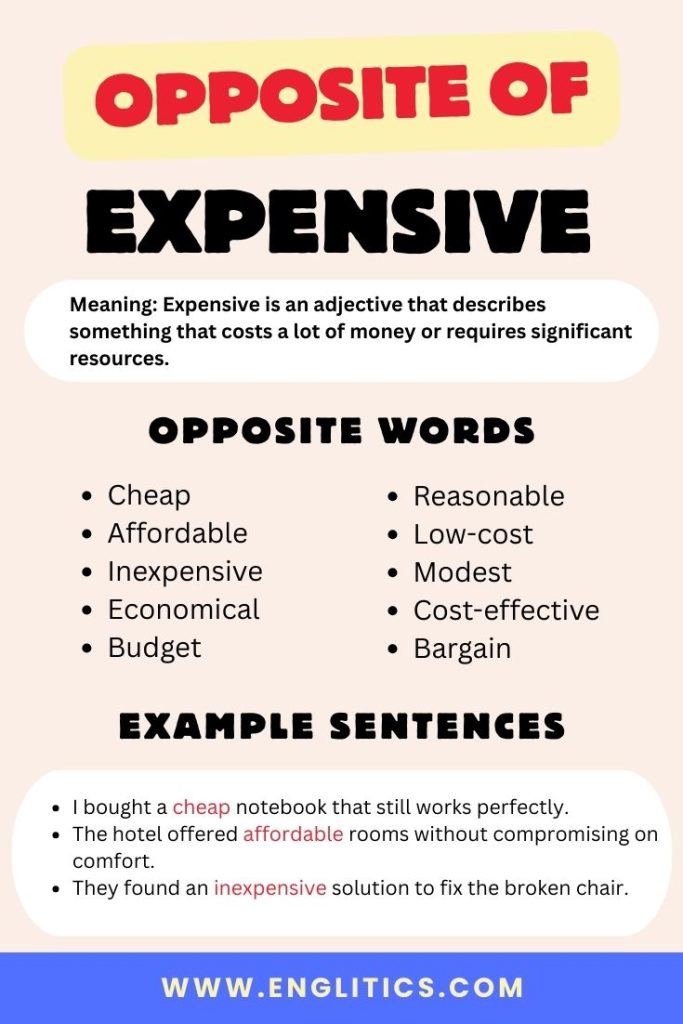
Expensive describes something that costs a lot of money, often linked to luxury goods or high-priced services. The Opposite of Expensive refers to things that are more affordable, low-cost, or priced within most people’s budget.
Common Antonyms for Expensive include cheap, affordable, inexpensive, budget, economical, and low-cost. For example, instead of purchasing an expensive designer bag, someone might go for a budget-friendly option. These words help describe price differences in shopping, planning, and financial choices.
Definition of “Expensive” and the Importance of Antonyms
Expensive, in its simplest form, means costing a lot of money. It implies that the price of something is high relative to its perceived value or the typical cost of similar items. The word can also carry connotations of luxury, quality, or exclusivity. Understanding the antonyms of “expensive” is essential because it allows for a more balanced and accurate description of cost. Using antonyms effectively helps you avoid generalizations and provide specific information about the affordability or value of goods and services. Antonyms are words with opposite meanings, and they are fundamental to building a comprehensive and versatile vocabulary in any language.
Antonyms not only broaden your vocabulary but also sharpen your understanding of the subtleties within language. They allow you to express contrasting ideas, compare and contrast different options, and provide a more complete picture of the subject you are discussing.
For example, instead of simply stating that a car is “not expensive,” using the word “affordable” provides a more positive and reassuring message, especially when marketing the car to potential buyers. The ability to choose the right antonym can significantly enhance your communication skills, making your writing and speaking more precise and impactful.
Structural Breakdown of Antonyms
Antonyms are typically formed through several methods, which include affixation, where prefixes are added to a word to create its opposite (e.g., happy/unhappy), and the use of entirely different words that naturally express opposing concepts (e.g., hot/cold). Understanding these structural elements can help you identify and remember antonyms more easily.
In the case of “expensive,” many of its antonyms are distinct words with their own roots, rather than being formed by simply adding a prefix.
The structure of antonyms also relates to how they function within sentences and phrases. They typically occupy the same grammatical position as the original word.
For instance, if “expensive” is used as an adjective to describe a noun (e.g., “an expensive car”), its antonym would also function as an adjective (e.g., “a cheap car”). Recognizing this structural parallelism can aid in using antonyms correctly and maintaining grammatical consistency in your writing and speech.
Opposite of Expensive
Antonyms are not all created equal; they fall into different categories based on the nature of their opposition. Recognizing these categories can help you choose the most appropriate antonym for a given context.
Gradable Antonyms
Gradable antonyms represent opposite points on a continuous spectrum. They allow for degrees of comparison.
For example, “hot” and “cold” are gradable antonyms because something can be warm, lukewarm, or cool. With “expensive,” gradable antonyms would include words like “cheap,” “affordable,” and “reasonable,” each indicating a different level of cost.
Complementary Antonyms
Complementary antonyms are pairs where the existence of one implies the non-existence of the other. There is no middle ground.
Examples include “on” and “off,” or “dead” and “alive.” While not directly applicable to “expensive,” understanding this type helps distinguish it from gradable antonyms where intermediate states exist.
Relational Antonyms
Relational antonyms describe a relationship from opposite perspectives. For example, “teacher” and “student,” or “buy” and “sell.” Again, not a direct match for “expensive,” but important for a complete understanding of antonym types.
Antonyms for “Expensive”
Here’s a detailed exploration of the various antonyms for “expensive,” each with its own nuance and context:
Cheap
Cheap is perhaps the most direct antonym of “expensive.” It implies that something costs very little. However, it can sometimes carry a negative connotation, suggesting low quality, particularly in the context of physical goods. The word “cheap” emphasizes a low price, sometimes at the expense of quality or durability.
Affordable
Affordable means that something is within one’s financial means; it doesn’t necessarily mean it’s the lowest price, but that it’s a price that most people can manage. “Affordable” often carries a positive connotation, suggesting good value for money without sacrificing quality. It is often used in marketing and advertising to appeal to a broad audience.
Inexpensive
Inexpensive is a neutral term that means not costing a great deal. It’s a milder alternative to “cheap” and doesn’t usually imply low quality. “Inexpensive” is a safe and versatile choice when you want to indicate a lower cost without any negative implications.
Reasonable
Reasonable suggests that the price is fair and justified, considering the quality and features of the product or service. It implies that the price is appropriate and not excessive. “Reasonable” is often used in business contexts to assure customers that they are getting a fair deal.
Budget-Friendly
Budget-friendly indicates that something is suitable for people who are trying to save money or stick to a budget. It emphasizes that the price is low enough to fit within a limited financial plan. “Budget-friendly” is a popular term in personal finance and lifestyle content.
Economical
Economical implies that something offers good value for the price, often suggesting efficiency and long-term savings. It’s not just about the initial cost, but also the cost of maintenance and operation. “Economical” is often used to describe cars, appliances, and other products that save money over time.
Low-Priced
Low-priced is a straightforward term indicating that the price is lower than average or expected. It doesn’t necessarily imply anything about quality, but simply focuses on the cost. “Low-priced” is a direct and unambiguous way to describe something that doesn’t cost much.
Discounted
Discounted means that the price has been reduced from its original or usual price. It suggests a temporary reduction in cost, often as part of a sale or promotion. “Discounted” implies that the item was once more expensive but is now available at a lower price.
Free
Free is the ultimate antonym of “expensive,” indicating that something costs absolutely nothing. It’s the lowest possible price and often implies that something is being given away as a promotion or gift. “Free” is a powerful word in marketing and advertising.
Valuable
Valuable, while not a direct antonym in terms of price, offers an interesting contrast. Something “valuable” may indeed be expensive, but it signifies that the cost is justified by the item’s worth, whether that worth is monetary, sentimental, or functional. In some contexts, highlighting that something is valuable can downplay the concern about it being expensive, by shifting the focus to its benefits and importance.
Examples of Antonyms in Sentences
To illustrate how these antonyms are used in practice, here are several examples organized in tables for clarity.
The following table shows how “expensive” is contrasted with several antonyms in different contexts.
| Sentence with “Expensive” | Sentence with Antonym |
|---|---|
| That diamond necklace is incredibly expensive. | You can find a similar necklace that is much more affordable. |
| Living in Manhattan is an expensive proposition. | Living in the suburbs is generally more inexpensive. |
| The luxury hotel was too expensive for our budget. | We found a budget-friendly guesthouse instead. |
| Premium gasoline is more expensive than regular. | Regular gasoline is more economical for everyday driving. |
| Designer clothes are often very expensive. | You can find low-priced alternatives at outlet stores. |
| The original painting was too expensive for the museum. | They acquired a discounted print instead. |
| Hiring a private tutor can be expensive. | There are many free online resources available. |
| The antique car was expensive, but it was a valuable investment. | The refurbished bicycle was cheap, but it got me around town. |
| Imported cheeses are often expensive. | Local cheeses can be more affordable and just as delicious. |
| Building a custom home can be very expensive. | Buying a pre-built home is often more inexpensive. |
| Attending a private university is expensive. | Attending a state university is more budget-friendly. |
| Driving a gas-guzzling SUV is expensive. | Driving a hybrid car is more economical in the long run. |
| Buying brand-name medications can be expensive. | Generic medications are often low-priced alternatives. |
| Purchasing concert tickets at the last minute can be expensive. | Buying tickets in advance can sometimes get you a discounted rate. |
| Using premium software often is expensive. | There are many free open-source software options. |
| That custom suit was very expensive, but it was a valuable addition to my wardrobe. | This off-the-rack suit was cheap and still looks presentable. |
| Traveling during peak season is often expensive. | Traveling during the off-season can be more affordable. |
| Ordering takeout every night is an expensive habit. | Cooking at home is generally more inexpensive. |
| The location of the office is expensive due to its central location. | The location of the office in the suburbs is more budget-friendly. |
| The new electric car is expensive to buy. | The new electric car is economical to run. |
| The designer shoes are too expensive for me to buy. | The shoes in the sale are low-priced and still stylish. |
| The dress was expensive, but it was on a discounted rack. | The dress was cheap, as it was in the bargain bin. |
| The new app is very expensive to download. | The old app is free to download. |
| The new house was very expensive, but it was very valuable. | The new house was cheap, but it had no garden. |
| That expensive watch does not tell the time. | That cheap watch tells the time perfectly. |
This table focuses on “affordable” and “inexpensive”, clarifying their specific usages.
| Sentence | Explanation |
|---|---|
| The apartment was surprisingly affordable for its location. | This implies the price was within reach, considering the desirable location. |
| We found an affordable daycare that met all our needs. | This suggests the daycare was reasonably priced and of good quality. |
| The restaurant offers an affordable lunch menu. | This indicates the lunch menu is priced to attract a wide range of customers. |
| The inexpensive phone case offers decent protection. | This suggests the case is low-cost but still provides adequate protection. |
| I bought an inexpensive printer for occasional use. | This implies the printer is not high-end but suitable for basic tasks. |
| The store sells inexpensive souvenirs for tourists. | This indicates the souvenirs are low-priced and targeted at tourists. |
| Although the course was comprehensive, it was relatively affordable. | This emphasizes that the course offered good value for its price. |
| She was looking for an affordable car that wouldn’t break the bank. | This suggests she wanted a car that was reasonably priced and wouldn’t strain her budget. |
| The hotel offered affordable packages for families during the summer. | This indicates the hotel had special deals that were within reach for families on vacation. |
| He found an inexpensive restaurant that served delicious local cuisine. | This implies the restaurant was low-cost but still offered high-quality food. |
| The inexpensive headphones were perfect for listening to music on the go. | This suggests the headphones were low-priced but still functional and suitable for travel. |
| We decided to stay in an affordable Airbnb instead of a hotel. | This indicates the Airbnb was a more budget-friendly option compared to a hotel. |
| The company provides affordable health insurance plans for its employees. | This suggests the health insurance plans are reasonably priced and accessible to the employees. |
| The inexpensive tool set was perfect for small household repairs. | This implies the tool set was low-cost but still useful for basic tasks around the house. |
| She bought an inexpensive dress for the party. | This indicates the dress was low-priced and suitable for the occasion. |
| The affordable furniture made it easy to furnish the new apartment. | This suggests the furniture was reasonably priced and made the furnishing process more manageable. |
| The inexpensive watch was reliable. | This indicates the watch was low-priced but still functional and trustworthy. |
| The affordable service made it accessible to all. | This suggests the service was reasonably priced and available to a wide range of people. |
| The inexpensive materials allowed for a cost-effective project. | This implies the materials were low-priced and made the project more budget-friendly. |
| The affordable education enabled many to improve their lives. | This suggests the education was reasonably priced and provided opportunities for advancement. |
| The affordable housing project aimed to provide homes for low-income families. | This indicates the housing project was designed to offer reasonably priced homes to those with limited financial resources. |
| He found an inexpensive textbook that covered all the necessary material for the course. | This implies the textbook was low-cost but still contained all the required information. |
| The company offered affordable payment plans to make their products accessible to more customers. | This suggests the payment plans were reasonably priced and made the products more attainable for a wider audience. |
| She bought an inexpensive notebook to jot down her ideas while traveling. | This indicates the notebook was low-priced and perfect for capturing thoughts on the go. |
| The affordable gym membership allowed her to stay fit without breaking the bank. | This suggests the gym membership was reasonably priced and enabled her to maintain her fitness routine without financial strain. |
This table compares “reasonable,” “economical,” and “budget-friendly.”
| Sentence | Explanation |
|---|---|
| The price of the service is quite reasonable, considering the quality. | This implies the price is fair given the high standard of service. |
| An economical car will save you money on gas in the long run. | This suggests the car is fuel-efficient and will result in long-term savings. |
| We are looking for a budget-friendly vacation option this year. | This indicates the vacation needs to fit within a limited financial plan. |
| The restaurant offers a reasonable price for its lunch special. | It means that the price is fair and not excessive for the food being offered. |
| It’s more economical to buy in bulk if you use the product frequently. | This suggests it saves you money in the long run due to the large quantity. |
| This store has budget-friendly options for back-to-school supplies. | It means it offers products that are affordable for families on a budget. |
| The contractor provided a reasonable estimate for the repairs. | This suggests the estimate was fair and not overpriced. |
| Investing in energy-efficient appliances is an economical choice. | This implies it saves money on energy bills over time. |
| They offer budget-friendly meal plans for students. | This indicates the meal plans are designed to be affordable for students with limited funds. |
| The reasonable shipping costs made the online purchase worthwhile. | This suggests the shipping fees were fair and didn’t deter the purchase. |
| It’s more economical to repair the old appliance than to buy a new one. | This implies repairing is cheaper in the long run compared to buying a new appliance. |
| We found a budget-friendly hotel that still offered great amenities. | This indicates the hotel was affordable but still provided good services and facilities. |
| The lawyer charged a reasonable fee for her services. | This suggests the fee was fair and justified for the legal work performed. |
| Using public transportation is an economical way to commute. | This implies it saves money on gas, parking, and car maintenance. |
| The store has a budget-friendly section with discounted items. | This indicates it offers products at reduced prices for customers on a tight budget. |
| The plumber offered a reasonable hourly rate for his work. | This suggests the rate was fair and not excessive for the plumbing services. |
| An economical car has a smaller engine and consumes less fuel. | This implies it’s designed to save money on fuel costs. |
| The company provides budget-friendly software solutions for small businesses. | This indicates the software is priced to be affordable for small businesses with limited resources. |
| The mechanic gave us a reasonable quote for the car repair. | This suggests the quote was fair and not overpriced for the repair work needed. |
| Choosing to rent instead of buy can be more economical in the short term. | This implies renting saves money upfront compared to the costs associated with buying. |
| They created a budget-friendly menu with options under $10. | This indicates the menu offers affordable choices for customers on a budget. |
Usage Rules and Considerations
When choosing an antonym for “expensive,” consider the context and the specific nuance you want to convey. “Cheap” can be suitable when emphasizing a very low price, but be mindful of the potential negative connotations.
“Affordable” and “inexpensive” are generally safer choices when you want to avoid implying low quality. “Reasonable” is best used when you want to emphasize fairness and value.
“Budget-friendly” is ideal for targeting cost-conscious consumers. “Economical” is appropriate when highlighting long-term savings and efficiency.
Pay attention to the register and tone of your writing or speech. In formal contexts, “inexpensive” or “reasonable” might be more appropriate than “cheap.” In marketing materials, “affordable” and “budget-friendly” are often used to create a positive impression.
Always consider your audience and the message you want to communicate when selecting the most suitable antonym.
Common Mistakes to Avoid
A common mistake is using “cheap” when you mean “inexpensive” or “affordable,” potentially implying that something is of low quality when that’s not the intention. Another mistake is using “economical” when you simply mean “low-priced,” as “economical” specifically refers to long-term savings or efficiency.
Here are some examples of common mistakes and their corrections:
| Incorrect | Correct | Explanation |
|---|---|---|
| This is a very cheap car; I don’t trust it. | This is a very inexpensive car; I hope it’s reliable. | “Inexpensive” is more neutral and avoids the negative connotation of “cheap.” |
| Buying that old house was very economical. | Buying that old house was very inexpensive. | “Economical” implies long-term savings, which may not be the case with an old house. |
| The food at that restaurant is cheap, so it must not be good. | The food at that restaurant is affordable, making it a great option for students. | “Affordable” suggests a reasonable price without implying low quality. |
| The cheap rental car got us from A to B. | The low-priced rental car got us from A to B. | “Low-priced” is a more neutral way of saying “cheap”, without the negative quality connotations. |
| The food at the new restaurant is cheap. | The food at the new restaurant is budget-friendly. | “Budget-friendly” is a more positive way of saying “cheap”, without the negative quality connotations. |
Practice Exercises
Test your understanding of antonyms for “expensive” with these exercises:
Exercise 1: Fill in the Blanks
Choose the most appropriate antonym for “expensive” from the options provided.
| Question | Options | Answer |
|---|---|---|
| The luxury version is too expensive; I’ll buy the ____ model. | a) cheap b) affordable c) reasonable | b) affordable |
| This store offers ____ options for students on a tight budget. | a) extravagant b) budget-friendly c) costly | b) budget-friendly |
| It’s more ____ to repair the appliance than to replace it. | a) pricey b) economical c) luxurious | b) economical |
| The restaurant has a ____ lunch menu, perfect for a quick bite. | a) expensive b) reasonable c) lavish | b) reasonable |
| You can find ____ souvenirs at the local market. | a) pricey b) inexpensive c) deluxe | b) inexpensive |
| The apartment was surprisingly ____, considering its location. | a) costly b) affordable c) premium | b) affordable |
| The car is ____ to run as it uses very little fuel. | a) expensive b) economical c) overpriced | b) economical |
| The shop sells ____ clothes for kids. | a) expensive b) low-priced c) dear | b) low-priced |
| The tickets were ____ because it was early bird offer. | a) expensive b) discounted c) costly | b) discounted |
| The software is ____ to use. | a) expensive b) free c) pricey | b) free |
Exercise 2: Sentence Rewriting
Rewrite the following sentences using an antonym for “expensive.”
- The high-end smartphone is too expensive for most people.
- Living in the city center is an expensive lifestyle.
- The designer handbag was an expensive purchase.
- The service is too expensive for us.
- The materials were expensive, making the project difficult to fund.
- That is an expensive restaurant.
- The art exhibition was very expensive to put on.
- Private schooling is expensive.
- The new car was very expensive to buy.
- The tickets were very expensive.
Answers:
- The affordable smartphone is within reach for most people.
- Living in the suburbs is a more budget-friendly lifestyle.
- The discounted handbag was a sensible purchase.
- The service is affordable for us.
- The materials were inexpensive, making the project easier to fund.
- That is a reasonably priced restaurant.
- The art exhibition was economical to put on.
- Public schooling is affordable.
- The new car was economical to run.
- The tickets were low-priced.
Advanced Topics: Nuances in Meaning
At an advanced level, understanding the subtle differences between antonyms becomes crucial. For instance, while “cheap” and “inexpensive” both denote low cost, “cheap” can imply poor quality or construction, whereas “inexpensive” simply indicates a lower price point without negative connotations.
Similarly, “economical” suggests a wise or efficient use of resources, often implying long-term savings, which is different from something being simply “affordable”.
Another advanced consideration is the use of euphemisms. Instead of directly stating something is “cheap,” one might use softer terms like “value-priced” or “competitively priced.” These euphemisms are often employed in marketing and sales to make products or services more appealing without suggesting inferiority.
Frequently Asked Questions
- What is the most direct antonym of “expensive”?The most direct antonym is “cheap,” but it’s important to be aware of its potentially negative connotations. “Inexpensive” is often a safer and more neutral alternative.
- When should I use “affordable” instead of “cheap”?Use “affordable” when you want to emphasize that something is within one’s financial means without implying low quality. It’s a more positive and reassuring term.
- What is the difference between “economical” and “inexpensive”?“Inexpensive” simply means not costing a great deal. “Economical” implies that something offers good value for the price, often suggesting efficiency and long-term savings.
- Is “budget-friendly” the same as “cheap”?No, “budget-friendly” is a more positive term that indicates something is suitable for people who are trying to save money or stick to a budget. It doesn’t necessarily imply low quality.
- Can “valuable” be considered an antonym of “expensive”?While not a direct antonym in terms of price, “valuable” can offer a contrasting perspective. It suggests that the cost is justified by the item’s worth, shifting the focus from price to benefit.
- How do I avoid using “cheap” in a negative way?Instead of “cheap,” consider using “inexpensive,” “affordable,” “budget-friendly,” or “low-priced.” These alternatives avoid the negative connotations associated with “cheap.”
- What is a good antonym for “expensive” in a business context?In a business context, “reasonable” is often a good choice. It suggests that the price is fair and justified, which can build trust with customers.
- Are there any situations where “cheap” is the best word to use?Sometimes, “cheap” is the most accurate word to describe something that is very low in price, especially if the low price is a key selling point. However, be mindful of your audience and the potential for misinterpretation.
Conclusion
Mastering the antonyms for “expensive” is an essential step in developing a nuanced and versatile vocabulary. By understanding the subtle differences between words like “cheap,” “affordable,” “inexpensive,” “reasonable,” and “economical,” you can communicate more effectively and avoid potential misunderstandings.
Remember to consider the context, tone, and audience when choosing the most appropriate antonym.
Continue to practice using these words in different sentences and situations to solidify your understanding. Pay attention to how native speakers use these terms in everyday conversation and writing.
With consistent effort, you’ll be able to confidently and accurately describe the cost of anything, from the most luxurious items to the most budget-friendly options. Always strive for clarity and precision in your language to ensure your message is received as intended.