Flaws refer to imperfections, weaknesses, or defects in someone or something—whether physical, moral, or functional. But when highlighting strength, excellence, or perfection, the opposite of flaws offers a more positive perspective. Antonyms for flaws help describe what is whole, polished, or without fault.
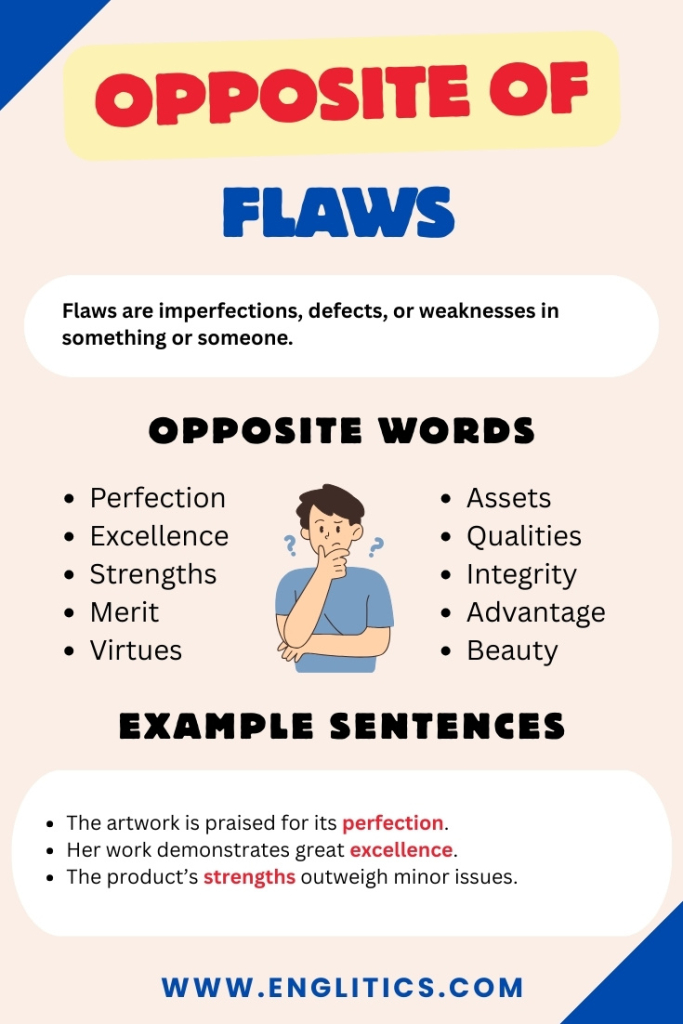
The opposite of flaws includes words like perfection, strengths, virtues, assets, and qualities. While perfection suggests a total absence of errors, strengths and virtues focus on positive traits or advantages. These antonyms are useful in personal evaluations, product reviews, and character assessments where the focus is on what’s right—not wrong.
Definition of “Flaw” and the Importance of Antonyms
A flaw is a defect, fault, or imperfection that mars the appearance, structure, or function of something. It can refer to a physical blemish, a character weakness, a logical fallacy, or any other shortcoming. Understanding the concept of a flaw is essential for identifying areas that need improvement and for appreciating the qualities that prevent or overcome such imperfections.
Antonyms, being words with opposite meanings, provide a crucial counterpoint to the concept of flaws. They allow us to describe the absence of flaws, highlighting the positive attributes that make something desirable, effective, or admirable.
By using antonyms for “flaw,” we can express the concepts of perfection, strength, excellence, completeness, and soundness. This ability is invaluable in various contexts, from writing and speaking to critical analysis and problem-solving.
Structural Breakdown: Understanding Root Words and Affixes
To effectively use antonyms, it’s helpful to understand how words are constructed. Many antonyms are formed by adding prefixes or suffixes to existing words.
Let’s explore some common affixes used to create antonyms for words related to flaws:
- Prefixes:
- un-: This prefix often indicates negation. For example, flawed becomes unflawed.
- im-/in-: Similar to un-, these prefixes denote the opposite. For example, imperfect is an antonym of something containing flaws.
- non-: This prefix also signifies the absence of something. For instance, non-defective indicates the lack of flaws.
- Suffixes:
- While suffixes are less commonly used to directly create antonyms for “flaw,” they can modify related words to convey a positive attribute. For example, adding -less can indicate the absence of something undesirable (e.g., spotless).
Understanding these structural elements can help you recognize and create antonyms more easily. By identifying the root word and the affix, you can often deduce the meaning of an unfamiliar word and its relationship to the concept of flaws.
Types and Categories of Antonyms for Flaws
Antonyms for “flaw” can be categorized based on the specific aspect of flawlessness they emphasize. Here are some key categories:
Perfection-Related Antonyms
These antonyms emphasize the absence of any imperfection whatsoever. They suggest a state of complete flawlessness and ideal quality.
Strength and Resilience-Related Antonyms
These antonyms highlight the ability to withstand stress, pressure, or adversity without succumbing to flaws. They emphasize robustness and durability.
Excellence and Superiority-Related Antonyms
These antonyms describe a state of surpassing ordinary standards, often indicating a level of quality that is free from significant flaws and remarkably outstanding.
Completeness and Wholeness-Related Antonyms
These antonyms emphasize the idea of being whole and lacking nothing essential. They suggest that all necessary elements are present and properly integrated, leaving no room for flaws arising from incompleteness.
Soundness and Validity-Related Antonyms
These antonyms are often used in the context of arguments, reasoning, or structures. They indicate that something is logically consistent, well-founded, and free from defects in its construction or reasoning.
Examples of Antonyms for Flaws
The following tables provide examples of antonyms for “flaw” categorized according to the types discussed above. Each table includes a word, its definition, and example sentences to illustrate its usage.
Perfection-Related Examples
This table showcases words that are direct opposites of flawed, focusing on the state of being absolutely perfect.
| Antonym | Definition | Example Sentence |
|---|---|---|
| Perfect | Being entirely without fault or defect. | The diamond was perfect, with no visible inclusions. |
| Immaculate | Perfectly clean, neat, or tidy; free from flaws. | Her performance was immaculate, earning her a standing ovation. |
| Flawless | Without any blemishes or imperfections; perfect. | The singer’s voice was flawless, captivating the audience. |
| Spotless | Perfectly clean; without any spots or blemishes. | The kitchen was spotless after she finished cleaning. |
| Pristine | In its original condition; unspoiled; perfect. | The antique car was in pristine condition. |
| Ideal | Representing the best possible example of something; perfect. | This weather is ideal for a picnic. |
| Exemplary | Serving as a desirable model; representing the best of its kind. | His behavior was exemplary, setting a positive example for others. |
| Unblemished | Not damaged or marked in any way; perfect. | Her skin was unblemished, a testament to her healthy lifestyle. |
| Untarnished | Not damaged or spoiled; remaining in perfect condition. | His reputation remained untarnished despite the controversy. |
| Supreme | Highest in quality, degree, or rank; excellent. | The chef’s culinary skills were supreme. |
| Unimpaired | Not weakened or damaged; functioning perfectly. | His vision remained unimpaired even at an old age. |
| Pure | Not mixed or adulterated with any other substance or material; free from flaws. | The gold was pure, with no impurities. |
| Classic | Judged over a period of time to be of the highest quality and outstanding of its kind. | The movie is a classic, enjoyed by generations. |
| Masterful | Showing great skill or artistry. | Her piano playing was masterful. |
| Virtuous | Having or showing high moral standards. | She was a virtuous woman, admired by all. |
| Faultless | Without any faults or imperfections; perfect. | His logic was faultless, making his argument very convincing. |
| A-Okay | Informal term meaning perfectly alright or in excellent condition. | After the repairs, the engine was A-Okay. |
| Top-notch | Of the highest quality; excellent. | The restaurant’s service was top-notch. |
| Paragon | A person or thing regarded as a perfect example of a particular quality. | He is a paragon of virtue. |
| Sublime | Of very great excellence or beauty. | The sunset over the ocean was sublime. |
Strength and Resilience-Related Examples
This table lists antonyms that focus on the robustness and ability to overcome flaws or weaknesses.
| Antonym | Definition | Example Sentence |
|---|---|---|
| Robust | Strong and healthy; able to withstand adverse conditions. | The building’s structure was robust and able to withstand earthquakes. |
| Resilient | Able to withstand or recover quickly from difficult conditions. | The economy proved to be resilient despite the recession. |
| Sound | In good condition; not damaged, injured, or diseased. | The old bridge was still structurally sound. |
| Solid | Firm and stable in shape; not liquid or fluid. | The foundation of the house was solid and secure. |
| Sturdy | Strongly built or made. | The furniture was sturdy and well-crafted. |
| Durable | Able to withstand wear, pressure, or damage. | The hiking boots were durable and lasted for years. |
| Unyielding | Not giving way to pressure; firm and resolute. | The steel frame was unyielding, providing excellent support. |
| Invulnerable | Impossible to harm or damage. | The knight seemed invulnerable in his armor. |
| Impregnable | Unable to be captured or broken into. | The fortress was impregnable, protecting the city from invaders. |
| Tough | Strong enough to withstand adverse conditions or rough handling. | The material was tough and resistant to tearing. |
| Impervious | Not allowing fluid to pass through; unable to be affected by. | The raincoat was impervious to water. |
| Adamant | Refusing to be persuaded or to change one’s mind. | He was adamant about his decision. |
| Tenacious | Tending to keep a firm hold of something; clinging or adhering closely. | The climber had a tenacious grip on the rope. |
| Resolute | Admirably purposeful, determined, and unwavering. | She was resolute in her determination to succeed. |
| Steadfast | Resolutely or dutifully firm and unwavering. | He remained steadfast in his beliefs. |
| Staunch | Loyal and committed in attitude. | He was a staunch supporter of the cause. |
| Unwavering | Steady or resolute; not wavering. | Her commitment to the project was unwavering. |
| Indomitable | Impossible to subdue or defeat. | Her spirit was indomitable, even in the face of adversity. |
| Hardy | Robust; capable of enduring difficult conditions. | The plant was hardy and could survive harsh winters. |
| Well-built | Constructed strongly and effectively. | The car was well-built and reliable. |
Excellence and Superiority-Related Examples
This table provides words associated with superior quality and the absence of significant flaws.
| Antonym | Definition | Example Sentence |
|---|---|---|
| Excellent | Extremely good; outstanding. | Her performance was excellent, earning her high praise. |
| Superior | Higher in rank, status, or quality. | This model is superior to the previous version. |
| Outstanding | Exceptionally good. | His contributions to the team were outstanding. |
| Remarkable | Worthy of attention; striking. | The artist’s skill was remarkable. |
| Exceptional | Unusual; not typical. | She demonstrated exceptional talent in mathematics. |
| First-rate | Of the highest quality. | The hotel provided first-rate service. |
| Top-quality | Of the best possible quality. | The product was made with top-quality materials. |
| World-class | Of the highest standard in the world. | The athlete was a world-class competitor. |
| Distinguished | Successful, authoritative, and commanding great respect. | He was a distinguished professor in his field. |
| Eminent | Famous and respected within a particular sphere or profession. | She was an eminent scientist known for her groundbreaking research. |
| Prestigious | Having a high reputation; respected and admired. | The university was highly prestigious. |
| Acclaimed | Publicly praised. | The novel was critically acclaimed. |
| Celebrated | Greatly admired; renowned. | The artist was celebrated for his innovative style. |
| Illustrious | Well-known, respected, and admired for past achievements. | The family had an illustrious history. |
| Renowned | Known or talked about by many people; famous. | The chef was renowned for his culinary creations. |
| Noteworthy | Deserving attention because of being important or interesting. | His contributions to the project were noteworthy. |
| Admirable | Deserving respect and approval. | Her dedication to her work was admirable. |
| Commendable | Deserving praise. | His efforts were highly commendable. |
| Laudable | Deserving praise and commendation. | The charity’s work was laudable. |
| Meritorious | Deserving reward or praise. | His actions were meritorious and deserving of recognition. |
Completeness and Wholeness-Related Examples
This table focuses on words that describe something whole, full, and lacking no essential part, thus free from flaws resulting from incompleteness.
| Antonym | Definition | Example Sentence |
|---|---|---|
| Complete | Having all the necessary or appropriate parts. | The set was complete with all the pieces. |
| Whole | Undamaged; not divided or disunited. | The pie was still whole when we opened the box. |
| Entire | With no part left out; whole. | The entire project was a success. |
| Full | Containing or holding as much as possible; having no empty space. | The glass was full of water. |
| Comprehensive | Complete; including all or nearly all elements or aspects of something. | The report was comprehensive, covering all the key issues. |
| Inclusive | Including or covering all the stated items or categories. | The price was inclusive of all taxes and fees. |
| Integrated | Combined; coordinated. | The software was fully integrated with the existing system. |
| Unified | Formed or united into a whole. | The country was unified after years of division. |
| Unabridged | Not cut or shortened; complete. | He read the unabridged version of the novel. |
| Conclusive | Serving to settle an issue; final. | The evidence was conclusive, proving his innocence. |
| Thorough | Complete with regard to every detail; exhaustive. | The investigation was thorough and uncovered all the facts. |
| Exhaustive | Examining all aspects or elements; comprehensive. | The research was exhaustive, covering every relevant study. |
| Total | Comprising the whole number or amount. | The total cost of the project was $1 million. |
| All-inclusive | Including everything; comprehensive. | The resort offered an all-inclusive package. |
| Universal | Relating to or done by all people or things in the world or in a particular group; applicable to all cases. | The principles of physics are universal. |
| Wholesome | Conducive to or suggestive of good health and physical well-being. | The meal was wholesome and nutritious. |
| Sound | Based on good judgment or sense. | He made a sound decision. |
| Sufficient | Enough to meet the needs. | There was sufficient food for everyone. |
| Adequate | Satisfactory or acceptable in quality or quantity. | The funding was adequate for the project. |
| Finished | Brought to an end; completed. | The painting was finally finished. |
Soundness and Validity-Related Examples
This table presents antonyms associated with logical correctness, structural integrity, and freedom from defects in reasoning or construction.
| Antonym | Definition | Example Sentence |
|---|---|---|
| Valid | Well-founded on evidence and corresponding accurately to the real world. | His argument was valid and logically sound. |
| Logical | Of or according to the rules of logic or formal argument. | Her reasoning was logical and easy to follow. |
| Rational | Based on or in accordance with reason or logic. | His decision was rational and well-considered. |
| Cogent | Clear, logical, and convincing. | He presented a cogent argument in favor of the proposal. |
| Sound | Based on good judgment or sense. | His advice was sound and helpful. |
| Well-founded | Based on good evidence or reasons. | The concerns were well-founded and needed to be addressed. |
| Justified | Having, done for, or marked by a good or legitimate reason. | His actions were justified given the circumstances. |
| Legitimate | Conforming to the law or to rules. | The business was operating under a legitimate license. |
| Authentic | Of undisputed origin; genuine. | The painting was an authentic masterpiece. |
| Genuine | Truly what something is said to be; authentic. | He showed genuine concern for her well-being. |
| Veritable | Used for emphasis, often to qualify a metaphor. | The project was a veritable success. |
| Bona fide | Genuine; real. | He was a bona fide expert in the field. |
| Firm | Not easily moved or shaken. | The foundation of the building was firm. |
| Stable | Not likely to change or fail; firmly established. | The economy was stable despite the global crisis. |
| Secure | Protected against attack or other criminal activity. | The data was stored in a secure server. |
| Well-reasoned | Based on good or sound judgment. | The essay was well-reasoned and persuasive. |
| Consistent | Acting or done in the same way over time, especially so as to be fair or accurate. | The results were consistent across all experiments. |
| Coherent | Logical and consistent. | The argument was coherent and easy to understand. |
| Articulate | Expressing oneself readily and clearly. | She was an articulate speaker. |
| Persuasive | Good at persuading someone to do or believe something through reasoning or the use of temptation. | His speech was persuasive and convinced many people. |
Usage Rules and Contextual Considerations
Choosing the right antonym for “flaw” depends heavily on the context. Consider what aspect of flawlessness you want to emphasize.
For example, if you’re describing a diamond, “flawless” or “pristine” might be appropriate. If you’re describing an argument, “valid” or “logical” would be more suitable.
When describing the construction of a building, “robust” or “sturdy” would be most fitting.
Also, be mindful of the connotations of different words. Some antonyms, like “immaculate” or “sublime,” carry a stronger sense of admiration or reverence than others.
Choose words that accurately reflect the intended tone and meaning.
Pay attention to the grammatical context as well. Ensure that the antonym you choose fits grammatically within the sentence.
For example, if you’re describing a noun, use an adjective (e.g., “the flawless diamond”). If you’re describing an action, use an adverb (e.g., “she performed flawlessly”).
Common Mistakes When Using Antonyms for Flaws
Here are some common mistakes to avoid when using antonyms for “flaw”:
- Using the wrong antonym for the context: For instance, saying “the argument was immaculate” when you should say “the argument was logical.”
- Misunderstanding the connotations of words: Using a word with a stronger or weaker connotation than intended.
- Grammatical errors: Using the wrong part of speech (e.g., using an adjective when an adverb is needed).
- Overusing certain antonyms: Vary your vocabulary to avoid repetition and make your writing more engaging.
Here are some examples of common mistakes with corrections:
| Incorrect | Correct | Explanation |
|---|---|---|
| The building’s design was immaculate. | The building’s design was sound. | “Immaculate” implies cleanliness, while “sound” implies structural integrity. |
| His logic was pristine. | His logic was valid. | “Pristine” implies original condition, while “valid” implies logical correctness. |
| She performed robustly. | She performed excellently. | “Robustly” implies strength, while “excellently” implies superior quality. |
| The product was complete, thus tough. | The product was complete, thus reliable. | “Tough” implies physical strength, while “reliable” implies consistency of performance. |
Practice Exercises
Test your understanding of antonyms for “flaw” with the following exercises.
Exercise 1: Matching Antonyms
Match each word on the left with its best antonym on the right.
| Word | Possible Antonyms |
|---|---|
| 1. Flawed | a. Sound |
| 2. Imperfect | b. Excellent |
| 3. Defective | c. Complete |
| 4. Incomplete | d. Flawless |
| 5. Weak | e. Robust |
| 6. Illogical | f. Logical |
Answer Key:
- 1-d
- 2-b
- 3-a
- 4-c
- 5-e
- 6-f
Exercise 2: Sentence Completion
Fill in the blank with the most appropriate antonym for “flaw” from the list provided.
Word Bank: valid, immaculate, resilient, comprehensive, outstanding, sturdy
| Question | Answer |
|---|---|
| 1. The bridge was designed to be extremely __________, able to withstand heavy traffic and strong winds. | sturdy |
| 2. Her research was __________, covering all aspects of the topic in great detail. | comprehensive |
| 3. Despite facing numerous challenges, the company proved to be __________, quickly recovering from each setback. | resilient |
| 4. The lawyer presented a __________ argument, convincing the jury of his client’s innocence. | valid |
| 5. The hotel room was __________, with every detail meticulously arranged and perfectly clean. | immaculate |
| 6. The athlete gave an __________ performance, breaking the world record. | outstanding |
Exercise 3: Identifying Antonyms in Context
Read each sentence and identify the antonym for “flaw” that is used.
| Sentence | Antonym |
|---|---|
| 1. The diamond was perfect, with no visible inclusions or blemishes. | perfect |
| 2. The old house was still structurally sound despite its age. | sound |
| 3. Her essay was well-reasoned and presented a compelling argument. | well-reasoned |
| 4. The product was made with top-quality materials and expert craftsmanship. | top-quality |
| 5. Despite the criticism, his reputation remained untarnished. | untarnished |
| 6. The team’s integrated approach ensured seamless coordination across all departments. | integrated |
Advanced Topics: Nuances and Connotations
For advanced learners, it’s important to understand the subtle nuances and connotations of different antonyms. Some words may have a more formal or technical tone, while others may be more informal or colloquial.
For example, “impeccable” and “flawless” both mean without flaws, but “impeccable” is often used in more formal contexts.
Furthermore, consider the emotional impact of your word choice. Some antonyms may evoke a sense of awe or admiration, while others may simply convey a sense of adequacy or functionality.
The choice depends on the specific message you want to convey and the audience you’re addressing.
Exploring the etymology of words can also provide valuable insights into their meanings and connotations. Understanding the origins of words can help you appreciate their nuances and use them more effectively.
Frequently Asked Questions
- What is the difference between “perfect” and “flawless”?Both “perfect” and “flawless” indicate the absence of flaws, but “perfect” often implies an ideal standard or the best possible example, while “flawless” specifically emphasizes the absence of any blemishes or imperfections. “Perfect” can also refer to suitability for a purpose, while “flawless” is more about the state of being without fault.
- How do I choose the right antonym for “flaw” in a sentence?Consider the context of the sentence and the specific aspect of flawlessness you want to highlight. Think about the object, concept, or situation you’re describing and choose an antonym that accurately reflects its positive qualities. Also, pay attention to the tone and connotations of different words.
- Are there any words that are both antonyms and synonyms for “flaw”?No, a word cannot be both an antonym and a synonym for “flaw” at the same time. Antonyms have opposite meanings, while synonyms have similar meanings. However, a word could be a synonym for a *type* of flaw (e.g., “blemish” is a synonym for a type of flaw) and another word can be an antonym of “flaw” (e.g., “perfection”).
- Can I use antonyms for “flaw” to describe abstract concepts?Yes, antonyms for “flaw” can be used to describe abstract concepts suchas ideas, arguments, or plans. For example, you can say an argument is “valid” or a plan is “sound.” The key is to choose an antonym that accurately reflects the absence of defects in the particular context.
- How can understanding antonyms for “flaw” improve my writing?Using antonyms for “flaw” can significantly enhance the precision and impact of your writing. It allows you to articulate positive qualities more effectively, create vivid contrasts, and avoid repetitive language. By mastering these antonyms, you can elevate your writing to a higher level of clarity and sophistication.
Conclusion
Mastering antonyms for “flaw” is an invaluable skill for anyone seeking to enhance their communication abilities. By understanding the nuances and connotations of various words, you can express the absence of imperfections with greater precision and impact.
Whether you’re describing a flawless performance, a valid argument, or a sturdy structure, the right antonym can make all the difference. Continue to explore the rich tapestry of the English language, and you’ll find that the more words you know, the more effectively you can express yourself.