The Opposite of Lack describes a state of having enough or more than needed. While “lack” points to something missing or not being available, its antonyms show abundance, presence, or sufficiency in quantity or quality.
Antonyms for Lack include abundance, surplus, and plenty. In this guide, you’ll see how each term works in everyday language, from describing food supplies to confidence levels. If you’re aiming to grow your vocabulary or write with more accuracy, these opposites will help you describe situations with clarity and balance.
Definition of “Lack” and Its Grammatical Context
The word “lack” signifies a state of being without something needed or desirable. Grammatically, “lack” can function as both a noun and a verb.
As a noun, it refers to the absence or shortage of something. For example, “There is a lack of funding for the project.” As a verb, it means to be without or deficient in something.
For example, “They lack the necessary skills for the job.” Understanding these grammatical roles is essential for identifying appropriate antonyms.
To effectively understand the antonyms of “lack”, it’s crucial to grasp the various contexts in which “lack” is used. This includes understanding the implications of deficiency in different scenarios, from material resources to abstract qualities.
The antonyms, therefore, will represent the opposite of these deficiencies.
Structural Breakdown of Sentences Using Antonyms of “Lack”
When using antonyms of “lack,” the sentence structure often shifts to emphasize the presence or abundance of something. Instead of stating what is missing, the focus is on what is available or plentiful.
This can involve using verbs that indicate possession or adjectives that describe abundance.
For instance, consider the sentence “They lack resources.” An antonymic transformation might be “They possess abundant resources” or “They have a wealth of resources.” The key is to replace the verb “lack” with a verb that indicates possession or to use adjectives that describe abundance, such as “abundant,” “plentiful,” or “sufficient.” Understanding these structural changes is fundamental to using antonyms of “lack” effectively.
Opposite of Lack
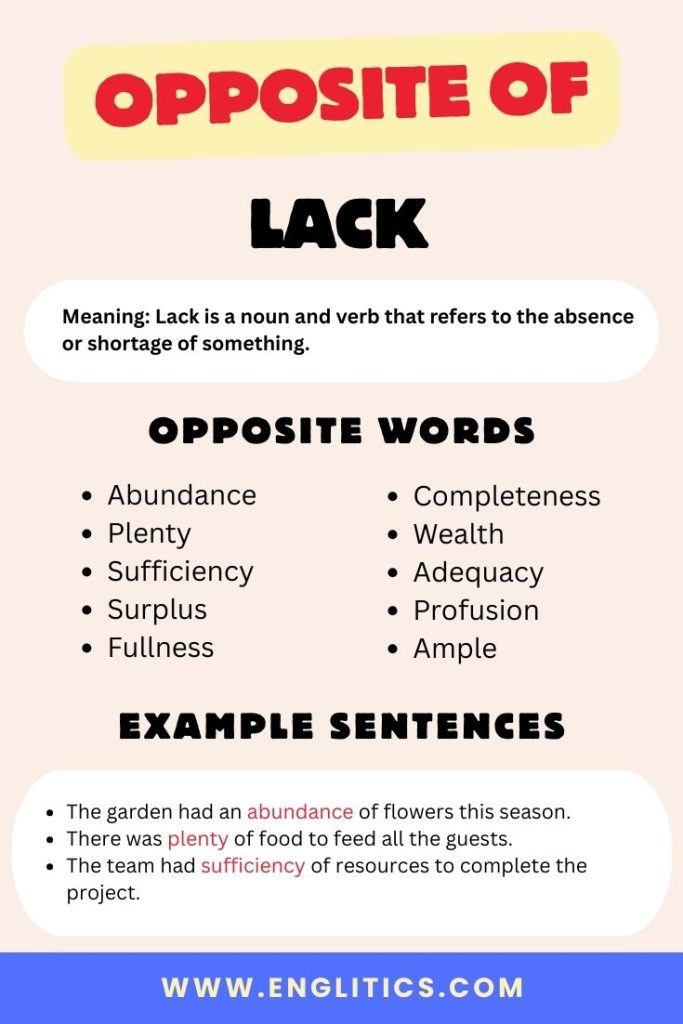
The antonyms for “lack” can be categorized into several groups, each conveying a slightly different nuance of abundance or sufficiency. These categories include:
Abundance and Plenty
These terms indicate a large quantity or supply of something. “Abundance” suggests a great amount, often more than enough, while “plenty” implies that there is a sufficient amount available.
Sufficiency and Adequacy
These antonyms denote that there is enough of something to meet a particular need or requirement. “Sufficiency” suggests that there is just enough, while “adequacy” implies that something is satisfactory or acceptable for a specific purpose.
Surplus and Excess
These terms indicate that there is more than what is needed or required. “Surplus” suggests that there is an extra amount available, while “excess” implies that there is too much, sometimes to an undesirable extent.
Wealth and Affluence
These antonyms refer to a large accumulation of material possessions or resources. “Wealth” generally refers to a large amount of assets, while “affluence” implies a state of having a great deal of money and enjoying a luxurious lifestyle.
Examples of Antonyms for “Lack” in Sentences
To illustrate the usage of these antonyms, let’s examine several examples in different contexts. These examples will highlight the nuances of each antonym and how they can be used effectively in sentences.
Examples Using “Abundance” and “Plenty”
The following table provides examples of sentences using “abundance” and “plenty” as antonyms for “lack.” Observe how these words convey a sense of more than enough.
| Original Sentence (With “Lack”) | Antonymic Sentence (With “Abundance” or “Plenty”) |
|---|---|
| The garden lacks flowers. | The garden has an abundance of flowers. |
| The project lacks funding. | The project has plenty of funding. |
| The desert lacks water. | The oasis has an abundance of water. |
| The store lacks customers today. | The store has plenty of customers today. |
| The team lacks talent. | The team has an abundance of talent. |
| The farm lacks rain this season. | The farm has had plenty of rain this season. |
| The pantry lacks food. | The pantry has an abundance of food. |
| The company lacks ideas. | The company has plenty of ideas. |
| The library lacks books on that topic. | The library has an abundance of books on that topic. |
| The city lacks green spaces. | The city has plenty of green spaces. |
| The organization lacks volunteers. | The organization has an abundance of volunteers. |
| The restaurant lacks parking. | The restaurant has plenty of parking. |
| The school lacks resources. | The school has an abundance of resources. |
| The country lacks natural resources. | The country has plenty of natural resources. |
| The website lacks content. | The website has an abundance of content. |
| The event lacks attendees. | The event has plenty of attendees. |
| The artist lacks inspiration. | The artist has an abundance of inspiration. |
| The athlete lacks stamina. | The athlete has plenty of stamina. |
| The solution lacks details. | The solution has an abundance of details. |
| The program lacks features. | The program has plenty of features. |
| The evidence lacks clarity. | The evidence has an abundance of clarity. |
| The project lacks support. | The project has plenty of support. |
| The region lacks industry. | The region has an abundance of industry. |
| The narrative lacks depth. | The narrative has plenty of depth. |
| The system lacks security. | The system has an abundance of security. |
Examples Using “Sufficiency” and “Adequacy”
The table below provides examples illustrating the use of “sufficiency” and “adequacy” as antonyms for “lack.” These words emphasize that there is enough to meet a particular need.
| Original Sentence (With “Lack”) | Antonymic Sentence (With “Sufficiency” or “Adequacy”) |
|---|---|
| The food lacks salt. | The food has a sufficiency of salt. |
| The explanation lacks detail. | The explanation has an adequacy of detail. |
| The shelter lacks blankets. | The shelter has a sufficiency of blankets. |
| The training lacks preparation time. | The training has an adequacy of preparation time. |
| The meeting lacks attendees for a quorum. | The meeting has a sufficiency of attendees for a quorum. |
| The car lacks fuel to finish the journey. | The car has an adequacy of fuel to finish the journey. |
| The budget lacks funds for the new project. | The budget has a sufficiency of funds for the new project. |
| The research lacks supporting data. | The research has an adequacy of supporting data. |
| The response lacks clarity to be understood. | The response has a sufficiency of clarity to be understood. |
| The security measures lack strength to protect the premises. | The security measures have an adequacy of strength to protect the premises. |
| The supplies lack quantity for everyone. | The supplies have a sufficiency of quantity for everyone. |
| The light lacks brightness to read comfortably. | The light has an adequacy of brightness to read comfortably. |
| The space lacks room for all the equipment. | The space has a sufficiency of room for all the equipment. |
| The information lacks depth for advanced readers. | The information has an adequacy of depth for advanced readers. |
| The proof lacks evidence to convict the suspect. | The proof has a sufficiency of evidence to convict the suspect. |
| The plan lacks detail for a long-term strategy. | The plan has an adequacy of detail for a long-term strategy. |
| The story lacks intrigue to keep readers engaged. | The story has a sufficiency of intrigue to keep readers engaged. |
| The security system lacks measures for total protection. | The security system has an adequacy of measures for total protection. |
| The medicine lacks dosage for effective treatment. | The medicine has a sufficiency of dosage for effective treatment. |
| The response lacks time for a detailed reply. | The response has an adequacy of time for a detailed reply. |
| The ingredients lack flavor for a delicious meal. | The ingredients have a sufficiency of flavor for a delicious meal. |
| The space lacks ventilation for comfortable living. | The space has an adequacy of ventilation for comfortable living. |
| The product lacks testing for market readiness. | The product has a sufficiency of testing for market readiness. |
| The explanation lacks examples for clear understanding. | The explanation has an adequacy of examples for clear understanding. |
| The procedure lacks steps for a successful implementation. | The procedure has a sufficiency of steps for a successful implementation. |
Examples Using “Surplus” and “Excess”
The following table illustrates the use of “surplus” and “excess” as antonyms for “lack.” These words convey the idea of having more than what is needed, sometimes even to an undesirable extent.
| Original Sentence (With “Lack”) | Antonymic Sentence (With “Surplus” or “Excess”) |
|---|---|
| The warehouse lacks storage space. | The warehouse has a surplus of storage space. |
| The diet lacks calories. | The diet has an excess of calories. |
| The market lacks produce. | The market has a surplus of produce. |
| The clothing lacks embellishments. | The clothing has an excess of embellishments. |
| The company lacks manpower. | The company has a surplus of manpower. |
| The fertilizer lacks nitrogen. | The fertilizer has an excess of nitrogen. |
| The library lacks copies of the new novel. | The library has a surplus of copies of the new novel. |
| The party lacks decorations. | The party has an excess of decorations. |
| The project lacks funds to complete all phases. | The project has a surplus of funds to complete all phases. |
| The workout lacks intensity for advanced athletes. | The workout has an excess of intensity for advanced athletes. |
| The stockroom lacks inventory after the sale. | The stockroom has a surplus of inventory after the sale. |
| The event lacks publicity, so few know about it. | The event has an excess of publicity, so everyone knows about it. |
| The recipe lacks sugar for a sweet dessert. | The recipe has an excess of sugar for a sweet dessert. |
| The security lacks personnel during busy hours. | The security has a surplus of personnel during busy hours. |
| The report lacks information to draw solid conclusions. | The report has an excess of information to draw solid conclusions. |
| The design lacks creativity for such a big project. | The design has an excess of creativity for such a big project. |
| The software lacks features compared to its competitors. | The software has an excess of features compared to its competitors. |
| The explanation lacks details to be clearly understood. | The explanation has an excess of details to be clearly understood. |
| The plan lacks flexibility to adapt to changes. | The plan has an excess of flexibility to adapt to changes. |
| The speech lacks emotion to touch the audience. | The speech has an excess of emotion to touch the audience. |
| The garden lacks attention and care. | The garden has a surplus of attention and care. |
| The website lacks images to attract visitors. | The website has an excess of images to attract visitors. |
| The book lacks chapters to fully develop the storyline. | The book has a surplus of chapters to fully develop the storyline. |
| The exercise lacks repetitions for muscle growth. | The exercise has an excess of repetitions for muscle growth. |
| The city lacks parks for outdoor activities. | The city has a surplus of parks for outdoor activities. |
Examples Using “Wealth” and “Affluence”
The following table provides examples of sentences using “wealth” and “affluence” as antonyms for “lack.” These words emphasize the possession of a large amount of material resources.
| Original Sentence (With “Lack”) | Antonymic Sentence (With “Wealth” or “Affluence”) |
|---|---|
| The family lacks financial resources. | The family has a wealth of financial resources. |
| The community lacks access to basic amenities. | The community enjoys affluence and access to basic amenities. |
| The region lacks industrial development. | The region boasts a wealth of industrial development. |
| The individual lacks opportunities for advancement. | The individual enjoys affluence and opportunities for advancement. |
| The country lacks natural resources for economic growth. | The country has a wealth of natural resources for economic growth. |
| The village lacks infrastructure for modern living. | The village enjoys affluence and infrastructure for modern living. |
| The organization lacks investments for future projects. | The organization has a wealth of investments for future projects. |
| The neighborhood lacks prosperity and development. | The neighborhood enjoys affluence, prosperity, and development. |
| The school lacks facilities to provide quality education. | The school has a wealth of facilities to provide quality education. |
| The area lacks businesses and economic opportunities. | The area enjoys affluence with numerous businesses and economic opportunities. |
| The city lacks cultural institutions and attractions. | The city has a wealth of cultural institutions and attractions. |
| The household lacks the means to afford luxury items. | The household enjoys affluence and can afford luxury items. |
| The district lacks resources for community programs. | The district has a wealth of resources for community programs. |
| The country lacks the capacity to support its citizens. | The country enjoys affluence and the capacity to support its citizens. |
| The project lacks financial backing and support. | The project has a wealth of financial backing and support. |
| The society lacks opportunities for social mobility. | The society enjoys affluence and opportunities for social mobility. |
| The museum lacks artifacts and historical items. | The museum has a wealth of artifacts and historical items. |
| The family lacks the ability to provide for their children’s education. | The family enjoys affluence and the ability to provide for their children’s education. |
| The foundation lacks donors to continue its mission. | The foundation has a wealth of donors to continue its mission. |
| The region lacks economic stability and growth. | The region enjoys affluence, economic stability, and growth. |
Usage Rules for Antonyms of “Lack”
When using antonyms of “lack,” it is essential to consider the context and the specific nuance you want to convey. Here are some general rules:
- Abundance and Plenty: Use these when you want to emphasize a large quantity or supply. They are suitable for describing resources, opportunities, or qualities.
- Sufficiency and Adequacy: Use these when you want to indicate that there is enough of something to meet a particular need. They are appropriate for describing resources, skills, or qualities that are adequate for a specific purpose.
- Surplus and Excess: Use these when you want to convey that there is more than what is needed. Be cautious when using “excess,” as it can sometimes imply an undesirable amount.
- Wealth and Affluence: Use these when referring to a large accumulation of material possessions or resources. They are suitable for describing financial situations, economic conditions, or material possessions.
It’s important to ensure that the antonym you choose aligns with the intended meaning and avoids ambiguity. Consider the connotations of each word and select the one that best fits the context.
Common Mistakes When Using Antonyms of “Lack”
Several common mistakes occur when using antonyms of “lack.” Being aware of these errors can help you avoid them and use the words correctly.
- Using “excess” when “surplus” is more appropriate: “Excess” often carries a negative connotation, implying too much of something. Use “surplus” when you simply want to indicate that there is more than what is needed without implying negativity.
- Misusing “sufficiency” and “adequacy”: These words are similar but not interchangeable. “Sufficiency” implies that there is just enough, while “adequacy” suggests that something is satisfactory for a specific purpose. Choose the word that best reflects the intended meaning.
- Incorrect verb agreement: Ensure that the verb agrees with the subject when using antonyms of “lack.” For example, “The project has plenty of resources” (not “have”).
- Ignoring context: Always consider the context when choosing an antonym. The most appropriate word will depend on the specific situation and the nuance you want to convey.
Here are some examples of correct and incorrect usage:
| Incorrect | Correct | Explanation |
|---|---|---|
| The diet has an excess of vitamins, which is healthy. | The diet has a sufficiency of vitamins, which is healthy. | “Excess” implies too much, which is not necessarily healthy. “Sufficiency” is more appropriate. |
| The team have abundance of talent. | The team has an abundance of talent. | The verb “have” should agree with the singular subject “team.” |
| The explanation has adequacy details. | The explanation has adequate details. | Adequacy is a noun, adequate is the adjective |
| The warehouse is lack of space. | The warehouse has a surplus of space. | The sentence structure is incorrect. Using an antonym corrects the statement. |
| The company don’t have plenty of resources. | The company has plenty of resources. | Incorrect negative form and verb agreement. |
Practice Exercises
To reinforce your understanding of the antonyms of “lack,” complete the following exercises. These exercises will help you practice using the words in different contexts and improve your overall vocabulary.
Exercise 1: Fill in the Blanks
Fill in the blanks with the most appropriate antonym of “lack” from the list provided: (abundance, sufficiency, surplus, wealth)
- The garden has an ______ of flowers, making it a beautiful sight.
- The project has a ______ of funding, allowing it to proceed smoothly.
- The food has a ______ of salt, making it tasty.
- The warehouse has a ______ of storage space, enabling efficient management.
- The family has a ______ of financial resources, ensuring a comfortable lifestyle.
- The company has a ______ of ideas, making it innovative.
- The light has a ______ of brightness to read comfortably.
- The recipe has a ______ of sugar, making it too sweet.
- The country has a ______ of natural resources, which boosts its economy.
- The security has a ______ of personnel during busy hours.
Answer Key:
- abundance
- sufficiency
- sufficiency
- surplus
- wealth
- abundance
- sufficiency
- surplus
- wealth
- surplus
Exercise 2: Sentence Transformation
Transform the following sentences by replacing “lack” with an appropriate antonym. Choose from: (plenty, adequacy, excess, affluence)
- The team lacks talent.
- The explanation lacks detail.
- The diet lacks calories.
- The community lacks access to basic amenities.
- The organization lacks investments for future projects.
- The response lacks time for a detailed reply.
- The design lacks creativity for such a big project.
- The event lacks publicity, so few know about it.
- The security system lacks measures for total protection.
- The narrative lacks depth.
Answer Key:
- The team has plenty of talent.
- The explanation has an adequacy of detail.
- The diet has an excess of calories.
- The community enjoys affluence and access to basic amenities.
- The organization has plenty of investments for future projects.
- The response has an adequacy of time for a detailed reply.
- The design has an excess of creativity for such a big project.
- The event has an excess of publicity, so everyone knows about it.
- The security system has an adequacy of measures for total protection.
- The narrative has plenty of depth.
Exercise 3: Synonym Replacement
Rewrite the following sentences using a synonym for the provided antonym. Synonyms can be one word or a phrase.
- The garden has an abundance of flowers. (Synonym for abundance)
- The project has a sufficiency of funding. (Synonym for sufficiency)
- The warehouse has a surplus of storage space. (Synonym for surplus)
- The family has a wealth of financial resources. (Synonym for wealth)
- The training has an adequacy of preparation time. (Synonym for adequacy)
- The recipe has an excess of sugar. (Synonym for excess)
- The company has plenty of ideas, making it innovative. (Synonym for plenty)
- The light has a sufficiency of brightness to read comfortably. (Synonym for sufficiency)
- The country has a wealth of natural resources, which boosts its economy. (Synonym for wealth)
- The security has a surplus of personnel during busy hours. (Synonym for surplus)
Answer Key:
- The garden has a profusion of flowers.
- The project has enough funding.
- The warehouse has a glut of storage space.
- The family has a fortune of financial resources.
- The training has ample preparation time.
- The recipe has too much sugar.
- The company has lots of ideas, making it innovative.
- The light has enough brightness to read comfortably.
- The country has a treasure of natural resources, which boosts its economy.
- The security has an overabundance of personnel during busy hours.
Advanced Topics: Nuances and Contextual Usage
For advanced learners, understanding the nuances of these antonyms is crucial. The choice of antonym depends heavily on the context and the specific meaning you want to convey.
For instance, “abundance” and “plenty” are generally positive, while “excess” can be negative. Similarly, “sufficiency” and “adequacy” are often used in more formal contexts, while “plenty” is more informal.
Furthermore, consider the cultural implications of these words. In some cultures, expressing “abundance” might be seen as boastful, while in others, it is perfectly acceptable.
Understanding these nuances will help you use the antonyms of “lack” more effectively and appropriately.
Frequently Asked Questions
-
- Q: What is the difference between “abundance” and “plenty”?
A: “Abundance” suggests a great amount, often more than enough, while “plenty” implies that there is a sufficient amount available. “Abundance” is often used in more formal contexts, while “plenty” is more informal.
-
- Q: When should I use “sufficiency” instead of “adequacy”?
A: “Sufficiency” implies that there is just enough to meet a particular need, while “adequacy” suggests that something is satisfactory or acceptable for a specific purpose. Use “sufficiency” when you want to emphasize that there is just enough, and “adequacy” when you want to indicate that something is satisfactory.
-
- Q: Is “excess” always negative?
A: Not always, but often. “Excess” implies that there is too much of something, which can be undesirable in many contexts. However, in some cases, “excess” can be used to emphasize a large quantity without necessarily implying negativity.
-
- Q: How can I improve my vocabulary of antonyms for “lack”?
A: Read widely, paying attention to how different words are used in different contexts. Use a thesaurus to explore synonyms and antonyms. Practice using the words in your own writing and speaking. Pay attention to the connotations of each word and how it fits into the overall meaning of the sentence.
-
- Q: Can “wealth” and “affluence” be used interchangeably?
A: While they are similar, “wealth” generally refers to a large amount of assets, while “affluence” implies a state of having a great deal of money and enjoying a luxurious lifestyle. “Wealth” is a broader term that can refer to any accumulation of resources, while “affluence” specifically relates to financial prosperity and its associated lifestyle.
-
- Q: What are some common phrases that use antonyms of “lack”?
A: Some common phrases include “an abundance of resources,” “plenty of opportunities,” “a wealth of experience,” “more than sufficient,” and “an excess of caution.” Recognizing these phrases can help you use the antonyms of “lack” more naturally.
-
- Q: How does context affect the choice of antonym?
A: Context plays a crucial role in determining the most appropriate antonym. Consider the specific situation, the intended meaning, and the connotations of each word. For example, when describing a food item, “sufficiency” might be more appropriate than “abundance,” depending on the desired flavor profile.
-
- Q: Are there any regional differences in the usage of these antonyms?
A: While the core meanings of these words are generally consistent across different regions, there may be slight variations in usage and connotation. Pay attention to how native speakers use these words in different regions to gain a better understanding of any regional nuances.
Conclusion
Mastering the antonyms of “lack” is a valuable skill for anyone seeking to enhance their English proficiency. By understanding the nuances of words like “abundance,” “sufficiency,” “surplus,” “wealth,” and their related terms, you can express ideas with greater precision and clarity.
This article has provided a comprehensive overview of these antonyms, including their definitions, usage rules, common mistakes, and practical examples.
Continue to practice using these words in your writing and speaking to solidify your understanding. Pay attention to the context and the specific meaning you want to convey.
With consistent effort, you can confidently use the antonyms of “lack” to enrich your vocabulary and improve your communication skills. Remember that language learning is a continuous journey, and every step you take brings you closer to fluency and mastery.