The Opposite of Beneficial describes something that causes harm, brings no value, or works against your well-being. While “beneficial” means helpful or good for someone or something, its antonyms point to negative effects or useless outcomes.
Antonyms for Beneficial include harmful, useless, and damaging. This guide offers clear examples to help you understand when to use these terms correctly—whether you’re talking about health choices, advice, or actions. Expanding your vocabulary with these opposites will make your writing and speaking more precise and effective.
Definition of ‘Beneficial’
The adjective “beneficial” describes something that produces good results or effects; it is advantageous, helpful, or favorable. It implies a positive impact or outcome.
The term is widely used across various contexts, including health, finance, and personal development, to indicate that something is contributing to improvement or well-being.
Key Characteristics of “Beneficial”:
- Positive Impact: It suggests a favorable outcome.
- Advantageous: It provides an edge or advantage.
- Helpful: It offers assistance or support.
- Favorable: It creates a positive condition or situation.
Structural Breakdown
The word “beneficial” is derived from the Latin word “beneficium,” meaning “a kindness, a benefit.” Its structure reflects its meaning:
- Bene-: A prefix meaning “well” or “good.”
- -fic-: A root meaning “to do” or “to make” (related to “fact” and “effect”).
- -ial: An adjectival suffix, indicating a quality or characteristic.
Therefore, “beneficial” literally means “doing good” or “making good.” Understanding this etymology can aid in remembering the word’s meaning and its relationship to other words with similar roots, such as “benefit,” “benefactor,” and “beneficiary.”
Overview of Antonyms for ‘Beneficial’
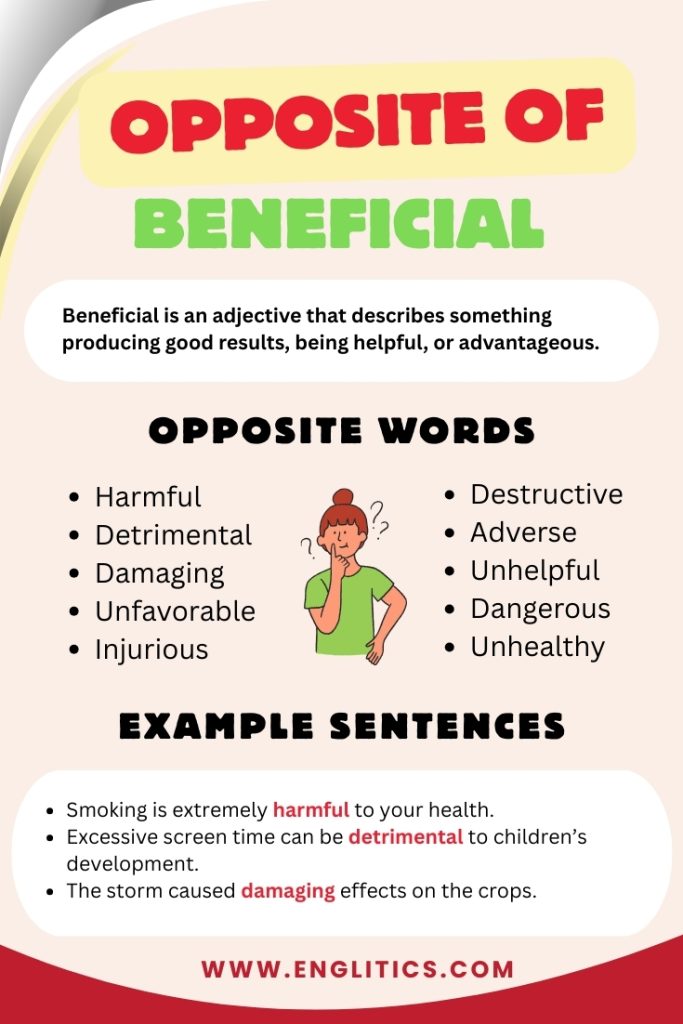
Antonyms are words with meanings that are opposite to each other. For “beneficial,” the antonyms convey the idea of something that is harmful, disadvantageous, or ineffective.
The choice of antonym depends on the specific context and the nuance you wish to express.
Common Antonyms for ‘Beneficial’:
- Harmful
- Detrimental
- Disadvantageous
- Adverse
- Ineffective
- Useless
- Worthless
- Injurious
Opposite of Beneficial
Antonyms can be categorized based on the nature of their opposition. Understanding these categories can help you choose the most appropriate antonym for “beneficial” in a given context.
Opposite in Effect
These antonyms directly contradict the positive effect of “beneficial,” indicating a negative or damaging outcome.
- Harmful: Causing or capable of causing harm.
- Detrimental: Causing damage or disadvantage.
- Injurious: Causing or likely to cause injury or harm.
Harmful Antonyms
These antonyms emphasize the negative consequences or results, highlighting the damaging aspect of something.
- Adverse: Unfavorable or creating difficulties.
- Damaging: Causing physical or emotional harm.
- Deleterious: Harmful often in a subtle or unexpected way.
Useless Antonyms
These antonyms suggest a lack of positive effect, indicating that something is not helpful or advantageous.
- Ineffective: Not producing the desired result.
- Useless: Having no practical purpose or result.
- Worthless: Having no real value or use.
Negative Antonyms
These antonyms simply negate the idea of being beneficial, indicating a lack of advantage or positivity.
- Disadvantageous: Creating unfavorable circumstances.
- Unfavorable: Not likely to lead to a positive outcome.
Examples of Antonyms in Use
The following examples illustrate how the different antonyms for “beneficial” can be used in sentences to convey opposite meanings. Understanding these examples will solidify your understanding of each term and its appropriate context.
Harmful Examples
The following table provides examples of using ‘harmful’ as an antonym for ‘beneficial’ in various contexts. These examples illustrate scenarios where something intended to be positive has a negative or damaging effect.
| Sentence | Explanation |
|---|---|
| Smoking is harmful to your health, unlike exercise which is beneficial. | Smoking has a damaging effect on health. |
| The harmful effects of pollution are a major concern for environmentalists. | Pollution has negative environmental consequences. |
| Spreading rumors can be harmful to someone’s reputation. | Rumors can damage someone’s public image. |
| Ignoring safety regulations can be harmful to workers. | Lack of safety measures can endanger employees. |
| Excessive sun exposure is harmful to the skin. | Too much sun can cause skin damage. |
| The harmful chemicals in pesticides can contaminate the soil. | Pesticides can negatively impact soil quality. |
| A diet high in processed foods is harmful to your well-being. | Processed foods can negatively affect health. |
| The harmful impact of deforestation includes loss of biodiversity. | Deforestation leads to a decline in plant and animal species. |
| Stress can be harmful to your mental health. | Stress can negatively affect psychological well-being. |
| The harmful consequences of neglecting your studies can be significant. | Ignoring academic responsibilities can lead to poor results. |
| Gossip can be harmful to workplace relationships. | Spreading rumors can damage professional connections. |
| The harmful rays of the sun can cause skin cancer. | Ultraviolet radiation can lead to serious health issues. |
| Lying is harmful to trust in a relationship. | Dishonesty can damage the foundation of a partnership. |
| The harmful effects of social media on self-esteem are being studied. | Social media can negatively impact personal confidence. |
| Ignoring mental health issues can be harmful in the long run. | Neglecting psychological well-being can have lasting negative effects. |
| The harmful toxins in the air contribute to respiratory problems. | Air pollutants can cause breathing difficulties. |
| Cutting corners in construction can be harmful to the structural integrity of a building. | Poor construction practices can compromise a building’s safety. |
| The harmful impact of fast fashion on the environment is significant. | The fast fashion industry contributes to environmental damage. |
| Overworking yourself can be harmful to both your physical and mental health. | Pushing yourself too hard can lead to burnout and health problems. |
| The harmful ingredients in some cosmetics can irritate the skin. | Certain cosmetic components can cause skin reactions. |
| Delaying necessary medical treatment can be harmful to your health. | Postponing medical care can worsen health conditions. |
| The harmful impact of cyberbullying on teenagers is a growing concern. | Online harassment can have severe emotional consequences for young people. |
Detrimental Examples
This table showcases sentences using ‘detrimental’ as an antonym for ‘beneficial.’ These examples highlight situations where something causes damage or disadvantage, often in a subtle or long-term way.
| Sentence | Explanation |
|---|---|
| Lack of sleep can be detrimental to your cognitive functions. | Insufficient sleep negatively affects thinking skills. |
| The detrimental effects of stress on the immune system are well-documented. | Stress weakens the body’s defense mechanisms. |
| Poor communication can be detrimental to team performance. | Ineffective communication hinders teamwork. |
| The detrimental impact of pollution on wildlife is a serious issue. | Pollution harms animal populations. |
| A sedentary lifestyle is detrimental to your overall health. | Lack of physical activity negatively affects well-being. |
| The detrimental consequences of neglecting infrastructure can be costly. | Ignoring infrastructure maintenance can lead to expensive repairs. |
| Excessive screen time can be detrimental to children’s development. | Too much screen time can negatively affect children’s growth. |
| The detrimental impact of climate change on coastal communities is evident. | Climate change harms coastal areas. |
| Unhealthy eating habits can be detrimental to your long-term health. | Poor diet choices negatively affect future well-being. |
| The detrimental effects of smoking extend beyond lung cancer. | Smoking causes various health problems. |
| Ignoring feedback can be detrimental to your professional growth. | Failing to listen to advice hinders career advancement. |
| The detrimental impact of overfishing on marine ecosystems is significant. | Overfishing harms ocean life. |
| A lack of education can be detrimental to your career prospects. | Insufficient schooling limits job opportunities. |
| The detrimental effects of deforestation on the environment are far-reaching. | Deforestation has widespread negative consequences. |
| Holding onto grudges can be detrimental to your mental health. | Harboring resentment negatively affects psychological well-being. |
| The detrimental toxins released by factories pollute the air and water. | Industrial emissions harm the environment. |
| Cutting funding for scientific research can be detrimental to innovation. | Reducing research budgets hinders progress. |
| The detrimental impact of plastic pollution on marine life is devastating. | Plastic waste harms ocean animals. |
| Failing to invest in renewable energy can be detrimental to the environment. | Neglecting sustainable energy harms the planet. |
| The detrimental effects of prolonged isolation on mental health are serious. | Extended periods of solitude can negatively affect psychological well-being. |
| Not properly maintaining your car can be detrimental to its performance and lifespan. | Neglecting car maintenance reduces its efficiency and durability. |
| The detrimental impact of soil erosion on agriculture is a major concern. | Soil loss harms crop production. |
Disadvantageous Examples
The subsequent table demonstrates the use of ‘disadvantageous’ as an antonym for ‘beneficial.’ These sentences illustrate situations where something creates unfavorable circumstances or reduces opportunities.
| Sentence | Explanation |
|---|---|
| Starting a business without a solid plan is disadvantageous. | Lacking a business plan creates unfavorable conditions. |
| Being unprepared for an interview puts you in a disadvantageous position. | Lack of preparation reduces your chances of success. |
| Living in a remote area can be disadvantageous for career opportunities. | Rural locations may limit job prospects. |
| The disadvantageous terms of the contract led to financial losses. | Unfavorable contract conditions caused monetary setbacks. |
| Having a criminal record is disadvantageous when applying for jobs. | A criminal history reduces employment opportunities. |
| The disadvantageous location of the store led to low sales. | Poor store placement resulted in reduced revenue. |
| Not speaking the local language can be disadvantageous when traveling. | Language barriers can create difficulties during travel. |
| The disadvantageous timing of the product launch resulted in poor sales. | Launching the product at an unfavorable time reduced its success. |
| Being unaware of market trends can be disadvantageous in business. | Lack of market knowledge hinders business success. |
| The disadvantageous weather conditions hampered the outdoor event. | Bad weather negatively affected the event. |
| Lacking experience can be disadvantageous when competing for a promotion. | Insufficient experience reduces chances of advancement. |
| The disadvantageous exchange rate made imports more expensive. | Unfavorable currency rates increased import costs. |
| Being stuck in traffic is disadvantageous when you’re late for a meeting. | Traffic delays reduce your punctuality. |
| The disadvantageous location of the new factory increased transportation costs. | Poor factory placement raised shipping expenses. |
| Having a weak internet connection can be disadvantageous when working remotely. | Poor internet service hinders remote work efficiency. |
| The disadvantageous terms of the loan made it difficult to repay. | Unfavorable loan conditions made repayment challenging. |
| Not having health insurance can be disadvantageous in case of an emergency. | Lack of insurance creates financial risks during medical crises. |
| The disadvantageous timing of the announcement overshadowed the good news. | Poorly timed announcement diminished positive impact. |
| Lacking access to education is disadvantageous for social mobility. | Limited education reduces opportunities for advancement. |
| The disadvantageous regulations made it difficult for small businesses to compete. | Unfavorable rules hindered small business success. |
| Being in debt can be disadvantageous when trying to save money. | Debt makes it harder to accumulate savings. |
| The disadvantageous tax policies discouraged investment in the region. | Unfavorable tax laws reduced investment. |
Useless Examples
The following table provides examples of using ‘useless’ as an antonym for ‘beneficial’ in various contexts. These examples illustrate scenarios where something lacks practical purpose or positive impact.
| Sentence | Explanation |
|---|---|
| Trying to fix a computer without any technical knowledge is useless. | Lacking skills makes computer repair ineffective. |
| The broken umbrella was useless in the heavy rain. | The damaged umbrella provided no protection. |
| Giving advice to someone who refuses to listen is useless. | Unheeded advice has no impact. |
| The useless tool couldn’t perform the task it was designed for. | The tool failed to fulfill its intended function. |
| Trying to start a fire with wet wood is useless. | Wet wood cannot be ignited. |
| The useless information provided no help in solving the problem. | The information offered no assistance. |
| Arguing with someone who is unwilling to compromise is useless. | Discussions with inflexible individuals are unproductive. |
| The useless app didn’t offer any practical features. | The app lacked valuable functionalities. |
| Trying to learn a new language without consistent practice is useless. | Inconsistent practice hinders language acquisition. |
| The useless directions led us in the wrong direction. | The instructions were inaccurate. |
| Trying to reason with someone who is extremely biased is useless. | Discussions with prejudiced individuals are futile. |
| The useless key didn’t fit any of the locks. | The key was incompatible with all locks. |
| Trying to force a solution on a complex problem is often useless. | Imposed solutions often fail to address the root cause. |
| The useless gadget didn’t perform any of its advertised functions. | The device failed to deliver its promised features. |
| Trying to teach someone who has no interest in learning is useless. | Unmotivated students are difficult to educate. |
| The useless spare part didn’t match the broken component. | The replacement part was incompatible. |
| Trying to negotiate with someone who is acting in bad faith is useless. | Dishonest individuals are difficult to bargain with. |
| The useless advice offered no practical solutions. | The suggestions were unhelpful. |
| Trying to control everything is useless; sometimes you have to let go. | Attempting to manage every detail is often unproductive. |
| The useless feature was removed in the latest software update. | The non-functional component was eliminated. |
Worthless Examples
The following table provides examples of using ‘worthless’ as an antonym for ‘beneficial’ in various contexts. These examples illustrate scenarios where something has no real value or significance, especially when compared to something beneficial.
| Sentence | Explanation |
|---|---|
| Without proper evidence, the accusations were worthless in court. | The claims lacked legal validity. |
| The worthless promises made by the politician were never fulfilled. | The politician’s pledges were empty and insincere. |
| Trying to save money with worthless coupons is a waste of time. | The coupons offer no real discounts. |
| The worthless antique turned out to be a fake. | The antique had no actual value. |
| Investing in a company with a worthless business model is risky. | The business lacks a viable strategy. |
| The worthless advice offered no practical solutions to the problem. | The suggestions were unhelpful and irrelevant. |
| Trying to build a business on a worthless idea is likely to fail. | The concept lacks potential for success. |
| The worthless warranty didn’t cover the damages to the product. | The warranty provided no protection. |
| Trying to negotiate with someone who is acting in bad faith is usually worthless. | Dishonest individuals are difficult to bargain with truthfully. |
| The worthless information provided no insights into the complex issue. | The data offered no valuable understanding. |
| Trying to convince someone who is completely closed-minded is worthless. | Discussing with inflexible individuals is unproductive. |
| The worthless effort didn’t produce any tangible results. | The activity yielded no meaningful outcomes. |
| Trying to repair the item with worthless tools is a waste of resources. | The tools are inadequate for the task. |
| The worthless apology didn’t address the harm caused. | The expression of remorse was insincere and inadequate. |
| Trying to learn from a worthless textbook is ineffective. | The textbook lacks quality and useful content. |
| The worthless attempt to fix the problem only made it worse. | The effort was counterproductive. |
| Trying to reason with someone who is completely irrational is worthless. | Discussing with illogical individuals is futile. |
| The worthless donation didn’t make a significant impact. | The contribution had minimal effect. |
| Trying to achieve success without hard work is worthless. | Effort is essential for accomplishment. |
| The worthless document had no legal standing. | The paper was invalid and unenforceable. |
Usage Rules for Antonyms of ‘Beneficial’
When using antonyms for “beneficial,” it’s important to consider the context and the specific nuance you want to convey. Here are some guidelines:
- Harmful vs. Detrimental: “Harmful” implies a direct and obvious negative effect, while “detrimental” suggests a more subtle or long-term negative impact.
- Useless vs. Worthless: “Useless” indicates a lack of practical purpose, while “worthless” suggests a lack of value or significance.
- Disadvantageous vs. Adverse: “Disadvantageous” implies unfavorable circumstances, while “adverse” suggests opposition or resistance.
- Context is Key: Always choose the antonym that best fits the specific situation you are describing.
Common Mistakes
Here are some common mistakes to avoid when using antonyms for “beneficial”:
| Incorrect | Correct | Explanation |
|---|---|---|
| The exercise was useless for my health. | The exercise was harmful for my health. | “Harmful” is more appropriate when describing a negative health impact. |
| The advice was detrimental, it was completely worthless. | The advice was worthless; it didn’t help at all. | “Worthless” better conveys the idea of lacking value or help. |
| His lack of experience was harmful to his career. | His lack of experience was disadvantageous to his career. | “Disadvantageous” is more appropriate when describing an unfavorable circumstance. |
| The medicine was ineffective, it caused me harm. | The medicine was harmful and ineffective. | The medicine was both damaging and didn’t work, so both words are needed. |
Practice Exercises
Test your understanding of antonyms for “beneficial” with the following exercises.
Exercise 1: Multiple Choice
Choose the best antonym for “beneficial” in each sentence.
| Question | Options | Answer |
|---|---|---|
| 1. The new policy was meant to be helpful, but it turned out to be quite ____. | a) advantageous b) detrimental c) useful d) favorable | b) detrimental |
| 2. Eating healthy foods is beneficial, while consuming too much sugar can be ____. | a) helpful b) advantageous c) harmful d) favorable | c) harmful |
| 3. The new tool was supposed to improve efficiency, but it proved to be ____. | a) effective b) useful c) worthless d) helpful | c) worthless |
| 4. Being prepared for the presentation is beneficial, while being unprepared is ____. | a) advantageous b) favorable c) disadvantageous d) helpful | c) disadvantageous |
| 5. Exercise is beneficial for your health, but a sedentary lifestyle is ____. | a) helpful b) favorable c) useful d) detrimental | d) detrimental |
| 6. Sunlight can be beneficial, but too much exposure can be ____. | a) helpful b) advantageous c) injurious d) favorable | c) injurious |
| 7. The new strategy was designed to be effective, but it turned out to be ____. | a) useful b) helpful c) ineffective d) favorable | c) ineffective |
| 8. Teamwork is beneficial for productivity, but poor communication can be ____. | a) helpful b) favorable c) detrimental d) useful | c) detrimental |
| 9. Investing in education is beneficial, while neglecting it can be ____. | a) advantageous b) favorable c) disadvantageous d) helpful | c) disadvantageous |
| 10. The new law was intended to be helpful, but it had an ____ effect on small businesses. | a) advantageous b) adverse c) useful d) favorable | b) adverse |
Exercise 2: Fill in the Blanks
Fill in the blank with the most appropriate antonym for “beneficial.”
| Question | Answer |
|---|---|
| 1. While regular exercise is beneficial, overtraining can be ____. | harmful |
| 2. The company’s new policy proved to be ____ to employee morale. | detrimental |
| 3. Arriving late for the interview put him in a ____ position. | disadvantageous |
| 4. The broken tool was completely ____ for the task. | useless |
| 5. The information provided was ____ and did not help solve the problem. | worthless |
| 6. The side effects of the medication were more ____ than beneficial. | harmful |
| 7. The lack of communication had a ____ impact on the team’s performance. | detrimental |
| 8. The ____ weather conditions forced the cancellation of the event. | adverse |
| 9. Trying to fix the problem without the proper tools is ____. | useless |
| 10. The politician’s promises turned out to be ____, as none were kept. | worthless |
Exercise 3: Sentence Completion
Complete the following sentences using an appropriate antonym for “beneficial.”
| Question | Answer |
|---|---|
| 1. While a balanced diet is beneficial for your health, a diet high in processed foods can be ____. | harmful to your well-being |
| 2. Although regular exercise is beneficial for reducing stress, excessive exercise can be ____. | detrimental to your joints and muscles |
| 3. While being well-prepared for a job interview is beneficial, arriving late and unprepared can be ____. | disadvantageous and ruin your chances |
| 4. Though having the right tools can be beneficial for a project, using the wrong tools can be ____. | useless and even damaging |
| 5. Although honest feedback can be beneficial for improvement, giving feedback without any constructive criticism can be ____. | worthless and demotivating |
| 6. While sunlight can be beneficial for vitamin D production, prolonged exposure can be ____. | injurious to the skin, causing burns |
| 7. Although some medications are beneficial for treating illnesses, others can be ____. | harmful due to severe side effects |
| 8. While clear communication is beneficial for team collaboration, a lack of transparency can be ____. | detrimental, breeding mistrust |
| 9. Although financial planning can be beneficial for securing your future, neglecting it can be ____. | disadvantageous, leading to financial instability |
| 10. While having accurate information is beneficial for decision-making, relying on misinformation can be ____. | harmful or even dangerous |
Advanced Topics
For advanced learners, consider exploring the nuances of antonym usage in different contexts. For example, in legal or medical settings, the choice of antonym can have significant implications.
Also, explore the use of euphemisms and how they relate to antonyms. For instance, instead of saying something is “harmful,” one might use a milder term like “unfavorable” to soften the impact.
Another advanced topic is the concept of auto-antonyms (also known as contranyms), which are words that can have opposite meanings depending on the context. While not directly related to “beneficial,” understanding auto-antonyms highlights the complexity and flexibility of the English language.
FAQ
Here are some frequently
asked questions regarding the antonyms of “beneficial”:
Q: Is ‘bad’ an antonym for ‘beneficial’?
A: While ‘bad’ can sometimes be used to indicate the opposite of ‘beneficial,’ it is a very general term. More specific antonyms like ‘harmful’ or ‘detrimental’ are usually more appropriate and provide a clearer understanding of the negative impact.
Q: Can ‘negative’ be used as an antonym for ‘beneficial’?
A: ‘Negative’ can function as an antonym in certain contexts, particularly when describing effects or outcomes. However, it is less direct than antonyms like ‘harmful’ or ‘disadvantageous,’ which more explicitly convey a negative impact.
Q: What is the difference between ‘detrimental’ and ‘harmful’?
A: ‘Harmful’ generally implies a more direct and immediate negative effect, while ‘detrimental’ suggests a more gradual or subtle negative impact. ‘Harmful’ is often used for things that cause obvious damage, whereas ‘detrimental’ is used for things that erode or undermine something over time.
Q: When should I use ‘useless’ instead of ‘worthless’ as an antonym for ‘beneficial’?
A: Use ‘useless’ when something lacks a practical purpose or cannot achieve a desired outcome. Use ‘worthless’ when something lacks value, importance, or significance.
For example, a broken tool is ‘useless,’ while a forged painting is ‘worthless.’
Q: Are there any situations where ‘beneficial’ has no direct antonym?
A: In some contexts, particularly when ‘beneficial’ is used in a very broad or general sense, it may be more appropriate to use a phrase like “not beneficial” or “without benefit” rather than a single-word antonym. This is especially true when you want to avoid implying a strong negative effect.
Conclusion
Understanding the antonyms for “beneficial” is essential for precise and effective communication. By exploring the nuances between words like ‘harmful,’ ‘detrimental,’ ‘disadvantageous,’ ‘useless,’ and ‘worthless,’ you can more accurately convey the opposite of something that is helpful or advantageous.
Continue to practice using these antonyms in various contexts to further enhance your vocabulary and writing skills. Mastering these nuances will undoubtedly be beneficial in your linguistic journey.