Every day, people all over the world step into shops and interact with shopkeepers to buy groceries, clothes, electronics, and more. These simple conversations are a core part of daily life—and they’re a perfect way to practice real-world English!
Whether you’re a beginner learning English or someone trying to sound more natural in everyday conversations, understanding how dialogues work between customers and shopkeepers can boost your speaking, listening, and grammar skills. You’ll pick up polite expressions, questions, and phrases commonly used in shopping scenarios.
What You’ll Learn in This Post:
- Useful vocabulary and polite expressions for shopping.
- Example dialogues between shopkeeper and customer in different situations.
- Tips on writing your own dialogues.
- Practice exercises to test your understanding.
By the end of this post, you’ll feel more confident when entering a store—whether it’s in your own country or while traveling abroad!
Key Vocabulary and Phrases
Before jumping into sample dialogues, it’s helpful to learn the common expressions used in shops and stores. These will help you understand and create realistic conversations.
Common Expressions Used by Shopkeepers:
| Phrase | Meaning |
| “How can I help you?” | A polite way to start the conversation. |
| “Yes, we have that in stock.” | Confirming availability of an item. |
| “That will be [amount].” | Telling the customer the total price. |
| “Would you like a bag?” | Offering a shopping bag. |
| “Please come again!” | Inviting the customer to return. |
Common Expressions Used by Customers:
| Phrase | Meaning |
| “Do you have…?” | Asking about product availability. |
| “How much is this?” | Inquiring about price. |
| “Can I get a discount?” | Asking for a lower price. |
| “I’m just looking, thanks.” | Politely declining help while browsing. |
| “Can I return this if there’s a problem?” | Asking about return policy. |
Bonus: Useful Vocabulary
- Price tag – A label showing how much something costs.
- Receipt – A paper that shows proof of purchase.
- Warranty – A promise that a product will be repaired or replaced if faulty.
- Counter – The table or surface where purchases are made.
- Cart/Basket – A container used to collect items while shopping.
Dialogue Between Shopkeeper and Customer
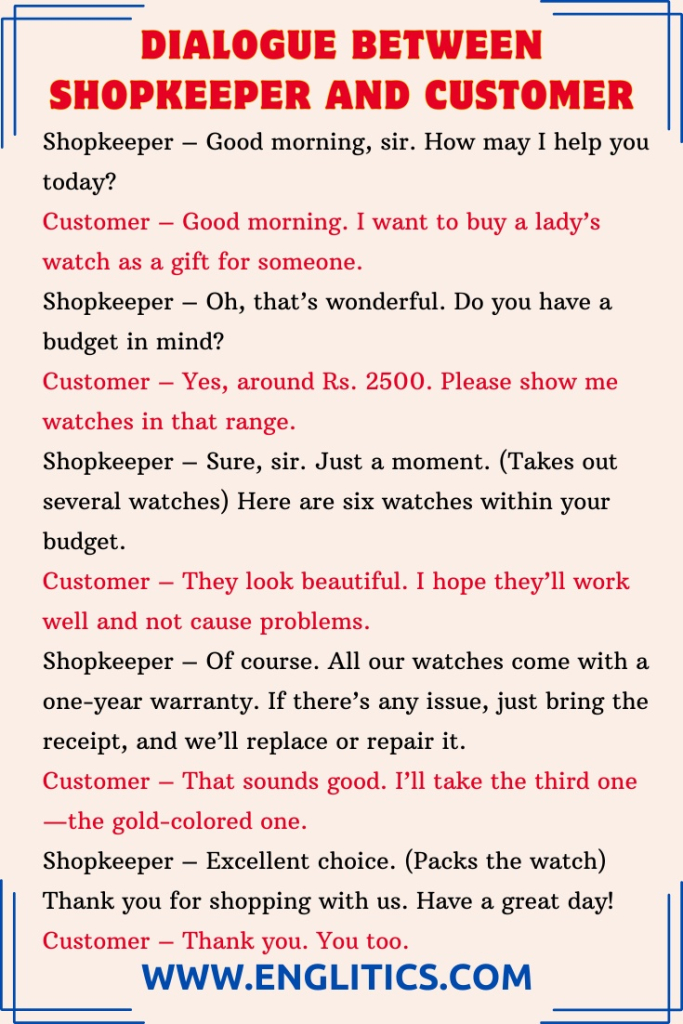
1. Dialogue Between Shopkeeper and Customer About Buying a Lady’s Watch
Shopkeeper – Good morning, sir. How may I help you today?
Customer – Good morning. I want to buy a lady’s watch as a gift for someone.
Shopkeeper – Oh, that’s wonderful. Do you have a budget in mind?
Customer – Yes, around Rs. 2500. Please show me watches in that range.
Shopkeeper – Sure, sir. Just a moment. (Takes out several watches) Here are six watches within your budget.
Customer – They look beautiful. I hope they’ll work well and not cause problems.
Shopkeeper – Of course. All our watches come with a one-year warranty. If there’s any issue, just bring the receipt, and we’ll replace or repair it.
Customer – That sounds good. I’ll take the third one—the gold-colored one.
Shopkeeper – Excellent choice. (Packs the watch) Thank you for shopping with us. Have a great day!
Customer – Thank you. You too.
2. Dialogue Between Shopkeeper and Customer About Buying Books
Customer – Hi there! I’m looking for some new books.
Shopkeeper – Hello! What kind of books are you interested in?
Customer – I love mystery novels. Do you have any recommendations?
Shopkeeper – Yes, we have a great selection. This one is called “The Hidden Clue.” It’s very popular.
Customer – That sounds interesting! How much is it?
Shopkeeper – It’s $12. Would you like to see more?
Customer – Yes, please. Do you have any more mystery books?
Shopkeeper – Certainly. Here are “Mystery in the Library” and “The Secret Code.”
Customer – I’ll take both of those, along with “The Hidden Clue.”
Shopkeeper – Great choices! Your total is $36.
Customer – Here’s my card. Thank you for your help!
Shopkeeper – You’re welcome! Enjoy your reading!
3. Dialogue Between Shopkeeper and Customer About Buying Shoes
Shopkeeper – Welcome! How can I assist you today?
Customer – I’m looking for a pair of formal shoes for an office event.
Shopkeeper – Sure. What’s your size and preferred color?
Customer – I wear size 9 and would prefer black or brown.
Shopkeeper – Here are a few options in both colors. These are leather and currently on discount.
Customer – Oh, they look classy. How much for this black pair?
Shopkeeper – That one is $75 after the discount.
Customer – That’s reasonable. Do you have a return policy in case they don’t fit well?
Shopkeeper – Yes, within 7 days with the receipt and box intact.
Customer – Perfect. I’ll go with the black pair.
Shopkeeper – Excellent. I’ll get them packed.
Customer – Thanks a lot!
Shopkeeper – My pleasure. Come again!
4. Dialogue Between Shopkeeper and Customer About Buying Fruits
Customer – Hello! Are these apples fresh?
Shopkeeper – Yes, ma’am. They arrived this morning. Would you like to try one?
Customer – No need, I trust you. How much per kilo?
Shopkeeper – $2.50 per kilogram.
Customer – Okay, give me 2 kilograms of apples and 1 kilogram of bananas.
Shopkeeper – Sure. That will be $5.75 in total.
Customer – Do you take mobile payments?
Shopkeeper – Yes, we accept all UPI and card payments.
Customer – Great. I’ll pay via QR.
Shopkeeper – Payment received. Thank you!
Customer – Thanks! See you next time.
5. Dialogue Between Shopkeeper and Customer About Returning a Product
Customer – Excuse me, I bought this toy car last week, but it’s not working.
Shopkeeper – I’m sorry to hear that. Do you have the receipt with you?
Customer – Yes, here it is.
Shopkeeper – Thank you. It’s still under the 7-day return window. Would you like a replacement or a refund?
Customer – I’d prefer a replacement, if possible.
Shopkeeper – Sure. Let me check if we have another one in stock… Yes, here you go.
Customer – Thank you for the quick help.
Shopkeeper – You’re most welcome. Let us know if you face any other issues.
Dialogue Writing Tips
Writing natural-sounding dialogues is a great way to build fluency in English. But many learners struggle to make their conversations sound realistic. Here are 6 practical tips to help you write effective and engaging dialogues—just like real conversations between a shopkeeper and a customer.
Start with a Clear Setting
Begin your dialogue by briefly imagining the place, purpose, and tone of the conversation. Ask yourself:
- Who is speaking? (A polite customer? A busy shopkeeper?)
- Where is this happening? (A grocery store? A bookshop?)
- Why are they interacting? (To buy something? Return a product?)
Example:
A customer walks into a bakery to buy a birthday cake.
Use Natural, Everyday Phrases
Avoid textbook-sounding expressions. Use simple, commonly spoken phrases that sound friendly and realistic.
| Instead of… | Try saying… |
| “I wish to purchase…” | “I’d like to buy…” |
| “Could you kindly inform me…” | “Can you tell me…” |
| “This item is quite pleasing” | “This looks nice!” |
Pro Tip: Listen to real conversations (in person or in movies) and note how people speak casually.
Keep the Conversation Polite
Politeness matters, especially in customer service situations. Make sure both the shopkeeper and customer use courteous expressions:
- “Good morning!” / “Hello!”
- “Can I help you?” / “Yes, please.”
- “Thank you!” / “You’re welcome!”
- “Have a nice day!”
Adding these elements builds realism and models good manners.
Add Logical Flow (Beginning → Middle → End)
Good dialogues have structure. Think of it like a short story with three clear parts:
- Beginning: Greeting and purpose
- Middle: Questions, product details, decision-making
- End: Purchase/thank-you/farewell
Example:
- “Hello, I need a birthday gift.”
- “Here are some perfumes within your budget.”
- “Perfect. I’ll take this one. Thanks!”
Include Common Shopping Questions
Here are some essential question patterns that frequently appear in store-related dialogues:
| Question Type | Examples |
| Product Inquiry | “Do you have this in medium size?” |
| Price | “How much does this cost?” |
| Availability | “Is this in stock?” |
| Warranty/Return | “Can I return this if there’s a problem?” |
| Request | “Could you gift-wrap this, please?” |
Encourage learners to reuse and modify these frames in their own writing.
Practice Role-Playing to Build Confidence
Once a dialogue is written, act it out! Role-playing is one of the best ways to:
- Practice pronunciation
- Gain speaking confidence
- Understand tone and politeness
- Memorize useful phrases
You can even record your dialogue and listen to your tone, pacing, and clarity.
Bonus Tip: Add Emotion or Personality
Let your characters show a bit of emotion—curiosity, hesitation, excitement. It makes the dialogue feel more human and less robotic.
Example:
- “Wow, that’s exactly what I was looking for!”
- “Hmm… I’m not sure. Do you have anything cheaper?”
Practice Exercises: Shopkeeper and Customer Dialogues
Exercise 1: Fill in the Blanks
Fill in the blanks with the most appropriate word or phrase from this list:
(budget, receipt, exchange, in stock, discount, gift wrap, refund, browse, warranty, total)
- I’d like to buy a blender, but my __________ is under $100.
- Do you have this bag __________? I need it in red.
- Is it possible to get a __________ on this item?
- Here’s the faulty item and the __________.
- Would you like me to __________ it for you?
- That product comes with a one-year __________.
- This dress isn’t my size. Can I get an __________?
- Sorry, we don’t offer a __________ on sale items.
- You’re welcome to __________ while I check in the back.
- Your __________ comes to $47.60.
Answer Key – Exercise 1:
- budget
- in stock
- discount
- receipt
- gift wrap
- warranty
- exchange
- refund
- browse
- total
Exercise 2: Sentence Rewriting
Rewrite each sentence to make it more natural and polite for a shopkeeper-customer conversation.
- “Give me this in a different color.”
- “How much this cost?”
- “You have this or not?”
- “I want cheaper item.”
- “Pack it fast.”
- “No, I don’t want help.”
- “I bought this yesterday. It’s broken.”
- “Why so expensive?”
- “Return this now.”
- “Where manager?”
Answer Key – Exercise 2:
- Could you please show me this in a different color?
- How much does this cost?
- Do you have this item in stock?
- Do you have anything more affordable?
- Could you please pack this quickly?
- No, thank you. I’m just looking.
- I purchased this yesterday, but it’s not working properly.
- Is there any reason for the high price?
- I’d like to return this, please.
- Could I speak to the manager, please?
Exercise 3: Multiple Choice
Choose the best response or phrase that fits the context.
- “This looks nice. How much is it?”
(a) It’s on the shelf.
(b) It’s $29.99.
(c) Yes, I can. - “Can I return this if it doesn’t fit?”
(a) No returns ever.
(b) Only with a receipt.
(c) Just keep it. - “Would you like it gift-wrapped?”
(a) Yes, please.
(b) I don’t know her.
(c) I forgot my wallet. - “Do you have this in size 8?”
(a) No, that’s expensive.
(b) Yes, it’s over there.
(c) That is not color. - “Can I pay by card?”
(a) Yes, we accept all major cards.
(b) No, this is large.
(c) I’ll bring it tomorrow. - “Here’s your bill.”
(a) Please pack fast.
(b) Thank you.
(c) That is green. - “I’m just browsing, thanks.”
(a) Oh, I’ll bring change.
(b) No problem. Let me know if you need help.
(c) This is expensive. - “Do you offer a student discount?”
(a) Yes, with valid ID.
(b) Only water here.
(c) That’s a large size. - “Can I exchange this shirt?”
(a) Yes, within 7 days with the receipt.
(b) No, you broke it.
(c) I don’t speak English. - “The item I bought is damaged.”
(a) Then keep it.
(b) You can try fixing it.
(c) I’m sorry to hear that. Let me check the return policy.
Answer Key – Exercise 3:
- (b) It’s $29.99.
- (b) Only with a receipt.
- (a) Yes, please.
- (b) Yes, it’s over there.
- (a) Yes, we accept all major cards.
- (b) Thank you.
- (b) No problem. Let me know if you need help.
- (a) Yes, with valid ID.
- (a) Yes, within 7 days with the receipt.
- (c) I’m sorry to hear that. Let me check the return policy.
Conclusion
Mastering everyday dialogues like those between a shopkeeper and a customer is essential for anyone learning English. These interactions teach you how to ask questions, respond politely, use transactional vocabulary, and build confidence in real-life situations. Whether you’re buying books, returning a product, or simply browsing, understanding these patterns can make your communication smoother and more natural.
Keep practicing the dialogues and expressions you’ve learned here. Try role-playing with a friend, writing your own conversations, or even acting them out aloud. The more you expose yourself to real-life English, the faster you’ll improve. And remember—every interaction is an opportunity to grow your language skills!