Studying is a big part of student life, and talking about it is a great way to practice English. Whether it’s discussing exam pressure, study techniques, or favorite subjects, a short conversation between friends about study helps learners express thoughts clearly and confidently.
For English learners, this kind of dialogue is useful for building vocabulary, understanding natural expressions, and improving spoken fluency. It also gives you real-life phrases that you can use in class or while talking with classmates.
Key Vocabulary and Phrases for Study Conversation
Common Phrases Used to Ask About Studies
| Phrase | Meaning |
|---|---|
| “How’s your studying going?” | Asking for a general update on schoolwork |
| “Are you ready for the test?” | Asking about exam preparation |
| “What subjects are you focusing on?” | Asking about study priorities |
| “Let’s study together sometime.” | Suggesting a group study |
| “Have you finished the homework?” | Asking if the other person has completed work |
Common Phrases Used to Talk About Studies
| Phrase | Meaning |
|---|---|
| “I’m struggling with science.” | Having difficulty with a subject |
| “I revised all of chapter 3.” | Talking about reviewing study material |
| “I need help with math.” | Asking for support in a subject |
| “I studied late last night.” | Mentioning time spent studying |
| “Let’s quiz each other.” | Suggesting an interactive way to review |
Bonus Vocabulary
- Revision – Reviewing notes or chapters before a test
- Notes – Summarized information written down during study
- Test – An exam or assessment
- Focus – Paying attention during study
- Syllabus – A list of topics for a subject or course
- Preparation – Getting ready for an exam or assignment
- Assignment – A task given by a teacher to complete
Short Conversation Between Two Friends About Study
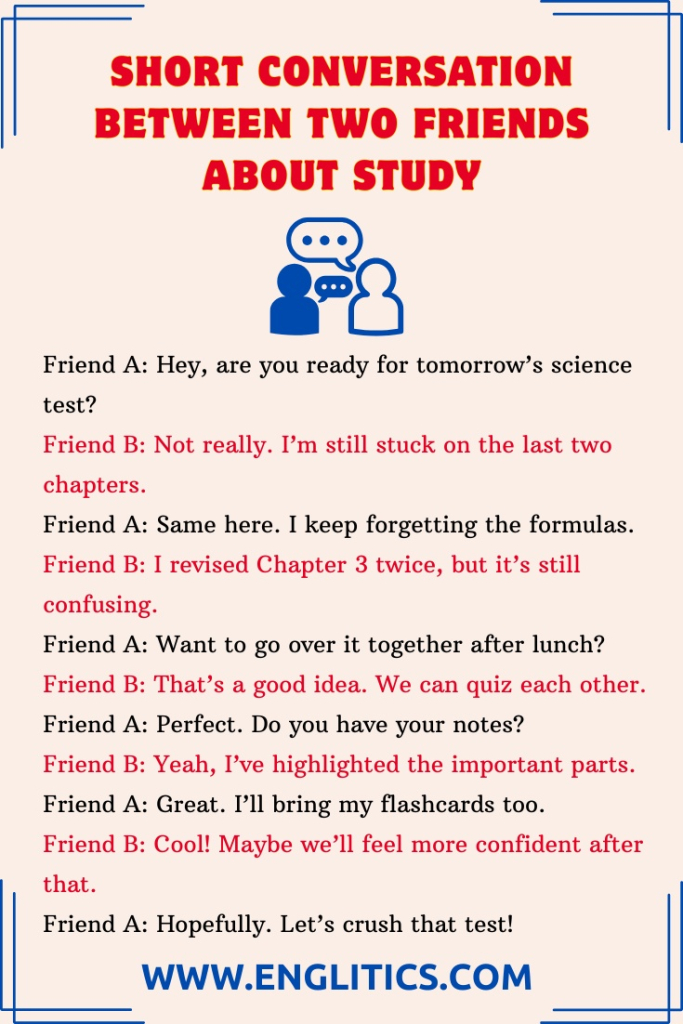
Dialogue 1: Conversation Between Two Friends Studying for an Exam
Friend A: Hey, are you ready for tomorrow’s science test?
Friend B: Not really. I’m still stuck on the last two chapters.
Friend A: Same here. I keep forgetting the formulas.
Friend B: I revised Chapter 3 twice, but it’s still confusing.
Friend A: Want to go over it together after lunch?
Friend B: That’s a good idea. We can quiz each other.
Friend A: Perfect. Do you have your notes?
Friend B: Yeah, I’ve highlighted the important parts.
Friend A: Great. I’ll bring my flashcards too.
Friend B: Cool! Maybe we’ll feel more confident after that.
Friend A: Hopefully. Let’s crush that test!
Dialogue 2: Conversation Between Two Friends Finishing Homework Together
Friend A: Have you finished the history homework?
Friend B: Not yet. I didn’t understand question 4.
Friend A: Oh, that one’s tricky. It’s about World War I.
Friend B: Yeah, I wasn’t sure what to write.
Friend A: I wrote about the causes and added an example.
Friend B: Can I see how you did it?
Friend A: Sure. Just don’t copy it, okay?
Friend B: Don’t worry. I’ll write it in my own words.
Friend A: Cool. Let’s finish it together now.
Friend B: Thanks! You always help me out.
Dialogue 3: Talking About Study Habits Between Two Friends
Friend A: You always finish your assignments early. How do you do it?
Friend B: I follow a schedule and try to avoid distractions.
Friend A: I get distracted so easily. Even my phone buzz throws me off.
Friend B: Try using a timer—30 minutes of study, then a 5-minute break.
Friend A: That sounds manageable. Do you study every day?
Friend B: I try to. A little each day is better than cramming.
Friend A: I usually wait until the night before the test.
Friend B: That’s risky. Studying early helps me stay relaxed.
Friend A: I think I’ll try your method this week.
Friend B: Do it! It’ll make studying less stressful.
Dialogue 4: Asking for Help with a Subject
Friend A: Hey, can you help me with math?
Friend B: Sure. What topic are you stuck on?
Friend A: Algebra. I don’t get how to solve equations.
Friend B: Okay, let’s go through a few problems together.
Friend A: Thanks! I just can’t figure out the steps.
Friend B: No worries. We’ll do it step by step.
Friend A: You explain things really well.
Friend B: Thanks! Teaching helps me understand better too.
Friend A: Maybe we should make this a regular thing.
Friend B: I’m in. Let’s help each other out.
Dialogue 5: Last-Minute Study Panic
Friend A: I totally forgot we have a quiz today!
Friend B: What? How did you forget?
Friend A: I thought it was next week. I didn’t revise anything.
Friend B: It’s okay. We’ve got 15 minutes. Let’s go over the key points.
Friend A: Really? That would help a lot.
Friend B: Here—start with these notes. They’re short and clear.
Friend A: Thanks! You’re a lifesaver.
Friend B: Don’t worry. You’ll do fine. Just stay calm.
Friend A: I’ll try. I owe you one!
Friend B: Just do your best. Good luck!
Dialogue Writing Tips
Writing a short conversation about study between friends is a great way to practice casual English. These dialogues often happen in real life—before tests, while doing homework, or when helping each other understand difficult topics. Here’s how to make your study-related dialogues sound natural, friendly, and effective.
1. Start with a Clear Situation
Think about where the friends are and what they’re talking about. This helps make the dialogue feel realistic.
Examples:
- Two friends are reviewing notes before a math quiz.
- A classmate asks another for help with an assignment.
Knowing the setting helps guide the tone and vocabulary.
2. Use Everyday Language
Students don’t talk like textbooks. Use real expressions and casual phrases.
Instead of:
“I am unprepared for the examination.”
Try:
“I’m not ready for the test.”
Natural English sounds friendly and relaxed, just like how people speak in school.
3. Show the Problem or Goal
A good short dialogue has a small issue or purpose. Maybe one friend is confused about a topic, or both are worried about a test. This creates a reason for the conversation to happen.
Example:
- “I don’t understand this question.”
- “Let’s go over it together.”
This makes the exchange useful and clear.
4. Keep It Short and Focused
Since the conversation is short, stay on one topic like homework, test prep, or study tips. Avoid changing subjects too often.
Stick to 10–12 lines with quick replies, like:
- “Did you study?”
- “A little. I still need to finish history.”
This keeps the dialogue easy to follow.
5. Include Study-Related Vocabulary
Use words like:
- test, chapter, notes, revise, help, assignment, focus, quiz, problem, explain
Example sentences:
- “Let’s revise Chapter 4 together.”
- “I still have to do the assignment.”
Using the right terms improves both fluency and vocabulary retention.
6. Add Friendly Reactions
Even in short conversations, reactions like “Thanks!”, “Seriously?”, or “You’re the best!” make the dialogue feel real. They also show emotion and build personality.
Example:
- “You finished the homework already?”
- “Yep. Want me to explain it?”
Add small expressions to make your dialogue come alive.
Practice Exercises
Exercise 1: Fill in the Blanks
Use the word bank to complete the study-related sentences.
Word Bank: (revise, assignment, chapter, quiz, focus, notes, test, help, homework, schedule)
- I need to __________ for the science quiz tomorrow.
- Have you finished the English __________?
- I couldn’t __________ during math class today.
- Can you __________ me with this question?
- I lost my __________ and now I can’t review.
- The __________ is on Monday, so start preparing.
- We should review the whole __________ before the exam.
- Our teacher gave us a surprise __________ today.
- I always do my __________ right after dinner.
- Let’s make a study __________ for the week.
Answer Key:
- revise
- assignment
- focus
- help
- notes
- test
- chapter
- quiz
- homework
- schedule
Exercise 2: Sentence Rewriting
Rewrite each sentence into casual, student-friendly English.
- “I have not completed my homework.”
- “This problem is too difficult to understand.”
- “Could you please assist me with this equation?”
- “I have a lack of concentration.”
- “I’m not ready for the examination.”
- “Would you like to revise together?”
- “I have forgotten everything I studied.”
- “Please wait a moment.”
- “You always complete your work on time.”
- “This lesson is extremely boring.”
Sample Answers:
- “I haven’t done my homework yet.”
- “This question is too hard.”
- “Can you help me with this?”
- “I can’t focus today.”
- “I’m not ready for the test.”
- “Wanna study together?”
- “I forgot everything I revised.”
- “Hold on a sec.”
- “You always finish early.”
- “This class is super boring.”
Exercise 3: Multiple Choice Questions
Choose the best answer for each situation.
- “Did you study for the quiz?”
a) Yes, a little.
b) No, I eat lunch.
c) I forget shoes. - “What’s your favorite subject?”
a) Tomorrow is Friday.
b) I like science the most.
c) Books are on the table. - “Why didn’t you do the assignment?”
a) My pen is blue.
b) I didn’t understand it.
c) The school is open. - “Can I borrow your notes?”
a) Sorry, I didn’t bring them.
b) I love weekends.
c) My teacher is nice. - “Let’s study together after school.”
a) I already cooked lunch.
b) Good idea! I need help.
c) What is your name? - “What chapter is the test on?”
a) It’s about Chapter 4 and 5.
b) I wore a jacket.
c) Let’s eat now. - “How do you stay focused?”
a) I use a timer and take breaks.
b) I run fast every day.
c) My dog is brown. - “You did well on the quiz!”
a) I forgot to brush.
b) Thanks! I studied hard.
c) The room is cold. - “I’m worried about the test.”
a) Don’t worry, we’ll review together.
b) The bell rang.
c) It’s raining today. - “Let’s do the homework now.”
a) I’m sleepy.
b) Okay, I’ve got my notebook.
c) Bananas are yellow.
Answer Key:
- a
- b
- b
- a
- b
- a
- a
- b
- a
- b
Exercise 4: Dialogue Building
Complete each mini-dialogue with a natural response.
- Friend A: “Have you finished the assignment?”
Friend B: ____________________________
Friend A: “Great, let’s check answers together.” - Friend A: “I can’t understand this question.”
Friend B: ____________________________
Friend A: “Thanks, that makes sense now.” - Friend A: “How do you prepare for tests?”
Friend B: ____________________________
Friend A: “I should try that method too.” - Friend A: “Wanna study after class?”
Friend B: ____________________________
Friend A: “Cool, library at 4?” - Friend A: “I left my notes at home.”
Friend B: ____________________________
Friend A: “Thanks! You saved me.” - Friend A: “Did you revise Chapter 6?”
Friend B: ____________________________
Friend A: “Let’s review it now.” - Friend A: “I got 7 out of 10 on the quiz.”
Friend B: ____________________________
Friend A: “Yeah, I’ll improve next time.” - Friend A: “How long do you study each day?”
Friend B: ____________________________
Friend A: “Maybe I should study more too.” - Friend A: “Let’s make a study group.”
Friend B: ____________________________
Friend A: “Cool. Let’s invite two more friends.” - Friend A: “I’m too tired to study tonight.”
Friend B: ____________________________
Friend A: “Good idea. Just 20 minutes of review.”
Sample Answers:
- “Yes, I did it last night.”
- “Want me to explain it to you?”
- “I read the chapter and take notes.”
- “Sure! I need to review too.”
- “You can borrow mine.”
- “Only the first part.”
- “That’s not bad—keep it up!”
- “About an hour every evening.”
- “I’m in! That’s a great idea.”
- “Just do a quick review—it helps.”
Conclusion
Talking about studies is one of the most common and useful ways to practice English in real-life settings. Whether it’s reviewing homework, preparing for a test, or just helping a friend understand a tough topic, short conversations about study allow learners to improve fluency, build vocabulary, and feel more confident using natural English.
The dialogues and exercises in this article offer realistic practice for students and English learners at different levels. Try role-playing these situations with a partner or writing your own dialogues based on your school experiences. Every short conversation is a step toward becoming a more confident English speaker—so keep practicing, keep speaking, and keep learning.