Every student faces challenges in school—whether it’s keeping up with homework, preparing for exams, or managing distractions. In many families, fathers play an active role in encouraging their children to study well, stay disciplined, and plan for a bright future.
That’s why the topic “Dialogue Between Father and Son About Studies” is not only common in real life—it’s perfect for English learners. These conversations help you practice natural sentence structure, speaking fluency, polite expressions, and useful vocabulary related to school and family life.
Whether you’re a student or a teacher, role-playing these dialogues can improve your confidence and help you use English in everyday situations.
Key Vocabulary and Phrases
Phrases Commonly Used by the Father
| Phrase | Meaning |
|---|---|
| “How are your studies going?” | Asking generally about school performance |
| “You need to stay focused.” | Advising to avoid distractions |
| “Let’s make a study plan together.” | Offering help with study planning |
| “That’s not acceptable.” | Expressing disappointment or concern |
| “I’m proud of your effort.” | Praising hard work |
Phrases Commonly Used by the Son
| Phrase | Meaning |
|---|---|
| “I’ve been struggling in math.” | Admitting difficulty in a subject |
| “I forgot to do the assignment.” | Confessing a mistake or missed homework |
| “I’ll try harder next time.” | Promising to improve |
| “Can you help me revise?” | Asking for help with studying |
| “Thanks for understanding.” | Showing gratitude for support |
Bonus Vocabulary
- Syllabus – A list of topics covered in a course
- Revision – Reviewing topics before a test
- Deadline – The final date to complete work
- Distraction – Something that takes away your focus
- Procrastinate – To delay or avoid doing something
- Performance – How well a student is doing academically
- Encouragement – Support or motivation given to someone
- Confidence – Belief in yourself or your abilities
Dialogues Between Father and Son About Studies
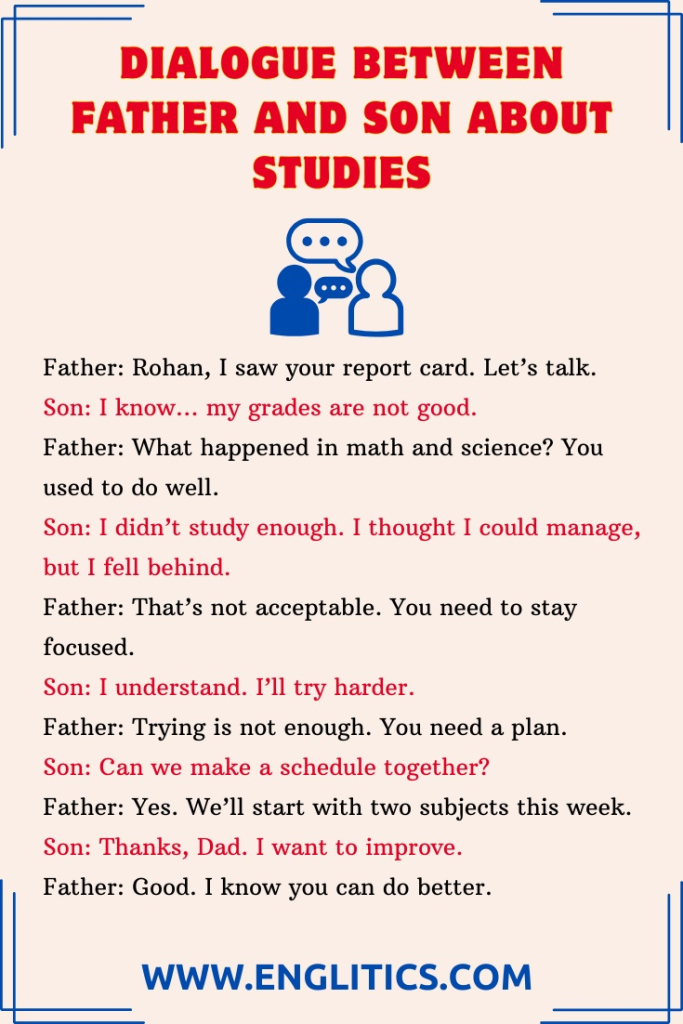
These dialogues show different realistic situations—from scolding to support, from disappointment to pride.
Dialogue 1: Father Concerned About Bad Grades
Father: Rohan, I saw your report card. Let’s talk.
Son: I know… my grades are not good.
Father: What happened in math and science? You used to do well.
Son: I didn’t study enough. I thought I could manage, but I fell behind.
Father: That’s not acceptable. You need to stay focused.
Son: I understand. I’ll try harder.
Father: Trying is not enough. You need a plan.
Son: Can we make a schedule together?
Father: Yes. We’ll start with two subjects this week.
Son: Thanks, Dad. I want to improve.
Father: Good. I know you can do better.
Dialogue 2: Son Stressed About Exams
Father: You look worried. Is everything okay?
Son: Exams are in two weeks, and I feel unprepared.
Father: Which subjects are troubling you the most?
Son: History and chemistry. Too much to remember.
Father: Don’t panic. Break your revision into daily parts.
Son: That might help. I always try to do too much at once.
Father: Focus on two chapters per day. I’ll quiz you on weekends.
Son: Thanks. That would keep me on track.
Father: Remember, small steps lead to big results.
Son: I’ll start right after dinner.
Father: That’s the spirit.
Dialogue 3: Son Distracted by Phone and Games
Father: Why are you still on your phone? You said you’d study after lunch.
Son: I was just checking something… then I started scrolling.
Father: You’ve wasted another hour.
Son: I know. I didn’t mean to.
Father: You need to learn self-control.
Son: Should I turn it off while studying?
Father: Even better—leave it in another room.
Son: I’ll do that from now on.
Father: Study first. Then reward yourself with some phone time.
Son: Deal. I’ll start with math.
Father: Good. Let’s stick to it this week.
Dialogue 4: Father Praising Son for Improvement
Father: I just saw your marks. Well done on English and science!
Son: Thanks, Dad. I’ve been putting in more effort.
Father: It shows. You’ve improved a lot.
Son: I’ve been doing extra practice papers.
Father: Excellent. Keep this habit.
Son: I want to do even better next term.
Father: We’ll create a new timetable for the next syllabus.
Son: Sounds good. I’m ready for it.
Father: I’m proud of you, son.
Son: That means a lot.
Dialogue 5: Planning a Study Schedule Together
Father: Have you thought about how you’ll prepare for finals?
Son: Not really. I’m feeling overwhelmed.
Father: Let’s sit together and create a plan.
Son: That would help. I never know where to begin.
Father: We’ll divide subjects over five days. Rest on the sixth.
Son: Can we do short revision quizzes too?
Father: Absolutely. We’ll check your progress each Sunday.
Son: Great! I think this will work.
Father: And no cramming the night before.
Son: Never again. I want to do this right.
Dialogue Writing Tips
Writing realistic and helpful dialogues is one of the best ways to learn English. Whether you’re role-playing as a student or a parent, these tips will help you sound natural and structured.
Start with a Clear Setting
Before you begin writing, imagine where and why the conversation is happening. This helps shape the tone, vocabulary, and flow.
Ask yourself:
- Who is speaking? (Father and son)
- Where are they? (At home? In the car?)
- What is the topic? (Poor grades? Exam stress?)
Example:
After dinner, a father sits down with his son to talk about an upcoming exam.
Use Everyday Language
Avoid overly formal or unnatural expressions. Keep it casual, emotional, and age-appropriate.
Instead of:
❌ “Your academic trajectory is underwhelming.”
Say:
✅ “Your grades have dropped a lot. What’s going on?”
Maintain a Polite and Supportive Tone
Even when expressing concern or disappointment, keep the tone caring and respectful. The goal is to guide, not criticize harshly.
Examples:
- “I’m here to help you.”
- “Let’s find a way to improve together.”
Follow a Logical Structure
A good dialogue has a beginning, middle, and end.
Structure:
- Start with a greeting or observation
- Discuss the problem or concern
- End with a solution or encouragement
Use Topic-Related Vocabulary
Include school and study-related terms like:
syllabus, exam, marks, distraction, revision, timetable, feedback
Show Emotion and Personality
Let characters express worry, frustration, or pride. This makes your dialogue feel real and relatable.
Example:
“I’m scared I’ll fail again, but I don’t want to give up.”
Practice Exercises
Now it’s time to practice! These three sections will help reinforce the vocabulary, tone, and structure of father-son conversations about studies.
Exercise 1: Fill in the Blanks
Use these words: (progress, exam, revise, feedback, distraction, effort, motivation, deadline, schedule, confidence)
- I have no _______ to study these days.
- We should create a daily _______ to manage time.
- Your teacher’s _______ says you’ve improved.
- The _______ for the science project is this Friday.
- You need to avoid every _______ while revising.
- He’s made a lot of _______ this term.
- Can you help me _______ for the chemistry test?
- You must give your best _______ every day.
- I want to do well in the _______ next week.
- You need more _______ in your own ability.
Answer Key:
- motivation
- schedule
- feedback
- deadline
- distraction
- progress
- revise
- effort
- exam
- confidence
Exercise 2: Sentence Rewriting (10 items)
Make each sentence sound more natural, polite, and conversational in a father-son dialogue.
Original Sentences:
- “I’m not interested in your advice.”
- “I failed again. I must be stupid.”
- “You’re the reason I can’t concentrate.”
- “Studying is useless. It doesn’t matter.”
- “I’ll start working when I feel like it.”
- “Why do you care about my grades?”
- “You always blame me for everything.”
- “I don’t want to talk about my report card.”
- “Stop checking on me every hour!”
- “I’ll just guess during the exam.”
Sample Rewritten Answers:
- “Can we talk about this later? I need some space.”
- “I feel really discouraged, but I’ll keep trying.”
- “I’ve been distracted, but it’s not your fault.”
- “Sometimes I struggle to see the value, but I know it’s important.”
- “I’m finding it hard to start, but I know I should.”
- “I guess I don’t always show it, but I do appreciate your help.”
- “It feels like I’m always at fault, and it’s frustrating.”
- “It’s tough for me to talk about my grades right now.”
- “I’d like to study quietly for a while. Can we check in later?”
- “I need to revise more, or I won’t feel ready for the test.”
Exercise 3: Multiple Choice (10 Questions)
Choose the most appropriate response for each conversation.
1. Father: “You’ve been missing deadlines again.”
a) “I don’t care.”
b) “I’m sorry. I’ll set reminders from now on.”
c) “Deadlines are stupid.”
2. Son: “I feel overwhelmed with all the subjects.”
a) “Just quit.”
b) “Let’s list them out and tackle one by one.”
c) “Ignore the hard ones.”
3. Father: “You did well in English this term!”
a) “It was easy anyway.”
b) “Thanks, I really focused this time.”
c) “Doesn’t mean much.”
4. Son: “I’m afraid I’ll fail again.”
a) “Then stop trying.”
b) “That’s okay. We’ll focus on improving together.”
c) “It’s hopeless.”
5. Father: “Why didn’t you ask for help earlier?”
a) “Because you’re always angry.”
b) “I didn’t want to bother you, but I should have.”
c) “I don’t need help.”
6. Son: “Can we revise chemistry together?”
a) “Do it yourself.”
b) “Of course. I’ll bring the book.”
c) “I hate chemistry.”
7. Father: “Put your phone away while studying.”
a) “I’ll do that now.”
b) “I need it for social media.”
c) “Stop nagging me.”
8. Son: “What if I disappoint you again?”
a) “You always do.”
b) “I believe in you. Keep doing your best.”
c) “Try not to.”
9. Father: “Let’s make a weekend revision plan.”
a) “That sounds helpful.”
b) “No thanks, I’m busy.”
c) “Why waste a weekend?”
10. Son: “Thanks for not shouting at me.”
a) “You deserved it.”
b) “Everyone makes mistakes. I’m here to support you.”
c) “Whatever.”
Answer Key:
- b
- b
- b
- b
- b
- b
- a
- b
- a
- b
Exercise 4 – Dialogue Building
Instructions: Complete each dialogue by writing 1–2 lines of natural, polite English for the missing part.
1. Father: “You’ve been really quiet today. Is something wrong?”
Son: ____________________________
Father: “Thanks for telling me. Let’s work through it together.”
2.Son: “I’m really anxious about tomorrow’s exam.”
Father: ____________________________
Son: “That means a lot. I’ll try my best.”
3.Father: “Can we talk about your study habits lately?”
Son: ____________________________
Father: “That’s honest. I think we can build a better routine together.”
4.Son: “I passed all my subjects this term!”
Father: ____________________________
Son: “Thanks! I couldn’t have done it without your help.”
5.Father: “Why haven’t you touched your books all weekend?”
Son: ____________________________
Father: “Okay, but tomorrow we’re starting fresh.”
Answer Key:
- “I needed a short break. I’ll start studying first thing tomorrow.”
- “I’m just feeling a bit down about my science results.”
- “That’s completely normal. Just do your best—I’m proud of you either way.”
- “I know I haven’t been consistent. I’m trying to fix that.”
- “That’s fantastic! I knew you could do it with some effort.”
Conclusion
Talking about school, stress, and goals at home is an essential part of growing up—and for English learners, it’s a fantastic area to build real-life communication skills. This dialogue between a father and son about studies covers a wide range of situations: frustration, discipline, encouragement, planning, and success.
By learning natural sentence structure, polite expressions, and topic-related vocabulary, you can confidently hold conversations about academic life in English. Use the dialogues, rewrite exercises, and role-play ideas to deepen your learning.