English is one of the most widely spoken languages in the world. From education and careers to travel and technology, knowing how to speak and understand English opens doors to endless opportunities. That’s why a dialogue between a teacher and a student about the importance of English is a helpful way to improve communication skills and fluency.
This kind of real-life conversation allows English learners to practice asking and answering questions, understand polite expressions, and explore vocabulary connected to learning and self-improvement. Whether you’re in a classroom or learning on your own, practicing such dialogues builds confidence and helps you use English more naturally.
Phrases for Talking About English Importance
Phrases Commonly Used by the Teacher
| Phrase | Meaning |
|---|---|
| “Why do you think English is important?” | Asking the student for their opinion |
| “English is used all over the world.” | Explaining global use of the language |
| “It helps you in higher education.” | Describing academic benefits |
| “Fluency takes practice.” | Emphasizing the need for regular speaking |
| “Try reading English newspapers daily.” | Giving practical study advice |
Phrases Commonly Used by the Student
| Phrase | Meaning |
|---|---|
| “I want to improve my English speaking.” | Expressing a learning goal |
| “Sometimes I’m scared to speak.” | Admitting fear or nervousness |
| “Will it help in getting a good job?” | Asking about career relevance |
| “How can I learn English faster?” | Requesting tips for improvement |
| “I watch English videos to practice.” | Sharing a learning method |
Bonus Vocabulary
- Communication – Exchanging ideas through speaking or writing
- Fluency – Speaking a language easily and smoothly
- Pronunciation – The way words are spoken
- Global – Something that includes or affects the whole world
- Confidence – Feeling sure about what you say or do
- Career – A job or profession someone does for a long time
- Practice – Doing something often to get better at it
Dialogue Between Teacher And Student About Importance Of English
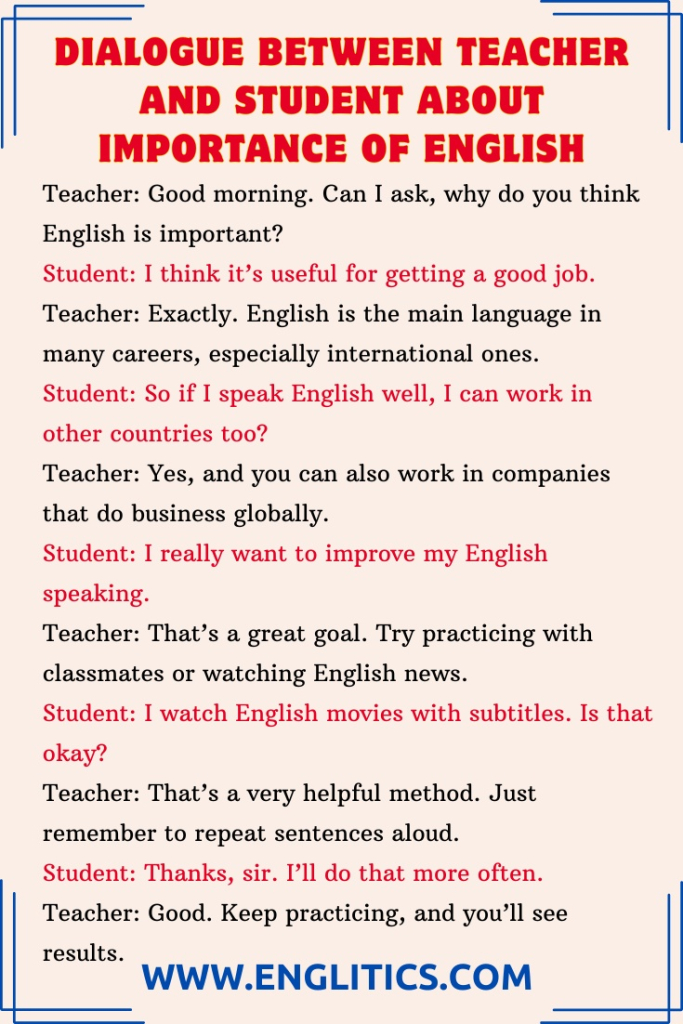
Conversation Between Teacher and Student on the Use of English in Careers
Teacher: Good morning. Can I ask, why do you think English is important?
Student: I think it’s useful for getting a good job.
Teacher: Exactly. English is the main language in many careers, especially international ones.
Student: So if I speak English well, I can work in other countries too?
Teacher: Yes, and you can also work in companies that do business globally.
Student: I really want to improve my English speaking.
Teacher: That’s a great goal. Try practicing with classmates or watching English news.
Student: I watch English movies with subtitles. Is that okay?
Teacher: That’s a very helpful method. Just remember to repeat sentences aloud.
Student: Thanks, sir. I’ll do that more often.
Teacher: Good. Keep practicing, and you’ll see results.
Teacher Encouraging Student to Speak English With Confidence
Teacher: I noticed you stay quiet in English class. Is everything alright?
Student: I get nervous. I’m scared I’ll make mistakes.
Teacher: Mistakes are part of learning. Even native speakers make them.
Student: Really? I thought I had to speak perfectly.
Teacher: No one starts perfect. Just focus on improving a little each day.
Student: I want to speak fluently one day.
Teacher: You will. Just keep speaking, reading, and listening to English.
Student: Should I join the English club at school?
Teacher: Absolutely! That’s a great way to practice in a fun way.
Student: I’ll join it this week. Thank you!
Teacher: You’re welcome. I’m proud of your effort.
Discussing English as a Global Language
Teacher: Do you know how many countries use English officially?
Student: I’m not sure. Maybe 20?
Teacher: Actually, over 50 countries use it officially, and many more use it daily.
Student: Wow! I didn’t know that.
Teacher: It’s also the main language in science, technology, and the internet.
Student: So learning English helps in all fields?
Teacher: Exactly. It connects people around the world.
Student: I guess that’s why so many websites are in English.
Teacher: Yes, and even many mobile apps use English first.
Student: I’ll try to improve my reading and writing too.
Teacher: Good idea. It will help you in every subject.
Student Asking for English Learning Tips
Student: Sir, how can I learn English faster?
Teacher: Start with simple goals. Like learning 5 new words every day.
Student: I keep forgetting the new words I learn.
Teacher: Use them in sentences. The more you use them, the easier they are to remember.
Student: Should I read storybooks or grammar books?
Teacher: Both are useful. Storybooks help with natural English.
Student: I enjoy reading comics. Are they helpful too?
Teacher: Yes! Comics teach you how people speak in real life.
Student: What about writing?
Teacher: Write short diary entries or summaries of what you read.
Student: I’ll try that. Thanks for the advice.
Teacher: Keep going. You’re doing well.
Talking About the Role of English in Education
Student: Is English really that important for higher education?
Teacher: Yes, especially if you plan to study abroad.
Student: I want to study in Canada.
Teacher: Then you’ll need to pass an English test like IELTS or TOEFL.
Student: I’ve heard those are difficult.
Teacher: Not if you prepare regularly. Many of the questions are about listening and speaking.
Student: I should start practicing now.
Teacher: Yes, early preparation gives you a big advantage.
Student: I’ll ask my parents if I can join a course.
Teacher: That’s a wise decision. I can recommend some good ones.
Student: Thank you, sir. I feel more confident now.
Dialogue Writing Tips
Writing a conversation between a teacher and a student is an excellent way to practice formal yet friendly English. It helps learners understand how to ask questions politely, express doubts, and use proper tone when speaking to someone in authority.
Here are 6 practical tips to help you write meaningful and natural dialogues:
1. Start With a Clear Setting
Before writing, ask yourself:
- Where is the conversation happening? (In class? After a lesson?)
- What’s the purpose? (Asking for advice? Learning about English?)
This helps you choose the right language and expressions.
Example:
A student talks to their teacher after class to ask about improving English fluency.
2. Use Polite, Respectful Language
A student should always speak respectfully to a teacher. Use polite phrases and question forms.
Instead of:
“You’re wrong.”
Try:
“I’m not sure I understand. Could you explain again?”
Instead of:
“Tell me what to do.”
Try:
“Can you give me some suggestions?”
3. Give the Dialogue a Purpose
The conversation should have a reason—like understanding why English is important, asking how to improve, or discussing future plans.
Example:
“Sir, is English helpful for getting a job abroad?”
A focused topic makes the dialogue easy to follow and more useful for learning.
4. Show the Student’s Interest and Effort
Let the student ask questions, show curiosity, and express goals. Teachers can respond with encouragement and helpful advice.
Example:
Student: “I really want to improve my speaking skills.”
Teacher: “That’s a great goal. Try speaking in English every day, even for 5 minutes.”
This kind of exchange shows active learning.
5. Use Education-Related Vocabulary
Include words like:
- communication, fluency, practice, pronunciation, grammar, vocabulary, speaking, listening, exam, improve, confident
Example Sentences:
- “English fluency helps you in almost any career.”
- “Reading English books builds vocabulary naturally.”
This improves both realism and learning value.
6. Keep the Tone Encouraging and Supportive
Teachers are usually supportive. Add kind expressions like:
- “Don’t worry, you’re doing well.”
- “Keep practicing—you’re improving.”
- “That’s a smart question.”
Positive language helps learners feel more motivated and makes the dialogue more authentic.
Practice Exercises
Exercise 1: Fill in the Blanks
Use the word bank to complete each sentence.
Word Bank: (fluency, confidence, communication, global, pronunciation, practice, grammar, improve, language, reading)
- I want to build my English __________ so I can speak clearly.
- English is a __________ language used around the world.
- Regular __________ is the key to learning any skill.
- Watching English shows helps with listening and __________.
- Speaking with others improves your __________ skills.
- It’s okay to make mistakes while you’re building __________.
- Reading books will help you __________ your vocabulary.
- English __________ can be tricky but gets easier with time.
- She’s working hard on her __________ because she wants to sound natural.
- Learning a new __________ opens many doors in life.
Answer Key:
- confidence
- global
- practice
- pronunciation
- communication
- fluency
- improve
- grammar
- pronunciation
- language
Exercise 2: Sentence Rewriting
Rewrite each sentence in polite, student-to-teacher language.
- “You’re wrong about English being useful.”
- “Give me some tips to learn fast.”
- “I don’t care about speaking fluently.”
- “I can’t do anything in English.”
- “Tell me what websites I should use.”
- “I won’t practice because I’m lazy.”
- “I already know everything about English.”
- “This language is boring.”
- “Stop asking me to improve.”
- “Why should I even learn this?”
Sample Rewritten Answers:
- “I’m not sure I understand. Could you explain more?”
- “Could you please share some tips to improve quickly?”
- “I’m still learning, but I hope to become fluent one day.”
- “I find English difficult. Can you help me improve?”
- “Could you recommend any good websites for learning?”
- “I sometimes lack motivation, but I want to try harder.”
- “I know some things, but I still need to learn more.”
- “Sometimes I find English hard to enjoy, but I want to get better.”
- “I know I should improve—thank you for reminding me.”
- “Can you explain why English is important for me?”
Exercise 3: Multiple Choice Questions
Choose the most suitable response.
- “Why should I learn English?”
a) Because it’s boring.
b) It opens up global opportunities.
c) It’s just a school rule. - “I’m scared to speak English.”
a) That’s okay—mistakes help you learn.
b) Then never speak.
c) Just speak in your native language. - “Can watching English videos help me?”
a) Not really.
b) Yes, especially with subtitles and repetition.
c) Only cartoons work. - “Will English help me study abroad?”
a) No, not needed.
b) Yes, it’s required for most universities.
c) Only for fun trips. - “How can I improve my pronunciation?”
a) Just ignore it.
b) Practice out loud and listen carefully to native speakers.
c) Use a dictionary only. - “What should I do if I forget new words?”
a) Stop learning.
b) Use flashcards and write them in sentences.
c) Keep using the wrong word. - “Is English useful in technology fields?”
a) Not at all.
b) Very much—it’s the main language in tech.
c) Only for doctors. - “How often should I practice English?”
a) Only once a month.
b) A little every day is best.
c) Never. - “Can I speak English with my friends?”
a) Yes, that’s great practice.
b) No, only in class.
c) Only when your teacher says so. - “What if I make a mistake while speaking?”
a) Just stop trying.
b) Keep going—mistakes are part of learning.
c) Laugh at yourself.
Answer Key:
- b
- a
- b
- b
- b
- b
- b
- b
- a
- b
Exercise 4: Dialogue Building
Complete each mini-dialogue with a natural student or teacher response.
- Teacher: “Why do you want to learn English?”
Student: ____________________________
Teacher: “That’s a great reason.” - Student: “I’m afraid to speak in front of others.”
Teacher: ____________________________
Student: “Thanks, I’ll try.” - Teacher: “What do you find hard in English?”
Student: ____________________________
Teacher: “Let’s work on that together.” - Student: “Is it okay to make mistakes?”
Teacher: ____________________________
Student: “That makes me feel better.” - Teacher: “What’s your favorite way to practice English?”
Student: ____________________________
Teacher: “That’s a fun way to learn.” - Student: “Can you suggest an English app?”
Teacher: ____________________________
Student: “Great, I’ll download it today.” - Teacher: “Do you use English outside the classroom?”
Student: ____________________________
Teacher: “Keep doing that—it helps.” - Student: “How long will it take to become fluent?”
Teacher: ____________________________
Student: “I’ll stay consistent.” - Teacher: “Have you tried writing in English?”
Student: ____________________________
Teacher: “Try keeping a short journal.” - Student: “Sometimes I feel like giving up.”
Teacher: ____________________________
Student: “You’re right. I won’t quit.”
Sample Answers:
- “Because I want to work abroad.”
- “Don’t worry—everyone starts that way.”
- “Grammar and pronunciation are tough for me.”
- “Absolutely. That’s how we grow.”
- “I like watching English YouTube videos.”
- “Try Duolingo or BBC Learning English.”
- “Yes, I speak with a friend after school.”
- “It depends, but daily practice speeds it up.”
- “No, I haven’t started yet.”
- “That’s normal. Just keep going, one step at a time.”
Conclusion
English is not just a subject in school—it’s a global tool for communication, learning, and success. Through a simple dialogue between teacher and student, learners can explore why English is important and how it impacts their future. These types of conversations help students understand the value of learning a language that connects people worldwide.
By practicing these dialogues and exercises, you’ll improve your vocabulary, gain confidence in speaking, and develop the ability to express your thoughts more clearly. Whether you dream of studying abroad, working in international companies, or simply speaking better English in daily life, the journey begins with real conversations. Keep learning, keep practicing, and let English be your bridge to new opportunities.