The Opposite of Adept describes someone who lacks skill, experience, or confidence in doing something. While an adept person handles tasks with ease and expertise, the opposite struggles or performs awkwardly, often needing help or practice.
Antonyms for Adept include clumsy, unskilled, and inexperienced. For example, a clumsy dancer might trip over steps instead of moving smoothly. An unskilled worker may need extra training to meet job demands. Someone inexperienced could make mistakes simply from lack of practice.
Definition of Adept
The word “adept” is an adjective that describes someone who is very skilled or proficient at something. It implies a high level of competence, expertise, and mastery in a particular area.
An adept individual is not only capable but also demonstrates a natural talent or learned proficiency. “Adept” can also be used as a noun, referring to a person who is highly skilled in a particular area or activity.
The term originates from the Latin word “adeptus,” meaning “having attained.” This etymology reflects the idea that an adept person has reached a certain level of skill or understanding through practice and experience. The word carries a positive connotation, suggesting accomplishment and expertise.
For example, an adept surgeon possesses the knowledge, precision, and dexterity necessary to perform complex operations successfully. An adept writer can craft compelling narratives and use language effectively.
An adept musician can play instruments with skill and artistry. In all these cases, “adept” signifies a high degree of competence and skill.
Structural Breakdown
The word “adept” functions primarily as an adjective, modifying nouns to describe their skill level. Its structure is relatively simple, consisting of a root word (“adept”) and lacking common prefixes or suffixes that would significantly alter its meaning.
Understanding the structure of “adept” helps in recognizing its role in sentence construction and how it relates to its antonyms.
As an adjective, “adept” typically precedes the noun it modifies or follows a linking verb. For example:
- “She is an adept dancer.” (Adjective before noun)
- “He is adept at problem-solving.” (Adjective after linking verb)
The word “adept” itself doesn’t have complex structural variations. Its simplicity makes it easy to understand and use correctly.
However, understanding its relationship to its antonyms requires a deeper look at the nuances of language and how different words convey varying degrees of skill and competence.
Opposite of Adept – Which Word is an Antonym of Adept?
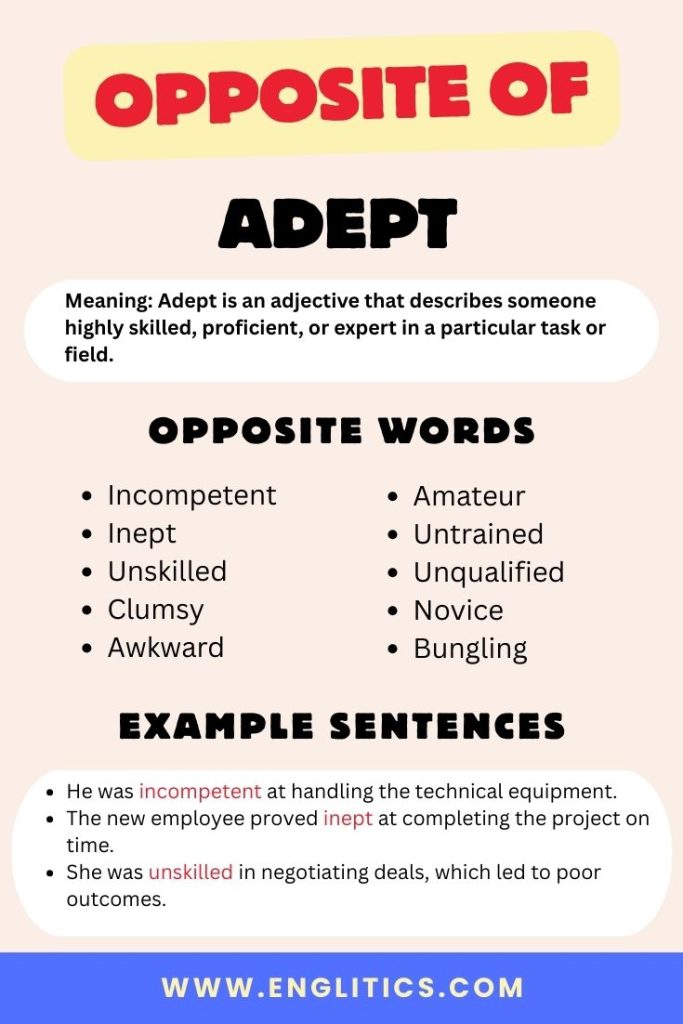
The antonyms for “adept” cover a spectrum of meanings, each describing a different aspect or degree of lacking skill. These antonyms range from general terms like “incompetent” to more specific ones like “clumsy.” Understanding these nuances is crucial for choosing the most appropriate word to convey the intended meaning.
Inept
“Inept” describes a general lack of skill or competence. It suggests an inability to perform tasks effectively, often due to a lack of training or natural talent.
An inept person may struggle with even simple tasks, making them unsuitable for roles requiring skill or precision. For example, an inept mechanic might struggle to diagnose engine problems, leading to further damage.
Incompetent
“Incompetent” is a stronger term than “inept,” implying a more significant lack of ability or qualification. It often suggests that someone is not only unskilled but also incapable of performing their duties or responsibilities adequately.
An incompetent employee, for instance, might consistently fail to meet performance expectations or make critical errors. This word often carries a negative connotation, implying a serious deficiency in skill or knowledge.
Unskilled
“Unskilled” simply means lacking specific skills or training. It’s a more neutral term than “inept” or “incompetent,” often used to describe someone who is new to a particular task or profession.
An unskilled worker, for example, may require extensive training to perform their job effectively. This term doesn’t necessarily imply a lack of potential, but rather a current lack of expertise.
Clumsy
“Clumsy” refers to a lack of physical coordination or grace. It describes someone who is awkward and prone to dropping things or bumping into objects.
A clumsy person might spill their coffee, trip over their own feet, or struggle with tasks requiring fine motor skills. This term is often used to describe physical awkwardness rather than a general lack of skill.
Awkward
“Awkward” can refer to both physical and social clumsiness. It describes someone who is uncomfortable or lacks grace in certain situations.
An awkward person might struggle to make small talk, feel uncomfortable in social gatherings, or have difficulty navigating unfamiliar environments. This term can also describe a situation that is uncomfortable or embarrassing.
Maladroit
“Maladroit” is a more formal and less common synonym for “clumsy” or “awkward.” It describes someone who is tactless, unskilled, or lacking in finesse. A maladroit diplomat, for example, might make insensitive remarks that damage international relations.
This term often implies a lack of social grace or professional skill.
Amateurish
“Amateurish” describes something done without professional skill or expertise. It suggests a lack of polish, refinement, and attention to detail.
An amateurish painting, for instance, might lack technical skill and artistic vision. This term is often used to describe work that is substandard or lacking in professionalism.
Bungling
“Bungling” describes someone who handles tasks clumsily or incompetently, often making a mess of things. It implies a lack of care, attention, and skill.
A bungling repairman, for example, might make a simple repair more complicated or cause further damage. This term often carries a negative connotation, suggesting a lack of competence and professionalism.
Greenhorn
“Greenhorn” is an informal term for a novice or beginner, someone who is new to a particular field or activity. It implies a lack of experience and knowledge.
A greenhorn sailor, for instance, might be unfamiliar with nautical terms and procedures. This term is often used humorously or affectionately, implying a lack of experience rather than a lack of potential.
Novice
“Novice” is a formal term for a beginner or someone who is new to a particular activity or skill. It implies a lack of experience and expertise.
A novice programmer, for example, might be learning the basics of coding and software development. This term is often used in educational or professional contexts to describe someone who is still learning.
Which word is an antonym of adept – Examples
The following tables provide examples of how these antonyms can be used in sentences, illustrating their different meanings and connotations. Each table focuses on a specific antonym category, offering a variety of contexts and scenarios.
This table illustrates the use of “inept” in various contexts, highlighting its meaning of a general lack of skill or competence.
| Sentence | Explanation |
|---|---|
| The inept chef managed to burn the water. | The chef lacked basic cooking skills. |
| He was an inept driver and caused several accidents. | His driving skills were poor and dangerous. |
| The inept administrator struggled to manage the team effectively. | The administrator lacked managerial skills. |
| She felt inept at handling the complex software. | She lacked the necessary skills to use the software. |
| The inept negotiator failed to reach a favorable agreement. | The negotiator lacked the skills to negotiate effectively. |
| He was deemed inept at public speaking. | He lacked the skill for giving speeches. |
| The inept surgeon made a critical error during the operation. | The surgeon’s lack of skill led to a mistake. |
| She was an inept gardener, unable to keep her plants alive. | She lacked the skills for gardening. |
| The inept teacher struggled to control the classroom. | The teacher lacked classroom management skills. |
| He was inept at handling delicate equipment. | He lacked the necessary skills to handle the equipment. |
| The inept programmer created numerous bugs in the code. | The programmer’s lack of skill led to errors. |
| She was inept at managing her finances. | She lacked the skills for managing money. |
| The inept mechanic misdiagnosed the problem with the car. | The mechanic’s lack of skill led to a wrong diagnosis. |
| He was an inept dancer, unable to follow the rhythm. | He lacked the skills for dancing. |
| The inept writer struggled to craft compelling stories. | The writer lacked the skills for writing. |
| She felt inept at navigating the complex bureaucracy. | She lacked the skills for dealing with bureaucracy. |
| The inept leader failed to inspire his team. | The leader lacked leadership skills. |
| He was considered inept at handling customer complaints. | He lacked the skills for customer service. |
| The inept painter created a messy and unattractive artwork. | The painter’s lack of skill resulted in poor art. |
| She was inept at using the new software. | She lacked the skills to use the software effectively. |
| The inept project manager failed to meet the deadlines. | The project manager’s lack of skill led to delays. |
| He was inept at fixing household appliances. | He lacked the skills for repairing appliances. |
| The inept speaker mumbled and stumbled through his presentation. | The speaker lacked public speaking skills. |
This table demonstrates the use of “incompetent,” which implies a more significant lack of ability or qualification than “inept.”
| Sentence | Explanation |
|---|---|
| The incompetent surgeon was barred from practicing medicine. | The surgeon’s lack of skill posed a danger to patients. |
| He was fired for being an incompetent employee. | His performance was consistently below standards. |
| The incompetent manager was unable to lead the team effectively. | The manager lacked the necessary skills to guide the team. |
| She was labeled as incompetent in her role as a financial advisor. | She lacked the expertise to provide sound financial advice. |
| The incompetent detective failed to solve the case. | The detective lacked the skills to investigate effectively. |
| The board deemed the CEO incompetent to lead the company. | The CEO lacked the leadership skills required. |
| The incompetent pilot made a series of critical errors. | The pilot’s lack of skill led to dangerous mistakes. |
| She was found to be incompetent in handling sensitive information. | She lacked the ability to manage confidential data. |
| The incompetent lawyer lost the case due to poor preparation. | The lawyer’s lack of skill resulted in a loss for the client. |
| He was considered incompetent for the position of head engineer. | He lacked the necessary skills for the role. |
| The incompetent politician made a series of embarrassing gaffes. | The politician’s lack of skill led to public humiliation. |
| She was deemed incompetent to perform the duties of a nurse. | She lacked the skills to provide adequate patient care. |
| The incompetent contractor failed to complete the project on time. | The contractor’s lack of skill led to delays. |
| He was labeled as an incompetent accountant due to numerous errors. | He lacked the skills to manage financial records accurately. |
| The incompetent mechanic caused further damage to the car. | The mechanic’s lack of skill worsened the problem. |
| She was found to be incompetent in her role as a teacher. | She lacked the ability to effectively educate students. |
| The incompetent journalist failed to verify the facts. | The journalist’s lack of skill led to inaccurate reporting. |
| He was considered incompetent for the role of lead scientist. | He lacked the necessary skills for the position. |
| The incompetent web developer created a website full of bugs. | The developer’s lack of skill resulted in a faulty website. |
| She was incompetent at managing the company’s social media. | She lacked the skills for managing social media effectively. |
| The incompetent security guard failed to notice the break-in. | The security guard’s lack of skill led to a security breach. |
| He was incompetent at handling the company’s finances. | He lacked the skills to manage financial matters effectively. |
| The incompetent event planner forgot to book the venue. | The event planner’s lack of skill caused a major problem. |
This table presents examples of “unskilled,” a more neutral term indicating a lack of specific skills or training.
| Sentence | Explanation |
|---|---|
| The unskilled laborer was assigned to basic tasks. | The laborer lacked specific skills for more complex jobs. |
| He started as an unskilled worker in the factory. | He had no prior experience or training. |
| The company hired unskilled workers and provided on-the-job training. | The new hires lacked specific skills but were willing to learn. |
| She was an unskilled candidate with no relevant experience. | She lacked the necessary skills for the job. |
| The unskilled volunteer assisted with simple tasks at the event. | The volunteer lacked specific skills but was helpful nonetheless. |
| He began his career as an unskilled apprentice. | He started with no prior knowledge or training. |
| The unskilled immigrant sought employment in manual labor. | The immigrant lacked specific skills but was willing to work hard. |
| She was an unskilled applicant with a great attitude. | She lacked the necessary skills but was enthusiastic. |
| The unskilled farmhand learned the ropes quickly. | The farmhand lacked experience but was a fast learner. |
| He was hired as an unskilled technician and trained on-site. | He started with no prior technical knowledge. |
| The unskilled worker made a mistake due to lack of experience. | The mistake was attributed to a lack of training. |
| She was an unskilled intern eager to learn new things. | She lacked experience but was enthusiastic about learning. |
| The unskilled mechanic was still learning the basics of car repair. | The mechanic lacked advanced skills but was progressing. |
| He started as an unskilled assistant in the office. | He had no prior administrative experience. |
| The unskilled artist was still developing their technique. | The artist lacked professional skills but was improving. |
| She was an unskilled cook but enjoyed trying new recipes. | She lacked culinary expertise but was passionate about cooking. |
| The unskilled programmer was enrolled in a coding bootcamp. | The programmer lacked experience but was actively learning. |
| He was an unskilled construction worker starting his career. | He had no prior experience in construction. |
| The unskilled electrician was still learning about electrical safety. | The electrician lacked advanced skills but was prioritizing safety. |
| She was an unskilled writer but had a lot of potential. | She lacked writing expertise but showed promise. |
| The unskilled carpenter was still learning how to use the tools. | The carpenter lacked advanced skills but was gaining experience. |
| He started as an unskilled data entry clerk. | He had no prior experience in data management. |
| The unskilled customer service representative was in training. | The representative lacked advanced skills but was learning the ropes. |
This table provides examples of how “clumsy” is used to describe a lack of physical coordination or grace.
| Sentence | Explanation |
|---|---|
| The clumsy waiter spilled the tray of drinks. | The waiter lacked coordination and dropped the drinks. |
| He was a clumsy dancer with two left feet. | His dancing lacked grace and coordination. |
| She was so clumsy that she tripped over the rug. | Her lack of coordination caused her to trip. |
| The clumsy child knocked over the vase. | The child lacked coordination and broke the vase. |
| He was too clumsy to play the violin. | His lack of coordination made it difficult to play. |
| The clumsy burglar tripped over the alarm wire. | The burglar’s lack of coordination alerted the authorities. |
| She was so clumsy that she often bumped into furniture. | Her lack of coordination caused her to hit objects. |
| The clumsy athlete struggled with agility drills. | The athlete’s lack of coordination hindered their performance. |
| He was too clumsy to handle the delicate glassware. | His lack of coordination made it risky to handle the items. |
| The clumsy dog wagged its tail and knocked over the lamp. | The dog’s lack of awareness caused the accident. |
| She was so clumsy that she always dropped her phone. | Her lack of coordination led to frequent accidents. |
| The clumsy carpenter accidentally hit his thumb with the hammer. | The carpenter’s lack of coordination caused the injury. |
| He was too clumsy to perform the intricate surgery | His lack of coordination made it impossible to perform the operation. |
| The clumsy cook burned herself while reaching for the pot. | The cook’s lack of coordination led to an injury. |
| She was so clumsy that she walked into the glass door. | Her lack of coordination caused her to bump into the door. |
| The clumsy painter accidentally knocked over the paint bucket. | The painter’s lack of coordination led to a mess. |
| He was too clumsy to thread the needle. | His lack of coordination made it difficult to perform the task. |
| The clumsy child tripped while running and scraped his knee. | The child’s lack of coordination led to an injury. |
| She was so clumsy that she often stubbed her toe. | Her lack of coordination caused frequent accidents. |
| The clumsy gardener stepped on the flower bed. | The gardener’s lack of coordination damaged the plants. |
| He was too clumsy to assemble the intricate model. | His lack of coordination made it impossible to complete the task. |
| The clumsy student dropped the test papers. | The student’s lack of coordination caused the papers to fall. |
| She was clumsy and often spilled things. | Her lack of coordination led to frequent messes. |
Usage Rules
When choosing an antonym for “adept,” it’s essential to consider the context and the specific meaning you want to convey. “Inept” and “incompetent” are suitable for describing a general lack of skill, while “unskilled” is more neutral and simply indicates a lack of training.
“Clumsy” and “awkward” are used to describe physical or social awkwardness, and “maladroit” is a more formal synonym for these terms. “Amateurish” describes work that lacks professional skill, “bungling” describes someone who handles tasks incompetently, and “greenhorn” and “novice” refer to beginners.
It’s also important to be aware of the connotations of each word. “Incompetent” and “bungling” carry negative connotations, implying a serious deficiency in skill or knowledge.
“Unskilled” is more neutral, while “greenhorn” can be used humorously or affectionately. Choosing the right word will ensure that your message is clear and accurate.
Consider the following examples:
- Incorrect: “He was an inept surgeon, so he performed the surgery flawlessly.”
- Correct: “He was an adept surgeon, so he performed the surgery flawlessly.”
- Incorrect: “She was adept at tripping over her own feet.”
- Correct: “She was clumsy and kept tripping over her own feet.”
Common Mistakes
One common mistake is using “inept” and “incompetent” interchangeably without considering the degree of skill deficiency. “Incompetent” implies a more serious lack of ability than “inept.” Another mistake is using “clumsy” to describe a general lack of skill when it should be reserved for physical awkwardness.
Additionally, learners sometimes confuse “unskilled” with “incompetent,” failing to recognize that “unskilled” simply means lacking training, while “incompetent” implies an inability to perform tasks adequately even with training.
Here are some examples of common mistakes and their corrections:
| Incorrect | Correct | Explanation |
|---|---|---|
| He was a clumsy programmer. | He was an inept programmer. | “Clumsy” refers to physical awkwardness, not programming skill. |
| She was incompetent at walking without tripping. | She was clumsy at walking without tripping. | “Clumsy” is more appropriate for describing physical coordination. |
| The unskilled manager was fired for his poor performance. | The incompetent manager was fired for his poor performance. | “Incompetent” better reflects a serious lack of ability leading to termination. |
| He was adept at dropping things. | He was clumsy and often dropped things. | “Adept” means skilled, the opposite of dropping things. |
| She was inept at playing the piano gracefully. | She was awkward at playing the piano gracefully. | “Awkward” better describes a lack of grace in movement. |
Practice Exercises
Test your understanding of antonyms for “adept” with these exercises. Choose the best antonym for “adept” in each sentence.
- The ______ mechanic misdiagnosed the car problem.
- adept
- inept
- skilled
- She was ______ at dancing and kept stepping on her partner’s toes.
- adept
- clumsy
- proficient
- The ______ employee made several critical errors.
- competent
- incompetent
- skilled
- He was hired as an ______ laborer with no prior experience.
- skilled
- unskilled
- expert
- The ______ negotiator failed to reach an agreement.
- adept
- bungling
- expert
- She was a ______ painter with no formal training.
- professional
- amateurish
- skilled
- The ______ public speaker mumbled and stumbled through his presentation.
- adept
- awkward
- eloquent
- He was a ______ at carpentry, always making mistakes.
- master
- maladroit
- skilled
- As a ______, he was still learning the basics of coding.
- expert
- novice
- professional
- He felt like a ______ trying to navigate the complex software.
- expert
- greenhorn
- professional
Answer Key:
- b
- b
- b
- b
- b
- b
- b
- b
- b
- b
Exercise 2: Fill in the blanks with the most appropriate antonym of “adept.”
- The ______ chef accidentally set the kitchen on fire. (inept, incompetent, unskilled)
- She was ______ at handling delicate machinery. (clumsy, awkward, maladroit)
- The ______ employee consistently missed deadlines. (inept, incompetent, unskilled)
- He was an ______ driver and caused multiple accidents. (inept, incompetent, unskilled)
- The ______ waiter dropped the entire tray of dishes. (clumsy, awkward, maladroit)
- The ______ politician made several embarrassing gaffes during the debate. (inept, incompetent, unskilled)
- She was a ______ artist, lacking formal training and experience. (amateurish, professional, skilled)
- The ______ handyman made a mess of the simple repair job. (bungling, expert, skilled)
- As a ______, he struggled to understand the complex concepts. (novice, expert, professional)
- Feeling like a ______, she nervously asked for help with the task. (greenhorn, expert, professional)
Answer Key:
- inept
- clumsy
- incompetent
- inept
- clumsy
- incompetent
- amateurish
- bungling
- novice
- greenhorn
Advanced Topics
For advanced learners, exploring the subtle differences between these antonyms in various contexts can be a valuable exercise. Consider how the choice of antonym can affect the tone and impact of your writing.
For example, using “incompetent” instead of “unskilled” can create a more critical and judgmental tone. Additionally, exploring the etymology of these words can provide a deeper understanding of their meanings and nuances.
Another advanced topic is the use of antonyms in figurative language. Metaphors and similes can be used to compare someone’s lack of skill to other objects or concepts.
For example, “He was as clumsy as a bull in a china shop” uses a simile to emphasize the person’s lack of coordination. Exploring these figurative uses can enhance your writing and communication skills.
FAQ
- What is the difference between “inept” and “incompetent”?“Inept” generally means lacking skill or aptitude, while “incompetent” suggests a more serious lack of ability or qualification, often implying an inability to perform duties adequately. “Incompetent” carries a stronger negative connotation.
- When should I use “clumsy” instead of “awkward”?Use “clumsy” to describe a lack of physical coordination or grace. Use “awkward” to describe both physical and social clumsiness or discomfort.
- Is “unskilled” a negative term?No, “unskilled” is a relatively neutral term that simply means lacking specific skills or training. It doesn’t necessarily imply a lack of potential or ability.
- What is the difference between “greenhorn” and “novice”?“Greenhorn” is an informal term for a beginner, while “novice” is a more formal term. Both refer to someone who is new to a particular field or activity, but “greenhorn” often carries a humorous or affectionate tone.
- When is it appropriate to use “maladroit”?“Maladroit” is a more formal and less common synonym for “clumsy” or “awkward.” It describes someone who is tactless, unskilled, or lacking in finesse. Use it when you want to convey a more sophisticated or literary tone.
- How can I improve my vocabulary of antonyms for “adept”?Read widely, pay attention to the nuances of language, and use a thesaurus to explore synonyms and antonyms. Practice using these words in your writing and conversation to solidify your understanding.
- Can “adept” have negative connotations in certain contexts?While “adept” generally has positive connotations, it can be used sarcastically or ironically to imply the opposite. For example, “He was adept at making excuses” could suggest that he was skilled at avoiding responsibility.
- Are there anyany idiomatic expressions that use antonyms of “adept”?
Yes, phrases like “all thumbs” (meaning clumsy) and “not up to par” (meaning not meeting the required level of skill) are idiomatic expressions that convey a lack of skill or competence.
Conclusion
Understanding the antonyms for “adept” is crucial for expressing nuanced meanings and accurately describing varying degrees of skill and competence. This guide has provided a comprehensive overview of antonym categories, usage rules, common mistakes, and practice exercises.
By mastering these antonyms, you can enhance your vocabulary and improve your communication and writing skills. Whether you’re describing someone as inept, clumsy, unskilled, or incompetent, you’ll be able to choose the most appropriate word to convey your intended meaning.