The opposite of admire is to dislike, criticize, or feel no respect for someone or something. While admire means to look up to, respect, or appreciate, its opposites express disapproval or a lack of interest.
Antonyms for admire include words like dislike, criticize, despise, scorn, and disapprove. These words are used when someone feels the opposite of respect—whether it’s for a person’s actions, qualities, or appearance. In this post, you’ll learn how to use these opposite words in everyday situations, along with simple examples.
Definition of ‘Admire’
The verb “admire” is defined as to regard with respect, approval, or warm approval. It conveys a positive sentiment toward someone or something, often based on their qualities, achievements, or appearance. “Admire” can also imply a sense of wonder or awe. It is a versatile word used in various contexts, from personal relationships to professional settings.
The term suggests a deep appreciation and positive evaluation. To admire someone is to hold them in high regard and acknowledge their worth.
It’s a feeling that can be inspired by skill, talent, beauty, or moral character. Understanding this positive connotation is essential for grasping the significance of its antonyms.
Structural Breakdown of ‘Admire’
“Admire” is a verb, and like most verbs, it can be conjugated into different tenses and forms. Here’s a basic structural breakdown:
- Base Form: admire
- Past Simple: admired
- Past Participle: admired
- Present Participle/Gerund: admiring
- Third-person Singular Present: admires
Understanding the different forms of “admire” allows you to use its antonyms effectively in various grammatical contexts. For instance, you might use “disliked” (past simple of “dislike,” an antonym) to contrast with “admired” in a narrative about past events.
The structural flexibility of “admire” and its antonyms is crucial for clear and precise communication.
Opposite of Admire
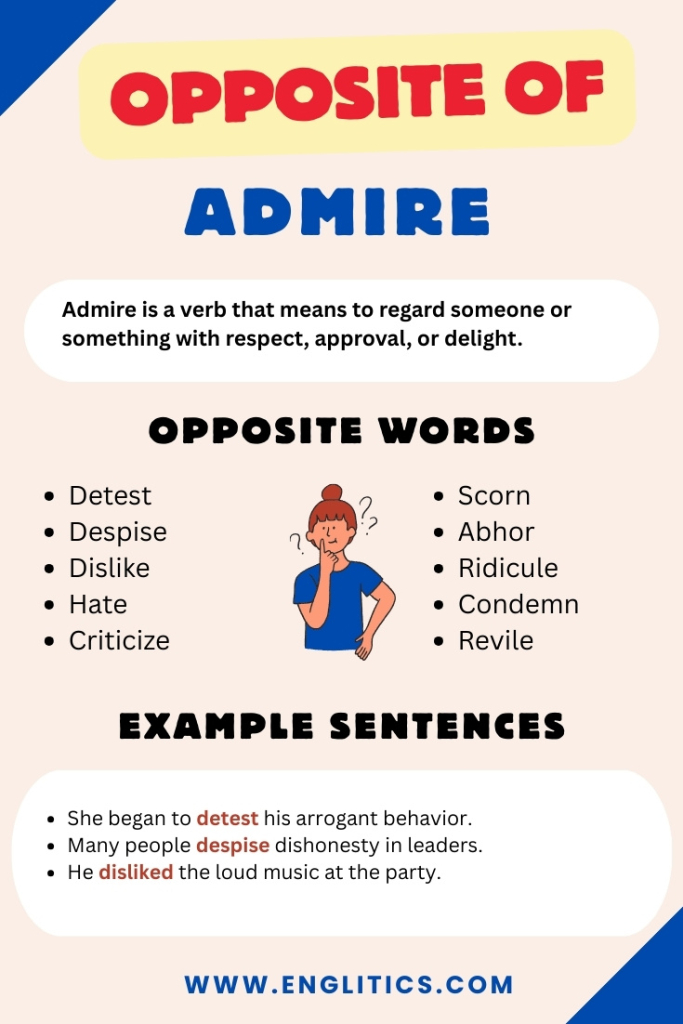
Antonyms can be categorized into different types based on their relationship to the original word. For “admire,” we can identify direct antonyms, indirect antonyms, and contextual antonyms.
Direct Antonyms: Dislike, Hate
Direct antonyms represent the most straightforward opposites of “admire.” “Dislike” and “hate” fall into this category. They express a feeling of aversion or strong disapproval.
Dislike indicates a mild feeling of aversion or disapproval. It’s weaker than “hate” but still represents a negative sentiment. It signifies a lack of positive regard, contrasting directly with the positive feeling of admiration.
Hate represents a strong feeling of aversion or intense dislike. It’s a powerful emotion and the strongest direct antonym of “admire.” It indicates a complete lack of respect or approval.
Indirect Antonyms: Disapprove, Deplore
Indirect antonyms express a sentiment that is contrary to admiration but not as directly opposed as “dislike” or “hate.” “Disapprove” and “deplore” are examples of indirect antonyms.
Disapprove means to have an unfavorable opinion of something or someone. It suggests a more reasoned or judgmental opposition compared to a simple dislike. It often implies a moral or ethical objection.
Deplore means to express strong disapproval of something. It carries a sense of sorrow or regret and is often used in formal contexts. It suggests a deeper level of negativity than simply “disapproving.”
Contextual Antonyms: Ignore, Disregard
Contextual antonyms are words that can function as antonyms of “admire” depending on the specific situation. “Ignore” and “disregard” can be considered antonyms in contexts where admiration would naturally lead to attention or consideration.
Ignore means to pay no attention to something or someone. In a situation where admiration would prompt close attention, ignoring becomes an antonym by representing a deliberate lack of engagement.
Disregard means to treat something or someone as unimportant or not worthy of consideration. Similar to “ignore,” it contrasts with the attention and respect implied by admiration.
Examples of Antonyms for ‘Admire’
To fully understand the usage of these antonyms, let’s examine them in various sentence structures and contexts.
Examples using ‘Dislike’
The following table provides examples of how “dislike” can be used as an antonym for “admire” in different scenarios.
| Sentence | Context |
|---|---|
| I dislike his arrogance; I certainly don’t admire it. | Expressing a negative opinion about someone’s personality. |
| She dislikes the painting, unlike others who admire its complexity. | Contrasting personal taste with general appreciation. |
| They dislike the new policy, while management admires its efficiency. | Showing opposing views on a work-related decision. |
| He dislikes modern art, preferring classical styles that many admire. | Expressing a preference for traditional art over modern art. |
| We dislike the way he behaves; we find nothing to admire. | Describing a negative reaction to someone’s behavior. |
| The critics disliked the movie, despite the director being widely admired. | Contrasting critical opinion with public admiration. |
| I dislike her singing voice, even though many admire her range. | Expressing a personal dislike despite popular opinion. |
| They disliked the new design, while the marketing team admired its boldness. | Showing differing opinions within a professional setting. |
| She dislikes the taste of coffee, while her friends admire its rich flavor. | Contrasting personal taste with common preference. |
| He disliked the novel’s complexity, unlike the professor who admired its depth. | Expressing a dislike for something that is generally admired for its sophistication. |
| The children disliked the strict teacher, although the parents admired her discipline. | Contrasting children’s dislike with parents’ admiration. |
| We dislike the politician’s policies, despite his supporters admiring his conviction. | Expressing disagreement with a politician’s actions, even if others admire his resolve. |
| I dislike the noise of the city, but many admire its vibrant energy. | Contrasting personal dislike with others’ admiration of city life. |
| She dislikes the formality of the event, while others admire its elegance. | Expressing a dislike for formality, even if others admire the elegance. |
| They dislike the taste of spicy food, although many admire its bold flavors. | Contrasting personal dislike of spicy food with others’ appreciation. |
| He disliked the movie’s ending, even though the critics admired its ambiguity. | Expressing disappointment with a movie’s conclusion, despite critics’ praise. |
| We dislike the company’s ethics, despite admiring their innovative products. | Expressing disapproval of unethical behavior, even while admiring innovation. |
| I dislike the artist’s style, although his technical skill is widely admired. | Contrasting personal dislike of an artistic style with admiration for technical skill. |
| She dislikes the cold weather, while others admire the beauty of winter. | Expressing a dislike for cold weather, even as others admire winter’s beauty. |
| They disliked the long commute, despite admiring the destination. | Contrasting a dislike for the commute with admiration for the destination. |
Examples using ‘Hate’
The following table provides examples of how “hate” can be used as an antonym for “admire” in different scenarios.
| Sentence | Context |
|---|---|
| I hate his dishonesty; I could never admire such a trait. | Expressing strong disapproval of someone’s character. |
| She hates the new building design, while the architect expects admiration. | Contrasting strong dislike with expected approval. |
| They hate the company’s policies, even though some admire its success. | Expressing strong disapproval of corporate practices. |
| He hates the taste of broccoli, unlike his brother who admires its nutritional value. | Expressing a strong dislike for a food that others appreciate. |
| We hate the way he treats others; we find nothing admirable in his behavior. | Describing a strong negative reaction to someone’s mistreatment of others. |
| The critics hated the play, although the playwright hoped for admiration. | Contrasting negative critical reception with the playwright’s expectations. |
| I hate the sound of nails on a chalkboard, even though some admire its unique quality. | Expressing a strong aversion to a sound that others might find interesting. |
| They hate the government’s corruption, despite some admiring its efficiency. | Showing strong disapproval of corruption, even if some admire the efficiency. |
| She hates the feeling of being rushed, while others admire the fast-paced lifestyle. | Expressing a strong dislike for being hurried, even if others admire the speed. |
| He hates the formality of black-tie events, unlike those who admire their elegance. | Expressing a strong aversion to formal events, even if others admire their sophistication. |
| The students hated the difficult exam, even though the professor admired its rigor. | Contrasting students’ dislike with the professor’s admiration for the exam’s difficulty. |
| We hate the constant traffic noise, despite others admiring the city’s vibrancy. | Expressing a strong dislike for traffic noise, even as others admire the city’s liveliness. |
| I hate the feeling of being watched, while some admire the attention it brings. | Expressing a strong dislike for being observed, even if others admire the attention. |
| She hates the flavor of licorice, although many admire its unique taste. | Contrasting a strong dislike for licorice with others’ appreciation. |
| They hate the long meetings, despite the manager admiring their collaborative nature. | Expressing a strong dislike for long meetings, even if the manager sees them as collaborative. |
| He hates the sight of spiders, although some admire their intricate webs. | Expressing a strong aversion to spiders, even though some admire their webs. |
| We hate the feeling of being cold, while others admire the crispness of winter air. | Expressing a strong dislike for the cold, even as others admire the winter air. |
| I hate the taste of olives, despite many admiring their Mediterranean flavor. | Contrasting a strong dislike for olives with others’ appreciation. |
| She hates the smell of gasoline, while some admire its association with power. | Expressing a strong aversion to the smell of gasoline, even if others associate it with power. |
| They hate the feeling of being seasick, although some admire the vastness of the ocean. | Contrasting a strong dislike for seasickness with others’ admiration of the ocean. |
Examples using ‘Disapprove’
The following table provides examples of how “disapprove” can be used as an antonym for “admire” in different scenarios.
| Sentence | Context |
|---|---|
| I disapprove of his behavior, even though some admire his audacity. | Expressing moral objection to someone’s actions. |
| She disapproves of the new regulations, while the council admires their intent. | Contrasting disapproval with official approval. |
| They disapprove of the company’s ethics, despite admiring its profitability. | Expressing disagreement with business practices. |
| He disapproves of the artist’s controversial themes, even though some admire their boldness. | Expressing disapproval of artistic themes, even if others admire the courage. |
| We disapprove of the politician’s decisions, although his supporters admire his resolve. | Showing disapproval of political decisions, even if supporters admire the politician’s determination. |
| The parents disapproved of their child’s career choice, despite others admiring its creativity. | Contrasting parents’ disapproval with others’ admiration of a career choice. |
| I disapprove of the way he speaks to others, even though some admire his directness. | Expressing disapproval of someone’s communication style, even if it’s seen as direct. |
| They disapprove of the company’s marketing tactics, despite the CEO admiring their effectiveness. | Showing disapproval of marketing tactics, even if they are effective. |
| She disapproves of the movie’s violence, while others admire its realism. | Expressing disapproval of violence in a movie, even if others admire its authenticity. |
| He disapproves of the government’s spending, unlike those who admire its investment in infrastructure. | Expressing disapproval of government spending, even if it benefits infrastructure. |
| The community disapproved of the proposed development, despite the mayor admiring its potential economic benefits. | Contrasting community disapproval with the mayor’s admiration for economic benefits. |
| We disapprove of the lack of transparency, even though some admire the company’s efficiency. | Expressing disapproval of a lack of transparency, even if the company is efficient. |
| I disapprove of his methods, but I admire his dedication. | Expressing both disapproval of methods and admiration for dedication. |
| She disapproves of the new dress code, while the management admires its professionalism. | Contrasting disapproval of a dress code with management’s admiration for its professional appearance. |
| They disapprove of the noise levels, even though some admire the city’s vibrant nightlife. | Expressing disapproval of noise, even as others admire the nightlife. |
| He disapproves of the candidate’s lack of experience, despite admiring his enthusiasm. | Expressing disapproval of a candidate’s lack of experience, even while admiring their enthusiasm. |
| We disapprove of their decision, but we admire their courage. | Expressing disapproval of a decision, while still admiring courage. |
| I disapprove of the book’s content, even though some admire its unique perspective. | Contrasting disapproval of content with admiration for perspective. |
| She disapproves of the wastefulness, while others admire the abundance. | Expressing disapproval of wastefulness, even as others admire abundance. |
| They disapprove of the company’s pollution, despite admiring its products. | Contrasting disapproval of pollution with admiration for products. |
Examples using ‘Deplore’
The following table provides examples of how “deplore” can be used as an antonym for “admire” in different scenarios.
| Sentence | Context |
|---|---|
| We deplore the violence, even though some admire the hero’s strength. | Expressing strong disapproval of violence in a narrative. |
| She deplores the company’s unethical practices, despite others admiring their profits. | Showing strong disapproval of corporate misconduct. |
| They deplore the destruction of the environment, even though some admire the progress. | Expressing deep sorrow and disapproval of environmental damage. |
| The human rights organization deplored the government’s actions, while the citizens admired their stability. | Expressing condemnation of government actions, despite citizens’ view of stability. |
| I deplore his lack of empathy, while others admire his sharp intellect. | Expressing deep disapproval of a person’s lack of compassion. |
| The community deplored the vandalism, although some admired the artist’s rebellious spirit. | Expressing strong disapproval of vandalism, even if some admire the artist’s rebellion. |
| She deplores the waste of resources, even as others admire the abundance. | Showing disapproval of resource wastage, despite others admiring plenty. |
| They deplore the exploitation of workers, although some admire the company’s success. | Expressing strong disapproval of worker exploitation, even if the company is successful. |
| He deplores the lack of education, even as others admire the country’s natural resources. | Expressing strong disapproval of a lack of education, even if the country has resources. |
| We deplore the erosion of values, even though some admire the modern lifestyle. | Expressing strong disapproval of declining values, even if some admire modern life. |
| I deplore the government’s corruption, but others admire its efficiency. | Expressing strong disapproval of corruption, even if the government is efficient. |
| She deplores the company’s pollution, but some admire its product innovations. | Showing strong disapproval of pollution, despite admiration for innovation. |
| They deplore the disregard for human rights, while others admire the nation’s power. | Expressing strong disapproval of human rights violations, even if the nation is powerful. |
| He deplores the commercialization of art, although many admire its accessibility. | Expressing strong disapproval of art commercialization, even if it becomes accessible. |
| We deplore the loss of biodiversity, even as others admire the expansion of development. | Expressing strong disapproval of biodiversity loss, despite admiration for development. |
| I deplore the lack of respect, but I understand their reasons. | Expressing strong disapproval of disrespect, but understanding the motives. |
| She deplores the constant noise, but others admire the city’s energy. | Showing strong disapproval of urban noise, even if others admire the city’s energy. |
| They deplore the violence in the film, yet some admire the special effects. | Expressing strong disapproval of film violence, despite admiration for the effects. |
| He deplores the waste of food, yet others admire the abundance. | Expressing strong disapproval of food waste, even as others admire the abundance. |
| We deplore the lack of communication, but we admire their effort. | Expressing strong disapproval of poor communication, while admiring effort. |
Examples using ‘Ignore’
The following table provides examples of how “ignore” can be used as an antonym for “admire” in different scenarios.
| Sentence | Context |
|---|---|
| I ignore his achievements; I don’t admire them at all. | Choosing not to acknowledge someone’s accomplishments. |
| She ignores his attempts to impress her, unlike those who admire his charm. | Deliberately disregarding someone’s efforts to gain attention. |
| They ignore the positive feedback, focusing only on the negative, though others admire their progress. | Deliberately overlooking positive aspects. |
| He ignores the beauty of nature, unlike those who admire its splendor. | Choosing not to appreciate the natural world. |
| We ignore his advice, finding nothing to admire in his strategies. | Disregarding someone’s suggestions due to a lack of respect. |
| The critics ignored the film’s artistic merit, although the director hoped they would admire it. | Deliberately overlooking a film’s artistic qualities. |
| I ignore the noise of the city, while others admire its vibrant energy. | Choosing not to notice the city’s noise, even as others admire its energy. |
| They ignore the company’s innovative ideas, despite the CEO admiring their potential. | Deliberately overlooking the potential of innovative ideas. |
| She ignores the compliments, even though others admire her talent. | Choosing not to acknowledge compliments, despite being admired. |
| He ignores the warning signs, although others admire his courage. | Deliberately overlooking warning signs, even if it takes courage. |
| The students ignored the professor’s advice, even though he was widely admired. | Choosing not to heed the advice of an admired figure. |
| We ignore the politician’s promises, despite his supporters admiring his conviction. | Deliberately overlooking a politician’s promises. |
| I ignore the risks involved, but others admire my adventurous spirit. | Choosing not to acknowledge risks, even as others admire adventurousness. |
| She ignores the beauty of the sunset, while others admire its colors. | Deliberately overlooking the beauty of a sunset. |
| They ignore the importance of teamwork, despite the manager admiring its effectiveness. | Choosing not to acknowledge the value of teamwork. |
| He ignores the cultural differences, although others admire his open-mindedness. | Deliberately overlooking cultural differences. |
| We ignore the historical significance, but some admire the modern architecture. | Choosing not to acknowledge historical significance. |
| I ignore the positive reviews, even though others admire the book’s plot. | Deliberately overlooking positive reviews. |
| She ignores the small victories; others admire her resilience. | Choosing not to acknowledge small wins. |
| They ignore the potential benefits, despite the community admiring the project. | Deliberately overlooking potential benefits. |
Examples using ‘Disregard’
The following table provides examples of how “disregard” can be used as an antonym for “admire” in different scenarios.
| Sentence | Context |
|---|---|
| I disregard his opinions; I certainly don’t admire them. | Treating someone’s views as unimportant. |
| She disregards the rules, unlike those who admire discipline. | Ignoring regulations and order. |
| They disregard the warning signs, even though others admire their courage. | Treating cautionary signals as insignificant. |
| He disregards the advice of experts, despite many admiring their knowledge. | Ignoring professional guidance. |
| We disregard the historical facts, finding nothing to admire in the past. | Treating historical information as irrelevant. |
| The company disregards ethical concerns, even though some admire their commitment to social responsibility. | Treating ethical considerations as unimportant. |
| I disregard the importance of teamwork, although the manager admires collaborative efforts. | Treating teamwork as unimportant. |
| She disregards the cultural differences, despite others admiring her sensitivity. | Treating cultural differences as irrelevant. |
| They disregard the positive aspects, even though some admire their optimism. | Treating positive aspects as unimportant. |
| He disregards the feelings of others, even though his friends admire his loyalty. | Treating the emotions of others as unimportant. |
| The students disregarded the teacher’s instructions, even though she was admired for her clarity. | Treating a teacher’s instructions as unimportant. |
| We disregard the environmental impact, despite others admiring our conservation efforts. | Treating environmental impact as unimportant. |
| I disregard the small details, but others admire my attention to them. | Treating small details as unimportant. |
| She disregards the social norms, even though some admire her conformity. | Treating social expectations as unimportant. |
| They disregard the long-term consequences, despite the strategist admiring their vision. | Treating long-term consequences as unimportant. |
| He disregards the power of words, although others admire his eloquence. | Treating the power of words as unimportant. |
| We disregard the value of experience, even though some admire our wisdom. | Treating experience as unimportant. |
| I disregard the potential problems, yet others admire my confidence. | Treating potential problems as unimportant. |
| She disregards the advice of elders, although some admire their knowledge. | Treating the advice of elders as unimportant. |
| They disregard the importance of history, despite the professor admiring its lessons. | Treating the importance of history as unimportant. |
Usage Rules for Antonyms of ‘Admire’
The correct usage of antonyms for “admire” depends on the context and the specific nuance you want to convey. Here are some general rules:
- “Dislike” is best used for mild disapproval or aversion.
- “Hate” is appropriate for expressing strong aversion or intense dislike.
- “Disapprove” is suitable for expressing moral or ethical objections.
- “Deplore” is used for expressing strong disapproval with a sense of sorrow or regret, often in formal settings.
- “Ignore” is appropriate when you want to emphasize a lack of attention or consideration.
- “Disregard” is suitable when you want to emphasize that something is treated as unimportant or not worthy of consideration.
Consider the intensity of the emotion you want to convey when choosing an antonym. Also, be mindful of the formality of the situation.
“Deplore,” for example, is more formal than “dislike.”
Common Mistakes
Learners often make mistakes when using antonyms for “admire.” Here are some common errors and how to avoid them:
- Using “hate” when “dislike” is more appropriate: “I hate his shirt” is too strong if you simply don’t prefer the shirt. Use “I dislike his shirt” instead.
- Using “disapprove” in informal contexts: “I disapprove of this ice cream flavor” sounds overly formal. “I dislike this ice cream flavor” is more natural.
- Misusing “ignore” and “disregard”: “I disregard his talent” implies you know he has talent but choose to treat it as unimportant. “I ignore his talent” means you don’t pay attention to it.
Here are some examples of common mistakes with corrections:
| Incorrect | Correct | Explanation |
|---|---|---|
| I hate his singing; it’s just not my favorite. | I dislike his singing; it’s just not my favorite. | “Hate” is too strong for a simple preference. |
| I disapprove of this casual outfit for the beach. | I don’t like this casual outfit for the beach. | “Disapprove” is too formal for a casual setting. |
| I ignore his rudeness, so I don’t admire him. | I disregard his rudeness, so I don’t admire him. | “Disregard” is more appropriate when acknowledging the rudeness but treating it as unimportant. |
Practice Exercises
Test your understanding of the antonyms for “admire” with these exercises.
- Exercise 1: Fill in the blank with the most appropriate antonym of “admire” (dislike, hate, disapprove, deplore, ignore, disregard).
Question Answer I ______ his arrogance; I find it very off-putting. dislike She ______ the way he treats animals; it’s unacceptable. deplores They ______ the new policy, finding it unfair. disapprove He ______ the noise of the city and prefers the countryside. hates We ______ his presence; he adds nothing to the conversation. disregard I ______ his achievements, finding nothing impressive about them. ignore She ______ the taste of the medicine, but knows it’s necessary. dislikes They ______ the lack of transparency in the company’s dealings. deplore He ______ the candidate’s policies, finding them harmful. disapproves We ______ the constant interruptions during the meeting. hate - Exercise 2: Rewrite the following sentences using an antonym of “admire.”
Question Answer I admire his dedication to his work. I dislike his obsession with his work. She admires the beauty of the sunset. She disregards the beauty of the sunset. They admire the company’s innovative approach. They disapprove of the company’s unconventional approach. He admires her courage in the face of adversity. He ignores her courage inthe face of adversity. We admire his honesty and integrity. We dislike his lack of transparency.
Advanced Topics
For advanced learners, consider these more complex aspects of using antonyms for “admire”:
- Irony and Sarcasm: Antonyms can be used ironically to convey the opposite of their literal meaning. For example, “I just admire his complete lack of effort” might sarcastically imply strong disapproval.
- Subtlety and Nuance: The choice of antonym can significantly alter the tone of a sentence. “Dislike” is gentler than “hate,” and “disapprove” suggests a more reasoned objection than either.
- Cultural Context: The connotations of “admire” and its antonyms can vary across cultures. Be mindful of these cultural differences when communicating with people from different backgrounds.
FAQ
What is the strongest antonym for “admire”?
The strongest direct antonym for “admire” is “hate,” as it conveys the most intense negative emotion.
When should I use “disapprove” instead of “dislike”?
Use “disapprove” when you want to express a moral or ethical objection, rather than a simple personal preference.
Can “ignore” really be an antonym for “admire”?
Yes, in contexts where admiration would naturally lead to attention or consideration, “ignore” can function as an antonym by representing a deliberate lack of engagement.
Is “deplore” a formal word?
Yes, “deplore” is a formal word that expresses strong disapproval with a sense of sorrow or regret. It’s often used in official statements or serious discussions.
Conclusion
Mastering the antonyms of “admire” significantly enhances your ability to express a wide range of emotions and opinions with precision. By understanding the nuances of words like “dislike,” “hate,” “disapprove,” “deplore,” “ignore,” and “disregard,” you can communicate more effectively and enrich your vocabulary.
Remember to consider the context, the intensity of the emotion you want to convey, and the formality of the situation when choosing the most appropriate antonym. Keep practicing, and you’ll become more confident in expressing your thoughts and feelings with clarity and accuracy.