Adversity means going through tough times, like facing problems, pain, or setbacks. It’s used when people talk about serious struggles—such as losing a job, getting sick, failing at something, or dealing with difficult situations in life. But sometimes, things go in the opposite direction. When life feels easy, successful, or full of good things, we use words that are the opposite of adversity.
The opposite of adversity includes words like success, prosperity, good fortune, comfort, and ease. These words show when someone is doing well, has support, or is in a strong and happy place. They are great for writing or talking about positive experiences, growth, and times when life is smooth and full of opportunity.
Table of Contents
- Introduction
- Defining Adversity
- Structural Breakdown of the Word “Adversity”
- Categories of Antonyms for Adversity
- Examples of Antonyms in Context
- Usage Rules and Considerations
- Common Mistakes in Using Antonyms for Adversity
- Practice Exercises
- Advanced Topics: Nuances and Connotations
- Frequently Asked Questions
- Conclusion
Defining Adversity
Adversity, at its core, signifies a state of misfortune, hardship, or suffering. It encompasses challenges, difficulties, and unfavorable circumstances that test an individual’s resilience and strength.
Adversity can manifest in various forms, ranging from personal struggles to widespread societal crises. It’s a universal experience, albeit one that varies greatly in intensity and duration from person to person.
Adversity is typically classified as a noun. Its function in a sentence is to represent the abstract concept of hardship or a specific instance of misfortune.
Understanding its connotations is crucial; it often implies a significant obstacle or prolonged period of difficulty, setting it apart from minor inconveniences or fleeting setbacks. The weight of adversity can be psychological, emotional, physical, or even financial, impacting various aspects of life.
In context, adversity often appears in discussions of resilience, perseverance, and overcoming obstacles. It’s a common theme in literature, philosophy, and psychology, where it serves as a catalyst for character development, personal growth, and the exploration of human potential.
Understanding the concept of adversity is essential for developing empathy and appreciating the struggles of others. Adversity is not merely a negative experience; it can also be a source of strength, wisdom, and compassion.
Structural Breakdown of the Word “Adversity”
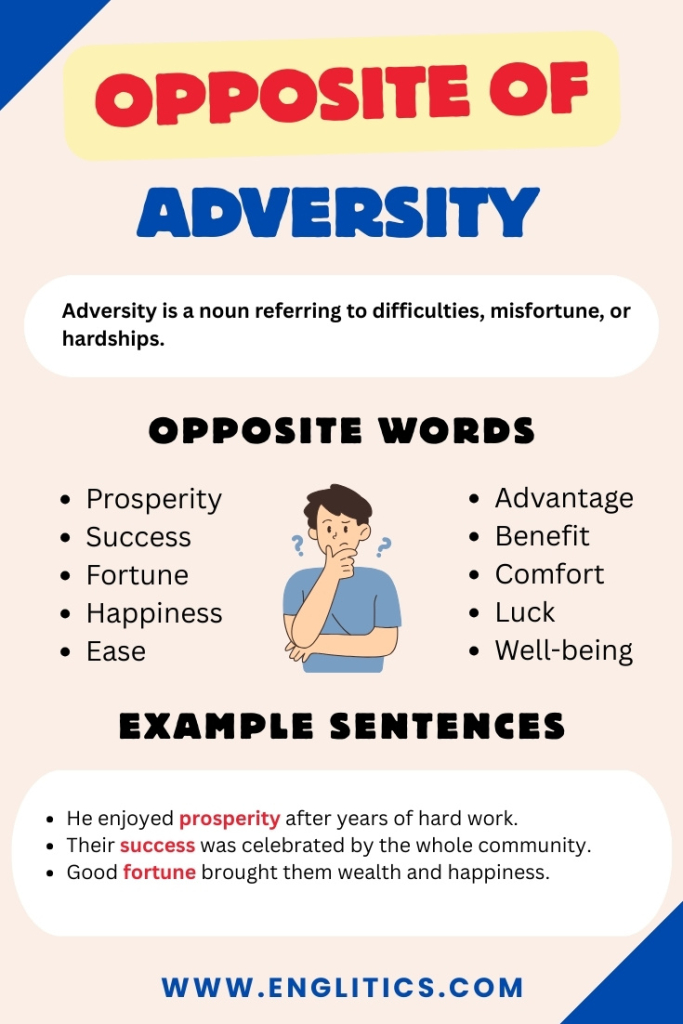
To fully grasp the meaning of “adversity,” it’s helpful to examine its etymology and structural components. The word originates from the Latin word adversus, meaning “opposite” or “against.” This Latin root highlights the fundamental nature of adversity as something that opposes or challenges us.
The suffix “-ity” is a common noun-forming suffix in English, indicating a state, quality, or condition. Therefore, “adversity” denotes the state or condition of being opposed or facing challenges.
This structural breakdown reveals the inherent negativity associated with the word, suggesting a force or circumstance that acts against one’s well-being or progress. Understanding this etymological background can deepen our appreciation for the word’s significance and its place within the broader lexicon of English.
Analyzing the word’s structure provides insight into its inherent meaning and helps differentiate it from similar terms. While other words might describe difficulty or challenges, “adversity” specifically implies a sustained and significant opposition, a state of being “against” something or someone.
This nuanced understanding is crucial for accurately using and interpreting the word in various contexts.
Categories of Antonyms for Adversity
The antonyms for adversity can be categorized based on different aspects of the concept. These categories help us understand the diverse ways in which the opposite of hardship can manifest.
Here’s a breakdown of these categories:
Success and Achievement
This category includes words that describe the attainment of goals, the fulfillment of aspirations, and the experience of positive outcomes. These words emphasize accomplishment and triumph over challenges, representing the antithesis of failure and setback.
Good Fortune and Luck
This category encompasses words that denote favorable circumstances, serendipitous events, and the experience of positive outcomes due to chance or external factors. These words highlight the role of luck and favorable conditions in achieving success and avoiding hardship.
Ease and Comfort
This category includes words that describe a state of relaxation, freedom from difficulty, and the absence of struggle. These words emphasize the absence of stress, effort, and hardship, representing a state of tranquility and well-being.
Happiness and Joy
This category encompasses words that denote positive emotions, contentment, and the absence of sorrow or distress. These words highlight the emotional well-being and positive mental state that contrasts with the suffering and negativity associated with adversity.
Protection and Safety
This category includes words that describe a state of being shielded from harm, danger, or threat. These words emphasize the absence of vulnerability and the presence of security, representing a safeguard against the negative forces that can lead to adversity.
Relief and Respite
This category encompasses words that denote a temporary or permanent alleviation of suffering, hardship, or distress. These words highlight the experience of being freed from the burden of adversity, representing a period of rest, recovery, or liberation.
Examples of Antonyms in Context
To illustrate the usage of antonyms for adversity, let’s explore examples within each category. The tables below provide a clear comparison between “adversity” and its contrasting terms.
The following table showcases antonyms related to success and achievement. These words emphasize accomplishment and triumph over challenges, representing the antithesis of failure and setback.
| Adversity | Antonyms (Success & Achievement) | Example Sentence |
|---|---|---|
| Adversity | Success | Despite facing immense adversity, she achieved remarkable success in her career. |
| Adversity | Triumph | The team’s adversity only fueled their determination, leading to an ultimate triumph. |
| Adversity | Victory | After years of adversity, the company finally achieved victory in the market. |
| Adversity | Achievement | Overcoming personal adversity, he celebrated a significant achievement by graduating top of his class. |
| Adversity | Accomplishment | Her greatest accomplishment was achieved after a period of significant adversity. |
| Adversity | Prosperity | The nation emerged from adversity into an era of unprecedented prosperity. |
| Adversity | Advancement | His advancement in the company was a direct result of his ability to overcome adversity. |
| Adversity | Fulfillment | She found fulfillment in her work, a stark contrast to the adversity she faced in her personal life. |
| Adversity | Realization | The realization of his dreams came after a long period of adversity. |
| Adversity | Attainment | The attainment of true happiness seemed impossible amidst the ongoing adversity. |
| Adversity | Flourishing | The business started flourishing only after overcoming initial adversity. |
| Adversity | Progress | Despite the initial adversity, steady progress was made on the project. |
| Adversity | Gain | The ultimate gain outweighed the initial adversity they had to endure. |
| Adversity | Success story | His life is a success story, a testament to overcoming immense adversity. |
| Adversity | Breakthrough | The scientific breakthrough came after years of research and facing much adversity. |
| Adversity | Triumph | The athlete’s triumph over injury was an inspiration, showcasing resilience after adversity. |
| Adversity | Achievement | The student’s academic achievement was especially impressive considering the adversity they faced at home. |
| Adversity | Accomplishment | Finishing the marathon was a significant accomplishment, especially given the adversity she had overcome in training. |
| Adversity | Prosperity | The town experienced a period of prosperity after overcoming the economic adversity. |
| Adversity | Advancement | His career advancement was a testament to his hard work and determination, despite facing considerable adversity. |
| Adversity | Fulfillment | She found fulfillment in helping others, which helped her overcome personal adversity. |
| Adversity | Realization | The realization of their business plan led to great success, a stark contrast to the initial adversity. |
| Adversity | Attainment | The attainment of peace was a long-fought battle, finally achieved after years of adversity. |
| Adversity | Flourishing | The garden began flourishing, a symbol of hope after a period of environmental adversity. |
This table illustrates antonyms related to good fortune and luck. These words denote favorable circumstances, serendipitous events, and positive outcomes due to chance or external factors.
| Adversity | Antonyms (Good Fortune & Luck) | Example Sentence |
|---|---|---|
| Adversity | Fortune | Despite the initial adversity, fortune smiled upon them in the end. |
| Adversity | Luck | It was pure luck that they survived the adversity of the storm. |
| Adversity | Serendipity | Their meeting was a stroke of serendipity, a welcome change from the recent adversity. |
| Adversity | Blessing | The unexpected inheritance was a blessing, alleviating much of their financial adversity. |
| Adversity | Providence | Some attributed their escape from adversity to divine providence. |
| Adversity | Favor | The judge showed them favor, mitigating the consequences of their past adversity. |
| Adversity | Good luck | After a period of immense adversity, they finally experienced a streak of good luck. |
| Adversity | Good fortune | Good fortune smiled upon them after weathering a long period of adversity. |
| Adversity | Chance | By chance, they stumbled upon a solution that helped them overcome their adversity. |
| Adversity | Destiny | Their destiny took a turn for the better, leading them away from adversity. |
| Adversity | Windfall | The unexpected windfall helped them recover from years of financial adversity. |
| Adversity | Fluke | It was a fluke that they found the lost document, ending their period of adversity. |
| Adversity | Jackpot | Winning the lottery was like hitting the jackpot, a complete turnaround from their previous adversity. |
| Adversity | Break | They finally got a break, which helped them escape their cycle of adversity. |
| Adversity | Serendipitous event | A serendipitous event occurred, offering them a way out of their adversity. |
| Adversity | Lucky break | The company got a lucky break when a major contract came through, alleviating their financial adversity. |
| Adversity | Fortuitous circumstance | A fortuitous circumstance arose, providing a solution to their long-standing adversity. |
| Adversity | Happy accident | It was a happy accident that led them to discover the new technology, ending their period of adversity. |
| Adversity | Stroke of luck | A stroke of luck changed their lives, helping them overcome years of adversity. |
| Adversity | Godsend | The volunteer support was a godsend, providing much-needed relief from their adversity. |
| Adversity | Golden opportunity | The golden opportunity presented itself unexpectedly, offering a chance to escape their adversity. |
| Adversity | Favorable outcome | Despite the initial challenges, a favorable outcome resulted, ending their period of adversity. |
| Adversity | Propitious moment | The propitious moment arrived when they least expected it, lifting them out of adversity. |
| Adversity | Positive turn | Their lives took a positive turn after enduring significant adversity. |
The following table presents antonyms that describe ease and comfort, emphasizing the absence of struggle and a state of tranquility.
| Adversity | Antonyms (Ease & Comfort) | Example Sentence |
|---|---|---|
| Adversity | Ease | After years of adversity, they finally lived a life of ease. |
| Adversity | Comfort | She sought comfort in her family after facing great adversity. |
| Adversity | Luxury | They lived in luxury, a stark contrast to the adversity they once knew. |
| Adversity | Tranquility | The quiet countryside offered tranquility, a welcome escape from the adversity of city life. |
| Adversity | Relaxation | He found relaxation in meditation after enduring significant adversity at work. |
| Adversity | Peace | She finally found peace after years of personal adversity. |
| Adversity | Contentment | He discovered contentment in simple things, a stark contrast to his past adversity. |
| Adversity | Well-being | She prioritized her well-being after overcoming a period of significant adversity. |
| Adversity | Serenity | The mountain retreat provided serenity, a much-needed break from the daily adversity. |
| Adversity | Leisure | He enjoyed his leisure time, a reward for overcoming past adversity. |
| Adversity | Calm | A sense of calm washed over her, replacing the stress of previous adversity. |
| Adversity | Pleasure | She found pleasure in simple activities, a welcome change from the recent adversity. |
| Adversity | Rest | After the storm, they found rest and recuperation, recovering from the adversity. |
| Adversity | Comfort zone | He settled into his comfort zone, a safe place after years of adversity. |
| Adversity | Easy life | They lived an easy life after years of struggling through adversity. |
| Adversity | Smooth sailing | After the initial difficulties, it was smooth sailing, a welcome change from the earlier adversity. |
| Adversity | Untroubled existence | She enjoyed an untroubled existence, a stark contrast to her previous life filled with adversity. |
| Adversity | Peaceful state | They finally achieved a peaceful state, escaping the constant stress of adversity. |
| Adversity | Carefree life | He embraced a carefree life, a reward for overcoming past adversity. |
| Adversity | Simple pleasures | They appreciated the simple pleasures of life after enduring significant adversity. |
| Adversity | Quietude | She sought quietude in her garden, finding solace from the adversity of the outside world. |
| Adversity | Easy street | They found themselves on easy street after years of financial adversity. |
| Adversity | Painless existence | He longed for a painless existence after enduring so much adversity. |
| Adversity | Stress-free environment | She created a stress-free environment at home, a sanctuary from the adversity at work. |
Here is a table that shows antonyms that denote happiness and joy, highlighting positive emotions and contentment.
| Adversity | Antonyms (Happiness & Joy) | Example Sentence |
|---|---|---|
| Adversity | Happiness | After a long period of adversity, they finally found happiness together. |
| Adversity | Joy | The birth of their child brought immense joy, a welcome change from the previous adversity. |
| Adversity | Bliss | They lived in a state of marital bliss, a far cry from the adversity they faced early in their relationship. |
| Adversity | Delight | She took delight in her grandchildren, forgetting the adversity of her past. |
| Adversity | Glee | The children were filled with glee at the sight of the presents, a stark contrast to the family’s recent adversity. |
| Adversity | Cheerfulness | Her cheerfulness was infectious, helping them to overcome their adversity. |
| Adversity | Contentment | He found contentment in his simple life, a peaceful escape from past adversity. |
| Adversity | Jubilation | The team erupted in jubilation after winning the championship, a triumph over years of adversity. |
| Adversity | Elation | She felt elation upon receiving the award, a reward for her perseverance through adversity. |
| Adversity | Euphoria | They experienced euphoria after completing the challenging project, a feeling of accomplishment after facing much adversity. |
| Adversity | Merriment | The holiday season brought merriment and laughter, helping them forget their recent adversity. |
| Adversity | Gladness | She felt gladness in her heart, a feeling she hadn’t experienced during the long period of adversity. |
| Adversity | Exhilaration | The roller coaster ride filled him with exhilaration, a welcome distraction from the adversity he faced at work. |
| Adversity | Lightheartedness | They approached life with lightheartedness, a coping mechanism for dealing with past adversity. |
| Adversity | Festivity | The town celebrated with festivity, a joyous occasion after overcoming a period of economic adversity. |
| Adversity | Amusement | They found amusement in watching old movies, a simple pleasure that helped them forget their adversity. |
| Adversity | Cheer | The holiday season brought cheer, a welcome change from the recent adversity. |
| Adversity | Good spirits | They remained in good spirits despite facing considerable adversity. |
| Adversity | Jollity | The party was filled with jollity and laughter, a much-needed break from the daily adversity. |
| Adversity | Pleasure | She found pleasure in her hobbies, a source of joy that helped her cope with adversity. |
| Adversity | Positive emotions | After years of adversity, they finally experienced a range of positive emotions. |
| Adversity | Smiles | Smiles returned to their faces after a long period of adversity. |
| Adversity | Laughter | The sound of laughter filled the room, a welcome change from the somber mood during the adversity. |
| Adversity | Delightful moments | They cherished the delightful moments, appreciating them even more after enduring so much adversity. |
Usage Rules and Considerations
When using antonyms for adversity, it’s crucial to consider the specific context and the nuances of each word. While many words can be used as general opposites, some may be more appropriate depending on the specific type of adversity being discussed.
For example, if the adversity is related to financial hardship, words like “prosperity” or “wealth” might be more fitting than “happiness” or “joy.”
Pay attention to the connotations of the antonyms. Some words might carry a stronger emotional charge or imply a particular type of success or well-being.
Choose words that accurately reflect the intended meaning and avoid using overly simplistic or generic antonyms that don’t capture the full complexity of the situation. Understanding the subtle differences between these words will enhance the precision and impact of your writing and communication.
Be mindful of the grammatical structure and sentence flow when incorporating antonyms. Ensure that the chosen word fits grammatically and that the sentence maintains a clear and coherent meaning.
Consider the overall tone and style of your writing and select antonyms that align with the intended effect. Using a thesaurus can be helpful, but always double-check the meaning and usage of any unfamiliar words to avoid misinterpretations.
Common Mistakes in Using Antonyms for Adversity
A common mistake is using overly general antonyms that don’t accurately reflect the specific type of adversity. For example, using “happiness” as an antonym for financial hardship is technically correct but lacks the precision of “prosperity” or “wealth.” Similarly, using “success” as an antonym for a personal tragedy might seem insensitive; words like “healing” or “recovery” would be more appropriate.
Another common mistake is misinterpreting the connotations of antonyms. Some words might imply a level of perfection or ease that is unrealistic or unattainable.
For instance, using “bliss” as an antonym for a difficult relationship might suggest an unrealistic expectation of constant happiness. Choose antonyms that are realistic and reflect the complexity of human experiences.
Avoid using antonyms that are grammatically incorrect or that disrupt the flow of the sentence. Ensure that the chosen word fits seamlessly into the sentence structure and that the meaning remains clear and coherent.
Always proofread your writing to catch any errors in grammar or usage. Consulting a dictionary or grammar guide can help clarify any doubts or uncertainties.
Here are some examples of common mistakes with corrections:
| Incorrect | Correct | Explanation |
|---|---|---|
| Despite the adversity, they found only happiness. | Despite the adversity, they found peace and contentment. | “Happiness” is too general; “peace and contentment” are more nuanced. |
| His adversity was replaced by success. | His adversity was replaced by a sense of healing and recovery. | “Success” doesn’t address the emotional impact of the adversity. |
| She overcame adversity and achieved bliss. | She overcame adversity and found moments of joy and fulfillment. | “Bliss” is an unrealistic expectation; “joy and fulfillment” are more attainable. |
Practice Exercises
Test your understanding of antonyms for adversity with these practice exercises:
Exercise 1: Fill in the Blanks
Choose the best antonym for “adversity” from the list provided to complete each sentence.
- After years of _____, the company finally achieved profitability. (adversity, prosperity, failure)
- Despite the _____, she maintained a positive attitude. (comfort, adversity, challenge)
- The _____ of the situation was a welcome change after months of hardship. (ease, difficulty, struggle)
- He found _____ in his family after facing immense personal challenges. (adversity, comfort, sorrow)
- The team celebrated their _____ after overcoming numerous obstacles. (victory, defeat, adversity)
- She attributed her _____ to hard work and dedication, not luck. (adversity, success, misfortune)
- They finally experienced _____ after a long period of financial strain. (relief, burden, adversity)
- The _____ of the countryside provided a much-needed escape from the city’s troubles. (tranquility, chaos, adversity)
- He found _____ in his hobbies, a distraction from the challenges of his job. (pleasure, stress, adversity)
- The _____ of the community helped them rebuild after the disaster. (unity, adversity, division)
Answer Key:
- prosperity
- adversity
- ease
- comfort
- victory
- success
- relief
- tranquility
- pleasure
- unity
Exercise 2: Matching
Match each word with its closest antonym for “adversity.”
- Hardship
- Misfortune
- Suffering
- Challenge
- Difficulty
Options:
- a) Ease
- b) Fortune
- c) Comfort
- d) Opportunity
- e) Happiness
Answer Key:
- Hardship – c) Comfort
- Misfortune – b) Fortune
- Suffering – e) Happiness
- Challenge – d) Opportunity
- Difficulty – a) Ease
Exercise 3: Sentence Completion
Complete each sentence using an appropriate antonym for “adversity.”
- After enduring years of _____, the family finally found a sense of stability and _____.
- Despite the initial _____, the project eventually achieved widespread _____ and recognition.
- She transformed her _____ into an opportunity for growth and _____.
- They sought _____ and relaxation after a period of intense _____ and stress.
- The community rallied together to provide _____ and support to those affected by _____.
Suggested Answers: (Note: Multiple answers may be possible)
- After enduring years of adversity, the family finally found a sense of stability and peace.
- Despite the initial adversity, the project eventually achieved widespread success and recognition.
- She transformed her adversity into an opportunity for growth and fulfillment.
- They sought comfort and relaxation after a period of intense adversity and stress.
- The community rallied together to provide relief and support to those affected by adversity.
Advanced Topics: Nuances and Connotations
For advanced learners, it’s essential to delve into the subtle nuances and connotations of antonyms for adversity. Words like “success” and “triumph” might seem interchangeable, but they carry different implications.
“Success” often refers to the attainment of a specific goal, while “triumph” implies a victory over significant obstacles or opposition.
Similarly, words like “happiness” and “joy” denote positive emotions, but “happiness” often suggests a more sustained and general state of well-being, while “joy” implies a more intense and fleeting emotion. Understanding these subtle differences allows for more precise and nuanced communication, enabling you to convey the intended meaning with greater accuracy and impact.
Consider the cultural and historical context when using antonyms for adversity. Some words might carry different connotations in different cultures or time periods.
For instance, the concept of “fortune” might be viewed differently in a culture that emphasizes hard work and self-reliance versus one that believes in fate and destiny. Being aware of these cultural and historical nuances can help you avoid misinterpretations and communicate effectively across diverse audiences.
Frequently Asked Questions
- What is the difference between an antonym and a synonym?An antonym is a word that has the opposite meaning of another word, while a synonym is a word that has a similar meaning. Forexample, “happy” is a synonym of “joyful,” and “sad” is an antonym of both “happy” and “joyful.”
- Can a word have multiple antonyms?Yes, many words have multiple antonyms, each reflecting a different aspect of the word’s meaning. The best antonym to use depends on the specific context and the intended nuance.
- Are antonyms always direct opposites?Not always. Some antonyms are gradable (e.g., hot and cold), while others are complementary (e.g., alive and dead). The relationship between a word and its antonym can vary depending on the specific words involved.
- How can I improve my vocabulary of antonyms?Read widely, use a thesaurus, and practice using new words in context. Pay attention to the nuances of different words and how they relate to each other. Consider using flashcards or other memory aids to help you remember new words and their antonyms.
- Is it important to consider the context when choosing an antonym?Absolutely. The context is crucial in determining the most appropriate antonym. A word can have multiple antonyms, and the best choice will depend on the specific meaning you want to convey.
- Can the antonyms for “adversity” also be considered synonyms for “success”?In some cases, yes. Many antonyms for “adversity,” such as “success,” “triumph,” and “prosperity,” can also be considered synonyms for “success,” depending on the specific context.
Conclusion
Mastering the antonyms for “adversity” is more than just an exercise in vocabulary building; it’s a way to enrich your understanding of the human experience and enhance your ability to communicate effectively. By recognizing the diverse ways in which the opposite of hardship can manifest, you can express a wider range of emotions, articulate more nuanced ideas, and appreciate the positive aspects of life with greater depth and clarity.
Whether you’re writing a novel, delivering a speech, or simply engaging in everyday conversation, a solid grasp of these contrasting terms will empower you to convey your intended meaning with greater precision and impact.
Continue to explore the rich tapestry of language, and embrace the power of words to shape your thoughts, express your emotions, and connect with others on a deeper level. The journey of linguistic discovery is a lifelong pursuit, one that offers endless opportunities for growth, learning, and self-expression.
As you expand your vocabulary and refine your understanding of language, you’ll unlock new possibilities for communication, creativity, and connection.