The Opposite of Affluent points to situations marked by financial struggle or limited resources. While “affluent” describes someone who is wealthy or well-off, its antonyms reflect a lack of money, comfort, or material stability.
Antonyms for Affluent include poor, impoverished, and needy. This guide explains each term with clear examples to help you use them accurately in writing and speech. Whether you’re a student expanding your vocabulary or a writer aiming for more precise language, understanding these opposites will help you communicate economic contrasts with clarity.
Definition of Affluent
The word “affluent” describes a state of having a great deal of money or wealth. It goes beyond simply being comfortable; it implies a level of financial abundance that allows for a luxurious lifestyle and the ability to afford a wide range of goods and services.
“Affluent” is an adjective, and it is often used to describe individuals, families, or even entire communities.
The term carries connotations of not just wealth, but also privilege and access to opportunities that are not available to everyone. It signifies a position of economic security and often implies a certain social status.
Understanding the full scope of this definition is essential before exploring its antonyms.
Structural Breakdown of “Affluent”
The word “affluent” comes from the Latin word affluens, which is the present participle of affluere, meaning “to flow to” or “to abound.” This etymological root suggests a continuous flow of resources, highlighting the idea of abundance and prosperity. The structure of the word itself doesn’t offer direct clues to its antonyms, but understanding its origin helps reinforce its meaning.
Breaking down the word etymologically can sometimes provide insight into related terms, but in this case, it primarily serves to deepen our understanding of the word’s positive connotation of abundance. This historical context helps in differentiating “affluent” from words that simply mean “rich” or “wealthy,” adding a layer of depth to its usage.
Opposite of Affluent
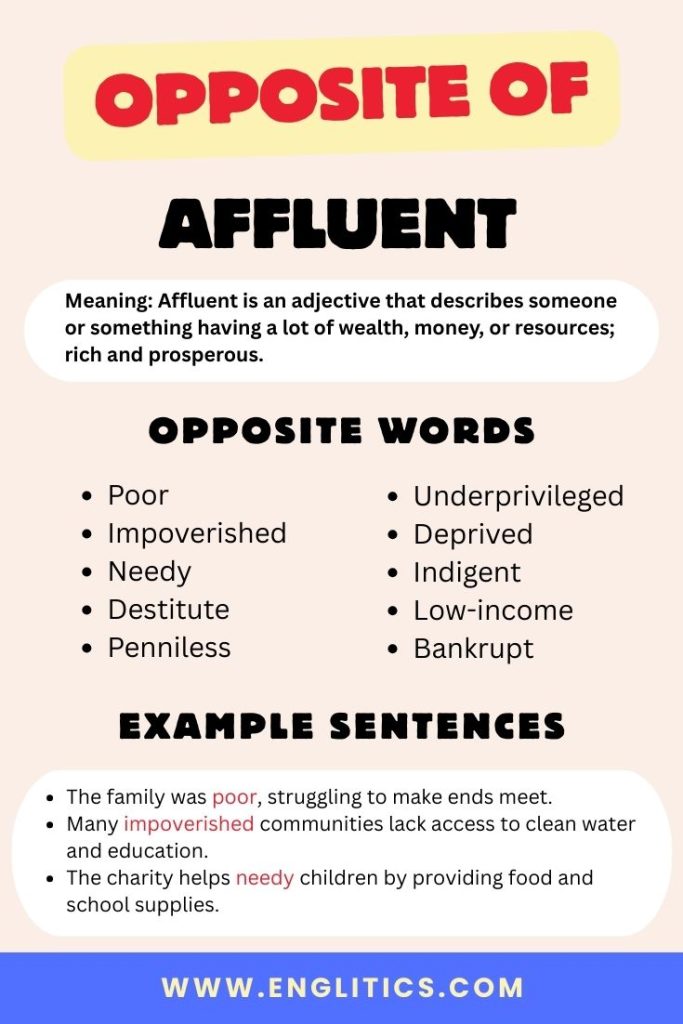
The antonyms for “affluent” can be categorized based on the severity and nature of the lack of wealth. Understanding these categories helps in choosing the most appropriate word to convey the intended meaning.
Poverty-Stricken
This term implies a severe and prolonged state of poverty, often with little to no hope of improvement. It suggests a lack of basic necessities and a struggle for survival.
Poor
This is a general term for lacking sufficient money to live comfortably. It is less extreme than “poverty-stricken” but still indicates a significant lack of financial resources.
Impoverished
This term suggests a state of having been made poor, often due to circumstances beyond one’s control. It implies a decline from a previous, more comfortable state.
Destitute
This indicates a complete lack of resources, often to the point of homelessness and starvation. It is one of the most extreme antonyms of “affluent.”
Needy
This term describes someone who requires assistance, often financial, to meet their basic needs. It suggests a dependence on charity or government support.
Bankrupt
This term refers to a legal state of being unable to pay debts. It implies a financial failure and a loss of assets.
Insolvent
Similar to bankrupt, “insolvent” means unable to pay debts, but it may not necessarily involve a formal legal declaration. It indicates a state of financial instability.
Penurious
This term describes someone who is extremely stingy or miserly, often to the point of living in poverty despite having some resources. It highlights a specific behavior related to money.
Indigent
This term refers to someone who is extremely poor and lacking the necessities of life. It is often used in legal or social contexts to describe someone eligible for public assistance.
Lacking
This is a general term that simply indicates a deficiency in something, in this case, financial resources. It is less specific than the other terms but can be useful in certain contexts.
Examples of Antonyms in Sentences
Understanding the nuances of each antonym requires seeing them in context. The following tables provide examples of how these words are used in sentences, illustrating their different connotations and levels of severity.
The following table contains examples of the antonym ‘Poor’ in a variety of sentences, showcasing its usage in different contexts. Note how the word is used to describe a lack of resources or a state of deprivation.
| Sentence |
|---|
| Despite working long hours, the family remained poor. |
| The poor community struggled to access basic healthcare. |
| He grew up in a poor neighborhood with limited opportunities. |
| The country’s poor economy led to widespread unemployment. |
| She donated to charities that support poor children. |
| The poor soil made it difficult to grow crops. |
| He felt poor in spirit after the loss. |
| The poor quality of the product disappointed many customers. |
| Many poor families rely on food banks for sustenance. |
| The bill aims to help poor people get education. |
| The poor living conditions affected the health of the residents. |
| Despite being poor, they were rich in community spirit. |
| They implemented policies to alleviate poverty among the poor. |
| The poor performance of the company led to its downfall. |
| He offered assistance to the poor family next door. |
| The poor infrastructure hindered economic development. |
| She dedicated her life to helping the poor and marginalized. |
| The poor air quality posed a threat to public health. |
| The poor sanitation contributed to the spread of diseases. |
| The poor harvests resulted in widespread famine. |
| The poor attendance at the meeting was disheartening. |
| He was born into a poor family but rose to prominence through hard work. |
| The poor visibility made driving dangerous. |
| She volunteered at a shelter for the poor and homeless. |
| The poor reviews of the movie discouraged viewers. |
This table provides examples of the antonym ‘Impoverished’ in sentences to illustrate its meaning of being made poor or depleted of resources. Notice how it emphasizes a decline from a previous state.
| Sentence |
|---|
| The war left the country impoverished. |
| The soil became impoverished due to over-farming. |
| The once-thriving community became impoverished after the factory closed. |
| He worked to help impoverished families in the region. |
| The impoverished nation struggled to rebuild its economy. |
| The impoverished artist sold his paintings for meager sums. |
| Years of drought impoverished the farmers. |
| The impoverished state lacked the resources to provide adequate healthcare. |
| She dedicated her career to helping impoverished communities. |
| The impoverished neighborhood suffered from high crime rates. |
| The economic crisis impoverished many middle-class families. |
| The impoverished school lacked basic supplies. |
| His family became impoverished after the financial crash. |
| The impoverished city struggled to provide basic services. |
| They provided aid to the impoverished villages. |
| The impoverished region suffered from malnutrition and disease. |
| He grew up in an impoverished environment but overcame many challenges. |
| The impoverished library lacked current books and resources. |
| The impoverished wildlife park struggled to feed the animals. |
| The hurricane impoverished the coastal communities. |
| The impoverished nation relied heavily on foreign aid. |
| The prolonged conflict impoverished the local population. |
| The impoverished orphanage struggled to care for the children. |
| The corruption impoverished the country’s resources. |
| The impoverished museum could not afford to acquire new exhibits. |
The following table provides examples of the antonym ‘Destitute’ in sentences, illustrating its meaning of being completely lacking in resources, often to the point of extreme poverty. Notice how it conveys a sense of utter deprivation.
| Sentence |
|---|
| The flood left many families destitute. |
| He was destitute and homeless after losing his job. |
| The charity provides food and shelter for destitute people. |
| She became destitute after the death of her husband. |
| The destitute refugees struggled to survive in the camp. |
| He felt destitute of hope after the devastating news. |
| The destitute village had no access to clean water. |
| She dedicated her life to helping the destitute and marginalized. |
| The economic crisis left many families destitute and without options. |
| The destitute man begged for money on the street. |
| The destitute community relied on aid from international organizations. |
| He lost everything and became completely destitute. |
| The destitute woman sold her belongings to feed her children. |
| After the fire, they were left destitute and with nothing. |
| The destitute children were orphaned and alone. |
| She worked tirelessly to support the destitute in her city. |
| The destitute family sought refuge in a temporary shelter. |
| He felt destitute of affection and companionship. |
| The destitute settlement had no access to medical care. |
| The earthquake left thousands destitute and homeless. |
| The destitute people lined up for food handouts. |
| She volunteered at a soup kitchen for the destitute and hungry. |
| The destitute village was ravaged by famine and disease. |
| He was reduced to a destitute state after the business failed. |
| The destitute family relied on the kindness of strangers. |
This table provides examples of the antonym ‘Bankrupt’ in sentences to illustrate its meaning of being financially ruined and unable to pay debts. Notice how it often involves legal or formal financial failure.
| Sentence |
|---|
| The company went bankrupt after years of losses. |
| He declared himself bankrupt to avoid paying his debts. |
| The bankrupt businessman lost all his assets. |
| The country faced economic collapse and was essentially bankrupt. |
| She was left financially bankrupt after the divorce. |
| The bankrupt corporation filed for bankruptcy protection. |
| He risked everything and went bankrupt trying to save his business. |
| The bankrupt farmer lost his land to the bank. |
| The economic downturn caused many businesses to go bankrupt. |
| She was emotionally bankrupt after the traumatic experience. |
| The bankrupt airline canceled all its flights. |
| He was declared bankrupt by the court. |
| The bankrupt company laid off all its employees. |
| She was left financially bankrupt and emotionally drained. |
| The bankrupt state struggled to provide basic services. |
| He made a series of bad investments and went bankrupt. |
| The bankrupt factory closed down, leaving many unemployed. |
| She felt morally bankrupt after betraying her friend. |
| The bankrupt organization was forced to sell its assets. |
| He was financially bankrupt and emotionally broken. |
| The bankrupt city struggled to recover from the economic crisis. |
| She was left bankrupt and without a home after the disaster. |
| The bankrupt trust fund could not provide for the beneficiaries. |
| He went bankrupt due to excessive spending habits. |
| The bankrupt enterprise was unable to pay its creditors. |
The following table provides examples of the antonym ‘Needy’ in sentences to illustrate its meaning of requiring assistance, often financial, to meet basic needs. Notice how it suggests a dependence on external support.
| Sentence |
|---|
| The charity helps needy families during the holidays. |
| She volunteered at a shelter for needy children. |
| The government provides assistance to needy individuals. |
| He donated to organizations that support the needy. |
| The needy students received scholarships to attend college. |
| She felt compassion for the needy and homeless. |
| The community rallied to support the needy after the disaster. |
| He worked to provide food and shelter for the needy. |
| The needy family received assistance from the local church. |
| She dedicated her life to helping the needy and vulnerable. |
| The needy patients relied on the free clinic for medical care. |
| He grew up in a needy neighborhood and understood their struggles. |
| The needy animals were rescued and taken to a shelter. |
| She organized a fundraiser to support the needy in her community. |
| The needy elderly received meals delivered to their homes. |
| He felt a responsibility to help the needy and less fortunate. |
| The needy refugees were provided with food, water, and shelter. |
| She volunteered her time to tutor needy children after school. |
| The needy families received assistance with their utility bills. |
| He donated his old clothes to a charity that helps the needy. |
| The needy patients received free medication from the clinic. |
| She dedicated her career to advocating for the rights of the needy. |
| The needy individuals were given job training and employment opportunities. |
| He felt a strong sense of empathy for the needy and suffering. |
| The needy families were provided with Christmas gifts and holiday meals. |
Usage Rules for Antonyms of Affluent
When using antonyms for “affluent,” it is important to consider the context and the specific nuance you want to convey. Here are some general rules:
- Consider the Severity: Choose an antonym that reflects the appropriate level of financial hardship. “Poor” is a general term, while “destitute” implies extreme poverty.
- Be Mindful of Connotations: Some words, like “penurious,” carry specific connotations that might not be appropriate in all situations.
- Maintain Consistency: Use the antonym consistently throughout your writing or speech to avoid confusion.
- Context is Key: The surrounding sentences should provide enough context to make the meaning of the antonym clear.
For example, if you are describing a family who struggles to make ends meet but still has a home and food, “poor” or “needy” might be more appropriate than “destitute.” If you are describing a company that has failed financially, “bankrupt” or “insolvent” would be the correct choice.
Common Mistakes When Using Antonyms of Affluent
Here are some common mistakes to avoid when using antonyms for “affluent”:
- Using “poor” when a stronger word is needed: Describing a homeless person as “poor” might be technically correct, but it doesn’t convey the full extent of their suffering. “Destitute” would be more accurate.
- Using “bankrupt” interchangeably with “poor”: “Bankrupt” has a specific legal meaning and should only be used when referring to a formal declaration of bankruptcy.
- Misunderstanding the connotations of “penurious”: This word implies stinginess, not just poverty. Using it incorrectly can change the meaning of your sentence.
Here are some examples of correct and incorrect usage:
| Incorrect | Correct |
|---|---|
| The affluent family lived in a shack. | The poor family lived in a shack. |
| The company was poor and declared bankruptcy. | The company was bankrupt after declaring bankruptcy. |
| He was so destitute that he gave all his money away. | He was so penurious that he hoarded all his money. |
| She was affluent of hope. | She was destitute of hope. |
Practice Exercises
Test your understanding of antonyms for “affluent” with these exercises. Choose the best antonym for “affluent” in each sentence.
Exercise 1: Choose the best antonym for “affluent” to complete each sentence.
| Question | Answer |
|---|---|
| Despite his hard work, he remained ______. | Poor |
| The war left the country ______ and in ruins. | Impoverished |
| After losing his job, he became ______ and homeless. | Destitute |
| The ______ family relied on food banks to survive. | Needy |
| The company went ______ after years of financial mismanagement. | Bankrupt |
| Due to bad investments, he became ______. | Insolvent |
| The ______ old man lived in a mansion but ate only scraps. | Penurious |
| The ______ were given free legal aid. | Indigent |
| The project was ______ in funding and had to be abandoned. | Lacking |
| While some lived in luxury, others were ______. | Poverty-stricken |
Exercise 2: Rewrite each sentence, replacing “affluent” with an appropriate antonym.
| Original Sentence | Rewritten Sentence |
|---|---|
| The affluent neighborhood had well-maintained parks and gardens. | The poor neighborhood lacked well-maintained parks and gardens. |
| The affluent family donated generously to charity. | The needy family received assistance from charity. |
| The affluent corporation invested in new technologies. | The bankrupt corporation struggled to pay its debts. |
| The affluent nation provided aid to developing countries. | The impoverished nation received aid from developed countries. |
| The affluent residents enjoyed a high quality of life. | The destitute residents struggled to survive. |
| He grew up in an affluent suburb of the city. | He grew up in an impoverished area of the city. |
| The affluent community had access to excellent healthcare. | The indigent community had limited access to healthcare. |
| The affluent school was well-equipped with resources. | The lacking school was poorly equipped with resources. |
| The affluent society valued material possessions. | The poverty-stricken society valued basic survival. |
| The affluent investor made wise financial decisions. | The insolvent investor made disastrous financial decisions. |
Exercise 3: Fill in the blank with the most suitable antonym of “affluent” from the list provided (poor, impoverished, destitute, needy, bankrupt).
| Question | Answer |
|---|---|
| After the factory closure, many families in the town became ______. | Impoverished |
| The ______ man begged on the streets for spare change. | Destitute |
| The ______ children received free lunches at school. | Needy |
| The ______ farmer lost his land due to drought. | Poor |
| The company went ______ after a series of bad investments. | Bankrupt |
Advanced Topics: Nuances and Connotations
At an advanced level, understanding the subtle differences in connotation is crucial. For example, “underprivileged” is a gentler term than “impoverished,” suggesting a lack of opportunities rather than a complete lack of resources.
“Disadvantaged” is another term that focuses on systemic barriers rather than individual poverty.
Additionally, the choice of antonym can be influenced by political or social perspectives. Some terms, like “working class,” focus on employment status rather than wealth.
Others, like “lower class,” can be seen as pejorative and should be used with caution.
Consider the impact of your word choice on your audience and the overall tone of your message. Being sensitive to these nuances will enhance your communication skills and make your writing more effective.
Frequently Asked Questions
- What is the difference between “poor” and “impoverished”?“Poor” is a general term for lacking sufficient money, while “impoverished” suggests a state of having been made poor, often due to external circumstances. Impoverished implies a decline from a previous, more comfortable state, whereas ‘poor’ is more of a general state.
- When should I use “destitute” instead of “poor”?Use “destitute” when you want to emphasize a complete lack of resources, often to the point of homelessness and starvation. It is a much stronger term than “poor” and should be reserved for extreme cases.
- Is “bankrupt” the same as “insolvent”?While both terms refer to an inability to pay debts, “bankrupt” usually implies a formal legal declaration, while “insolvent” can refer to a general state of financial instability without a formal process.
- What is the connotation of “penurious”?“Penurious” implies stinginess or miserliness, often to the point of living in poverty despite having some resources. It highlights a specific behavior related to money, not just a lack of it.
- Is “indigent” a common term?“Indigent” is often used in legal or social contexts to describe someone eligible for public assistance. It is a more formal term than “poor” and is often used in official documents.
- Can “lacking” be used as an antonym for “affluent”?“Lacking” is a general term that can indicate a deficiency in financial resources, but it is less specific than other antonyms. It is best used when you want to emphasize a general lack of something rather than a specific state of poverty.
- Are there any polite ways to say someone is not affluent?Yes, terms like “low-income,” “modest means,” or “economically disadvantaged” can be used as more polite alternatives to “poor” or “impoverished.” These terms focus on economic status without being overly negative.
- How do I choose the best antonym for “affluent” in a sentence?Consider the context, the severity of the financial situation, and the specific nuance you want to convey. Choose the word that most accurately reflects the situation and avoids any unintended connotations.
Conclusion
Mastering the antonyms of “affluent” is a valuable step in expanding your vocabulary and improving your ability to communicate effectively. By understanding the nuances of words like “poor,” “impoverished,” “destitute,” and “bankrupt,” you can choose the most appropriate term to convey your intended meaning.
Remember to consider the context, connotations, and severity of the situation when selecting an antonym.
Continue to practice using these words in your writing and speech, and pay attention to how they are used by others. With continued effort, you will develop a strong command of these important vocabulary words and enhance your overall language skills.
Keep exploring, keep learning, and keep expanding your linguistic horizons!