Aggressive means being forceful, pushy, or ready to fight—either with words or actions. It often describes someone who acts in a strong, angry, or overly bold way. While this can sometimes show confidence, it can also come across as rude or threatening. When you want to describe someone who stays calm, kind, or gentle, the opposite of aggressive is a better fit.
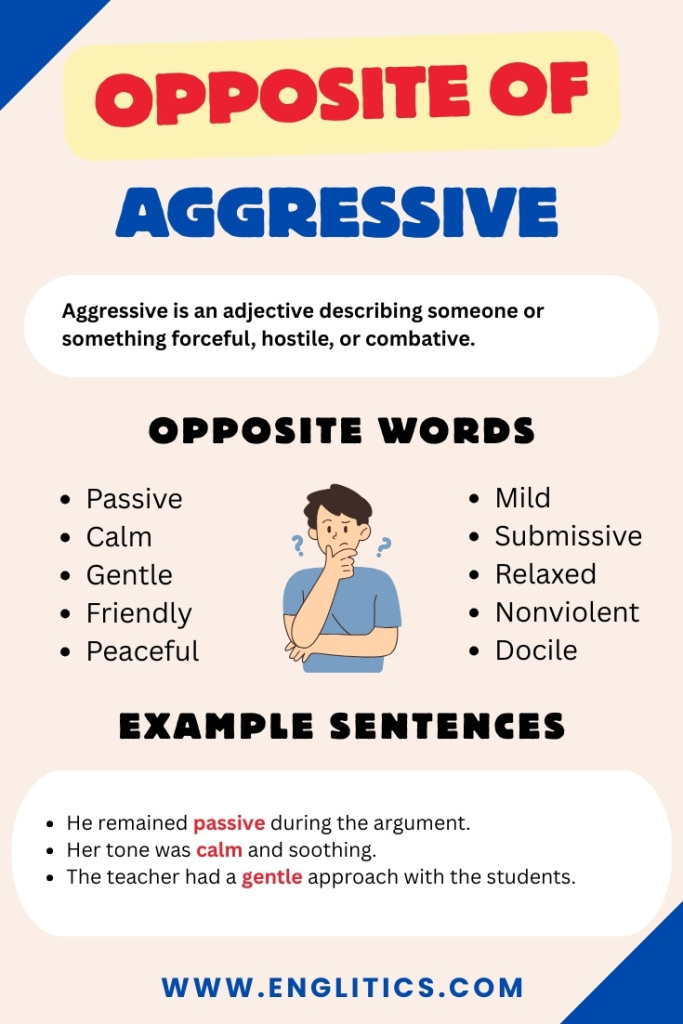
The opposite of aggressive includes words like gentle, calm, peaceful, passive, and friendly. These words describe people who avoid conflict, speak kindly, or act with care. Whether you’re talking about a person’s behavior, a tone of voice, or a way of solving problems, using the opposite of aggressive helps show a softer, more respectful approach.
Table of Contents
- Introduction
- Definition of “Aggressive”
- Structural Breakdown of Antonyms
- Types of Antonyms
- Examples of Antonyms for “Aggressive”
- Usage Rules for Antonyms
- Common Mistakes
- Practice Exercises
- Advanced Topics: Nuances and Context
- FAQ
- Conclusion
Definition of “Aggressive”
The word “aggressive” describes behavior that is forceful, hostile, or intended to dominate. It can refer to physical actions, verbal communication, or even a general attitude.
Aggression often involves an attempt to assert oneself at the expense of others, sometimes through intimidation or violence. Understanding the nuances of “aggressive” behavior is essential for identifying appropriate antonyms.
The term can be used in various contexts, from describing a competitive business strategy to characterizing a person’s demeanor in social interactions.
In a psychological context, “aggressive” may refer to a behavior driven by anger or frustration. In business, it could describe a proactive and assertive approach to sales or marketing.
In sports, it might refer to a player’s intense and relentless style of play. Therefore, the appropriate antonym will depend heavily on the specific context in which “aggressive” is used.
Structural Breakdown of Antonyms
Antonyms, also known as opposites, are words that have contrasting meanings. They play a crucial role in language by allowing us to express differences, create contrast, and provide a more complete understanding of a concept. Understanding the structure of antonyms involves recognizing how they relate to the original word and how they differ in meaning. Antonyms help to clarify the meaning of a word by highlighting what it is not.
Antonyms can be formed in several ways. Some are created by adding prefixes like “un-,” “in-,” “dis-,” or “non-” to a base word (e.g., “happy” vs.
“unhappy,” “active” vs. “inactive”).
Others are entirely different words that have naturally evolved to represent opposite meanings (e.g., “hot” vs. “cold,” “good” vs.
“bad”). Recognizing these structural patterns can aid in identifying and understanding antonyms effectively.
The relationship between a word and its antonym is one of opposition, where one word negates or contradicts the other.
Types of Antonyms
Antonyms are not all created equal. There are different types of antonyms, each with its own characteristics and nuances.
Understanding these categories can help in choosing the most appropriate antonym for a given context. The three main types of antonyms are complementary, gradable, and relational.
Complementary Antonyms
Complementary antonyms are pairs of words where the presence of one implies the absence of the other, and vice versa. There is no middle ground between them; something is either one or the other.
For example, “alive” and “dead” are complementary antonyms. If something is alive, it cannot be dead, and if it is dead, it cannot be alive.
These antonyms create a binary opposition.
When considering the antonyms of “aggressive,” complementary antonyms might be less directly applicable, as aggression often exists on a spectrum rather than being a simple on/off state. However, in certain contexts, a complementary antonym might be appropriate.
For example, if “aggressive” is used to describe an action that is explicitly violent, then “non-violent” could be considered a complementary antonym.
Gradable Antonyms
Gradable antonyms are words that exist on a continuum. They represent opposite ends of a scale, with various degrees or levels in between.
Examples include “hot” and “cold,” “big” and “small,” and “happy” and “sad.” These antonyms allow for comparative statements, such as “slightly warm” or “very cold.” The existence of intermediate states is what defines gradable antonyms.
Most antonyms for “aggressive” fall into the gradable category. Words like “passive,” “gentle,” and “calm” represent varying degrees of non-aggression.
The choice of which gradable antonym to use depends on the specific level of intensity being described. For instance, “gentle” implies a moderate lack of aggression, while “passive” suggests a more pronounced absence of aggressive behavior.
Relational Antonyms
Relational antonyms are pairs of words that describe a relationship from opposite perspectives. One word implies the existence of the other.
Examples include “teacher” and “student,” “buyer” and “seller,” and “above” and “below.” These antonyms are related by the roles or positions they represent within a specific context.
Relational antonyms are less directly applicable to “aggressive” in the context of individual behavior or characteristics. However, in certain situations, they can be relevant.
For example, if “aggressive” describes the behavior of a predator, then “defensive” or “evasive” might describe the behavior of its prey. The relationship is defined by the interaction between the two entities.
Examples of Antonyms for “Aggressive”
To fully understand the antonyms of “aggressive,” it is helpful to examine specific examples and their contexts. The following sections provide detailed explanations and examples of various antonyms, categorized by their nuanced meanings.
These examples illustrate how the choice of antonym depends on the specific aspect of “aggressive” behavior being addressed.
Passive
“Passive” describes a state of inaction or acceptance without resistance. A passive person tends to avoid confrontation and conflict.
This antonym is useful when describing someone who is not assertive or proactive. Passivity can be a deliberate choice or a result of fear or lack of confidence.
The following table provides examples of sentences using “aggressive” and its antonym “passive” in various contexts.
| Sentence with “Aggressive” | Sentence with “Passive” |
|---|---|
| The aggressive salesman pushed the customer to buy the product. | The passive customer listened quietly to the salesman’s pitch. |
| The aggressive player was penalized for his rough tackles. | The passive player avoided physical contact during the game. |
| Her aggressive tone intimidated her colleagues. | Her passive demeanor made her seem approachable. |
| The aggressive marketing campaign aimed to dominate the market. | The passive marketing strategy relied on word-of-mouth. |
| His aggressive behavior led to many arguments. | His passive nature prevented him from standing up for himself. |
| The aggressive dog barked and lunged at strangers. | The passive dog remained calm and quiet. |
| The aggressive CEO demanded immediate results. | The passive employee accepted the workload without complaint. |
| The aggressive nation initiated a war. | The passive nation remained neutral. |
| The aggressive competitor tried to sabotage the project. | The passive team member did not interfere with the project. |
| The aggressive driver cut off other cars on the highway. | The passive driver waited patiently in traffic. |
| The aggressive lawyer cross-examined the witness relentlessly. | The passive lawyer presented a mild and gentle case. |
| The aggressive student constantly interrupted the teacher. | The passive student listened attentively without speaking. |
| The aggressive investor sought high-risk, high-reward opportunities. | The passive investor preferred low-risk, stable investments. |
| The aggressive manager micromanaged every task. | The passive manager allowed employees to work independently. |
| The aggressive journalist asked probing and confrontational questions. | The passive journalist reported facts without challenging them. |
| The aggressive policy was met with resistance. | The passive policy was easily accepted. |
| The aggressive approach to problem-solving often leads to quick decisions. | The passive approach to problem-solving involves waiting for solutions to emerge. |
| The aggressive sales tactics were off-putting to many customers. | The passive sales tactics resulted in fewer sales, but happier customers. |
| The aggressive stance during negotiations created tension. | The passive stance during negotiations fostered a collaborative environment. |
| The aggressive actions of the government led to protests. | The passive response of the government allowed the situation to escalate. |
| The aggressive questioning style was designed to break the suspect. | The passive questioning style aimed to build trust with the suspect. |
| The aggressive implementation of the new rules caused confusion. | The passive implementation of the new rules led to slow adoption. |
| The aggressive expansion strategy led to rapid growth. | The passive growth strategy resulted in steady, but slow, progress. |
| The aggressive defense of the territory prevented invasion. | The passive defense of the territory allowed the enemy to advance. |
| The aggressive pursuit of perfection led to burnout. | The passive acceptance of imperfections led to greater overall happiness. |
Docile
“Docile” describes someone who is easily taught or managed; obedient. A docile person is typically compliant and willing to follow instructions.
This antonym is often used in the context of training animals or describing someone who is very agreeable and submissive. Docility implies a lack of resistance or defiance.
The following table provides examples of sentences using “aggressive” and its antonym “docile” in various contexts.
| Sentence with “Aggressive” | Sentence with “Docile” |
|---|---|
| The aggressive stallion was difficult to control. | The docile mare was easy to handle. |
| The aggressive student challenged the teacher’s authority. | The docile student followed the teacher’s instructions without question. |
| The aggressive employee constantly argued with his manager. | The docile employee always agreed with his manager’s decisions. |
| The aggressive dog bit anyone who approached its territory. | The docile dog wagged its tail and greeted visitors happily. |
| The aggressive protestors clashed with the police. | The docile crowd dispersed peacefully. |
| The aggressive child threw tantrums when he didn’t get his way. | The docile child accepted disappointment calmly. |
| The aggressive general ordered a full-scale attack. | The docile soldiers followed the orders without hesitation. |
| The aggressive lion roared and bared its teeth. | The docile lamb followed the shepherd quietly. |
| The aggressive negotiator made unreasonable demands. | The docile negotiator accepted the terms without arguing. |
| The aggressive bacteria multiplied rapidly. | The docile bacteria remained dormant. |
| The aggressive investor took risky positions in the market. | The docile investor followed the advice of his financial advisor. |
| The aggressive reporter pursued the story relentlessly. | The docile reporter accepted the official narrative without questioning. |
| The aggressive politician attacked his opponents viciously. | The docile politician avoided confrontation and focused on unity. |
| The aggressive marketing strategy used shock tactics to attract attention. | The docile marketing strategy used subtle persuasion to build trust. |
| The aggressive approach to problem-solving involved forcing a solution. | The docile approach to problem-solving involved adapting to the situation. |
| The aggressive implementation of the new policy sparked outrage. | The docile implementation of the new policy went largely unnoticed. |
| The aggressive expansion of the empire led to conflict with neighboring states. | The docile existence of the kingdom allowed it to remain at peace. |
| The aggressive defense of the territory involved heavy fortifications and constant patrols. | The docile defense of the territory relied on diplomacy and negotiation. |
| The aggressive pursuit of wealth led to unethical behavior. | The docile acceptance of one’s lot led to contentment. |
| The aggressive interrogation techniques were designed to break the suspect’s will. | The docile interrogation techniques were designed to build rapport with the suspect. |
| The aggressive enforcement of the law led to widespread resentment. | The docile enforcement of the law allowed minor offenses to go unpunished. |
| The aggressive competition in the market led to innovation and lower prices. | The docile competition in the market led to stagnation and lack of progress. |
| The aggressive cultivation of the land depleted the soil. | The docile cultivation of the land preserved its fertility. |
| The aggressive application of the treatment caused severe side effects. | The docile application of the treatment had minimal impact. |
Meek
“Meek” describes someone who is quiet, gentle, and easily imposed upon; submissive. A meek person is often humble and unassertive, avoiding conflict and seeking to please others.
Meekness can be seen as a virtue in some contexts, but it can also imply a lack of strength or courage.
The following table provides examples of sentences using “aggressive” and its antonym “meek” in various contexts.
| Sentence with “Aggressive” | Sentence with “Meek” |
|---|---|
| The aggressive lawyer grilled the witness on the stand. | The meek witness answered the questions timidly. |
| The aggressive bully pushed the smaller children around. | The meek child tried to avoid the bully’s attention. |
| The aggressive boss constantly criticized his employees. | The meek employee accepted the criticism without complaint. |
| The aggressive sales tactics were effective but unethical. | The meek sales approach failed to generate many leads. |
| The aggressive military strategy involved a frontal assault. | The meek defense strategy involved retreating and regrouping. |
| The aggressive political campaign attacked the opponent’s character. | The meek political campaign focused on the candidate’s own merits. |
| The aggressive dog growled and snapped at anyone who approached. | The meek dog cowered in the corner, afraid of everyone. |
| The aggressive negotiator made uncompromising demands. | The meek negotiator conceded to all the other party’s requests. |
| The aggressive investor took high risks to achieve high returns. | The meek investor avoided risk and settled for low returns. |
| The aggressive approach to problem-solving involved confrontation and force. | The meek approach to problem-solving involved compromise and accommodation. |
| The aggressive assertion of dominance led to conflict and resentment. | The meek acceptance of subservience led to exploitation. |
| The aggressive pursuit of success led to burnout and stress. | The meek acceptance of mediocrity led to a lack of fulfillment. |
| The aggressive implementation of the new rules caused widespread resistance. | The meek implementation of the new rules led to confusion and inconsistency. |
| The aggressive expansion of the business led to rapid growth but also increased risk. | The meek approach to business growth led to slow but steady progress. |
| The aggressive questioning style intimidated the suspect. | The meek questioning style failed to elicit any useful information. |
| The aggressive defense lawyer challenged every piece of evidence. | The meek defense lawyer offered no resistance to the prosecution’s case. |
| The aggressive music was loud and jarring. | The meek music was soft and soothing. |
| The aggressive lighting in the room was harsh and unflattering. | The meek lighting in the room was dim and subtle. |
| The aggressive colors in the painting were bold and vibrant. | The meek colors in the painting were muted and pastel. |
| The aggressive lines of the building were sharp and angular. | The meek lines of the building were curved and flowing. |
| The aggressive flavor of the spice was strong and pungent. | The meek flavor of the spice was mild and delicate. |
| The aggressive texture of the fabric was rough and scratchy. | The meek texture of the fabric was smooth and soft. |
| The aggressive sound of the engine was powerful and roaring. | The meek sound of the engine was quiet and purring. |
| The aggressive smell of the perfume was overpowering and intense. | The meek smell of the perfume was faint and subtle. |
Gentle
“Gentle” describes someone who is kind, considerate, and mild-mannered. A gentle person avoids causing harm or distress and treats others with care and compassion.
This antonym is often used to describe someone who is nurturing and compassionate. Gentleness implies a lack of force or harshness.
The following table provides examples of sentences using “aggressive” and its antonym “gentle” in various contexts.
| Sentence with “Aggressive” | Sentence with “Gentle” |
|---|---|
| The aggressive surgeon performed the operation quickly and forcefully. | The gentle doctor examined the patient with care and compassion. |
| The aggressive trainer pushed the athletes to their limits. | The gentle coach encouraged the athletes with positive reinforcement. |
| The aggressive parent scolded the child harshly. | The gentle parent spoke to the child with understanding and empathy. |
| The aggressive gardener pruned the plants severely. | The gentle gardener trimmed the plants carefully. |
| The aggressive waves crashed against the shore. | The gentle breeze rustled the leaves. |
| The aggressive storm raged through the night. | The gentle rain nourished the earth. |
| The aggressive heat beat down on the desert. | The gentle sunlight warmed the meadow. |
| The aggressive winds whipped through the mountains. | The gentle stream flowed through the valley. |
| The aggressive currents pulled the swimmer under. | The gentle waves lapped at the shore. |
| The aggressive interrogation tactics broke the suspect’s will. | The gentle questioning approach built trust with the suspect. |
| The aggressive marketing campaign used shock tactics to grab attention. | The gentle marketing campaign used heartwarming stories to connect with customers. |
| The aggressive political rhetoric incited anger and division. | The gentle political discourse promoted understanding and unity. |
| The aggressive music was loud and jarring. | The gentle music was soft and soothing. |
| The aggressive lighting was harsh and unflattering. | The gentle lighting was soft and flattering. |
| The aggressive colors were bold and vibrant. | The gentle colors were muted and pastel. |
| The aggressive lines of the design were sharp and angular. | The gentle lines of the design were curved and flowing. |
| The aggressive flavor of the spice was strong and pungent. | The gentle flavor of the spice was mild and delicate. |
| The aggressive texture of the fabric was rough and scratchy. | The gentle texture of the fabric was smooth and soft. |
| The aggressive sound of the engine was powerful and roaring. | The gentle sound of the engine was quiet and purring. |
| The aggressive smell of the perfume was overpowering and intense. | The gentle smell of the perfume was faint and subtle. |
| The aggressive approach to negotiation involved making uncompromising demands. | The gentle approach to negotiation involved finding common ground and compromise. |
| The aggressive implementation of the new policy caused widespread resentment. | The gentle implementation of the new policy allowed for a smooth transition. |
| The aggressive expansion of the business led to rapid growth but also increased risk. | The gentle expansion of the business led to slow but steady progress. |
| The aggressive defense of the territory involved heavy fortifications and constant patrols. | The gentle defense of the territory relied on diplomacy and negotiation. |
| The aggressive pursuit of wealth led to unethical behavior. | The gentle pursuit of happiness led to contentment and fulfillment. |
Peaceful
“Peaceful” describes a state of tranquility, harmony, and absence of conflict or violence. A peaceful person or situation is characterized by calmness and serenity.
This antonym is often used to describe a setting or environment free from disturbance. Peacefulness implies a lack of aggression or hostility.
The following table provides examples of sentences using “aggressive” and its antonym “peaceful” in various contexts.
| Sentence with “Aggressive” | Sentence with “Peaceful” |
|---|---|
| The aggressive nation invaded its neighbor. | The peaceful nation maintained its neutrality. |
| The aggressive protesters clashed with the police. | The peaceful demonstrators marched silently. |
| The aggressive rhetoric incited violence. | The peaceful message promoted understanding. |
| The aggressive dog barked and lunged at strangers. | The peaceful dog slept soundly in the sun. |
| The aggressive music was loud and jarring. | The peaceful music was soft and soothing. |
| The aggressive storm raged through the night. | The peaceful night was filled with stars. |
| The aggressive traffic filled the city streets. | The peaceful countryside offered a respite from the noise. |
| The aggressive competition led to cutthroat business practices. | The peaceful collaboration fostered innovation and growth. |
| The aggressive interrogation tactics broke the suspect’s will. | The peaceful dialogue resolved the conflict. |
| The aggressive approach to problem-solving involved confrontation. | The peaceful approach to problem-solving involved mediation. |
| The aggressive assertion of dominance led to conflict. | The peaceful coexistence promoted harmony. |
| The aggressive pursuit of wealth led to unhappiness. | The peaceful acceptance of one’s circumstances led to contentment. |
| The aggressive enforcement of the law caused resentment. | The peaceful resolution of disputes prevented escalation. |
| The aggressive expansion of the empire led to war. | The peaceful development of the nation led to prosperity. |
| The aggressive pursuit of power corrupted the leader. | The peaceful exercise of authority inspired trust. |
| The aggressive marketing campaign alienated many customers. | The peaceful branding strategy built a loyal following. |
| The aggressive political rhetoric divided the nation. | The peaceful calls for unity resonated with the people. |
| The aggressive interrogation techniques violated human rights. | The peaceful investigation respected due process. |
| The aggressive actions of the government sparked protests. | The peaceful response of the government quelled the unrest. |
| The aggressive tactics of the company led to its downfall. | The peaceful strategies of the organization ensured its longevity. |
| The aggressive language used in the debate was offensive. | The peaceful tone of the discussion was respectful and constructive. |
| The aggressive behavior of the animal was threatening. | The peaceful demeanor of the animal was calming. |
| The aggressive energy of the city was overwhelming. | The peaceful atmosphere of the countryside was relaxing. |
| The aggressive style of the painting was jarring. | The peaceful composition of the artwork was soothing. |
| The aggressive pace of the work was exhausting. | The peaceful rhythm of the day was restorative. |
Submissive
“Submissive” describes someone who is ready to conform to the authority or will of others; obedient. A submissive person tends to yield to the demands or control of others, often without resistance.
This antonym is often used to describe a person who lacks independence or assertiveness. Submissiveness implies a willingness to be controlled.
The following table provides examples of sentences using “aggressive” and its antonym “submissive” in various contexts.
| Sentence with “Aggressive” | Sentence with “Submissive” |
|---|---|
| The aggressive leader demanded absolute obedience. | The submissive followers complied without question. |
| The aggressive dog dominated the other animals in the pack. | The submissive dog cowered and avoided eye contact. |
| The aggressive negotiator made uncompromising demands. | The submissive negotiator accepted all the terms without argument. |
| The aggressive salesman pressured the customer into buying the product. | The submissive customer signed the contract without reading it carefully. |
| The aggressive player fouled his opponent intentionally. | The submissive player avoided physical contact. |
| The aggressive boss micromanaged every detail of the employees’ work. | The submissive employee followed every instruction to the letter. |
| The aggressive nation threatened its neighbors with military force. | The submissive nation yielded to the demands of the powerful state. |
| The aggressive marketing campaign used deceptive tactics. | The submissive consumers believed the advertisements without questioning. |
| The aggressive interrogation techniques broke the suspect’s will. | The submissive suspect confessed to the crime. |
| The aggressive approach to problem-solving involved forcing a solution. | The submissive approach to problem-solving involved accepting the outcome. |
| The aggressive assertion of dominance led to conflict. | The submissive acceptance of authority maintained order. |
| The aggressive pursuit of wealth led to corruption. | The submissive acceptance of poverty led to resignation. |
| The aggressive enforcement of the rules caused resentment. | The submissive compliance with the regulations prevented disruption. |
| The aggressive expansion of the empire led to war and conquest. | The submissive adherence to treaties preserved peace. |
| The aggressive pursuit of power corrupted the leader. | The submissive acceptance of fate defined the character. |
| The aggressive marketing campaign alienated many customers. | The submissive acceptance of the product led to increased sales. |
| The aggressive political rhetoric divided the nation. | The submissive acceptance of the status quo maintained stability. |
| The aggressive interrogation techniques violated human rights. | The submissive silence of the prisoners protected the information. |
| The aggressive actions of the government sparked protests. | The submissive response of the people allowed the government to consolidate power. |
| The aggressive tactics of the company led to its downfall. | The submissive strategies of the organization ensured its survival. |
| The aggressive language used in the debate was offensive. | The submissive attitude during the discussion was respectful. |
| The aggressive behavior of the animal was threatening. | The submissive posture of the animal was non-threatening. |
| The aggressive energy of the city was overwhelming. | The submissive acceptance of the city’s energy was calming. |
| The aggressive style of the painting was jarring. | The submissive interpretation of the artwork was soothing. |
| The aggressive pace of the work was exhausting. | The submissive adherence to the schedule was manageable. |
Timid
“Timid” describes someone who is shy, hesitant, and lacking in confidence. A timid person tends to avoid risks and new situations, often due to fear or anxiety.
This antonym is often used to describe a person who is easily frightened or intimidated. Timidity implies a lack of courage or assertiveness.
The following table provides examples of sentences using “aggressive” and its antonym “timid” in various contexts.
| Sentence with “Aggressive” | Sentence with “Timid” |
|---|---|
| The aggressive salesperson pushed the customer to make a purchase. | The timid customer hesitated to ask questions. |
| The aggressive player charged towards the goal. | The timid player stayed on the sidelines. |
| The aggressive boss criticized the employee’s performance. | The timid employee avoided eye contact with the boss. |
| The aggressive lawyer cross-examined the witness intensely. | The timid witness spoke softly and hesitantly. |
| The aggressive negotiator made bold demands. | The timid negotiator accepted the initial offer. |
| The aggressive dog barked loudly at strangers. | The timid dog hid behind its owner’s legs. |
| The aggressive student challenged the teacher’s authority. | The timid student avoided participating in class discussions. |
| The aggressive driver sped through the intersection. | The timid driver waited patiently for the light to change. |
| The aggressive entrepreneur took risks to start a new business. | The timid entrepreneur hesitated to invest in the venture. |
| The aggressive protesters marched through the streets. | The timid protesters stood silently on the sidelines. |
| The aggressive journalist asked tough questions. | The timid journalist avoided controversial topics. |
| The aggressive investor bought high-risk stocks. | The timid investor kept their money in a savings account. |
| The aggressive manager demanded immediate results. | The timid manager hesitated to set deadlines. |
| The aggressive nation threatened its neighbors. | The timid nation sought diplomatic solutions. |
| The aggressive cat pounced on its prey. | The timid mouse scurried away. |
| The aggressive approach to problem-solving involved direct confrontation. | The timid approach to problem-solving involved avoiding conflict. |
| The aggressive assertion of rights led to legal battles. | The timid acceptance of injustice led to continued oppression. |
| The aggressive pursuit of knowledge led to groundbreaking discoveries. | The timid avoidance of challenges led to stagnation. |
| The aggressive enforcement of the law caused public outcry. | The timid application of the rules led to inconsistency and unfairness. |
| The aggressive expansion of the company led to rapid growth. | The timid approach to growth led to missed opportunities. |
| The aggressive marketing tactics were effective but controversial. | The timid marketing efforts failed to attract attention. |
| The aggressive language used in the debate was forceful and persuasive. | The timid tone of the discussion was hesitant and unconvincing. |
| The aggressive behavior of the animal was a sign of dominance. | The timid behavior of the animal was a sign of submission. |
| The aggressive energy of the city was exhilarating and inspiring. | The timid avoidance of the city’s energy led to a sheltered existence. |
Non-violent
“Non-violent” describes the absence of violence or the use of peaceful means to achieve a goal. A non-violent approach emphasizes dialogue, negotiation, and passive resistance rather than physical force or aggression.
This antonym is often used in the context of social and political movements. Non-violence implies a commitment to peaceful methods.
The following table provides examples of sentences using “aggressive” and its antonym “non-violent” in various contexts.
| Sentence with “Aggressive” | Sentence with “Non-violent” |
|---|---|
| The aggressive protesters resorted to vandalism and violence. | The non-violent protesters organized a peaceful march. |
| The aggressive regime used military force to suppress dissent. | The non-violent movement used civil disobedience to challenge the regime. |
| The aggressive tactics of the police escalated the conflict. | The non-violent approach of the mediators de-escalated the tension. |
| The aggressive foreign policy led to war and conflict. | The non-violent diplomacy prevented the outbreak of hostilities. |
| The aggressive interrogation methods involved physical coercion. | The non-violent questioning techniques relied on psychological persuasion. |
| The aggressive actions of the company harmed the environment. | The non-violent practices of the organization protected the ecosystem. |
| The aggressive rhetoric incited hatred and violence. | The non-violent communication promoted understanding and empathy. |
| The aggressive behavior of the bully intimidated the other children. | The non-violent intervention of the teacher resolved the conflict. |
| The aggressive approach to conflict resolution involved threats and intimidation. | The non-violent approach to conflict resolution involved mediation and negotiation. |
| The aggressive assertion of power led to oppression and injustice. | The non-violent resistance to tyranny inspired hope and change. |
| The aggressive pursuit of wealth led to exploitation and inequality. | The non-violent advocacy for social justice promoted fairness and equality. |
| The aggressive enforcement of the law caused resentment and distrust. | The non-violent community policing built trust and cooperation. |
| The aggressive expansion of the empire led to conquest and subjugation. | The non-violent promotion of human rights fostered peace and freedom. |
| The aggressive marketing tactics used manipulative techniques. | The non-violent advertising strategies relied on honesty and transparency. |
| The aggressive competition in the market led to unethical practices. | The non-violent collaboration among businesses fostered innovation and sustainability. |
| The aggressive use of technology raised ethical concerns. | The non-violent application of technology improved lives and protected the environment. |
| The aggressive development of the land destroyed natural habitats. | The non-violent conservation efforts preserved biodiversity and ecological balance. |
| The aggressive pursuit of military superiority threatened global security. | The non-violent promotion of disarmament reduced the risk of war. |
| The aggressive actions of the state violated international law. | The non-violent adherence to international norms promoted peace and cooperation. |
| The aggressive policies of the government sparked widespread protests. | The non-violent dialogue between the government and the people resolved the crisis. |
| The aggressive tactics of the company led to its downfall. | The non-violent strategies of the organization ensured its long-term success. |
| The aggressive language used in the debate was inflammatory and divisive. | The non-violent tone of the discussion was respectful and constructive. |
| The aggressive behavior of the animal was a sign of aggression. | The non-violent actions of the animal were a sign of peace. |
| The aggressive energy of the city was overwhelming and chaotic. | The non-violent rhythm of the countryside was calming and restorative. |
Usage Rules for Antonyms
Using antonyms effectively requires understanding the specific context and nuance of the word you are trying to contrast. Here are some rules to keep in mind:
- Consider the Context: The most appropriate antonym depends on the specific situation. For example, in a business context, the antonym of “aggressive” might be “cautious,” while in a social context, it might be “gentle.”
- Understand the Degree: Choose an antonym that reflects the appropriate level of contrast. “Passive” implies a stronger lack of aggression than “gentle.”
- Avoid Absolutes: Be cautious of using complementary antonyms unless the situation truly represents an either/or scenario. Gradable antonyms often provide a more nuanced and accurate description.
- Maintain Consistency: Ensure that the antonym you choose is consistent with the overall tone and style of your writing.
By following these rules, you can use antonyms to enhance the clarity and impact of your communication.
Common Mistakes
When using antonyms, it’s easy to make mistakes that can undermine the clarity of your writing. Here are some common pitfalls to avoid:
- Using the Wrong Type of Antonym: Choosing a complementary antonym when a gradable antonym is more appropriate (or vice versa).
- Ignoring Context: Selecting an antonym that doesn’t fit the specific situation being described.
- Overgeneralizing: Assuming that an antonym always has the exact opposite meaning in all contexts.
- Creating False Dichotomies: Presenting a situation as an either/or choice when other options exist.
Here are some examples of common mistakes and their corrections:
Mistake: “The aggressive negotiator was dead.”
Correct: “The aggressive negotiator was gentle.” (Using “gentle” provides a more appropriate contrast in this context.)
Mistake: “The aggressive dog was alive.”
Correct: “The aggressive dog was docile.” (Using “docile” offers a better contrast to the dog’s temperament.)
Mistake: “The aggressive approach was non-existent.”
Correct: “The aggressive approach was passive.” (Using “passive” creates a more accurate contrast in the approach.)
Practice Exercises
To reinforce your understanding of antonyms for “aggressive,” try the following exercises:
Exercise 1: Fill in the Blanks
Choose the best antonym for “aggressive” in each sentence:
- The aggressive marketing campaign was replaced with a more __________ approach. (gentle, dead, above) gentle
- Instead of being aggressive, he adopted a __________ stance during the negotiations. (submissive, alive, teacher) submissive
- The aggressive player was known for his fouls, while his teammate was known for his __________ play. (peaceful, hot, buyer) peaceful
Exercise 2: Sentence Completion
Complete each sentence by providing an antonym for “aggressive” that fits the context:
- While the company’s sales team was known for its aggressive tactics, the customer service department was known for its __________ approach. caring/patient
- Instead of taking an aggressive stance, the diplomat chose to pursue a __________ solution. peaceful/diplomatic
- The manager praised the employee for handling the difficult situation with a __________ demeanor, rather than an aggressive one. calm/gentle
Exercise 3: Antonym Identification
Identify the best antonym for “aggressive” in each of the following scenarios:
- Describing a nation’s foreign policy: (a) hostile, (b) peaceful, (c) dominant b
- Describing a negotiator’s style: (a) assertive, (b) compromising, (c) demanding b
- Describing a dog’s behavior: (a) playful, (b) docile, (c) energetic b
Advanced Topics: Nuances and Context
The use of antonyms can be further refined by considering more advanced aspects of language, such as nuances and context. Understanding these elements allows for a more precise and effective use of antonyms, enhancing the overall quality of communication.
- Cultural Context: Different cultures may perceive “aggressive” behavior differently. What is considered assertive in one culture might be seen as aggressive in another. Therefore, the choice of antonym should be sensitive to cultural norms.
- Emotional Nuance: The emotional tone of a word can influence the choice of antonym. For example, if “aggressive” implies anger, an antonym like “calm” might be appropriate. If it implies determination, an antonym like “hesitant” might be more fitting.
- Figurative Language: In figurative language, such as metaphors and similes, the use of antonyms can create powerful imagery and convey complex ideas.
By considering these advanced topics, you can develop a more sophisticated understanding of antonyms and their role in language.
FAQ
What is the difference between an antonym and a synonym?
An antonym is a word that has the opposite meaning of another word, while a synonym is a word that has a similar meaning.
How can knowing antonyms improve my vocabulary?
Knowing antonyms expands your understanding of word meanings and relationships, allowing you to express yourself more precisely and effectively.
Are there any situations where “aggressive” has no true antonym?
In some highly specific contexts, there may not be a perfect antonym. However, by considering the nuances of the situation, you can usually find a word that provides a reasonable contrast.
Can the antonym of “aggressive” change depending on the part of speech (noun, verb, adjective, adverb)?
Yes, the best antonym can vary depending on how “aggressive” is used. For instance, the antonym for the adjective “aggressive” might be different from the antonym for the adverb “aggressively.”
Conclusion
Mastering the antonyms of “aggressive” is a valuable skill that enhances your ability to communicate effectively and express a wide range of ideas. By understanding the different types of antonyms, considering the context, and avoiding common mistakes, you can use these words to add depth and precision to your language.
Whether you are writing, speaking, or simply trying to improve your vocabulary, a solid grasp of antonyms will serve you well. Remember to practice using these words in various contexts to solidify your understanding and build confidence in your communication skills.
With consistent effort, you can master the art of using antonyms to enrich your language and express your thoughts with greater clarity and impact.