The opposite of ambiguous is a message that’s easy to interpret, with a single, clear meaning that leaves no room for confusion. While ambiguous language can lead to misunderstanding or mixed signals, its opposites provide certainty, structure, and clear direction.
Antonyms for ambiguous include words like explicit, unmistakable, clear, definite, and precise. These terms are often used in situations where clarity is critical—such as giving instructions, making decisions, or writing formal content. In this post, you’ll learn how each word works in context, so you can choose the best one for your meaning.
Defining ‘Ambiguous’
The word ‘ambiguous’ originates from the Latin word “ambiguus,” meaning “doubtful” or “wavering.” In English, ‘ambiguous’ describes something that is open to more than one interpretation; it lacks clarity and precision, leading to uncertainty. Ambiguity can occur in various forms of communication, including written text, spoken language, and even visual representations.
Understanding the nuances of ‘ambiguous’ is crucial for effective communication, as it allows us to identify and address potential misunderstandings.
Classification: ‘Ambiguous’ is an adjective, meaning it modifies a noun or pronoun. It describes the quality of something being unclear or open to multiple interpretations.
Function: The function of ‘ambiguous’ is to highlight a lack of clarity. It points out that a statement, situation, or piece of information is not straightforward and could be understood in different ways. It signals a potential problem in communication that needs to be addressed for better comprehension.
Contexts: ‘Ambiguous’ can be used in numerous contexts, including:
- Legal Documents: An ambiguous clause in a contract can lead to disputes.
- Literary Works: Authors sometimes use ambiguity intentionally to create depth and complexity.
- Everyday Conversation: Ambiguous statements can cause confusion in daily interactions.
- Technical Manuals: Ambiguous instructions can lead to errors in operation.
- Political Discourse: Politicians may use ambiguity to appeal to a wider audience without committing to specific positions.
Structural Breakdown of Ambiguity
Ambiguity arises when the structure or wording of a statement allows for multiple interpretations. Several factors contribute to this:
- Vagueness: Lack of specific details or precise language.
- Polysemy: Words having multiple meanings.
- Syntactic Ambiguity: Sentence structure allowing different interpretations of relationships between words.
- Contextual Ambiguity: Reliance on context that is not clearly established or shared.
For example, the sentence “Visiting relatives can be tiresome” is ambiguous. It could mean that the act of visiting relatives is tiresome, or that the relatives who are visiting are tiresome.
The syntactic structure allows for both interpretations.
Another example: “I saw her duck.” This could mean that I saw her lower her head quickly (the verb ‘duck’), or it could mean that I saw her pet duck (the noun ‘duck’). The word ‘duck’ itself is polysemous, contributing to the ambiguity.
Understanding these structural elements helps in identifying and resolving ambiguity in communication. By paying attention to word choice, sentence structure, and context, we can strive for greater clarity and precision.
Opposite of Ambiguous
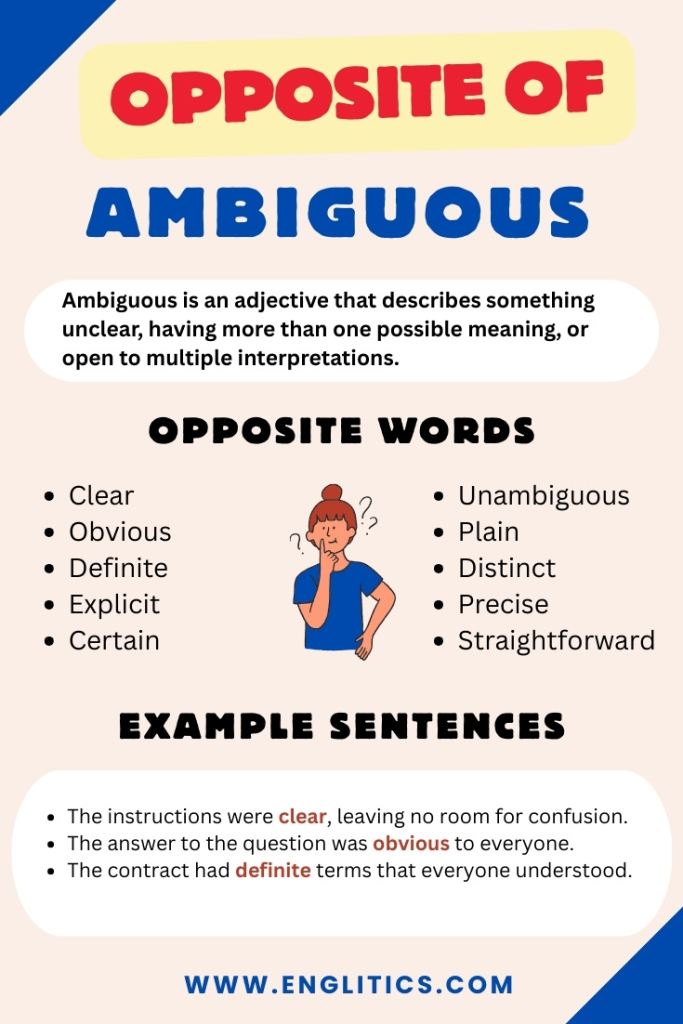
Antonyms for ‘ambiguous’ fall into several categories, each emphasizing a different aspect of clarity and precision. These categories include:
Clear and Explicit
Words like clear, explicit, unambiguous, lucid, and plain emphasize the ease of understanding and lack of potential for misinterpretation. They suggest that the information is presented in a way that is easily grasped and leaves no room for doubt.
Definite and Precise
Terms such as definite, precise, specific, and exact highlight the accuracy and particularity of the information. They indicate that the details are well-defined and leave no room for vagueness or generality.
Obvious and Evident
Words like obvious, evident, apparent, and manifest suggest that the information is easily perceived and readily understood. They imply that the meaning is straightforward and requires little or no interpretation.
Certain and Unquestionable
Terms such as certain, unquestionable, indisputable, and unequivocal emphasize the lack of doubt or uncertainty. They indicate that the information is firmly established and cannot be reasonably challenged.
Examples of Antonyms in Use
To better understand how these antonyms function, let’s examine them in various contexts with specific examples.
Examples Using ‘Clear’ and ‘Explicit’
The following table provides examples of sentences using ‘ambiguous’ and their corresponding revisions using ‘clear’ or ‘explicit’.
| Original Sentence (Ambiguous) | Revised Sentence (Clear/Explicit) |
|---|---|
| The instructions were ambiguous, so I didn’t know what to do. | The instructions were clear, so I knew exactly what to do. |
| His statement was ambiguous and open to interpretation. | His statement was explicit and left no room for interpretation. |
| The contract contained ambiguous clauses. | The contract contained clear and unambiguous clauses. |
| Her answer was ambiguous, leaving us unsure of her position. | Her answer was clear, making her position obvious. |
| The rules were ambiguous and difficult to understand. | The rules were clear and easy to understand. |
| The sign was ambiguous, leading to confusion. | The sign was clear, preventing confusion. |
| The message was ambiguous, causing miscommunication. | The message was explicit, ensuring clear communication. |
| The guidelines were ambiguous and subject to interpretation. | The guidelines were clear and left no room for interpretation. |
| The explanation was ambiguous, leaving many questions unanswered. | The explanation was explicit, answering all questions. |
| The report was ambiguous and lacked specific details. | The report was clear and included all necessary details. |
| The agreement was ambiguous, leading to disagreements. | The agreement was clear, preventing disagreements. |
| The policy was ambiguous and open to different interpretations. | The policy was explicit, leaving no room for misinterpretation. |
| The definition was ambiguous and hard to grasp. | The definition was clear and easy to understand. |
| The plan was ambiguous, so we didn’t know how to proceed. | The plan was clear, so we knew exactly how to proceed. |
| The terms were ambiguous and required further clarification. | The terms were explicit and required no further clarification. |
| The instructions given were ambiguous. | The instructions given were clear and concise. |
| The presentation was ambiguous and hard to follow. | The presentation was clear and easy to follow. |
| The meaning of the poem was ambiguous to many readers. | The meaning of the poem was clear and accessible to all readers. |
| The question posed was ambiguous, leading to varied responses. | The question posed was clear, resulting in consistent responses. |
| The project’s goals were ambiguous and undefined. | The project’s goals were clear and well-defined. |
| The feedback was ambiguous and unhelpful. | The feedback was explicit and helpful. |
| The announcement was ambiguous, causing confusion among employees. | The announcement was clear, ensuring everyone understood. |
| The explanation of the concept was ambiguous. | The explanation of the concept was clear and straightforward. |
| The details provided were ambiguous and insufficient. | The details provided were explicit and comprehensive. |
This table illustrates how replacing ‘ambiguous’ with ‘clear’ or ‘explicit’ significantly improves the clarity and understanding of the sentences.
Examples Using ‘Definite’ and ‘Precise’
The following table showcases examples of sentences using ‘ambiguous’ and their revisions using ‘definite’ or ‘precise’.
| Original Sentence (Ambiguous) | Revised Sentence (Definite/Precise) |
|---|---|
| The deadline was ambiguous, so I wasn’t sure when to submit the report. | The deadline was definite, so I knew exactly when to submit the report. |
| The measurements were ambiguous and open to interpretation. | The measurements were precise and left no room for interpretation. |
| The instructions lacked definite steps. | The instructions included definite steps. |
| The description was ambiguous, so it was hard to visualize. | The description was precise, making it easy to visualize. |
| The location was ambiguous; we didn’t know exactly where to go. | The location was definite; we knew precisely where to go. |
| The amount was ambiguous, leading to confusion. | The amount was precise, preventing confusion. |
| The terms of the agreement were ambiguous. | The terms of the agreement were definite and well-defined. |
| His role in the project was ambiguous. | His role in the project was definite and specific. |
| The timing was ambiguous, causing scheduling conflicts. | The timing was precise, preventing scheduling conflicts. |
| The criteria for evaluation were ambiguous. | The criteria for evaluation were definite and measurable. |
| The scope of the project was ambiguous. | The scope of the project was definite and well-defined. |
| The outcome was ambiguous, leaving us uncertain. | The outcome was definite, removing all uncertainty. |
| The quantity was ambiguous. | The quantity was precise and clearly stated. |
| The boundaries were ambiguous, leading to disputes. | The boundaries were definite, preventing disputes. |
| The purpose of the meeting was ambiguous. | The purpose of the meeting was definite and clearly communicated. |
| The details provided were ambiguous. | The details provided were precise and comprehensive. |
| The specifications were ambiguous and incomplete. | The specifications were definite and complete. |
| The instructions were ambiguous, so I couldn’t follow them accurately. | The instructions were precise, so I could follow them accurately. |
| The agenda was ambiguous, leading to an unfocused discussion. | The agenda was definite, ensuring a focused discussion. |
| The instructions regarding payment were ambiguous. | The instructions regarding payment were definite and clear. |
| The timeline for completion was ambiguous. | The timeline for completion was precise and clearly outlined. |
| The definition of the term was ambiguous. | The definition of the term was precise and well-defined. |
| The goals of the campaign were ambiguous. | The goals of the campaign were definite and measurable. |
| The assessment criteria were ambiguous and subjective. | The assessment criteria were precise and objective. |
This table demonstrates how replacing ‘ambiguous’ with ‘definite’ or ‘precise’ enhances the accuracy and clarity of the sentences.
Examples Using ‘Obvious’ and ‘Evident’
This table illustrates the use of ‘obvious’ and ‘evident’ as antonyms for ‘ambiguous’.
| Original Sentence (Ambiguous) | Revised Sentence (Obvious/Evident) |
|---|---|
| His intentions were ambiguous, making it hard to trust him. | His intentions were obvious, making it easy to understand him. |
| The solution was ambiguous, so we kept searching. | The solution was obvious, saving us time and effort. |
| The connection was not obvious. | The connection was evident. |
| The reason for his absence was ambiguous. | The reason for his absence was obvious. |
| The winner of the race was ambiguous due to the photo finish. | The winner of the race was obvious to everyone watching. |
| The impact of the policy was ambiguous. | The impact of the policy was evident. |
| The source of the problem was ambiguous. | The source of the problem was obvious to the investigators. |
| The need for change was ambiguous. | The need for change was evident to all stakeholders. |
| The significance of the discovery was ambiguous at first. | The significance of the discovery was obvious after further analysis. |
| The risk involved was ambiguous. | The risk involved was evident and well-documented. |
| The advantages were not obvious. | The advantages were evident upon closer inspection. |
| The outcome was ambiguous. | The outcome was obvious from the start. |
| The result was ambiguous. | The result was evident in the data. |
| The meaning of the symbol was ambiguous. | The meaning of the symbol was obvious to those familiar with the culture. |
| The link between the two events was ambiguous. | The link between the two events was evident after the investigation. |
| The motive behind the action was ambiguous. | The motive behind the action was obvious to those who knew him. |
| The truth was ambiguous. | The truth was evident after the evidence was presented. |
| The potential benefits were ambiguous. | The potential benefits were obvious and widely recognized. |
| The pattern was ambiguous. | The pattern was evident upon closer examination. |
| The reason for the decline was ambiguous. | The reason for the decline was obvious to industry experts. |
| The advantages of the new system were ambiguous. | The advantages of the new system were evident after the pilot program. |
| The impact of the new law was ambiguous at first. | The impact of the new law was obvious after a year. |
| The link between the two incidents was ambiguous. | The link between the two incidents was evident to the investigators. |
| The source of the error was ambiguous. | The source of the error was obvious after debugging the code. |
This table illustrates how using ‘obvious’ and ‘evident’ can clarify statements that were previously unclear or open to interpretation.
Examples Using ‘Certain’ and ‘Unquestionable’
The following table demonstrates how ‘certain’ and ‘unquestionable’ can replace ‘ambiguous’ to convey assurance and clarity.
| Original Sentence (Ambiguous) | Revised Sentence (Certain/Unquestionable) |
|---|---|
| The outcome of the election was ambiguous. | The outcome of the election was certain. |
| His guilt was ambiguous. | His guilt was unquestionable after the evidence was presented. |
| The success of the project was ambiguous. | The success of the project was certain, given the positive results. |
| The validity of the data was ambiguous. | The validity of the data was unquestionable after verification. |
| Her commitment to the cause was ambiguous. | Her commitment to the cause was certain, as demonstrated by her actions. |
| The long-term effects were ambiguous. | The long-term effects were certain, based on the research. |
| The reliability of the source was ambiguous. | The reliability of the source was unquestionable due to its history. |
| The accuracy of the information was ambiguous. | The accuracy of the information was certain after cross-referencing. |
| The necessity of the change was ambiguous. | The necessity of the change was unquestionable given the circumstances. |
| The benefit of the investment was ambiguous. | The benefit of the investment was certain, based on market analysis. |
| The future of the company was ambiguous. | The future of the company was certain, thanks to the new strategy. |
| The truth was ambiguous. | The truth was unquestionable after the investigation. |
| The results of the test were ambiguous. | The results of the test were certain and conclusive. |
| The feasibility of the plan was ambiguous. | The feasibility of the plan was certain after the pilot study. |
| The impact of the policy was ambiguous. | The impact of the policy was certain and well-documented. |
| The value of the asset was ambiguous. | The value of the asset was certain after appraisal. |
| The existence of the phenomenon was ambiguous. | The existence of the phenomenon was unquestionable after numerous observations. |
| The benefits of the treatment were ambiguous. | The benefits of the treatment were certain, based on clinical trials. |
| The need for reform was ambiguous. | The need for reform was unquestionable, given the current problems. |
| The cause of the accident was ambiguous. | The cause of the accident was certain after the investigation. |
| His motives were ambiguous. | His motives were certain, based on his past actions. |
| The identity of the perpetrator was ambiguous. | The identity of the perpetrator was certain after the DNA analysis. |
| The effectiveness of the strategy was ambiguous. | The effectiveness of the strategy was certain, proven by the results. |
| The outcome of the negotiation was ambiguous. | The outcome of the negotiation was certain after the agreement was signed. |
This table illustrates how replacing ‘ambiguous’ with ‘certain’ or ‘unquestionable’ enhances the confidence and assurance conveyed by the sentences.
Usage Rules for Antonyms of ‘Ambiguous’
When using antonyms for ‘ambiguous,’ it’s essential to consider the context and the specific nuance you want to convey. Here are some rules to guide you:
- ‘Clear’ and ‘Explicit’: Use these when you want to emphasize ease of understanding. ‘Clear’ is more general, while ‘explicit’ suggests detailed and precise information.
- ‘Definite’ and ‘Precise’: Choose these when accuracy and specificity are important. ‘Definite’ indicates firmness and lack of vagueness, while ‘precise’ highlights exactness in measurements or details.
- ‘Obvious’ and ‘Evident’: Opt for these when you want to suggest that the information is easily perceived and understood. ‘Obvious’ implies that something is readily apparent, while ‘evident’ suggests that something is supported by evidence.
- ‘Certain’ and ‘Unquestionable’: Use these when you want to convey a lack of doubt or uncertainty. ‘Certain’ indicates a firm belief or knowledge, while ‘unquestionable’ suggests that something is beyond dispute.
Exceptions: While these antonyms generally work well, there might be specific contexts where they are not entirely interchangeable. For example, in a philosophical discussion, ‘unquestionable’ might be too strong, as it suggests a closed-minded approach to inquiry. In such cases, ‘clear’ or ‘definite’ might be more appropriate.
Common Mistakes
One common mistake is using an antonym that doesn’t quite fit the context. For example:
| Incorrect | Correct | Explanation |
|---|---|---|
| The painting’s meaning was ambiguous, but now it’s definite. | The painting’s meaning was ambiguous, but now it’s clear. | ‘Definite’ implies a precise, measurable quality, which doesn’t fit the subjective interpretation of art. ‘Clear’ is more appropriate. |
| The instructions were ambiguous, but now they are obvious. | The instructions were ambiguous, but now they are clear and explicit. | ‘Obvious’ suggests something easily perceived, but the instructions may have needed detailed clarification rather than becoming self-evident. |
| The evidence was ambiguous, but now it is certain. | The evidence was ambiguous, but now it is conclusive. | ‘Certain’ can imply a personal belief. ‘Conclusive’ is better because it suggests that the evidence itself leads to a definite conclusion. |
Another common error is using the antonym without providing sufficient context. Simply stating that something is “clear” doesn’t necessarily make it so. You need to explain why it is clear by providing details or evidence.
Practice Exercises
Test your understanding of antonyms for ‘ambiguous’ with these exercises.
Exercise 1: Fill in the Blanks
Choose the best antonym for ‘ambiguous’ from the list provided to complete each sentence. (clear, definite, obvious, certain)
| Question | Answer |
|---|---|
| 1. The instructions were so __________ that even a child could understand them. | clear |
| 2. The terms of the contract were __________ and left no room for misinterpretation. | definite |
| 3. The solution to the problem was __________, once we looked at the data. | obvious |
| 4. The outcome of the experiment was __________, proving our hypothesis. | certain |
| 5. The message was __________ and to the point, leaving no room for confusion. | clear |
| 6. The deadline for submission is __________, so make sure to submit on time. | definite |
| 7. It was __________ that he was the best candidate for the job. | obvious |
| 8. The success of the project is __________, given the team’s hard work and dedication. | certain |
| 9. The explanation was __________ and straightforward, making it easy to grasp the concept. | clear |
| 10. The measurements were __________ and precise, ensuring accurate results. | definite |
Exercise 2: Rewrite the Sentences
Rewrite the following sentences, replacing the word ‘ambiguous’ with a suitable antonym.
| Original Sentence | Rewritten Sentence |
|---|---|
| 1. The politician’s statement was ambiguous, leaving voters unsure of his stance. | The politician’s statement was clear, clearly outlining his stance. |
| 2. The meaning of the poem was ambiguous and open to multiple interpretations. | The meaning of the poem was evident, revealing a profound message about life. |
| 3. The results of the survey were ambiguous, making it difficult to draw conclusions. | The results of the survey were definite, allowing for clear conclusions to be drawn. |
| 4. The instructions were ambiguous, so the workers were confused. | The instructions were clear, so the workers understood. |
| 5. The details of the plan were ambiguous. | The details of the plan were specific. |
| 6.The intent of the message was ambiguous. | The intent of the message was clear. |
| 7. The rules were ambiguous and left to interpretation. | The rules were explicit and left nothing to interpretation. |
| 8. The definition was ambiguous and undefined. | The definition was precise and well-defined. |
| 9. The source of the rumor was ambiguous. | The source of the rumor was certain. |
| 10. The value of the investment was ambiguous. | The value of the investment was unquestionable. |
Advanced Topics
For advanced learners, consider exploring the intentional use of ambiguity in literature and rhetoric. Authors often use ambiguity to create layers of meaning, engage readers, and provoke thought.
In rhetoric, politicians might use ambiguity to appeal to a broad audience without taking a firm stance on controversial issues. Understanding these advanced applications requires a nuanced understanding of language and context.
Another advanced topic is the concept of “constructive ambiguity,” where deliberate vagueness can be used to foster collaboration and innovation. By leaving room for interpretation, individuals are encouraged to contribute their own ideas and perspectives, leading to more creative solutions.
Frequently Asked Questions
- What is the difference between ‘ambiguous’ and ‘vague’?‘Ambiguous’ means open to more than one interpretation, while ‘vague’ means lacking clarity or precision. Something ambiguous can have multiple distinct meanings, while something vague is simply unclear.
- How can I avoid ambiguity in my writing?Use precise language, provide sufficient context, and carefully structure your sentences to avoid multiple interpretations. Review your writing from the perspective of someone unfamiliar with the topic to identify potential ambiguities.
- Is ambiguity always a bad thing?No, ambiguity can be used intentionally for artistic effect or to encourage creative thinking. However, in most professional and academic contexts, clarity is preferred.
- What part of speech is ‘ambiguous’?‘Ambiguous’ is an adjective.
- How do you use “unambiguous” in a sentence?You can use “unambiguous” to describe something that is clear and has only one possible interpretation. For example: “The instructions were unambiguous, so I followed them easily.”
- What are some synonyms for “clear” (as an antonym of ambiguous)?Some synonyms for “clear” in this context include: explicit, lucid, plain, straightforward, and transparent. The best choice will depend on the specific nuance you want to convey.
- Can a situation be ambiguous?Yes, a situation can be ambiguous if its meaning or implications are unclear or open to multiple interpretations. For example: “The company’s future remains ambiguous due to the current economic climate.”
- How does context help resolve ambiguity?Context provides additional information that helps narrow down the possible interpretations of an ambiguous statement. By considering the surrounding text, the speaker’s intentions, and the overall situation, we can often determine the most likely meaning.
Conclusion
Mastering the antonyms for ‘ambiguous’ is essential for clear and effective communication. By understanding the nuances of words like ‘clear,’ ‘definite,’ ‘obvious,’ and ‘certain,’ you can significantly improve the precision and impact of your writing and speech.
Remember to consider the context and specific meaning you want to convey when choosing an antonym. Continue practicing and refining your understanding of these concepts to become a more confident and articulate communicator.
Aim for clarity in your expression to avoid misunderstandings and ensure your message is accurately received.