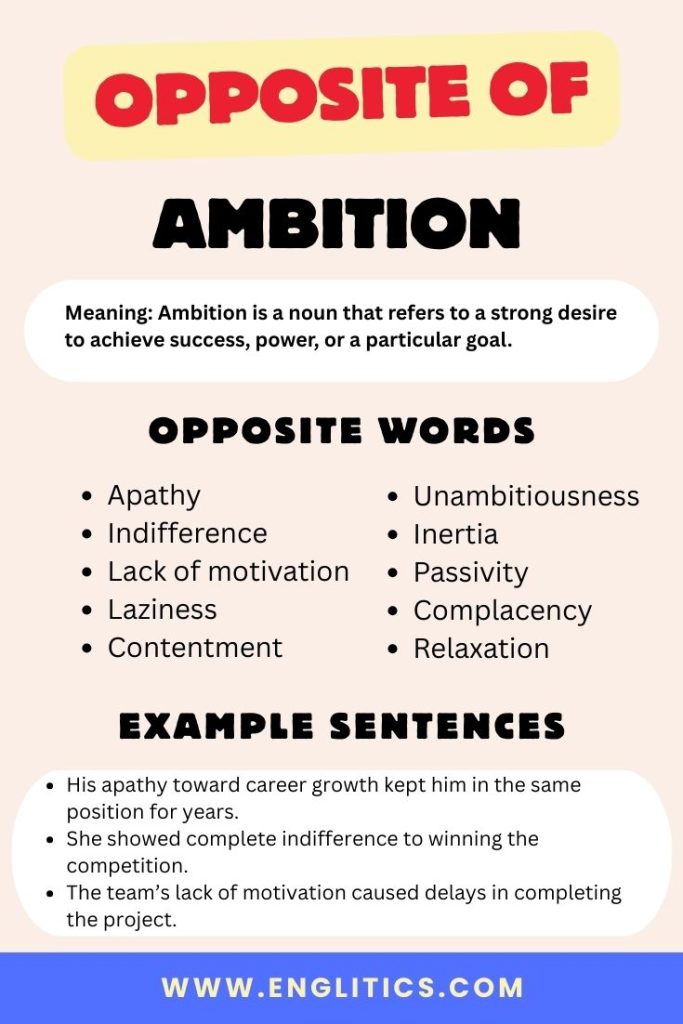
The Opposite of Ambition refers to a lack of motivation, drive, or desire to achieve goals. While ambition pushes someone to aim higher and work hard, its opposite leans toward passivity, contentment with the status quo, or a disinterest in personal advancement.
Antonyms for Ambition include apathy, laziness, and indifference. For example, a person showing apathy might not care about future goals. Someone lazy may avoid effort or hard work altogether. If a person is indifferent, they show no interest in improving or striving for success.
Definition of Ambition
Ambition is a strong desire or determination to achieve success, power, fame, or other goals. It involves a proactive and often persistent effort to reach a desired outcome. Ambition can be a positive trait, driving individuals to excel and contribute to society. However, it can also have negative connotations if it becomes excessive or is pursued at the expense of others.
Ambition functions as a noun, describing the state of having a strong desire for achievement. It can also be used adjectivally, as in “ambitious plans” or “an ambitious person,” where it modifies another noun.
The context in which “ambition” is used often determines whether it’s perceived positively or negatively. For instance, striving for personal growth is typically seen as positive ambition, whereas ruthlessly pursuing power at any cost is viewed negatively.
Structural Breakdown
The word “ambition” comes from the Latin word ambitio, which originally referred to the act of going around to solicit votes. This historical context highlights the active, striving nature of ambition. Morphologically, “ambition” is a single-word noun. Related words include “ambitious” (adjective), “ambitiously” (adverb), and “ambitiousness” (noun).
Understanding the structural elements of “ambition” and its related forms helps in recognizing its grammatical function in different contexts. For example:
- Noun: Her ambition drove her to succeed.
- Adjective: He had ambitious goals for the future.
- Adverb: She worked ambitiously to achieve her dreams.
Recognizing these structural variations allows for more precise and effective communication, ensuring that the intended meaning is accurately conveyed.
Opposite of Ambition
The antonyms of ambition fall into several categories, each representing a different aspect of its opposite. These categories include a lack of ambition, contentment, humility, apathy, and resignation.
Understanding these categories provides a more comprehensive view of the spectrum of attitudes and motivations that exist in contrast to ambition.
Lack of Ambition
This category includes words that directly denote the absence of a strong desire for achievement. It signifies a state where individuals are not driven by the pursuit of success or advancement.
Terms like “lack of drive,” “aimlessness,” and “indolence” fall into this category. These words often carry a neutral or negative connotation, depending on the context.
Contentment and Satisfaction
This category represents a state of being happy and satisfied with one’s current situation. It implies a lack of desire for more, suggesting a sense of fulfillment and peace.
Words like “satisfaction,” “contentedness,” and “complacency” are included here. While contentment can be positive, excessive complacency might hinder personal growth.
Humility and Modesty
Humility and modesty involve a lack of excessive pride or arrogance, often accompanied by a focus on others rather than oneself. It is the opposite of the self-aggrandizement often associated with unchecked ambition.
Words like “meekness,” “unassumingness,” and “self-effacement” fall into this category. Humility is generally viewed as a positive trait.
Apathy and Indifference
Apathy and indifference represent a lack of interest, enthusiasm, or concern. It signifies a detachment from goals and a general lack of motivation.
Words like “unconcern,” “passivity,” and “lethargy” are part of this category. Apathy is often viewed negatively, as it can lead to stagnation and missed opportunities.
Resignation and Acceptance
Resignation and acceptance involve acknowledging and accepting a situation, often one that is unfavorable, without actively trying to change it. It implies a yielding to circumstances and a lack of resistance.
Words like “acquiescence,” “submission,” and “capitulation” are included here. While resignation can bring peace, it can also prevent necessary action.
Examples of Antonyms in Sentences
To fully understand the antonyms of ambition, it’s essential to see them used in context. The following tables provide examples of how each category of antonyms can be used in sentences, illustrating their meanings and connotations.
The first table focuses on antonyms related to a lack of ambition. These examples show how the absence of a strong drive can manifest in different situations.
| Antonym | Example Sentence |
|---|---|
| Lack of Drive | His lack of drive prevented him from pursuing higher education. |
| Aimlessness | After retirement, he felt a sense of aimlessness without a clear goal. |
| Indolence | Her indolence led to missed deadlines and poor performance. |
| Passivity | His passivity in the meeting meant his concerns were never addressed. |
| Lethargy | The summer heat induced a state of lethargy, making it hard to be productive. |
| Idleness | Too much idleness can lead to boredom and dissatisfaction. |
| Inactivity | Prolonged inactivity can have negative effects on physical health. |
| Stagnation | The company suffered from stagnation due to a lack of innovation. |
| Complacency | Their complacency allowed competitors to gain a market advantage. |
| Listlessness | A feeling of listlessness overcame her after the long winter. |
| Apathy | Voter apathy is a major concern in democratic societies. |
| Indifference | His indifference to the project’s success was disheartening. |
| Nonchalance | She approached the difficult task with surprising nonchalance. |
| Disinterest | His disinterest in the topic was evident in his lack of questions. |
| Negligence | His negligence in completing the report led to serious consequences. |
| Remissness | Her remissness in attending to her duties resulted in a warning. |
| Dereliction | The soldier was charged with dereliction of duty. |
| Slackness | The team’s slackness caused them to fall behind schedule. |
| Laxity | The laxity of security measures made the building vulnerable. |
| Torpor | The bear entered a state of torpor during the winter months. |
| Inertia | The government’s inertia on climate change is a serious issue. |
| Stasis | The company was in a state of stasis, unable to innovate or grow. |
| Acedia | The monk struggled with acedia, a spiritual listlessness. |
The next table illustrates antonyms related to contentment and satisfaction. These examples demonstrate how a sense of fulfillment can counteract the drive for more.
| Antonym | Example Sentence |
|---|---|
| Satisfaction | She found satisfaction in her simple, uncomplicated life. |
| Contentedness | He exuded contentedness as he sat by the fire with his family. |
| Complacency | His complacency with the status quo prevented him from seeking improvements. |
| Fulfillment | She found fulfillment in her career as a social worker. |
| Gratification | He felt a sense of gratification after completing the challenging project. |
| Pleasure | She took immense pleasure in painting landscapes. |
| Delight | The children showed delight at the sight of the presents. |
| Enjoyment | He derived great enjoyment from playing the piano. |
| Well-being | Yoga and meditation contributed to her overall well-being. |
| Serenity | She found serenity in the quiet solitude of the mountains. |
| Tranquility | The lake provided a sense of tranquility and peace. |
| Equanimity | He faced the challenges with equanimity and composure. |
| Composure | Despite the pressure, she maintained her composure. |
| Calmness | The calmness of the sea was soothing. |
| Peacefulness | The village was known for its peacefulness. |
| Repletion | After the feast, he felt a sense of repletion. |
| Satiety | He reached a point of satiety and could eat no more. |
| Satiation | The meal provided complete satiation. |
| Sufficiency | They had a sufficiency of resources to complete the project. |
| Adequacy | The funding was adequate to cover the expenses. |
| Enough | They had enough food to last the winter. |
| Ample | There was ample space for everyone to sit comfortably. |
| Profusion | The garden was in a profusion of blooms. |
This table focuses on antonyms related to humility and modesty. These examples show how a lack of excessive pride can be a virtue.
| Antonym | Example Sentence |
|---|---|
| Meekness | Her meekness should not be mistaken for weakness. |
| Unassumingness | His unassumingness made him approachable and likable. |
| Self-effacement | Her self-effacement often led her to downplay her achievements. |
| Modesty | He accepted the award with modesty and gratitude. |
| Humbleness | Her humbleness was a refreshing contrast to the arrogance of others. |
| Lowliness | He remembered his days of lowliness and remained grounded. |
| Submissiveness | Her submissiveness in the relationship was a cause for concern. |
| Servility | He refused to show servility to those in power. |
| Deference | He showed deference to his elders. |
| Respect | She treated everyone with respect, regardless of their status. |
| Reverence | The ancient temple was treated with reverence. |
| Esteem | He held his mentor in high esteem. |
| Admiration | She expressed her admiration for the artist’s work. |
| Veneration | The saint was held in veneration by the community. |
| Unpretentiousness | His unpretentiousness was disarming and genuine. |
| Simplicity | She valued the simplicity of rural life. |
| Plainness | The room was decorated with plainness and functionality. |
| Egalitarianism | The company promoted egalitarianism and equal opportunities. |
| Selflessness | Her selflessness in helping others was inspiring. |
| Altruism | His altruism led him to volunteer at the homeless shelter. |
| Benevolence | The philanthropist was known for his benevolence. |
| Charity | She donated generously to charity. |
| Compassion | He showed compassion for the suffering of others. |
The next table illustrates antonyms related to apathy and indifference. These examples show how a lack of interest can affect behavior and outcomes.
| Antonym | Example Sentence |
|---|---|
| Unconcern | His unconcern about the environment was alarming. |
| Passivity | Her passivity in the face of injustice was disappointing. |
| Lethargy | The medication caused lethargy as a side effect. |
| Unresponsiveness | The patient’s unresponsiveness to treatment was a concern. |
| Listlessness | She struggled with listlessness after the loss of her job. |
| Acedia | The monk battled acedia, a spiritual apathy. |
| Torpor | The city seemed to be in a state of economic torpor. |
| Stupor | He fell into a stupor after the traumatic event. |
| Dullness | The dullness of the lecture made it hard to stay awake. |
| Insensitivity | His insensitivity to her feelings was hurtful. |
| Impassivity | The judge remained impassive throughout the trial. |
| Detachment | Her detachment from the situation made it difficult to empathize. |
| Aloofness | His aloofness made him seem unapproachable. |
| Coldness | Her coldness towards strangers was off-putting. |
| Uncaring | His uncaring attitude towards the homeless was criticized. |
| Callousness | The dictator’s callousness towards his people was appalling. |
| Heartlessness | His heartlessness in firing the employees was shocking. |
| Ruthlessness | The businessman’s ruthlessness helped him climb the corporate ladder. |
| Mercilessness | The tyrant was known for his mercilessness. |
| Pitilessness | Her pitilessness towards her enemies was legendary. |
| Indurate | His heart had become indurate after years of hardship. |
| Obduracy | The criminal showed obduracy and refused to cooperate. |
The final table illustrates antonyms related to resignation and acceptance. These examples show how yielding to circumstances can be both a source of peace and a barrier to change.
| Antonym | Example Sentence |
|---|---|
| Acquiescence | Her acquiescence to the demands of her boss was disheartening. |
| Submission | His submission to the authority of the government was unquestioning. |
| Capitulation | The army’s capitulation marked the end of the war. |
| Yielding | Her yielding to the pressure of her peers was regrettable. |
| Compliance | His compliance with the rules was exemplary. |
| Conformity | The society valued conformity and discouraged individuality. |
| Obedience | The dog’s obedience to its owner was impressive. |
| Deference | He showed deference to the opinions of his elders. |
| Subservience | Her subservience to her husband was a cultural norm. |
| Receptiveness | Her receptiveness to new ideas was a valuable asset. |
| Openness | His openness to different perspectives made him a good mediator. |
| Amenability | Her amenability to change made her a flexible employee. |
| Passivity | His passivity in the face of injustice was criticized. |
| Inaction | The government’s inaction on the issue was disappointing. |
| Resignation | She accepted her fate with resignation. |
| Fatalism | His fatalism led him to believe that his destiny was predetermined. |
| Stoicism | He faced the challenges with stoicism and fortitude. |
| Patience | Her patience was tested during the long wait. |
| Fortitude | He showed fortitude in the face of adversity. |
| Endurance | Her endurance during the marathon was remarkable. |
| Tolerance | The community showed tolerance towards different cultures. |
| Forbearance | He showed forbearance towards his annoying neighbor. |
Usage Rules for Antonyms
Using antonyms effectively requires understanding the nuances of their meanings and the contexts in which they are appropriate. While antonyms provide a contrast to ambition, they are not always interchangeable.
The choice of antonym depends on the specific aspect of ambition you want to negate.
For example, if you want to emphasize a lack of motivation, “lack of drive” or “apathy” might be suitable. If you want to highlight satisfaction with the current state, “contentment” or “complacency” would be more appropriate.
If you want to focus on a lack of pride, “humility” or “modesty” would be the best choice.
It’s also important to consider the connotations of the antonyms. Some antonyms, like “complacency” and “apathy,” often carry negative connotations, while others, like “contentment” and “humility,” are generally viewed positively.
The context and tone of your writing or speech should guide your choice of antonym.
Common Mistakes
One common mistake is using antonyms interchangeably without considering their specific meanings. For example, using “apathy” when “contentment” is more appropriate, or vice versa.
This can lead to miscommunication and a lack of precision in your writing or speech.
Another common mistake is overlooking the connotations of antonyms. Using a negatively charged antonym when a neutral or positive one is intended can create a negative impression.
For example, describing someone as “complacent” when you mean they are simply “content” can be misleading.
Here are some examples of common mistakes and their corrections:
| Incorrect | Correct | Explanation |
|---|---|---|
| He showed apathy towards his family’s success. | He showed contentment with his family’s success. | “Apathy” implies a lack of interest, while “contentment” suggests satisfaction. |
| She was ambitious in her humility. | She was modest in her achievements. | “Humility” is already the opposite of ambition, so “ambitious” is contradictory. |
| His resignation made him successful. | His ambition made him successful. | “Resignation” implies acceptance of a negative situation, the opposite of striving for success. |
Practice Exercises
Test your understanding of the antonyms of ambition with these exercises. Choose the best antonym for “ambition” in each sentence, considering the context and intended meaning.
Exercise 1: Fill in the blanks with the most appropriate antonym from the list: apathy, contentment, humility, lack of drive, resignation.
| Question | Answer |
|---|---|
| 1. After years of striving, he finally found _______ in his simple life. | contentment |
| 2. Her _______ prevented her from pursuing her dreams, leading to regret. | lack of drive |
| 3. Despite the challenges, she approached life with _______, accepting what she could not change. | resignation |
| 4. His _______ towards the suffering of others was disheartening. | apathy |
| 5. She accepted the award with _______, acknowledging the contributions of her team. | humility |
| 6. The employee’s _______ led to missed deadlines and poor performance reviews. | lack of drive |
| 7. Finding _______ in the present moment, she stopped chasing after future goals. | contentment |
| 8. The politician’s _______ towards the concerns of the citizens led to his downfall. | apathy |
| 9. After the defeat, the team showed _______, accepting the outcome gracefully. | resignation |
| 10. The manager demonstrated _______ by giving credit to his team members for the success. | humility |
Exercise 2: Choose the best antonym for “ambitious” in each sentence from the following list: content, unambitious, humble, apathetic, resigned.
| Question | Answer |
|---|---|
| 1. He was _______ with his current job and had no desire for promotion. | content |
| 2. She had an _______ approach to life, preferring simplicity over grand achievements. | unambitious |
| 3. Despite his talent, he remained _______, never seeking recognition or praise. | humble |
| 4. He was _______ towards the project, showing no interest in its success. | apathetic |
| 5. After the setback, she felt _______ to her fate, accepting the outcome without resistance. | resigned |
| 6. The worker was _______ and did not strive for any advancement in the company. | unambitious |
| 7. She was _______ with her small garden and the simple joys it brought her. | content |
| 8. The student was _______ about improving his grades, showing no motivation to study. | apathetic |
| 9. He was _______ to the fact that he would never achieve his dreams. | resigned |
| 10. The leader was _______, always attributing success to the efforts of the team. | humble |
Exercise 3: Rewrite the following sentences, replacing the word “ambition” or “ambitious” with an appropriate antonym.
| Original Sentence | Rewritten Sentence |
|---|---|
| 1. Her ambition drove her to work tirelessly. | Her contentment allowed her to enjoy life without constant striving. |
| 2. He was an ambitious young executive. | He was an unambitious young executive, content with his current position. |
| 3. Their ambition led them to conquer new markets. | Their ruthlessness led them to conquer new markets. |
| 4. She channeled her ambition into community service. | She channeled her selflessness into community service. |
| 5. His ambition was admired by his colleagues. | His humility was admired by his colleagues. |
| 6. The company fostered an ambitious culture. | The company fostered a competitive culture. |
| 7. He had ambitious plans for the future. | He had simple plans for the future. |
| 8. His ambition was insatiable. | His greed was insatiable. |
| 9. She was driven by ambition to succeed. | She was driven by a desire to help others. |
| 10. The project required an ambitious approach. | The project required a cautious approach. |
Advanced Topics
At an advanced level, understanding the antonyms of ambition involves exploring the philosophical and psychological implications of these concepts. For example, the concept of “contentment” can be linked to philosophical ideas about happiness and fulfillment, while “apathy” can be related to psychological conditions like depression and burnout.
Additionally, the cultural context plays a significant role in how ambition and its antonyms are perceived. In some cultures, ambition is highly valued, while in others, contentment and humility are considered more important.
Understanding these cultural nuances is essential for effective cross-cultural communication.
Exploring the etymology and historical usage of these words can also provide a deeper understanding of their meanings and connotations. For example, the word “complacency” originally had a more positive connotation, suggesting a state of peaceful satisfaction.
Over time, it has acquired a more negative meaning, implying a lack of awareness and a resistance to change.
FAQ
Q1: Are all antonyms of ambition negative?
No, not all antonyms of ambition are negative. Some antonyms, like “contentment” and “humility,” are generally viewed positively.
The connotation depends on the specific word and the context in which it is used.
Q2: Can complacency be a good thing?
While “complacency” often has a negative connotation, a certain level of satisfaction with one’s achievements can be beneficial for mental well-being. However, excessive complacency can lead to stagnation and missed opportunities.
Q3: How can I avoid being too ambitious?
Setting realistic goals, prioritizing your well-being, and valuing relationships over achievements can help you avoid becoming overly ambitious. It’s also important to reflect on your motivations and ensure that your ambition is not driven by external pressures or a need for validation.
Q4: What is the difference between apathy and contentment?
“Apathy” is a lack of interest or concern, often associated with a negative or indifferent attitude. “Contentment” is a state of happiness and satisfaction with one’s current situation, implying a sense of fulfillment and peace.
Q5: How does culture influence the perception of ambition?
Different cultures place varying degrees of emphasis on ambition. Some cultures value achievement and success, while others prioritize contentment, humility, and community harmony.
These cultural values influence how ambition and its antonyms are perceived.
Q6: Is it possible to be both ambitious and humble?
Yes, it is possible to be both ambitious and humble. Ambitious individuals can strive for success while remaining grounded, acknowledging the contributions of others, and avoiding excessive pride.
Q7: How can understanding the antonyms of ambition improve my writing?
Understanding the antonyms of ambition allows you to express a wider range of emotions and attitudes in your writing. It also enables you to create more nuanced and accurate portrayals of characters and situations.
Q8: What are some other words related to ambition?
Some related words include drive, determination, aspiration, motivation, zeal, and enterprise. These words share the common theme of striving towards a goal, but they differ in their intensity and connotations.
Conclusion
Exploring the antonyms of ambition offers valuable insights into the diverse range of human motivations and attitudes. From the lack of drive to the embrace of contentment, understanding these contrasting concepts enriches your vocabulary and sharpens your communication skills.
By mastering the nuances of these words and their usage, you can express yourself with greater precision and depth.
Remember to consider the context and connotations of each antonym when choosing the most appropriate word. Practice using these antonyms in your writing and speech to solidify your understanding.
With continued effort, you can effectively navigate the spectrum of ambition and its opposites, enhancing your ability to communicate effectively and thoughtfully.