The Opposite of Amicable describes interactions that are hostile, unfriendly, or filled with tension. While “amicable” refers to peaceful, cooperative, or good-natured behavior—especially during disagreements—its opposite leans toward conflict or bitterness.
Antonyms for Amicable include hostile, unfriendly, and antagonistic. For example, a hostile argument may involve shouting instead of calm discussion. An unfriendly gesture could create distance rather than resolve tension. If someone is antagonistic, they may purposely stir up conflict instead of seeking peace.
Definition of Amicable
The word “amicable” is an adjective that describes a relationship or interaction characterized by friendliness, goodwill, and a lack of antagonism. It implies a desire for peace and harmony between individuals or groups. The term is derived from the Latin word amicabilis, meaning “friendly.” In essence, an amicable situation is one where people are agreeable and willing to cooperate.
Classification: Adjective
Function: To describe the quality of being friendly or peaceable.
Context: Commonly used in describing relationships, negotiations, and social interactions.
Structural Breakdown of Amicable
Understanding the structure of “amicable” can provide deeper insight into its meaning and usage. The word is composed of:
- amic-: Root derived from the Latin word amicus, meaning “friend.”
- -able: Suffix indicating capability or suitability.
Therefore, “amicable” can be interpreted as “capable of being a friend” or “suitable for friendship.” This structural breakdown highlights the inherent positive and relational nature of the word.
Opposite of Amicable
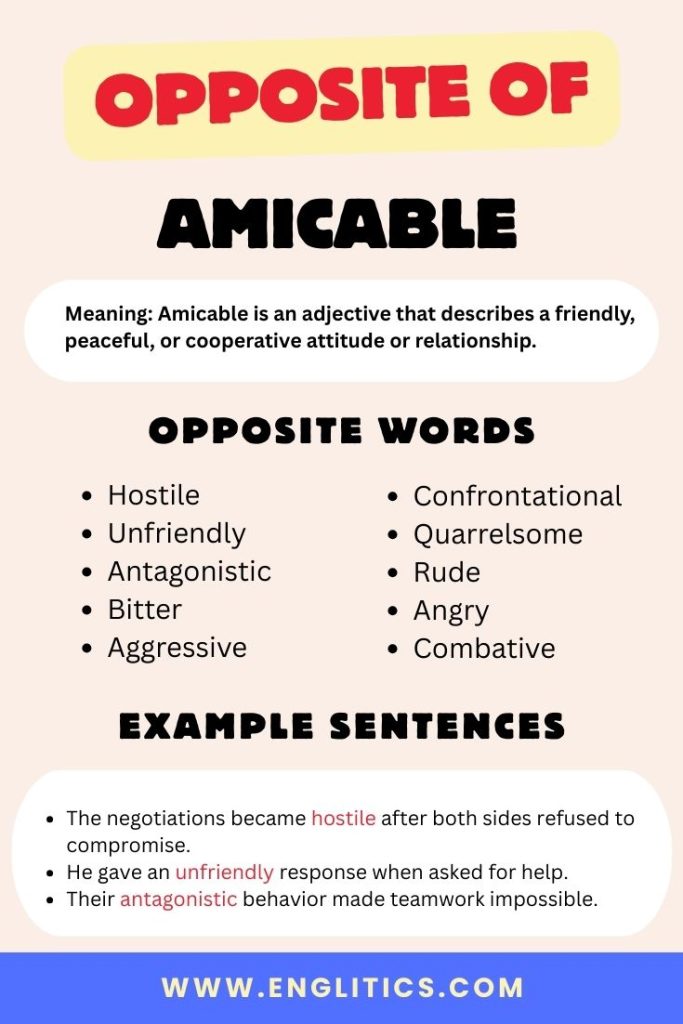
Antonyms for “amicable” represent the opposite end of the spectrum, describing relationships and interactions marked by hostility, disagreement, or unfriendliness. These antonyms can range in intensity from mild disagreement to outright aggression.
Antagonistic
Definition: Showing or feeling active opposition or hostility towards someone or something.
Usage: “Antagonistic” is used to describe a situation or individual characterized by active opposition. It implies a sense of rivalry or conflict.
Example: “The lawyer adopted an antagonistic approach during the cross-examination.”
Hostile
Definition: Unfriendly; antagonistic.
Usage: “Hostile” suggests a more intense form of unfriendliness, often indicating a readiness to attack or confront.
Example: “The environment in the office became hostile after the announcement of the layoffs.”
Unfriendly
Definition: Not friendly; showing dislike or a lack of warmth.
Usage: “Unfriendly” is a general term indicating a lack of warmth or friendliness. It is less intense than “hostile” or “antagonistic.”
Example: “The new neighbor seemed unfriendly and kept to himself.”
Belligerent
Definition: Hostile and aggressive.
Usage: “Belligerent” describes someone eager to fight or argue. It implies a readiness to engage in conflict.
Example: “His belligerent attitude made it difficult to have a peaceful conversation.”
Quarrelsome
Definition: Tending to argue or disagree.
Usage: “Quarrelsome” describes someone who frequently engages in arguments or disputes. It suggests a predisposition to conflict.
Example: “The quarrelsome siblings were always bickering over trivial matters.”
Discordant
Definition: Disagreeing or incongruous.
Usage: “Discordant” is often used to describe situations or relationships lacking harmony or agreement. It can also refer to clashing sounds or ideas.
Example: “The discordant opinions within the committee made it difficult to reach a consensus.”
Examples of Amicable and Its Antonyms
The following tables provide examples of “amicable” used in sentences, along with sentences using its antonyms. These examples are categorized to illustrate the different nuances of each antonym.
Table 1: Amicable vs. Antagonistic
This table compares the use of “amicable” with its antonym “antagonistic,” highlighting the difference in conveying friendliness versus opposition.
| Amicable | Antagonistic |
|---|---|
| The meeting concluded with an amicable agreement between the parties. | The lawyer adopted an antagonistic approach during the cross-examination. |
| They maintained an amicable relationship despite their differing opinions. | His antagonistic behavior created tension in the group. |
| The negotiations were conducted in an amicable manner. | The two companies have an antagonistic relationship due to intense competition. |
| An amicable settlement was reached out of court. | The politician’s antagonistic remarks sparked controversy. |
| The team members have an amicable working environment. | The antagonistic atmosphere in the office made it difficult to concentrate. |
| We had an amicable discussion about the project’s future. | The protestors held an antagonistic demonstration against the government. |
| The landlord and tenant have an amicable understanding. | The antagonistic debate format encouraged heated arguments. |
| The two leaders had an amicable exchange of views. | The antagonistic rivalry between the two schools is well-known. |
| An amicable solution was found to resolve the dispute. | The antagonistic tone of the email was offensive. |
| The mediator helped to create an amicable atmosphere. | The antagonistic forces clashed on the battlefield. |
| Their amicable demeanor made everyone feel welcome. | His antagonistic stare was quite intimidating. |
| The amicable resolution of the problem pleased everyone. | The antagonistic narrative undermined the peace talks. |
| An amicable gathering of friends and family ensued. | The antagonistic nature of the business deal caused many problems. |
| They parted ways on amicable terms. | The meeting ended on antagonistic terms. |
| The company fosters an amicable culture among its employees. | The company has an antagonistic relationship with its competitors. |
| The amicable settlement prevented a lengthy court battle. | The antagonistic approach prolonged the negotiations. |
| The discussion remained amicable despite the sensitive topic. | The discussion became antagonistic when politics were mentioned. |
| The amicable behavior of the staff impressed the visitors. | The antagonistic attitude of the security guard made people uncomfortable. |
| The two nations maintained amicable diplomatic relations. | The two nations engaged in antagonistic cyber warfare. |
| The amicable transfer of power ensured a smooth transition. | The antagonistic coup attempt destabilized the country. |
| The amicable cooperation between the departments led to the project’s success. | The antagonistic competition between the departments hindered the project’s progress. |
| The amicable gesture of goodwill improved relations between the two groups. | The antagonistic act of sabotage worsened relations between the two groups. |
| The amicable atmosphere at the conference fostered collaboration and innovation. | The antagonistic atmosphere at the conference stifled creativity and communication. |
Table 2: Amicable vs. Hostile
This table contrasts the use of “amicable” with “hostile,” emphasizing the difference between friendliness and unfriendliness.
| Amicable | Hostile |
|---|---|
| The discussions were amicable and productive. | The atmosphere in the meeting was hostile and unproductive. |
| He offered an amicable greeting to his neighbor. | He received a hostile stare from the stranger. |
| The company strives to maintain amicable relations with its clients. | The company faced a hostile takeover attempt. |
| They resolved the conflict through amicable negotiation. | The negotiations broke down due to hostile demands. |
| The tone of the letter was amicable and reassuring. | The tone of the email was hostile and threatening. |
| An amicable agreement was reached between the parties involved. | A hostile dispute erupted between the neighbors. |
| The teacher fostered an amicable learning environment. | The classroom became hostile after the argument. |
| The two countries maintained amicable diplomatic ties. | The two countries severed diplomatic ties due to hostile actions. |
| The employees had an amicable and supportive relationship. | The employees faced a hostile and competitive environment. |
| The settlement was amicable and benefited both sides. | The divorce was hostile and resulted in a bitter legal battle. |
| The amicable resolution brought peace to the community. | The hostile invasion brought chaos and destruction. |
| The amicable exchange of ideas led to innovation. | The hostile rejection of new ideas stifled progress. |
| The amicable gesture of friendship was well-received. | The hostile act of aggression was condemned. |
| The amicable atmosphere at the event was enjoyable. | The hostile atmosphere at the protest was unsettling. |
| The amicable nature of the discussion facilitated understanding. | The hostile nature of the debate hindered communication. |
| The amicable spirit of cooperation led to success. | The hostile competition led to resentment and conflict. |
| The amicable working relationship improved productivity. | The hostile work environment reduced morale. |
| The amicable tone of the negotiation helped reach an agreement. | The hostile tone of the negotiation made it difficult to compromise. |
| The amicable sharing of resources benefited everyone. | The hostile hoarding of resources created scarcity. |
| The amicable support of the community helped the family recover. | The hostile rejection by the community left the family isolated. |
| The amicable transfer of knowledge benefited the students. | The hostile withholding of information hindered learning. |
| The amicable discussion resolved the misunderstanding. | The hostile confrontation escalated the conflict. |
| The amicable agreement was a win-win situation. | The hostile takeover was a zero-sum game. |
Table 3: Amicable vs. Unfriendly
This table shows examples of “amicable” contrasted with “unfriendly,” highlighting the difference between showing warmth and disliking.
| Amicable | Unfriendly |
|---|---|
| She gave him an amicable smile. | She gave him an unfriendly glare. |
| The staff were amicable and helpful. | The staff were unfriendly and unhelpful. |
| They had an amicable conversation over coffee. | They had an unfriendly exchange of words. |
| The atmosphere at the party was amicable and welcoming. | The atmosphere at the party was unfriendly and awkward. |
| The neighbors have an amicable relationship. | The neighbors have an unfriendly relationship. |
| The meeting concluded on amicable terms. | The meeting concluded on unfriendly terms. |
| The company promotes an amicable work environment. | The company has an unfriendly and competitive culture. |
| The two leaders had an amicable meeting. | The two leaders had an unfriendly standoff. |
| The settlement was reached in an amicable manner. | The dispute was resolved in an unfriendly way. |
| The teacher has an amicable approach to teaching. | The teacher has an unfriendly and strict approach. |
| The amicable nature of the discussion facilitated understanding. | The unfriendly tone of the discussion hindered communication. |
| The amicable gesture was appreciated by everyone. | The unfriendly behavior was noticed by everyone. |
| The amicable atmosphere made the event enjoyable. | The unfriendly atmosphere made the event uncomfortable. |
| The amicable cooperation led to a successful outcome. | The unfriendly competition led to failure. |
| The amicable exchange of ideas was productive. | The unfriendly criticism was unproductive. |
| The amicable working relationship improved morale. | The unfriendly work environment decreased morale. |
| The amicable resolution satisfied all parties. | The unfriendly verdict disappointed many. |
| The amicable assistance was greatly appreciated. | The unfriendly refusal was disappointing. |
| The amicable interaction left a positive impression. | The unfriendly encounter left a negative impression. |
| The amicable guidance helped him succeed. | The unfriendly neglect hindered his progress. |
| The amicable conversation helped them connect. | The unfriendly silence created distance. |
| The amicable welcome made the guests feel at home. | The unfriendly reception made the guests feel unwelcome. |
| The amicable support helped the team overcome challenges. | The unfriendly sabotage hindered the team’s efforts. |
Table 4: Amicable vs. Belligerent
This table showcases the use of “amicable” versus “belligerent,” contrasting peaceful interactions with aggressive ones.
| Amicable | Belligerent |
|---|---|
| Despite their differences, they maintained an amicable relationship. | His belligerent attitude made it impossible to have a calm discussion. |
| The negotiations were conducted in an amicable and respectful manner. | The protesters adopted a belligerent stance against the government policies. |
| The two countries signed an amicable treaty to promote peace. | The belligerent rhetoric of the politician fueled tensions between the nations. |
| The company strives to create an amicable work environment where employees can thrive. | The belligerent behavior of the manager created a toxic atmosphere in the office. |
| They resolved their dispute through amicable mediation. | The argument escalated into a belligerent shouting match. |
| The teacher fostered an amicable classroom atmosphere where students felt comfortable participating. | The student’s belligerent defiance of the rules led to disciplinary action. |
| The discussion remained amicable, even when dealing with sensitive topics. | The debate turned belligerent when personal attacks were made. |
| The community came together in an amicable display of support for the family in need. | The gang members engaged in belligerent acts of violence against rival groups. |
| The neighbors worked together in an amicable spirit to improve their community. | The belligerent dispute over property lines led to a long and costly legal battle. |
| The international conference aimed to promote amicable relations between countries. | The belligerent foreign policy of the nation sparked international condemnation. |
| The amicable settlement prevented a lengthy and costly court battle. | The belligerent refusal to compromise prolonged the conflict. |
| The amicable exchange of ideas led to innovative solutions. | The belligerent rejection of new ideas stifled progress. |
| The amicable cooperation between departments improved efficiency. | The belligerent competition between departments hindered collaboration. |
| The amicable tone of the meeting facilitated productive discussions. | The belligerent tone of the email escalated the conflict. |
| The amicable gesture of goodwill improved relations between the two organizations. | The belligerent act of aggression damaged the peace process. |
| The amicable leadership style fostered a positive work environment. | The belligerent management style created a stressful and hostile workplace. |
| The amicable approach to problem-solving led to effective resolutions. | The belligerent approach to negotiations resulted in a stalemate. |
| The amicable atmosphere at the event made everyone feel welcome. | The belligerent atmosphere at the rally created a sense of unease. |
| The amicable communication style enhanced understanding and collaboration. | The belligerent communication style led to misunderstandings and conflict. |
| The amicable relationship between the siblings made family gatherings enjoyable. | The belligerent rivalry between the siblings made family gatherings tense. |
| The amicable transfer of power ensured a smooth transition of leadership. | The belligerent coup attempt destabilized the government. |
| The amicable agreement benefited all parties involved. | The belligerent demands of the negotiator led to a breakdown in talks. |
| The amicable spirit of cooperation helped the community overcome challenges. | The belligerent resistance to change hindered progress. |
Table 5: Amicable vs. Quarrelsome
This table illustrates the contrast between “amicable” and “quarrelsome,” highlighting the distinction between friendly and argumentative behavior.
| Amicable | Quarrelsome |
|---|---|
| Despite their differences, they maintained an amicable relationship. | The quarrelsome neighbors were always arguing over petty issues. |
| The discussions were amicable and focused on finding common ground. | The meeting turned quarrelsome as participants bickered over minor details. |
| The mediator helped the parties reach an amicable agreement. | The quarrelsome nature of the siblings made family gatherings tense. |
| The colleagues had an amicable and supportive working relationship. | The quarrelsome team members frequently clashed over project responsibilities. |
| The two leaders engaged in an amicable exchange of ideas. | The two politicians engaged in a quarrelsome debate. |
| The tone of the email was amicable and conciliatory. | The tone of the email was quarrelsome and accusatory. |
| The settlement was reached in an amicable manner, benefiting both parties. | The divorce proceedings were quarrelsome and dragged on for months. |
| The teacher fostered an amicable and collaborative classroom environment. | The students became quarrelsome during the group project. |
| The two countries resolved their dispute through amicable negotiations. | The two countries engaged in a quarrelsome exchange of diplomatic notes. |
| The company promotes an amicable and inclusive workplace culture. | The company experienced a quarrelsome internal power struggle. |
| The amicable approach to problem-solving led to effective solutions. | The quarrelsome approach to negotiations resulted in a stalemate. |
| The amicable atmosphere encouraged open communication and collaboration. | The quarrelsome atmosphere stifled creativity and innovation. |
| The amicable nature of the discussion helped to build trust and understanding. | The quarrelsome nature of the debate hindered progress toward a resolution. |
| The amicable spirit of cooperation led to a successful outcome. | The quarrelsome competition between the teams led to resentment and conflict. |
| The amicable working relationship improved productivity and morale. | The quarrelsome work environment decreased efficiency and job satisfaction. |
| The amicable tone of the conversation helped to de-escalate the situation. | The quarrelsome tone of the argument made the situation worse. |
| The amicable gesture of goodwill improved relations between the two groups. | The quarrelsome accusations damaged the relationship between the two parties. |
| The amicable resolution of the conflict brought peace to the community. | The quarrelsome dispute divided the community. |
| The amicable sharing of resources benefited everyone involved. | The quarrelsome hoarding of resources created scarcity and resentment. |
| The amicable support of the community helped the family overcome their challenges. | The quarrelsome criticism from the community made the situation even more difficult. |
| The amicable transfer of knowledge benefited the students. | The quarrelsome withholding of information hindered learning and progress. |
| The amicable agreement was a win-win situation for all involved. | The quarrelsome negotiation resulted in a lose-lose outcome. |
| The amicable leadership style fostered a positive and collaborative work environment. | The quarrelsome management style created a stressful and hostile workplace. |
Usage Rules for Antonyms of Amicable
When using antonyms of “amicable,” consider the specific context and the degree of opposition you wish to convey. Here are some general usage rules:
- Antagonistic: Use when describing active opposition or rivalry.
- Hostile: Use when describing intense unfriendliness or a readiness to attack.
- Unfriendly: Use as a general term for a lack of warmth or friendliness.
- Belligerent: Use when describing someone eager to fight or argue.
- Quarrelsome: Use when describing someone who frequently engages in arguments or disputes.
- Discordant: Use when describing a lack of harmony or agreement.
Common Mistakes When Using Antonyms of Amicable
Here are some common mistakes to avoid when using antonyms of “amicable”:
| Incorrect | Correct | Explanation |
|---|---|---|
| The meeting was very amicable, full of hostility. | The meeting was hostile and unproductive. | “Amicable” and “hostile” are antonyms and cannot be used together to describe the same meeting. |
| He gave an amicable glare. | He gave an unfriendly glare. | “Amicable” implies friendliness, which contradicts “glare,” so “unfriendly” is more appropriate. |
| The negotiation was amicable, leading to a belligerent outcome. | The negotiation failed, leading to a belligerent outcome. | “Amicable” implies a peaceful resolution, so “belligerent outcome” is contradictory. |
| She has an amicable personality, always quarrelsome. | She has a quarrelsome personality, always looking for an argument. | “Amicable” and “quarrelsome” are opposite traits and cannot be used to describe the same person. |
| The class had an amicable environment, filled with discord. | The class had a discordant environment, filled with tension. | “Amicable” and “discordant” are contradictory; “discordant” better describes a tense environment. |
Practice Exercises
Complete the following sentences by choosing the most appropriate antonym of “amicable” from the options provided.
Exercise 1
| Question | Options | Answer |
|---|---|---|
| 1. Despite their initial disagreements, they eventually reached an __________ agreement. | (a) amicable, (b) hostile, (c) friendly | (b) hostile |
| 2. The __________ atmosphere in the office made it difficult to concentrate. | (a) amicable, (b) belligerent, (c) unfriendly | (b) belligerent |
| 3. He received an __________ response to his proposal. | (a) amicable, (b) antagonistic, (c) pleasant | (b) antagonistic |
| 4. The __________ siblings were always arguing over toys. | (a) amicable, (b) quarrelsome, (c) agreeable | (b) quarrelsome |
| 5. The __________ opinions within the group made it hard to reach a consensus. | (a) amicable, (b) discordant, (c) harmonious | (b) discordant |
| 6. The new neighbor was quite __________ and never spoke to anyone. | (a) amicable, (b) unfriendly, (c) sociable | (b) unfriendly |
| 7. The meeting turned __________ when the discussion became heated. | (a) amicable, (b) hostile, (c) congenial | (b) hostile |
| 8. His __________ behavior made it difficult to have a civil conversation. | (a) amicable, (b) belligerent, (c) peaceful | (b) belligerent |
| 9. The __________ relationship between the two companies led to constant lawsuits. | (a) amicable, (b) antagonistic, (c) cooperative | (b) antagonistic |
| 10. The __________ atmosphere at the event made everyone feel uncomfortable. | (a) amicable, (b) quarrelsome, (c) welcoming | (b) quarrelsome |
Exercise 2
| Question | Options | Answer | |
|---|---|---|---|
| 1. The __________ takeover of the company led to significant changes in management. | (a) amicable, (b) hostile, (c) friendly | (b) hostile | |
| 2. The __________ remarks made by the speaker offended many audience members. | (a) amicable, (b) belligerent, (c) agreeable | (b) belligerent | |
| 3. The __________ competition between the two departments hindered collaboration. | (a) amicable, (b) antagonistic, (c) supportive | (b) antagonistic | |
| 4. The __________ discussions often led to arguments and disagreements. | (a) amicable, (b) quarrelsome, (c) peaceful | (b) quarrelsome | |
| 5. The __________ opinions within the committee delayed the decision-making process. | (a) amicable, (b) discordant, (c) harmonious | (b) discordant | |
| 6. The staff at the hotel were generally __________ and unhelpful. | (a) amicable, (b) unfriendly, (c) welcoming | (b) unfriendly | |
| 7. The atmosphere in the courtroom became increasingly __________ as the trial progressed. | (a) amicable, (b) hostile, (c) congenial | (b) hostile | |
| 8. His __________ attitude made it difficult | to work with him. | (a) amicable, (b) belligerent, (c) agreeable | (b) belligerent |
| 9. The __________ relationship between the two countries led to a trade war. | (a) amicable, (b) antagonistic, (c) cooperative | (b) antagonistic | |
| 10. The __________ environment made it difficult for new employees to adjust. | (a) amicable, (b) unwelcoming, (c) pleasant | (b) unwelcoming |
Advanced Topics: Nuances and Context
Understanding the nuances and context in which the antonyms of “amicable” are used can significantly enhance your communication skills. Each antonym carries a specific connotation that makes it suitable for different situations.
- Formal vs. Informal: Some antonyms, like “hostile,” are suitable for both formal and informal contexts, while others, like “belligerent,” might be more appropriate for specific situations.
- Intensity: The intensity of the antonym should match the situation. For example, “unfriendly” is milder than “hostile” and should be used accordingly.
- Specific Context: Consider the context. “Discordant” might be used to describe opinions or sounds, while “quarrelsome” is more suitable for describing people.
FAQ: Frequently Asked Questions
What is the difference between “hostile” and “antagonistic”?
“Hostile” implies a more intense form of unfriendliness and a readiness to attack, while “antagonistic” suggests active opposition or rivalry.
When should I use “unfriendly” instead of “hostile”?
Use “unfriendly” when you want to describe a general lack of warmth or friendliness without implying a readiness to attack.
Can “discordant” be used to describe people?
While “discordant” primarily describes a lack of harmony in sounds or opinions, it can indirectly describe people whose views clash significantly.
Is “belligerent” a formal or informal word?
“Belligerent” can be used in both formal and informal contexts, but it is often used when describing aggressive behavior or attitudes.
How do I choose the right antonym for “amicable”?
Consider the specific context, the intensity of the opposition you want to convey, and the formality of the situation.
Conclusion
Mastering the antonyms of “amicable” is a valuable step toward enhancing your English vocabulary and improving your communication skills. By understanding the nuances and contexts in which these words are used, you can express a wider range of meanings with greater precision.
Whether you are writing, speaking, or simply looking to expand your vocabulary, this guide provides a comprehensive resource for understanding and using the antonyms of “amicable” effectively. Keep practicing and refining your understanding to truly master these concepts.