The Opposite of Approve reflects disapproval, rejection, or a lack of agreement. While to approve means to accept, support, or agree with something, its opposite signals objection or refusal to accept an idea, action, or request.
Antonyms for Approve include reject, disapprove, and oppose. For example, instead of agreeing with a plan, someone might reject it outright. A disapproving parent may not allow a certain behavior. If a group opposes a proposal, they actively work against its acceptance.
Definition of “Approve”
The verb “approve” signifies to officially agree to something or to consider something good or acceptable. It implies a positive judgment, endorsement, or permission.
“Approve” can be used in various contexts, ranging from formal settings like government legislation to informal situations like expressing liking for a friend’s new haircut.
Classification: “Approve” is a transitive verb, meaning it requires a direct object. It can also be used intransitively, particularly when the object is understood or implied.
Function: The function of “approve” is to convey agreement, permission, or positive evaluation. It indicates that a particular action, plan, or object meets a certain standard or is deemed satisfactory.
Contexts: “Approve” appears in legal, professional, personal, and academic contexts. For instance, a government might approve a new law, a manager might approve an employee’s expense report, or a parent might approve their child’s choice of college.
Structural Breakdown of “Approve”
The word “approve” typically follows a subject-verb-object (SVO) structure in a sentence. The subject is the one doing the approving, the verb is “approve” (or its conjugated form), and the object is what is being approved.
Basic Structure: Subject + Approve + Object
Examples:
- The committee approved the budget. (Subject: committee, Verb: approved, Object: budget)
- I approve of your decision. (Subject: I, Verb: approve, Object: your decision)
- She approves the new policy. (Subject: She, Verb: approves, Object: the new policy)
The verb “approve” can also be used with prepositions such as “of,” indicating a favorable opinion or agreement. The structure then becomes: Subject + Approve + of + Noun/Gerund.
Example: He approves of my plan. (Subject: He, Verb: approves, Preposition: of, Object: my plan)
Types of Antonyms for “Approve”
Antonyms for “approve” can be categorized based on the degree of opposition they express. Understanding these categories helps in choosing the most appropriate antonym for a given context.
Direct Antonyms
Direct antonyms express a clear and opposite meaning to “approve.” These words directly contradict the idea of agreement or acceptance. Examples include “reject,” “deny,” and “disapprove.”
Indirect Antonyms
Indirect antonyms imply a lack of approval without directly stating it. These words suggest a negative outcome or a failure to meet the required standards.
Examples include “decline,” “dismiss,” and “overrule.”
Contextual Antonyms
Contextual antonyms depend on the specific situation to convey the opposite of “approve.” These words might not always be antonyms in every context, but they function as such in particular instances. An example is “criticize,” which implies a lack of approval through negative feedback.
Opposite of Approve
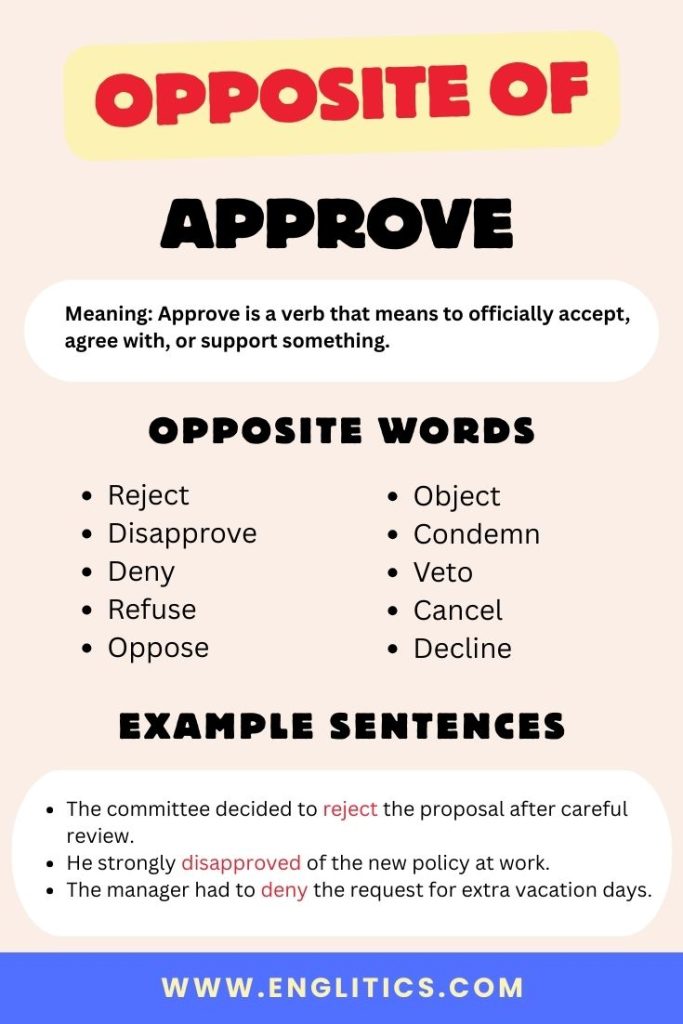
This section provides extensive examples of antonyms for “approve,” categorized for clarity. Each category includes multiple examples to illustrate the different ways these antonyms can be used in sentences.
Reject
“Reject” means to refuse to accept or consider something. It indicates a firm refusal or denial.
The following table provides examples of sentences using “reject” as an antonym for “approve.” Each sentence illustrates how “reject” conveys the opposite meaning of “approve” in various contexts.
| Sentence | Context |
|---|---|
| The committee rejected the proposal due to budget constraints. | Business/Finance |
| She rejected his offer of marriage. | Personal |
| The university rejected his application because of low grades. | Education |
| The editor rejected the manuscript, citing a lack of originality. | Publishing |
| The quality control team rejected the defective products. | Manufacturing |
| The community rejected the plan to build a new highway through the park. | Community Planning |
| The voters rejected the proposed tax increase. | Politics |
| He rejected the idea of working overtime on the weekend. | Workplace |
| The patient’s body rejected the transplanted organ. | Medical |
| The software rejected the invalid password. | Technology |
| The customs officer rejected the counterfeit goods. | Law Enforcement |
| The art critic rejected the artist’s new exhibition as uninspired. | Art Criticism |
| The environmental agency rejected the company’s permit application. | Environmental Regulation |
| The school board rejected the proposal to shorten the school day. | Education Policy |
| The landlord rejected the tenant’s request for a rent reduction. | Real Estate |
| The insurance company rejected the claim due to insufficient evidence. | Insurance |
| The government rejected the foreign aid request. | International Relations |
| The judge rejected the defendant’s appeal. | Law |
| The audience rejected the comedian’s offensive jokes. | Entertainment |
| The scientist rejected the hypothesis after conducting further experiments. | Science |
| The funding committee rejected the research grant application. | Academia |
| The network rejected the pilot episode of the new TV show. | Television |
| The dating app rejected the profile for violating community guidelines. | Technology |
| The factory rejected the raw materials due to poor quality. | Manufacturing |
| The human resources department rejected the candidate’s job application. | Human Resources |
Disapprove
“Disapprove” means to have or express an unfavorable opinion about something. It suggests a lack of agreement or satisfaction.
The table below illustrates the use of “disapprove” as an antonym for “approve.” The examples cover a range of situations where expressing disapproval is appropriate.
| Sentence | Context |
|---|---|
| My parents disapprove of my career choice. | Personal |
| The teacher disapproved of the student’s disruptive behavior. | Education |
| The manager disapproved of the employee’s late arrival. | Workplace |
| She disapproved of the new regulations. | General |
| The health inspector disapproved of the restaurant’s unsanitary conditions. | Health and Safety |
| The community members disapproved of the proposed construction project. | Community Development |
| The financial advisor disapproved of the risky investment strategy. | Finance |
| The fashion critic disapproved of the designer’s unconventional collection. | Fashion |
| The ethics committee disapproved of the researcher’s methods. | Research Ethics |
| The security team disapproved of the unauthorized access attempt. | Security |
| The environmental group disapproved of the company’s pollution practices. | Environmental Advocacy |
| The historical society disapproved of the planned demolition of the old building. | Historical Preservation |
| The literary critic disapproved of the author’s latest novel. | Literature |
| The medical board disapproved of the doctor’s controversial treatment. | Medical Ethics |
| The planning commission disapproved of the developer’s zoning request. | Urban Planning |
| The sports commentators disapproved of the athlete’s unsportsmanlike conduct. | Sports |
| The legal team disapproved of the proposed settlement terms. | Law |
| The film reviewers disapproved of the movie’s weak plot. | Film Criticism |
| The academic panel disapproved of the student’s thesis. | Academia |
| The board of directors disapproved of the CEO’s excessive spending. | Corporate Governance |
| The quality assurance team disapproved of the product’s design flaws. | Quality Assurance |
| The neighborhood association disapproved of the proposed noise ordinance. | Local Governance |
| The scientific community disapproved of the unsupported claims. | Scientific Integrity |
| The regulatory agency disapproved of the misleading advertising. | Consumer Protection |
| The editorial board disapproved of the controversial op-ed piece. | Journalism |
Deny
“Deny” means to state that something is not true; to refuse to admit or acknowledge something.
The following table provides examples of how “deny” functions as an antonym for “approve,” emphasizing the refusal of truth or acknowledgement.
| Sentence | Context |
|---|---|
| The suspect denied the allegations made against him. | Legal |
| The company denied any involvement in the scandal. | Corporate |
| He denied her request for a loan. | Personal Finance |
| The government denied access to the classified documents. | Politics |
| She denied that she had ever met him before. | Personal |
| The insurance company denied the claim due to a pre-existing condition. | Insurance |
| The witness denied seeing the incident occur. | Law |
| The athlete denied using performance-enhancing drugs. | Sports |
| The school denied the student’s request for an extension. | Education |
| The hospital denied the patient’s application for financial assistance. | Healthcare |
| The organization denied the rumors circulating about its financial stability. | Nonprofit |
| The website denied the user access due to suspicious activity. | Technology |
| The embassy denied the visa application. | International Relations |
| The library denied the request to purchase the expensive book. | Library Science |
| The research team denied the validity of the preliminary findings. | Science |
| The customer service representative denied the refund request. | Customer Service |
| The editor denied the author’s revisions to the manuscript. | Publishing |
| The admissions office denied the transfer student’s application. | Higher Education |
| The judge denied the motion to dismiss the case. | Legal Procedure |
| The regulatory agency denied the company’s request for an exemption. | Government Regulation |
| The social media platform denied the user’s appeal to reinstate their account. | Social Media |
| The foundation denied the grant proposal due to limited funding. | Philanthropy |
| The security system denied access to the restricted area. | Security Systems |
| The airline denied the passenger boarding due to overbooking. | Travel Industry |
| The university denied the professor tenure. | Academic Administration |
Veto
“Veto” means to reject or prohibit, especially by someone in authority. This term is often used in a political or legal context.
The following table provides examples of how “veto” functions as an antonym for “approve,” particularly in scenarios involving authority and decision-making.
| Sentence | Context |
|---|---|
| The president vetoed the bill passed by Congress. | Politics |
| The governor vetoed the state budget. | Government |
| The board of directors vetoed the CEO’s proposal. | Corporate Governance |
| The city council vetoed the zoning change request. | Local Government |
| The committee vetoed the amendment to the constitution. | Law |
| The school principal vetoed the student’s petition. | Education Administration |
| The union leader vetoed the proposed contract agreement. | Labor Relations |
| The judge vetoed the lawyer’s objection. | Legal Procedure |
| The homeowners association vetoed the homeowner’s renovation plans. | Community Association |
| The editor-in-chief vetoed the controversial article. | Journalism |
| The scientific review panel vetoed the research study due to ethical concerns. | Research Ethics |
| The planning commission vetoed the developer’s proposal for a high-rise building. | Urban Planning |
| The military commander vetoed the risky mission plan. | Military Strategy |
| The regulatory agency vetoed the company’s application for a new product. | Government Regulation |
| The international committee vetoed the resolution on human rights violations. | International Diplomacy |
| The funding organization vetoed the grant application for the arts project. | Arts Funding |
| The censorship board vetoed the film due to offensive content. | Film Industry |
| The standards body vetoed the new industry standard. | Industry Standards |
| The design team vetoed the proposed changes to the product. | Product Development |
| The safety inspector vetoed the operation of the equipment due to safety hazards. | Workplace Safety |
| The editorial board vetoed the publication of the controversial study. | Academic Publishing |
| The review committee vetoed the candidate’s promotion application. | Human Resources |
| The oversight committee vetoed the allocation of funds to the project. | Project Management |
| The ethics panel vetoed the experiment due to potential harm to participants. | Scientific Research |
| The supervisory board vetoed the manager’s decision to close the department. | Business Management |
Decline
“Decline” means to politely refuse an invitation or offer; to become smaller, fewer, or less; decrease.
The following table provides examples of how “decline” functions as an antonym for “approve,” emphasizing refusal or a decrease in acceptance.
| Sentence | Context |
|---|---|
| She declined his invitation to the party. | Social |
| The company declined to comment on the allegations. | Corporate Communications |
| The patient’s health declined rapidly. | Medical |
| The offer was declined due to unfavorable terms. | Business |
| The number of applicants declined this year. | Education/Statistics |
| The politician declined to answer the reporter’s questions. | Politics |
| The organization declined the donation due to ethical concerns. | Nonprofit |
| The athlete declined to participate in the event. | Sports |
| The economy declined during the recession. | Economics |
| The quality of the product declined over time. | Manufacturing |
| The population of the town declined significantly. | Demographics |
| The stock price declined after the earnings report. | Finance |
| The funding for the project was declined due to budget cuts. | Project Management |
| The invitation to collaborate was declined by the research team. | Academia |
| The opportunity to merge was declined by the smaller company. | Mergers and Acquisitions |
| The request for assistance was declined by the overwhelmed staff. | Social Services |
| The offer to mediate was declined by both parties. | Conflict Resolution |
| The proposal to expand the business was declined by the board. | Corporate Strategy |
| The application for a loan was declined by the bank. | Banking |
| The request to reschedule the meeting was declined due to scheduling conflicts. | Scheduling |
| The recommendation to implement the new policy was declined by the administration. | Policy Making |
| The suggestion to change the marketing strategy was declined. | Marketing |
| The plea for help was declined due to lack of resources. | Emergency Response |
| The proposition to renegotiate the contract was declined by the supplier. | Contract Negotiation |
| The invitation to speak at the conference was declined by the expert. | Public Speaking |
Usage Rules for Antonyms of “Approve”
Using antonyms of “approve” correctly requires understanding the nuances of each word and its specific connotations. Here are some general rules to follow:
- Context Matters: Choose the antonym that best fits the context of the sentence. Consider the degree of opposition you want to express.
- Formal vs. Informal: Some antonyms are more formal than others. “Reject” and “deny” are generally more formal than “disapprove.”
- Specificity: Select an antonym that accurately reflects the reason for disapproval. For example, “veto” implies rejection by someone in authority.
- Grammatical Structure: Ensure that the antonym fits grammatically within the sentence. Pay attention to verb tenses and subject-verb agreement.
Example:
- Incorrect: The manager approve of the employee’s performance.
- Correct: The manager disapproved of the employee’s performance.
Common Mistakes
Learners often make mistakes when using antonyms of “approve.” Here are some common errors and how to avoid them:
| Incorrect | Correct | Explanation |
|---|---|---|
| The committee approve the proposal. | The committee rejected the proposal. | “Approve” is used incorrectly. “Reject” conveys the opposite meaning. |
| She approved of his behavior, which was wrong. | She disapproved of his behavior. | Using “disapproved” indicates a negative opinion of the behavior. |
| The president approved the bill. (when he actually vetoed it) | The president vetoed the bill. | “Vetoed” is the correct term for rejecting a bill by an executive authority. |
| He approved to help them. | He declined to help them. | “Declined” is used to politely refuse an offer of help. |
| The company approved the rumors. | The company denied the rumors. | “Denied” is the correct term for stating that something is not true. |
Practice Exercises
Test your understanding of antonyms for “approve” with these exercises.
Exercise 1: Multiple Choice
Choose the best antonym for “approve” in each sentence.
| Question | Options | Answer |
|---|---|---|
| The teacher did not _______ the student’s excuse for being late. | (a) accept (b) reject (c) consider (d) allow | (b) reject |
| My parents _______ of my decision to study abroad. | (a) agree (b) support (c) disapprove (d) encourage | (c) disapprove |
| The president decided to _______ the new law. | (a) pass (b) veto (c) support (d) endorse | (b) veto |
| She _______ his offer of help. | (a) accepted (b) welcomed (c) declined (d) appreciated | (c) declined |
| The company _______ any responsibility for the accident. | (a) admitted (b) acknowledged (c) denied (d) confirmed | (c) denied |
| The manager _______ the employee’s request for a raise. | (a) granted (b) approved (c) refused (d) supported | (c) refused |
| The committee _______ the proposed budget increase. | (a) endorsed (b) ratified (c) rejected (d) sanctioned | (c) rejected |
| The critic _______ the artist’s new painting. | (a) praised (b) admired (c) condemned (d) lauded | (c) condemned |
| The school board _______ the proposal to extend the school day. | (a) adopted (b) embraced (c) vetoed (d) sanctioned | (c) vetoed |
| The doctor _______ the patient’s request for unnecessary surgery. | (a) authorized (b) permitted (c) denied (d) supported | (c) denied |
Exercise 2: Sentence Completion
Fill in the blank with the best antonym for “approve” from the list: reject, disapprove, deny, veto, decline.
| Question | Answer |
|---|---|
| The admissions committee decided to _______ his application due to incomplete documents. | reject |
| My grandmother _______ of my modern hairstyle. | disapproves |
| The government _______ the claims made by the opposition party. | denied |
| The governor chose to _______ the controversial bill. | veto |
| She had to _______ the invitation to the conference due to a prior commitment. | decline |
| The editor decided to _______ the submission because it did not meet the publication’s standards. | reject |
| The community members _______ of the construction of the new factory near their homes. | disapproved |
| The spokesperson _______ to comment on the ongoing investigation. | declined |
| The judge _______ the defendant’s motion for a new trial. | denied |
| The board of directors had the power to _______ the CEO’s decision. | veto |
Exercise 3: Synonym/Antonym Identification
Determine whether the given word is a synonym or antonym of “approve.”
| Word | Synonym/Antonym |
|---|---|
| Endorse | Synonym |
| Reject | Antonym |
| Sanction | Synonym |
| Disapprove | Antonym |
| Ratify | Synonym |
| Veto | Antonym |
| Decline | Antonym |
| Condemn | Antonym |
| Authorize | Synonym |
| Deny | Antonym |
Advanced Topics
For advanced learners, it’s important to understand the subtle differences between the antonyms of “approve” and how they are used in more complex contexts. For example, consider the use of “table” as a parliamentary procedure, which means to postpone or put aside a motion indefinitely, effectively killing it.
This can be seen as a specialized antonym of “approve” in a very specific context.
Also, exploring the etymology of these words can provide deeper insights into their meanings and usage. Understanding the origins of “approve,” “reject,” “deny,” “veto,” and “decline” can enhance your vocabulary and improve your ability to use these words accurately and effectively.
Finally, analyzing literary examples and real-world case studies can further refine your understanding. Examining how these antonyms are used in literature, legal documents, and news articles can provide valuable context and demonstrate their practical application.
FAQ
Here are some frequently asked questions about antonyms of “approve”:
- What is the most common antonym for “approve”?The most common antonym is likely “disapprove,” as it directly expresses an unfavorable opinion or lack of agreement. However, the best choice depends on the specific context.
- When should I use “reject” instead of “disapprove”?Use “reject” when you want to convey a firm refusal or denial. “Reject” implies a more decisive action than “disapprove,” which simply expresses a negative opinion.
- What is the difference between “veto” and “reject”?“Veto” is specifically used when someone in authority, such as a president or governor, rejects a decision or proposal. “Reject” is a more general term and can be used in various contexts.
- Is “decline” always an antonym for “approve”?Not always. “Decline” can also mean to decrease or diminish. However, when used to refuse an invitation or offer, it functions as an antonym for “approve.”
- How do I choose the right antonym for “approve” in a sentence?Consider the context, the degree of opposition you want to express, and the formality of the situation. Choose the word that most accurately reflects the reason for disapproval or rejection.
- Can “criticize” be considered an antonym for “approve”?In certain contexts, yes. “Criticize” implies a lack of approval through negative feedback or evaluation. However, it’s a contextual antonym and not a direct opposite.
- What’s the difference between ‘deny’ and ‘reject’?‘Deny’ often involves a statement of untruth or refusal to acknowledge something. For instance, someone might deny an accusation. ‘Reject,’ on the other hand, means to refuse to accept something, such as a proposal or an application. While both are antonyms of ‘approve,’ ‘deny’ focuses more on disavowal, and ‘reject’ focuses on refusal of acceptance.