Confident people believe in themselves. They speak clearly, take action without fear, and trust their abilities. Whether it’s giving a speech, trying something new, or leading a group, confidence shows strength. But not everyone feels that sure of themselves. Sometimes, the opposite of confident is a better way to describe someone’s mindset.
Antonyms for confident include words like insecure, nervous, shy, doubtful, and unsure. These words show a lack of self-belief or fear of failure. In this post, you’ll learn how to use these opposite words in the right context—with easy examples to help you understand the differences in tone and meaning.
Definition of “Confident”
“Confident” is an adjective that describes a state of self-assurance and belief in one’s abilities or qualities. It implies a feeling of certainty and trust in oneself or something else.
A confident person typically approaches situations with a positive outlook, believing in their capacity to succeed or handle challenges effectively.
Confidence is not merely a feeling; it’s often rooted in experience, preparation, and a realistic assessment of one’s strengths and weaknesses. It’s important to distinguish confidence from arrogance, which involves an exaggerated sense of self-importance and disregard for others.
Classification
As an adjective, “confident” modifies nouns or pronouns to describe their state or quality. It belongs to the broader category of adjectives that describe emotions, attitudes, and personal characteristics.
Function
The primary function of “confident” is to describe someone who feels sure of themselves and their abilities. It can also be used to describe situations or outcomes that are expected with a high degree of certainty.
For example, “a confident speaker” or “a confident prediction.”
Contexts
“Confident” is used in various contexts, including:
- Personal Development: Describing a person’s self-esteem and belief in their potential.
- Business: Indicating a company’s or individual’s assurance in their products, services, or strategies.
- Sports: Describing an athlete’s mental state and belief in their ability to perform well.
- Relationships: Reflecting the security and trust within a partnership.
- Academic: Expressing a student’s assurance in their knowledge and understanding.
Structural Breakdown of Confidence
Understanding the structure of the word “confident” and its related forms can provide a deeper insight into its meaning and usage. “Confident” is derived from the Latin word “confidere,” meaning “to trust fully.”
- Root Word: The root word is “fide,” which means “faith” or “trust.”
- Prefix: The prefix “con-” means “with” or “together.”
- Suffix: The suffix “-ent” is an adjectival suffix, indicating a state or quality.
Therefore, “confident” literally means “with full trust” or “having faith.” This etymological breakdown helps to understand the core meaning of the word and its connection to related terms like “confidence,” “confide,” and “confidential.”
The noun form, confidence, describes the state of being confident. For example: “Her confidence was inspiring.” The verb form, confide, means to trust someone enough to tell them a secret. For example: “I confide in my best friend.”
Opposite of Confident
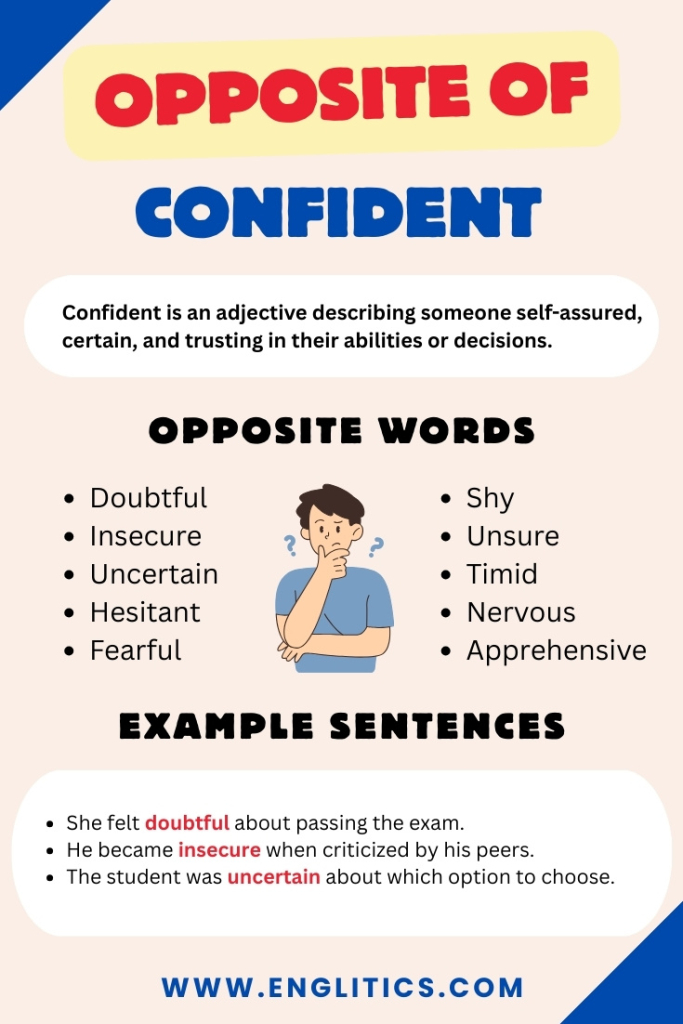
Antonyms are words that have opposite meanings. When considering antonyms for “confident,” it’s important to recognize that the opposite of confidence can manifest in various forms, each with its own nuance.
Here are several categories of antonyms for “confident”:
Lack of Self-Assurance
These antonyms directly express a deficiency in self-belief and certainty.
- Insecure: Feeling uncertain about oneself, one’s abilities, or one’s worth.
- Unsure: Lacking certainty or conviction.
- Hesitant: Tentative and unwilling to act due to doubt or fear.
- Apprehensive: Anxious or fearful that something bad will happen.
- Timid: Lacking courage or confidence; easily frightened.
Fear and Anxiety
These antonyms highlight the emotional states that often accompany a lack of confidence.
- Anxious: Experiencing worry, nervousness, or unease.
- Fearful: Feeling afraid or apprehensive.
- Nervous: Easily agitated or alarmed.
- Worried: Anxious or troubled about actual or potential problems.
- Scared: Feeling fear or alarm.
Humility and Modesty
These antonyms emphasize a lack of arrogance or boastfulness, which can be seen as the opposite extreme of excessive confidence.
- Humble: Having or showing a modest or low estimate of one’s own importance.
- Modest: Unassuming or moderate in the estimation of one’s abilities or achievements.
- Unassuming: Not pretentious or arrogant; modest.
- Reserved: Slow to reveal emotion or opinions.
- Self-effacing: Not claiming attention for oneself; retiring and modest.
Doubt and Skepticism
These antonyms focus on uncertainty and questioning, both in oneself and in external factors.
- Doubtful: Feeling uncertainty or lack of conviction.
- Skeptical: Having doubts about something; not easily convinced.
- Dubious: Hesitating or doubting.
- Unconvinced: Not persuaded or certain.
- Questioning: Expressing doubt or uncertainty.
Weakness and Vulnerability
These antonyms describe a state of being susceptible to harm or easily influenced, which contrasts with the strength and resilience implied by confidence.
- Vulnerable: Susceptible to physical or emotional harm.
- Weak: Lacking physical strength or the power to withstand attack.
- Defenseless: Unable to protect oneself from attack.
- Helpless: Unable to help oneself; dependent on others.
- Powerless: Without the ability to influence or control events.
Examples of Antonyms
To illustrate the usage of these antonyms, consider the following examples. These examples are organized into tables based on the categories discussed above, making it easier to understand the context and nuance of each word.
Lack of Self-Assurance Examples
The following table provides examples of how antonyms related to a lack of self-assurance are used in sentences.
| Antonym | Example Sentence |
|---|---|
| Insecure | She felt insecure about her public speaking abilities despite practicing for weeks. |
| Unsure | He was unsure whether he had made the right decision, constantly second-guessing himself. |
| Hesitant | The student was hesitant to answer the question, fearing he might be wrong. |
| Apprehensive | She felt apprehensive about the upcoming exam, knowing how much it would affect her grade. |
| Timid | The timid kitten hid under the sofa, afraid of the new environment. |
| Insecure | Despite her talent, she remained insecure about her artistic abilities. |
| Unsure | He was unsure of his next move, feeling lost in the complex situation. |
| Hesitant | She was hesitant to share her innovative ideas, fearing ridicule from her peers. |
| Apprehensive | The young actor was apprehensive about performing on the big stage. |
| Timid | The timid mouse scurried away at the slightest sound. |
| Insecure | His insecure nature prevented him from pursuing his dreams. |
| Unsure | They were unsure of the path ahead, as the map was incomplete. |
| Hesitant | He was hesitant about investing in the risky venture. |
| Apprehensive | She felt apprehensive about flying due to her fear of heights. |
| Timid | The timid puppy was scared of the vacuum cleaner. |
| Insecure | She felt insecure when comparing herself to others on social media. |
| Unsure | He was unsure of how to proceed with the difficult project. |
| Hesitant | She was hesitant to trust him after the previous betrayal. |
| Apprehensive | He felt apprehensive about the job interview, despite his qualifications. |
| Timid | The timid child clung to his mother’s leg in the crowded room. |
Fear and Anxiety Examples
This table illustrates how antonyms related to fear and anxiety are used to convey a lack of confidence.
| Antonym | Example Sentence |
|---|---|
| Anxious | He felt anxious before the presentation, his palms sweating nervously. |
| Fearful | She was fearful of the dark, always needing a nightlight. |
| Nervous | He became nervous whenever he had to speak in public. |
| Worried | She was worried about her children’s safety during the storm. |
| Scared | The little boy was scared of the loud thunder. |
| Anxious | She felt anxious about the health of her aging parents. |
| Fearful | He was fearful of failing the exam, which would affect his scholarship. |
| Nervous | She felt nervous before her first date, unsure of what to expect. |
| Worried | He was worried about the financial stability of his company. |
| Scared | The cat was scared of the new dog in the house. |
| Anxious | She felt anxious about the upcoming surgery and its potential risks. |
| Fearful | He was fearful of heights, avoiding tall buildings and bridges. |
| Nervous | She felt nervous about meeting her partner’s family for the first time. |
| Worried | He was worried about the impact of climate change on future generations. |
| Scared | The baby was scared of the sudden loud noise. |
| Anxious | She felt anxious about the results of her medical tests. |
| Fearful | He was fearful of rejection, which prevented him from expressing his feelings. |
| Nervous | She felt nervous about driving in heavy traffic. |
| Worried | He was worried about the rising cost of living. |
| Scared | The child was scared of the monster under his bed. |
Humility and Modesty Examples
The following table demonstrates how antonyms related to humility and modesty are used in sentences.
| Antonym | Example Sentence |
|---|---|
| Humble | Despite his success, he remained humble and grateful for his opportunities. |
| Modest | She was modest about her achievements, never boasting about her accomplishments. |
| Unassuming | He had an unassuming demeanor, despite being a brilliant scientist. |
| Reserved | She was reserved and didn’t immediately share her opinions with strangers. |
| Self-effacing | He was self-effacing, always deflecting praise and giving credit to others. |
| Humble | The humble farmer lived a simple life, content with his work. |
| Modest | The modest artist never sought fame, focusing solely on her craft. |
| Unassuming | The unassuming volunteer quietly dedicated his time to helping others. |
| Reserved | The reserved librarian preferred the company of books to large crowds. |
| Self-effacing | The self-effacing comedian made jokes at his own expense to entertain the audience. |
| Humble | His humble beginnings taught him the value of hard work. |
| Modest | She was modest about her wealth, living a simple lifestyle. |
| Unassuming | The unassuming professor was a world-renowned expert in his field. |
| Reserved | The reserved diplomat carefully chose his words to avoid causing offense. |
| Self-effacing | The self-effacing leader always put his team’s needs before his own. |
| Humble | He remained humble despite receiving numerous awards and accolades. |
| Modest | She was modest about her intelligence, never flaunting her knowledge. |
| Unassuming | The unassuming detective solved the case without drawing attention to himself. |
| Reserved | The reserved scientist preferred working in the lab to attending social events. |
| Self-effacing | The self-effacing writer always downplayed the success of her novels. |
Doubt and Skepticism Examples
This table provides examples of how antonyms related to doubt and skepticism are used in sentences.
| Antonym | Example Sentence |
|---|---|
| Doubtful | She was doubtful about the accuracy of the news report. |
| Skeptical | He remained skeptical of the politician’s promises. |
| Dubious | They were dubious about the company’s claims of rapid growth. |
| Unconvinced | The jury remained unconvinced by the defendant’s alibi. |
| Questioning | He was questioning his decision to move to a new city. |
| Doubtful | She was doubtful that the team could win the championship. |
| Skeptical | He was skeptical about the effectiveness of the new treatment. |
| Dubious | They were dubious about the authenticity of the antique. |
| Unconvinced | The teacher remained unconvinced that the student had completed the assignment himself. |
| Questioning | She was questioning her career path and considering a change. |
| Doubtful | He was doubtful about the long-term success of the project. |
| Skeptical | She remained skeptical about the existence of ghosts. |
| Dubious | They were dubious about the quality of the product based on its low price. |
| Unconvinced | The investor remained unconvinced by the startup’s business plan. |
| Questioning | He was questioning his friendship after the betrayal. |
| Doubtful | She was doubtful that she could finish the marathon. |
| Skeptical | He was skeptical about the claims made in the advertisement. |
| Dubious | They were dubious about the intentions of the stranger. |
| Unconvinced | The audience remained unconvinced by the magician’s trick. |
| Questioning | She was questioning her sanity after experiencing strange occurrences. |
Weakness and Vulnerability Examples
The table below showcases how antonyms related to weakness and vulnerability are used in sentences.
| Antonym | Example Sentence |
|---|---|
| Vulnerable | The small business was vulnerable to economic downturns. |
| Weak | He felt weak after recovering from the illness. |
| Defenseless | The baby bird was defenseless against predators. |
| Helpless | She felt helpless watching the disaster unfold on television. |
| Powerless | The citizens felt powerless against the corrupt government. |
| Vulnerable | The old building was vulnerable to damage from the earthquake. |
| Weak | The weak bridge was closed for repairs. |
| Defenseless | The defenseless animals were at the mercy of the poachers. |
| Helpless | He felt helpless as he watched his house burn down. |
| Powerless | The individual felt powerless against the large corporation. |
| Vulnerable | Children are particularly vulnerable to online scams. |
| Weak | His argument was weak and easily refuted. |
| Defenseless | The defenseless nation sought assistance from its allies. |
| Helpless | She felt helpless as she watched her friend struggle with addiction. |
| Powerless | The voter felt powerless in the face of political corruption. |
| Vulnerable | The computer system was vulnerable to cyber attacks. |
| Weak | The weak economy struggled to recover from the recession. |
| Defenseless | The defenseless refugees sought shelter from the war. |
| Helpless | He felt helpless as he watched the accident happen. |
| Powerless | The employee felt powerless against the unfair policies of the company. |
Usage Rules for Antonyms of “Confident”
When using antonyms of “confident,” it’s important to consider the specific context and the nuance you want to convey. Each antonym carries a slightly different meaning, and choosing the right word can significantly impact the message.
- Insecurity vs. Humility: “Insecure” implies a lack of self-worth, while “humble” suggests a modest assessment of one’s abilities. Use “insecure” when describing someone who doubts their capabilities and “humble” when describing someone who doesn’t boast about their achievements.
- Fear vs. Doubt: “Fearful” indicates a sense of alarm or apprehension, while “doubtful” suggests uncertainty or skepticism. Use “fearful” when describing someone who is afraid of something and “doubtful” when describing someone who questions something.
- Vulnerability vs. Weakness: “Vulnerable” implies susceptibility to harm, while “weak” suggests a lack of strength or power. Use “vulnerable” when describing something that is easily damaged or affected and “weak” when describing something that lacks force or resilience.
Exception: Some antonyms can be used interchangeably in certain contexts. For example, “unsure” and “doubtful” can both be used to describe a state of uncertainty.
Common Mistakes
One common mistake is using “arrogant” as an antonym for “confident.” While arrogance is the opposite of humility, it’s not a direct antonym for “confident.” Confidence is a healthy belief in one’s abilities, while arrogance is an exaggerated sense of self-importance.
Another mistake is using “shy” interchangeably with “insecure” or “timid.” While shyness can sometimes stem from insecurity, it’s primarily a personality trait characterized by discomfort in social situations. A shy person may still be confident in their abilities, even if they are hesitant to express themselves.
Here are some examples of correct and incorrect usage:
| Incorrect | Correct | Explanation |
|---|---|---|
| She was confident, so she was arrogant. | She was confident, but not arrogant. | Arrogance is an extreme, not a direct opposite of confidence. |
| He was shy, so he was insecure about his intelligence. | He was shy, but confident in his intelligence. | Shyness doesn’t necessarily mean a lack of confidence. |
| She was vulnerable, so she was weak at math. | She was vulnerable because she lacked experience. | Vulnerability refers to susceptibility, not necessarily a lack of skill. |
Practice Exercises
Test your understanding of antonyms for “confident” with these exercises. Choose the best antonym for “confident” in each sentence.
Exercise 1: Fill in the Blanks
| Question | Answer |
|---|---|
| 1. Despite his hard work, he felt _________ about his chances of getting a promotion. | doubtful |
| 2. She was _________ about speaking in front of a large audience, even though she was well-prepared. | nervous |
| 3. The company was _________ to the changing market conditions and struggled to adapt. | vulnerable |
| 4. He remained _________ about his accomplishments, always giving credit to his team. | humble |
| 5. She was _________ to voice her opinion, fearing she would be criticized. | hesitant |
| 6. After the accident, he felt _________ and unable to cope with daily tasks. | helpless |
| 7. She was _________ of the new manager’s leadership skills. | skeptical |
| 8. He was _________ of his ability to pass the difficult exam. | unsure |
| 9. The old building was _________ to damage from the approaching hurricane. | vulnerable |
| 10. Despite her talent, she was _________ about her singing abilities. | insecure |
Exercise 2: Multiple Choice
| Question | Choices | Answer |
|---|---|---|
| 1. Which word is the best antonym for “confident” in the context of public speaking? | a) arrogant b) nervous c) humble d) strong | b) nervous |
| 2. Which word best describes someone who doesn’t believe in their own abilities? | a) modest b) secure c) insecure d) reserved | c) insecure |
| 3. Which word suggests a lack of certainty or conviction? | a) certain b) sure c) unsure d) assertive | c) unsure |
| 4. Which word implies a fear of potential harm or danger? | a) fearless b) brave c) fearful d) bold | c) fearful |
| 5. Which word best describes someone who is easily influenced or swayed? | a) strong b) resilient c) vulnerable d) powerful | c) vulnerable |
| 6. Which word best describes a modest and unassuming person? | a) arrogant b) boastful c) humble d) assertive | c) humble |
| 7. Which word expresses doubt or disbelief? | a) certain b) convinced c) skeptical d) trusting | c) skeptical |
| 8. Which word denotes a state of lacking courage? | a) brave b) fearless c) timid d) bold | c) timid |
| 9. Which word suggests a feeling of helplessness? | a) capable b) empowered c) helpless d) potent | c) helpless |
| 10. Which word represents a tendency to hesitate before acting? | a) decisive b) resolute c) hesitant d) determined | c) hesitant |
Advanced Topics
For advanced learners, exploring the psychological aspects of confidence and its antonyms can provide a deeper understanding of their usage. Consider the following:
- Imposter Syndrome: A psychological pattern in which an individual doubts their accomplishments and has a persistent internalized fear of being exposed as a “fraud.” This can lead to feelings of insecurity and anxiety, despite evidence of their competence.
- Dunning-Kruger Effect: A cognitive bias in which people with low ability at a task overestimate their ability, while those with high ability underestimate their ability. This can affect how individuals perceive their own confidence levels.
- The Role of Confidence in Leadership: Confidence is often seen as a key trait in effective leaders, but it’s important to balance confidence with humility and empathy. Overconfidence can lead to poor decision-making and alienate followers.
Furthermore, exploring the cultural nuances of confidence and its antonyms can be insightful. In some cultures, modesty and humility are highly valued, while in others, assertiveness and self-promotion are encouraged.
Understanding these cultural differences can help avoid misunderstandings and promote effective communication.
FAQ
- What is the difference between “insecure” and “shy”?While both terms relate to a lack of ease in certain situations, “insecure” refers to a lack of confidence in oneself, whereas “shy” refers to a discomfort or inhibition in social settings. A person can be shy but still confident in their abilities, or they can be outgoing but insecure about their worth.
- Is “arrogant” a true antonym for “confident”?“Arrogant” is more accurately described as the opposite of “humble” or “modest.” While arrogance involves an overestimation of one’s abilities, confidence is a realistic and healthy belief in oneself. They exist on different axes of personality traits.
- How can I improve my confidence?Improving confidence involves setting realistic goals, focusing on your strengths, practicing self-compassion, and challenging negative thoughts. Seeking feedback from trusted sources and celebrating your successes can also boost your self-esteem.
- When is it appropriate to use “doubtful” instead of “unsure”?“Doubtful” is best used when questioning the validity or truth of something, while “unsure” is more appropriate when expressing a lack of certainty about a decision or action. For example, “I am doubtful about his claims” versus “I am unsure about which path to take.”
- How does “vulnerable” relate to a lack of confidence?Feeling vulnerable often stems from a lack of confidence in one’s ability to protect oneself from harm, whether physical or emotional. It can also arise from a perceived lack of control over a situation, leading to feelings of anxiety and insecurity.
- Can someone be both confident and humble?Yes, absolutely. A confident person can still be humble by acknowledging their limitations, giving credit to others, and remaining grounded despite their successes. In fact, genuine confidence often leads to humility, as one doesn’t feel the need to constantly prove themselves.
- What is the role of confidence in achieving goals?Confidence plays a crucial role in achieving goals by providing the motivation, resilience, and belief in oneself necessary to overcome obstacles. A confident person is more likely to take risks, persevere through challenges, and ultimately succeed in their endeavors.
- How can I help someone who is struggling with insecurity?You can help by offering encouragement, providing constructive feedback, and helping them identify their strengths. It’s also important to listen to their concerns without judgment and encourage them to seek professional help if needed.
Conclusion
Understanding the antonyms of “confident” is essential for effective communication and a deeper understanding of human emotions and attitudes. By mastering words like “insecure,” “fearful,” “humble,” “doubtful,” and “vulnerable,” you can express a wider range of perspectives and nuances in your writing and speech.
Remember to consider the specific context and the subtle differences between these antonyms to convey your intended meaning accurately.
Continual practice and exposure to diverse texts will further enhance your vocabulary and improve your ability to use these antonyms effectively. Embrace the challenge of expanding your linguistic toolkit, and you’ll find yourself communicating with greater precision and impact.
Keep exploring and refining your understanding of the English language, and you’ll unlock new levels of fluency and expression.