Opposite of disappointed means feeling happy or pleased because something turned out well. While “disappointed” describes being let down or unhappy when things don’t go as expected, its opposite shows satisfaction or joy from a good outcome.
Antonyms for disappointed include satisfied, pleased, content, delighted, or thrilled. For example, instead of feeling disappointed after a test, a student might feel pleased with their score if they did well. These words help describe positive feelings when hopes are met. Using these antonyms can make your writing more expressive and help explain different emotions clearly.
Definition of Disappointed
Disappointed is an adjective that describes the feeling of sadness or dissatisfaction that arises when something does not meet one’s expectations or hopes. It implies a sense of letdown or frustration due to an unmet desire or a failed outcome. The feeling can range from mild dissatisfaction to deep sorrow, depending on the significance of the expectation and the extent of the failure.
In essence, to be disappointed means to experience a gap between what was hoped for and what actually occurred. This gap can stem from various sources, such as unmet promises, failed attempts, or simply unfavorable circumstances.
Understanding the nuances of “disappointed” is crucial for identifying its antonyms, which represent the opposite spectrum of emotions and experiences.
The term is often used in contexts involving expectations, plans, and outcomes. For instance, one might be disappointed by a poor performance, a canceled event, or a broken promise.
The intensity of the disappointment often correlates with the importance of the expectation. It’s a common human experience that can drive motivation for improvement or lead to feelings of resignation.
Structural Breakdown
The word “disappointed” is derived from the verb “disappoint,” which is formed by adding the prefix “dis-” to the verb “appoint.” The prefix “dis-” typically indicates negation or reversal. Thus, “disappoint” literally means “to undo an appointment” or “to fail to meet an expectation.” Adding the suffix “-ed” transforms the verb into an adjective, describing the state of being disappointed.
Breaking down the word in this way helps to understand its etymological roots and semantic content. The prefix “dis-” is a common element in English vocabulary, appearing in words such as “disagree,” “disapprove,” and “disconnect.” Recognizing this pattern can aid in deciphering the meanings of other words with similar prefixes.
The base word “appoint” suggests a setting of expectations or a designation of something to happen. When something fails to be as “appointed,” or as expected, the feeling of disappointment arises.
Thus, understanding the morphological structure of “disappointed” provides a deeper appreciation for its meaning and usage.
Opposite of Disappointed
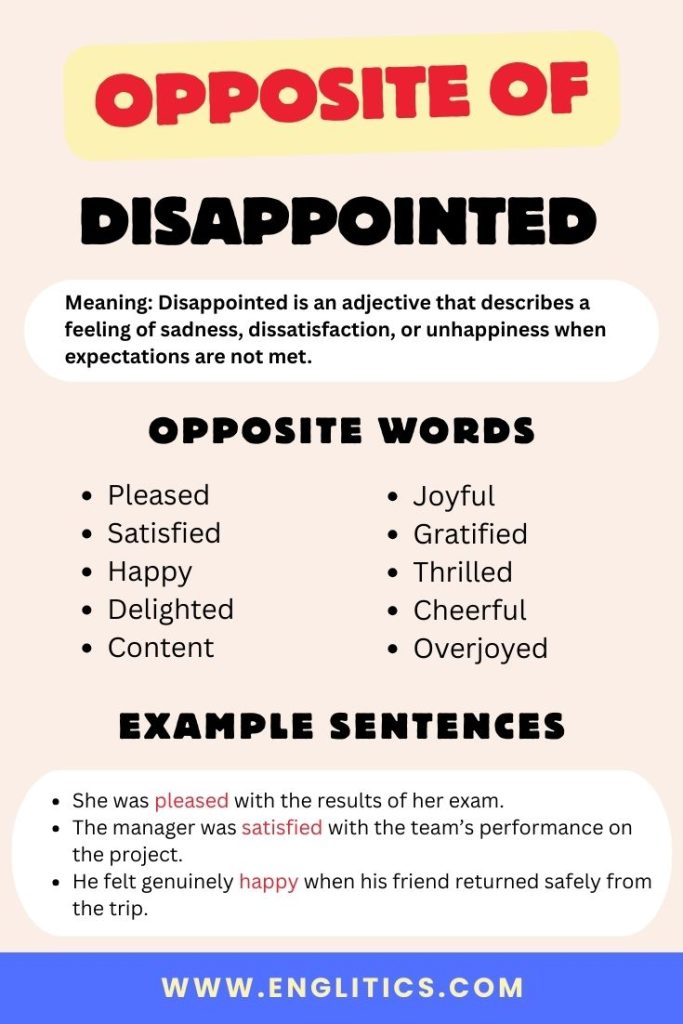
Antonyms are words with opposite meanings. There are several types of antonyms, each differing in the nature of the opposition.
Understanding these types can help in selecting the most appropriate antonym for “disappointed” in various contexts.
Complementary Antonyms
Complementary antonyms are pairs where the presence of one means the absence of the other. For example, alive and dead are complementary antonyms.
In the context of “disappointed,” a complementary antonym might be “content,” where being content implies the absence of disappointment.
Gradable Antonyms
Gradable antonyms represent opposite ends of a spectrum, allowing for degrees of variation between them. For example, hot and cold are gradable antonyms, as there are varying degrees of temperature between them.
For “disappointed,” gradable antonyms might include “pleased” and “satisfied,” representing different levels of positive feelings.
Relational Antonyms
Relational antonyms are pairs where the existence of one depends on the existence of the other. For example, teacher and student are relational antonyms.
While less directly applicable to “disappointed,” understanding relational antonyms helps appreciate the broader concept of opposition in language.
Reversives
Reversives indicate movement in opposite directions. Examples include enter and exit, or tie and untie.
They are not directly applicable to the word “disappointed” but are important to recognize as a type of antonym.
List of Antonyms for Disappointed
Here is a list of words that serve as antonyms for “disappointed,” each with slightly different connotations and levels of intensity:
- Pleased
- Satisfied
- Delighted
- Thrilled
- Content
- Fulfilled
- Gratified
- Elated
- Happy
- Joyful
- Excited
- Overjoyed
These words represent a range of positive emotions and experiences that contrast with the negative feeling of disappointment. The choice of the most appropriate antonym will depend on the specific context and the desired level of emphasis.
Examples of Antonyms in Use
The following sections provide examples of how each antonym can be used in sentences to convey a meaning opposite to that of “disappointed.” Each example demonstrates the specific nuance and context in which the antonym is most appropriate.
Pleased
Pleased suggests a mild sense of satisfaction or approval. It implies that expectations have been met or slightly exceeded, resulting in a positive feeling. The following table provides examples of sentences using the word “pleased.”
| Sentence | Explanation |
|---|---|
| She was pleased with her exam results. | The results met her expectations, bringing her satisfaction. |
| The manager was pleased with the team’s performance. | The team performed well, meeting the manager’s expectations. |
| He was pleased to receive the award. | Receiving the award brought him a sense of satisfaction. |
| I am pleased to announce the successful completion of the project. | The project’s success has brought satisfaction. |
| The chef was pleased with the customer’s feedback. | The positive feedback brought the chef satisfaction. |
| She was pleased with the progress she had made in therapy. | The progress in therapy met her expectations. |
| The teacher was pleased with the students’ engagement in the lesson. | The students’ involvement satisfied the teacher. |
| He was pleased with the gift his friend gave him. | The gift brought him a sense of satisfaction. |
| The company was pleased with the increase in sales. | The increased sales met the company’s expectations. |
| She was pleased to see her family after a long trip. | Seeing her family brought her joy and satisfaction. |
| The artist was pleased with the final result of his painting. | The completed painting met the artist’s expectations. |
| He was pleased with the outcome of the negotiations. | The outcome of the negotiations brought him satisfaction. |
| The volunteers were pleased with the impact of their work. | Their work had a positive impact, bringing them satisfaction. |
| She was pleased with how the event turned out. | The event’s success brought her a sense of satisfaction. |
| The coach was pleased with the athlete’s determination. | The athlete’s determination satisfied the coach. |
| He was pleased to hear the good news from his doctor. | The good news brought him relief and satisfaction. |
| The homeowners were pleased with the renovations. | The renovations met their expectations, bringing them satisfaction. |
| She was pleased with the service she received at the restaurant. | The excellent service satisfied her. |
| The author was pleased with the positive reviews of his book. | The positive reviews brought the author satisfaction. |
| He was pleased with the efficiency of the new system. | The new system’s efficiency met his expectations. |
| The gardener was pleased with the blooming flowers. | The blossoming flowers brought the gardener joy. |
| She was pleased with her new hairstyle. | The new hairstyle satisfied her expectations. |
| The community was pleased with the new park. | The new park brought a sense of satisfaction to the community. |
| He was pleased with the quality of the product. | The product’s quality met his standards. |
Satisfied
Satisfied indicates a feeling of contentment because one’s needs, desires, or expectations have been met. It is a stronger term than “pleased,” suggesting a deeper sense of fulfillment. The following table provides examples of sentences using the word “satisfied.”
| Sentence | Explanation |
|---|---|
| She was satisfied with her performance in the competition. | Her performance met her expectations, bringing her contentment. |
| The customer was satisfied with the service provided. | The service met the customer’s needs, resulting in satisfaction. |
| He was satisfied that he had done his best. | He felt content knowing he had put in his best effort. |
| The company was satisfied with the quarterly profits. | The profits met the company’s expectations, bringing contentment. |
| She was satisfied with the outcome of the meeting. | The meeting’s result met her expectations, bringing satisfaction. |
| He felt satisfied after completing the challenging project. | Completing the difficult project brought him a sense of fulfillment. |
| The teacher was satisfied with the students’ understanding of the material. | The students’ comprehension met the teacher’s expectations. |
| She was satisfied with the cleanliness of the hotel room. | The room’s cleanliness met her standards, bringing her contentment. |
| The team was satisfied with their overall progress. | The team’s advancement met their expectations, resulting in satisfaction. |
| He was satisfied with the taste of the meal. | The meal’s flavor met his expectations, bringing him contentment. |
| The client was satisfied with the design proposal. | The design met the client’s needs and expectations. |
| She was satisfied with the quality of the workmanship. | The workmanship met her standards, bringing her contentment. |
| The manager was satisfied with the employee’s dedication. | The employee’s commitment met the manager’s expectations. |
| He was satisfied with the level of support he received. | The support met his needs, bringing him contentment. |
| The audience was satisfied with the performance. | The performance met the audience’s expectations. |
| She was satisfied with the variety of options available. | The range of choices met her needs, bringing satisfaction. |
| The parents were satisfied with the school’s curriculum. | The curriculum met the parents’ expectations. |
| He was satisfied with his new car’s fuel efficiency. | The car’s efficiency met his expectations. |
| The residents were satisfied with the community services. | The services met their needs, bringing contentment. |
| She felt satisfied after volunteering at the shelter. | Volunteering fulfilled her sense of purpose. |
| He was satisfied with the thoroughness of the report. | The report’s detail met his expectations. |
| The customers were satisfied with the store’s return policy. | The return policy met their needs, bringing contentment. |
| She was satisfied with the comfort of the new furniture. | The furniture’s comfort met her standards. |
| He felt satisfied after a productive day at work. | A productive day at work brought him a sense of fulfillment. |
Delighted
Delighted expresses a high degree of pleasure or joy. It suggests a sense of great happiness and gratification, often exceeding expectations. The following table provides examples of sentences using the word “delighted.”
| Sentence | Explanation |
|---|---|
| She was delighted by the surprise party her friends threw for her. | The surprise party brought her great joy and happiness. |
| The children were delighted to see the animals at the zoo. | Seeing the animals brought the children immense pleasure. |
| He was delighted to hear that he had been accepted into his dream university. | The news of his acceptance brought him great joy and excitement. |
| They were delighted with the excellent service at the hotel. | The exceptional service brought them immense pleasure and satisfaction. |
| She was delighted to receive such a thoughtful gift. | The thoughtful gift brought her great joy and appreciation. |
| He was delighted to learn that his project had been approved. | The approval of his project brought him immense happiness. |
| The fans were delighted by the team’s victory. | The team’s win brought the fans great excitement and happiness. |
| She was delighted to see her old friends at the reunion. | Seeing her old friends brought her immense joy and nostalgia. |
| He was delighted with the positive feedback on his presentation. | The positive feedback brought him immense satisfaction and happiness. |
| The couple was delighted to announce their engagement. | The announcement of their engagement brought them great joy. |
| She was delighted to find a rare book at the antique store. | Finding the rare book brought her immense pleasure. |
| He was delighted to see his children perform in the school play. | Seeing his children on stage brought him great joy and pride. |
| The audience was delighted by the comedian’s performance. | The comedian’s performance brought the audience great amusement. |
| She was delighted to receive a scholarship for her studies. | The scholarship brought her immense relief and joy. |
| He was delighted to spend the day with his family. | Spending time with his family brought him great happiness. |
| The travelers were delighted by the breathtaking scenery. | The scenery brought them immense pleasure and awe. |
| She was delighted to hear her favorite song on the radio. | Hearing her favorite song brought her a moment of pure joy. |
| He was delighted to see his garden blooming in the spring. | The blooming garden brought him a sense of peace and happiness. |
| The volunteers were delighted to help those in need. | Helping others brought them a sense of fulfillment and joy. |
| She was delighted to receive an unexpected invitation to the event. | The invitation brought her a pleasant surprise and happiness. |
| He was delighted to find a solution to the complex problem. | Finding the solution brought him a sense of accomplishment and joy. |
| The guests were delighted by the elegant decorations at the party. | The decorations brought the guests a sense of wonder and joy. |
| She was delighted to receive praise from her mentor. | The praise brought her immense encouragement and happiness. |
| He was delighted to see the positive impact of his work on the community. | The impact of his work brought him immense satisfaction and joy. |
Thrilled
Thrilled conveys an even stronger emotion than delighted, indicating intense excitement and pleasure. It suggests a feeling of exhilaration and extreme happiness. The following table provides examples of sentences using the word “thrilled.”
| Sentence | Explanation |
|---|---|
| She was thrilled to win the first prize in the competition. | Winning the prize brought her immense excitement and joy. |
| The children were thrilled to go to the amusement park. | Going to the park brought the children extreme excitement and pleasure. |
| He was thrilled to receive the job offer he had been hoping for. | Receiving the offer brought him immense happiness and excitement. |
| They were thrilled to see their favorite band perform live. | Seeing the band live brought them extreme excitement and pleasure. |
| She was thrilled to be chosen as the lead in the play. | Being chosen brought her immense joy and excitement. |
| He was thrilled to achieve his long-term goal. | Achieving his goal brought him immense satisfaction and excitement. |
| The fans were thrilled by the team’s unexpected comeback. | The comeback brought the fans extreme excitement and joy. |
| She was thrilled to hear that her book had become a bestseller. | Hearing the news brought her immense happiness and excitement. |
| He was thrilled to embark on a new adventure. | Starting the adventure brought him immense excitement and anticipation. |
| They were thrilled to witness the historical event. | Witnessing the event brought them a unique sense of excitement and awe. |
| She was thrilled to receive a standing ovation after her performance. | The standing ovation brought her immense pride and excitement. |
| He was thrilled to be reunited with his long-lost friend. | The reunion brought him immense joy and emotional excitement. |
| The audience was thrilled by the magician’s incredible illusions. | The illusions brought the audience a sense of wonder and excitement. |
| She was thrilled to be recognized for her contributions to the project. | The recognition brought her immense satisfaction and excitement. |
| He was thrilled to see his invention come to life. | Seeing his invention work brought him a sense of accomplishment and excitement. |
| The tourists were thrilled by the stunning fireworks display. | The fireworks brought them a sense of awe and excitement. |
| She was thrilled to be invited to the exclusive event. | The invitation brought her a sense of prestige and excitement. |
| He was thrilled to conquer his biggest fear. | Overcoming his fear brought him a sense of empowerment and excitement. |
| The rescuers were thrilled to find the missing hikers safe and sound. | Finding the hikers brought them immense relief and excitement. |
| She was thrilled to receive a proposal from her boyfriend. | The proposal brought her immense happiness and excitement. |
Content
Content suggests a state of peaceful happiness and satisfaction. It implies a sense of being at ease and accepting one’s current situation without wanting more. The following table provides examples of sentences using the word “content.”
| Sentence | Explanation |
|---|---|
| She was content with her simple life in the countryside. | She found peace and happiness in her rural life. |
| He was content to spend his evening reading a book by the fire. | He found satisfaction and relaxation in reading. |
| They were content with their small apartment and each other’s company. | They found happiness and fulfillment in their relationship and home. |
| She was content with her job, even though it wasn’t glamorous. | She found satisfaction and purpose in her work. |
| He was content to let others take the lead in the project. | He was comfortable and at peace with his role in the project. |
| They were content to watch the sunset together in silence. | They found peace and happiness in each other’s presence. |
| She was content with her progress, even though it was slow. | She found satisfaction in her gradual improvements. |
| He was content to spend his retirement pursuing his hobbies. | He found fulfillment and enjoyment in his leisure activities. |
| The cat was content to nap in the sun all afternoon. | The cat found comfort and relaxation in the warmth of the sun. |
| She was content with her current relationships and friendships. | She found happiness and fulfillment in her social connections. |
| He was content to live in the moment, without worrying about the future. | He found peace in focusing on the present. |
| She was content with the knowledge that she had done her best. | She found satisfaction in her efforts and integrity. |
| He was content to listen to the rain falling outside. | He found peace and relaxation in the sounds of nature. |
| She was content with the simple joys of everyday life. | She found happiness in the small, ordinary moments. |
| He was content to share his knowledge and experience with others. | He found satisfaction in helping and guiding others. |
| She was content to work behind the scenes, without seeking recognition. | She found fulfillment in her contributions, regardless of accolades. |
| He was content to support his family and provide for their needs. | He found purpose and satisfaction in his role as a provider. |
| She was content to learn new things and expand her horizons. | She found stimulation and fulfillment in continuous learning. |
| He was content to live a life of purpose and meaning. | He found fulfillment in his values and actions. |
| She was content to offer help whenever she could. | Offering help made her happy. |
Usage Rules for Antonyms
When choosing an antonym for “disappointed,” it’s important to consider the context and the specific nuance you want to convey. Pleased and satisfied are suitable for situations where expectations have been met. Delighted and thrilled are appropriate when expressing great joy or excitement. Content is ideal for conveying a sense of peaceful happiness and acceptance.
Pay attention to the intensity of the emotion you want to express. If the situation calls for a mild sense of satisfaction, “pleased” or “satisfied” would be appropriate.
If the situation warrants a strong sense of joy, “delighted” or “thrilled” would be more suitable. If you want to convey a sense of peaceful happiness, “content” would be the best choice.
Also, consider the formality of the context. “Pleased” and “satisfied” are generally appropriate in both formal and informal settings.
“Delighted” and “thrilled” are more expressive and may be more suitable for informal settings. “Content” is a more reflective term and can be used effectively in both formal and informal contexts.
Common Mistakes
One common mistake is using an antonym that doesn’t quite fit the context. For example, using “thrilled” when “pleased” would be more appropriate, or using “content” when “satisfied” better reflects the situation.
It is important to choose the antonym that accurately conveys the intended meaning.
Another common mistake is using an antonym that is too strong or too weak for the situation. For instance, saying “I was thrilled with my meal” when the meal was simply satisfactory, or saying “I was pleased with the news” when the news was truly delightful.
Pay attention to the intensity of the emotion and choose the antonym accordingly.
A further mistake is confusing antonyms with synonyms. While synonyms have similar meanings, antonyms have opposite meanings.
Make sure you understand the precise meaning of each word before using it as an antonym for “disappointed.”
Here are some examples of common mistakes and their corrections:
| Incorrect | Correct | Explanation |
|---|---|---|
| I was thrilled with my average performance. | I was satisfied with my average performance. | “Thrilled” implies a higher degree of excitement than is appropriate for an average performance. |
| She was content to win the lottery. | She was thrilled to win the lottery. | “Content” suggests a sense of peaceful happiness, while “thrilled” better conveys the excitement of winning the lottery. |
| He was pleased to receive a life-saving award. | He was delighted to receive a life-saving award. | “Pleased” is too mild for such a significant honor. |
Practice Exercises
These exercises will help you practice using the antonyms for “disappointed.”
Exercise 1: Multiple Choice
Choose the best antonym for “disappointed” in each sentence.
| Question | Options | Answer |
|---|---|---|
| After the successful presentation, the team was _____. | (a) disappointed (b) pleased (c) sad (d) angry | (b) pleased |
| The customer was _____ with the quality of the product. | (a) frustrated (b) satisfied (c) upset (d) annoyed | (b) satisfied |
| She was _____ to hear that she had won the scholarship. | (a) devastated (b) delighted (c) miserable (d) heartbroken | (b) delighted |
| He was _____ to see his old friends at the reunion. | (a) bored (b) thrilled (c) indifferent (d) apathetic | (b) thrilled |
| She felt _____ with her life and accomplishments. | (a) discontent (b) content (c) dissatisfied (d) regretful | (b) content |
| The manager was ______ with the employee’s dedication. | (a) irritated (b) satisfied (c) displeased (d) bothered | (b) satisfied |
| The students were ______ to learn they had no homework. | (a) annoyed (b) delighted (c) agitated (d) worried | (b) delighted |
| He was ______ to see his hard work rewarded. | (a) saddened (b) thrilled (c) discouraged (d) disheartened | (b) thrilled |
| She was ______ with her personal growth over the past year. | (a) frustrated (b) content (c) restless (d) agitated | (b) content |
| The audience was ______ by the performance. | (a) bored (b) pleased (c) uninterested (d) indifferent | (b) pleased |
Exercise 2: Sentence Completion
Fill in the blank with the most appropriate antonym for “disappointed.”
| Question | Answer |
|---|---|
| After receiving the promotion, he was absolutely __________. | thrilled |
| The customer was _________ with the excellent service he received. | satisfied |
| She was _________ to find her lost wallet. | delighted |
| The teacher was _________ with the students’ enthusiasm. | pleased |
| Despite the challenges, she was ________ with her progress. | content |
| Upon hearing the good news, he was absolutely __________. | delighted |
| After finishing the marathon, she felt __________. | satisfied |
| The team was _________ with their successful collaboration. | pleased |
| He was __________ to be reunited with his family. | thrilled |
| Despite the setbacks, she remained ________ with her life. | content |
Exercise 3: Synonym/Antonym Identification
Identify whether the given word is a synonym or antonym for “disappointed.”
| Word | Synonym/Antonym | Answer |
|---|---|---|
| Frustrated | Synonym | Synonym |
| Pleased | Antonym | Antonym |
| Satisfied | Antonym | Antonym |
| Delighted | Antonym | Antonym |
| Upset | Synonym | Synonym |
| Content | Antonym | Antonym |
| Thrilled | Antonym | Antonym |
| Annoyed | Synonym | Synonym |
| Fulfilled | Antonym | Antonym |
| Disheartened | Synonym | Synonym |
Advanced Topics
For advanced learners, exploring the nuances of these antonyms in various literary and rhetorical contexts can further enhance understanding. Consider how different authors use these words to create specific effects or to convey complex emotions.
For instance, a novelist might use “content” to depict a character who has found inner peace, or “thrilled” to describe a character’s moment of triumph.
Additionally, exploring the cultural connotations of these words can provide deeper insights. Some cultures may place a greater emphasis on certain emotions, and this can be reflected in the way these words are used.
For example, in some cultures, being “content” may be seen as a virtue, while in others, striving for greater achievements and feeling “thrilled” may be more valued.
Finally, delving into the etymology of these words can provide a richer understanding of their historical roots and semantic evolution. Tracing the origins of “pleased,” “satisfied,” “delighted,” “thrilled,” and “content” can reveal interesting connections and nuances that are not immediately apparent.
FAQ
What is the difference between “pleased” and “satisfied”?
“Pleased” suggests a mild sense of satisfaction or approval, while “satisfied” indicates a deeper sense of contentment because one’s needs, desires, or expectations have been fully met.
When should I use “delighted” instead of “thrilled”?
“Delighted” expresses a high degree of pleasure or joy, while “thrilled” conveys an even stronger emotion, indicating intense excitement and pleasure. Use “thrilled” when the feeling is more intense and exhilarating.
Is “content” always a positive emotion?
Yes, “content” is generally a positive emotion, suggesting a state of peaceful happiness and satisfaction with one’s current situation.
Can “satisfied” sometimes have a negative connotation?
In some rare contexts, “satisfied” can imply complacency or a lack of ambition. However, in most cases, it is used to express a positive feeling of fulfillment.
Are there any other antonyms for “disappointed” that are not included in the list?
Yes, depending on the context, other words like “elated,” “gratified,” and “overjoyed” can also serve as antonyms for “disappointed.”
Conclusion
Mastering the antonyms for “disappointed” is a valuable step in expanding your English vocabulary and enhancing your communication skills. By understanding the nuances of words like “pleased,” “satisfied,” “delighted,” “thrilled,” and “content,” you can more effectively express a wide range of positive emotions and convey your intended meaning with precision.
Remember to consider the context, intensity, and formality of the situation when choosing the most appropriate antonym. With practice and attention to detail, you can confidently use these words to enrich your writing and speech.