The Opposite of Dominate refers to actions or situations where someone gives up control, follows instead of leads, or allows others to take charge. While dominate means to lead or overpower, its opposite shows cooperation, submission, or letting go of authority.
Common Antonyms for Dominate include submit, yield, follow, obey, surrender, and relinquish. For example, instead of dominating a team discussion, someone might step back and let others share ideas. These words help describe behaviors or roles that involve humility, listening, or shared control.
Definition of Dominate
The verb “dominate” means to have control over, influence, or power over someone or something. It implies a position of authority and often suggests a forceful or controlling nature.
“Dominate” can be used in various contexts, including politics, business, sports, and personal relationships. Understanding its multifaceted nature is key to grasping the meaning of its antonyms.
The core idea is that of exerting superior power or influence.
In essence, to dominate is to hold a commanding position, often to the exclusion of others. It can also refer to being the most prominent or noticeable feature of something.
This concept forms the basis for understanding the range of words that represent the opposite of dominance.
Structural Breakdown of “Dominate”
The word “dominate” comes from the Latin word dominari, meaning “to rule” or “to be master.” Its structure reflects its meaning. The root “domin-” signifies “lord” or “master,” and the suffix “-ate” is a verb-forming suffix. This etymological understanding provides a deeper insight into the word’s inherent sense of control and power.
Breaking down the word helps us appreciate the inherent sense of power and control embedded within its construction. Recognizing the Latin root reinforces the idea of mastery and authority, which is essential when exploring its antonyms.
Opposite of Dominate
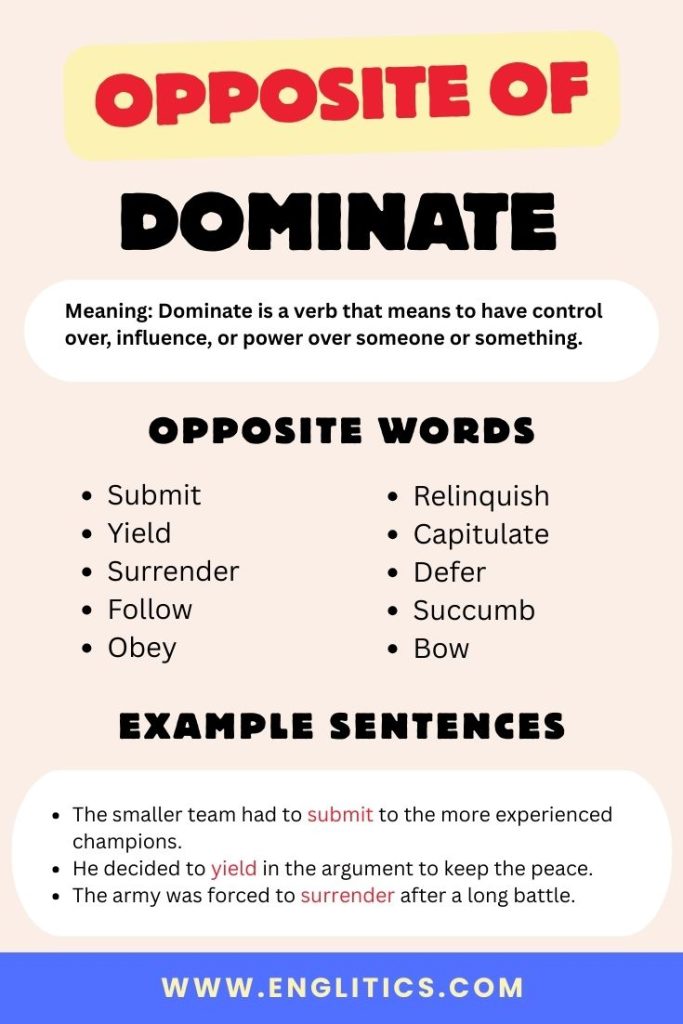
The antonyms of “dominate” vary depending on the specific context. They can range from words implying weakness or submission to those suggesting cooperation and equality.
Here, we’ll explore different categories of antonyms, each offering a unique perspective on the opposite of dominance.
Weaken
Words like “weaken” suggest a reduction in power or influence. This is a direct contrast to the strengthening and assertion of control that “dominate” implies.
To weaken is to lose strength, either physically or metaphorically.
Examples of words in this category include: undermine, impair, erode, debilitate.
Support
“Support” implies providing assistance or reinforcement to others, rather than exerting control. It represents a collaborative approach, the opposite of individual dominance.
Supporting involves empowering others.
Examples of words in this category include: aid, assist, help, bolster, encourage.
Obey
“Obey” means to comply with or follow the commands of someone in authority. It is a direct opposite of dominating, as it involves relinquishing control and submitting to another’s will.
Obeying suggests a hierarchical relationship.
Examples of words in this category include: submit, comply, yield, heed, adhere.
Follow
Similar to “obey,” “follow” implies a lack of leadership or control. It suggests taking direction from someone else, rather than imposing one’s own will.
Following involves taking a passive role.
Examples of words in this category include: trail, shadow, succeed, come after, be led.
Serve
“Serve” means to provide a service or benefit to others, often in a subordinate role. It contrasts with dominating, which implies using others for one’s own benefit.
Serving emphasizes selflessness and dedication.
Examples of words in this category include: assist, help, attend to, cater to, minister to.
Assist
“Assist” is similar to “support” but often implies a more direct and active role in helping someone. It’s the antithesis of controlling by actively contributing to someone else’s success.
Assisting involves actively helping someone.
Examples of words in this category include: aid, help, support, back, lend a hand.
Cooperate
“Cooperate” means to work together towards a common goal. It is the opposite of dominating, which implies individual control and often disregards the input of others.
Cooperating emphasizes teamwork.
Examples of words in this category include: collaborate, participate, contribute, unite, work together.
Submit
“Submit” indicates yielding to the authority or control of another. It’s a direct contrast to dominating, where one asserts their own authority.
Submitting involves relinquishing control.
Examples of words in this category include: surrender, yield, succumb, defer, capitulate.
Relinquish
“Relinquish” means to voluntarily give up control or power. It stands in direct opposition to dominating, which involves seizing and maintaining control.
Relinquishing involves giving something up.
Examples of words in this category include: abandon, cede, waive, surrender, renounce.
Defer
“Defer” means to yield to another’s judgment or opinion. It’s the opposite of dominating, where one insists on their own way.
Deferring involves respecting someone else’s opinion.
Examples of words in this category include: yield, submit, accede, bow, give way.
Examples of Antonyms in Sentences
Understanding antonyms involves seeing them in context. The following tables provide examples of how these antonyms can be used in sentences, demonstrating their contrasting meanings.
The table below shows examples of how “dominate” and its antonyms related to weakening are used in sentences.
| Word | Example Sentence |
|---|---|
| Dominate | The company aimed to dominate the market with its innovative products. |
| Weaken | Constant criticism can weaken a person’s self-confidence. |
| Undermine | His constant complaints undermined the team’s morale. |
| Impair | Lack of sleep can significantly impair cognitive function. |
| Erode | Years of neglect can erode the foundation of a building. |
| Debilitate | The illness debilitated him, leaving him unable to work. |
| Dominate | She tried to dominate the conversation with her opinions. |
| Weaken | The scandal weakened his political standing. |
| Undermine | Spreading rumors can undermine someone’s reputation. |
| Impair | Drinking alcohol can impair your judgment. |
| Erode | Inflation can erode the value of savings. |
| Debilitate | The chronic pain debilitated her quality of life. |
| Dominate | The basketball team dominated the game from start to finish. |
| Weaken | The heavy rain weakened the bridge’s structure. |
| Undermine | Disagreements can undermine the foundation of a relationship. |
| Impair | Fatigue can impair driving ability. |
| Erode | Continuous waves eroded the coastline. |
| Debilitate | The disease debilitated his immune system. |
| Dominate | The dictator dominated his country for decades. |
| Weaken | The lack of resources weakened their ability to fight the fire. |
The table below shows examples of how “dominate” and its antonyms related to support are used in sentences.
| Word | Example Sentence |
|---|---|
| Dominate | He wanted to dominate the project and take all the credit. |
| Support | The community came together to support the local school. |
| Aid | We need to aid the victims of the natural disaster. |
| Assist | The nurse assisted the doctor during the surgery. |
| Bolster | The new policy will bolster the economy. |
| Encourage | Parents should encourage their children to pursue their dreams. |
| Dominate | The large corporation tried to dominate the smaller businesses. |
| Support | The government provides financial support for education. |
| Aid | International organizations offer aid to developing countries. |
| Assist | The software assists users in managing their finances. |
| Bolster | The positive feedback bolstered her confidence. |
| Encourage | Teachers encourage students to ask questions. |
| Dominate | The experienced player dominated the younger athletes. |
| Support | Friends support each other through difficult times. |
| Aid | First responders aid those injured in accidents. |
| Assist | Volunteers assist in organizing community events. |
| Bolster | The strong economy bolstered the stock market. |
| Encourage | Mentors encourage their mentees to achieve their goals. |
| Dominate | He sought to dominate every aspect of her life. |
| Support | She needed support from her family during the challenging time. |
The table below shows examples of how “dominate” and its antonyms related to obedience are used in sentences.
| Word | Example Sentence |
|---|---|
| Dominate | The general dominated his troops with strict orders. |
| Obey | Soldiers must obey the commands of their superiors. |
| Submit | He refused to submit to their demands. |
| Comply | Citizens are expected to comply with the law. |
| Yield | The smaller car had to yield to the truck at the intersection. |
| Heed | You should heed the advice of experienced professionals. |
| Adhere | The company must adhere to the safety regulations. |
| Dominate | The dictator tried to dominate the population through fear. |
| Obey | Children should obey their parents’ instructions. |
| Submit | The athlete had to submit to a drug test. |
| Comply | Businesses must comply with environmental standards. |
| Yield | The government had to yield to public pressure. |
| Heed | It’s wise to heed warnings about severe weather. |
| Adhere | Scientists must adhere to ethical guidelines. |
| Dominate | The teacher didn’t want to dominate the students’ learning. |
| Obey | Dogs are trained to obey commands. |
| Submit | The defendant had to submit to the court’s decision. |
| Comply | Employees must comply with company policies. |
| Yield | Drivers must yield to pedestrians in crosswalks. |
| Heed | Travelers should heed travel advisories. |
The table below shows examples of how “dominate” and its antonyms related to following are used in sentences.
| Word | Example Sentence |
|---|---|
| Dominate | He wanted to dominate the group’s decision-making process. |
| Follow | The students followed the teacher’s instructions carefully. |
| Trail | The detective trailed the suspect through the city. |
| Shadow | The bodyguard had to shadow the VIP at all times. |
| Succeed | One event succeeded the previous one in the schedule. |
| Come after | Autumn comes after summer in the yearly cycle. |
| Be led | The blind man needed to be led across the busy street. |
| Dominate | The lead singer dominated the performance with her stage presence. |
| Follow | The crowd followed the parade down Main Street. |
| Trail | Hikers trail the marked path through the forest. |
| Shadow | Reporters shadow politicians to report on their activities. |
| Succeed | Winter succeeds autumn in the yearly cycle. |
| Come after | The dessert comes after the main course in a meal. |
| Be led | The tourists asked to be led on a tour of the historic site. |
| Dominate | She tried to dominate the conversation with her own stories. |
| Follow | The dog followed his owner loyally. |
| Trail | The climber trailed the experienced mountaineer. |
| Shadow | The private investigator shadowed the suspect discreetly. |
| Succeed | Good times often succeed difficult periods. |
| Come after | The epilogue comes after the main story in a book. |
The table below shows examples of how “dominate” and its antonyms related to serving are used in sentences.
| Word | Example Sentence |
|---|---|
| Dominate | The corporation’s goal was to dominate the industry, regardless of the cost to others. |
| Serve | The waiter was there to serve the customers. |
| Assist | The teaching assistant would assist the professor during lectures. |
| Help | He was always willing to help his neighbors with their chores. |
| Attend to | The doctor made sure to attend to all of his patients’ needs. |
| Cater to | The hotel staff was trained to cater to the guests’ every whim. |
| Minister to | The priest would minister to the sick and needy in the community. |
| Dominate | The bully tried to dominate the others with intimidation. |
| Serve | The soldier was proud to serve his country. |
| Assist | The librarian would assist patrons with finding books and resources. |
| Help | Volunteers help at the local soup kitchen every week. |
| Attend to | The flight attendant will attend to your needs during the flight. |
| Cater to | The restaurant caters to a variety of dietary preferences. |
| Minister to | Nurses minister to patients in the hospital. |
| Dominate | The powerful country sought to dominate its smaller neighbors. |
| Serve | The public servant dedicated his life to serve the community. |
| Assist | The research team worked together to assist each other in the experiments. |
| Help | The community group organized events to help those in need. |
| Attend to | The customer service representative will attend to your inquiry promptly. |
| Cater to | The travel agency caters to adventurous travelers. |
Usage Rules and Considerations
When using antonyms of “dominate,” it’s important to consider the specific context and the nuance you want to convey. The choice of antonym depends on whether you want to emphasize weakness, cooperation, obedience, or something else entirely.
Consider the power dynamics at play.
For instance, if you want to highlight a collaborative effort, “cooperate” or “assist” would be appropriate. If you want to emphasize a lack of control, “obey” or “follow” might be more suitable.
The key is to select the word that best reflects the intended meaning.
Common Mistakes to Avoid
One common mistake is using an antonym that doesn’t quite fit the context. For example, using “weaken” when “support” would be more appropriate to describe a collaborative effort.
Another error is misinterpreting the nuance of different antonyms, leading to inaccurate or awkward phrasing. The key is to understand the subtle differences between the various antonyms.
Here are some examples of common mistakes and their corrections:
| Incorrect | Correct | Explanation |
|---|---|---|
| He dominated the meeting by cooperating. | He dominated the meeting, not allowing others to speak. | “Cooperating” is an antonym, so it contradicts the meaning of “dominated”. |
| The team dominated by supporting each other. | The team won by supporting each other. | “Supporting” is the opposite of dominating, so it doesn’t fit in this context. |
| She wanted to dominate, so she obeyed her boss. | She wanted to get ahead, so she obeyed her boss. | “Obeyed” implies a lack of dominance, creating a contradictory statement. |
| The country dominated by following international laws. | The country gained respect by following international laws. | “Following” suggests a lack of control, which contrasts with “dominated”. |
| He dominated the group by serving their needs. | He led the group by serving their needs. | “Serving” implies a helpful role, which is the opposite of dominating. |
Practice Exercises
Test your understanding with these exercises. Choose the best antonym for “dominate” in each sentence.
Exercise 1: Fill in the blank with the most appropriate antonym of “dominate” from the list: obey, assist, weaken, cooperate, follow.
| Question | Answer |
|---|---|
| 1. Instead of trying to _________ the conversation, she listened attentively. | follow |
| 2. The goal was to _________ the team’s efforts, not to control them. | assist |
| 3. The dictator sought to _________ the population, but they resisted. | weaken |
| 4. Instead of trying to _________ the project, they decided to work together. | dominate |
| 5. The soldiers were trained to _________ their commanding officer without question. | obey |
| 6. He chose to ________ the rules rather than trying to bend them to his will. | obey |
| 7. Her illness began to ________ her strength, making it difficult to perform daily tasks. | weaken |
| 8. The team decided to ________ on the project to ensure its success. | cooperate |
| 9. Instead of leading, he chose to ________ his mentor’s guidance. | follow |
| 10. The volunteer offered to ________ the elderly woman with her groceries. | assist |
Exercise 2: Choose the best antonym for “dominate” from the options provided.
| Question | Options | Answer |
|---|---|---|
| 1. The CEO wanted to _________ the market. | (a) cooperate (b) relinquish (c) control | (a) cooperate |
| 2. The student decided to _________ the teacher’s instructions. | (a) ignore (b) follow (c) lead | (b) follow |
| 3. The politician chose to _________ his power for the good of the people. | (a) maintain (b) relinquish (c) increase | (b) relinquish |
| 4. Instead of dominating, she preferred to _________ her colleagues. | (a) undermine (b) support (c) criticize | (b) support |
| 5. The athlete had to _________ to the referee’s decision. | (a) challenge (b) submit (c) question | (b) submit |
| 6. The disease started to _________ his immune system. | (a) strengthen (b) weaken (c) maintain | (b) weaken |
| 7. The teammates decided to _________ to achieve their common goal. | (a) compete (b) cooperate (c) oppose | (b) cooperate |
| 8. He chose to _________ his ego and listen to others’ opinions. | (a) inflate (b) suppress (c) defer | (c) defer |
| 9. The nurse was there to _________ the patient with their recovery. | (a) dominate (b) assist (c) neglect | (b) assist |
| 10. Instead of taking charge, he chose to _________ his friend’s lead. | (a) ignore (b) follow (c) overtake | (b) follow |
Advanced Topics: Nuances and Context
The choice of antonyms can also depend on the specific nuance you want to convey. “Relinquish,” for example, implies a voluntary giving up of power, while “submit” suggests a more forced or unwilling surrender.
Similarly, “cooperate” emphasizes teamwork, while “assist” focuses on providing help to an individual. Understanding these subtle differences is essential for precise communication.
Also, context is very important. The antonym of “dominate” in a sports context will differ from that in a political context.
Furthermore, the connotation of the antonyms can vary. Some antonyms, like “weaken,” may have negative connotations, while others, like “support,” have positive connotations.
Consider the emotional impact of your word choice on your audience.
Frequently Asked Questions (FAQ)
Here are some frequently asked questions about antonyms for “dominate”:
- What is the most direct antonym of “dominate”?The most direct antonym depends on the context. However, “obey” and “submit” are often considered direct opposites, as they imply yielding to authority, which is the antithesis of exerting control.
- How do I choose the right antonym for “dominate”?Consider the specific context and the nuance you want to convey. Think about whether you want to emphasize weakness, cooperation, obedience, or something else. Also, consider the emotional impact of your word choice.
- Are there any synonyms for the antonyms of “dominate”?Yes, many. For example, synonyms for “obey” include “comply,” “yield,” and “heed.” Synonyms for “support” include “aid,” “assist,” and “bolster.” Expanding your vocabulary of synonyms will help you choose the most precise antonym for “dominate” in any given situation.
- Can “dominate” have positive connotations?While “dominate” often implies a negative control, it can sometimes have positive connotations in specific contexts. For example, a sports team might “dominate” a game through skill and teamwork, which is generally seen as a positive achievement. However, it’s essential to be mindful of the potential negative implications.
- What is the difference between “cooperate” and “assist” as antonyms of “dominate”?“Cooperate” implies working together towards a common goal, emphasizing teamwork and shared responsibility. “Assist,” on the other hand, focuses on providing help or support to an individual, highlighting the act of aiding someone else.
- How does context affect the choice of antonym for “dominate”?Context is crucial. In a political context, an antonym might be “relinquish” (power). In a business context, it might be “cooperate” (with competitors). In a personal relationship, it could be “support” (your partner). The situation dictates the most appropriate antonym.
- Is “serve” always an antonym of “dominate”?Generally, yes. “Serve” implies putting the needs of others before your own and acting in their best interests. This is the opposite of dominating, which often involves prioritizing your own needs and exerting control over others.
- What are some common collocations with antonyms of “dominate”?Common collocations include: “obey the law,” “support the team,” “weaken the economy,” “cooperate with colleagues,” “assist a client,” “follow instructions,” and “relinquish control.” Learning these collocations can help you use the antonyms more naturally and effectively.
Conclusion
Mastering the antonyms of “dominate” is a valuable step in expanding your English vocabulary and improving your communication skills. By understanding the nuances of words like “weaken,” “support,” “obey,” “follow,” “serve,” “assist,” “cooperate,” “submit,” “relinquish,” and “defer,” you can express yourself with greater precision and clarity.
Remember to consider the context and the specific meaning you want to convey when choosing the most appropriate antonym.
Continue practicing with these words in different contexts to solidify your understanding. Pay attention to how native speakers use them in conversation and writing.
With consistent effort, you’ll be able to confidently and effectively use antonyms of “dominate” to enrich your language skills.