Opposite of elude means to face, catch, or come into contact with something rather than avoid it. While “elude” suggests escaping, dodging, or staying out of reach, its opposite shows a direct encounter or capture, often involving less stealth or evasion.
Antonyms for elude include confront, capture, face, meet, or encounter. For example, instead of eluding a tough question during class, a student might face it head-on and try their best to answer. These words help describe moments when someone no longer avoids a challenge or obstacle, but instead deals with it directly. Whether in stories about chase scenes or everyday problem-solving, knowing these antonyms improves clarity and strengthens your vocabulary.
Definition of Elude
The word “elude” is a verb that means to evade or escape from (a danger, enemy, or pursuer), typically in a skillful or cunning way. It can also mean to fail to be grasped or remembered by (someone).
The term carries a sense of something being difficult to catch or understand.
Classification: Verb
Function: To describe the act of avoiding, escaping, or being incomprehensible.
Contexts:
- Physical escape: “The prisoner eluded the guards.”
- Abstract avoidance: “The solution to the problem eluded her.”
- Evasion of understanding: “The meaning of the poem eluded me.”
Structural Breakdown of Elude
The word “elude” is derived from the Latin word “eludere,” which means “to mock” or “to frustrate.” The prefix “e-” means “out,” and “ludere” means “to play.” Over time, the meaning evolved to signify escaping or avoiding something, often through cleverness or skill.
The verb “elude” follows standard English verb conjugation rules:
- Base form: elude
- Past tense: eluded
- Past participle: eluded
- Present participle: eluding
- Third-person singular present: eludes
Understanding the etymology and grammatical structure helps in appreciating the word’s nuances and using it correctly.
Opposite of Elude
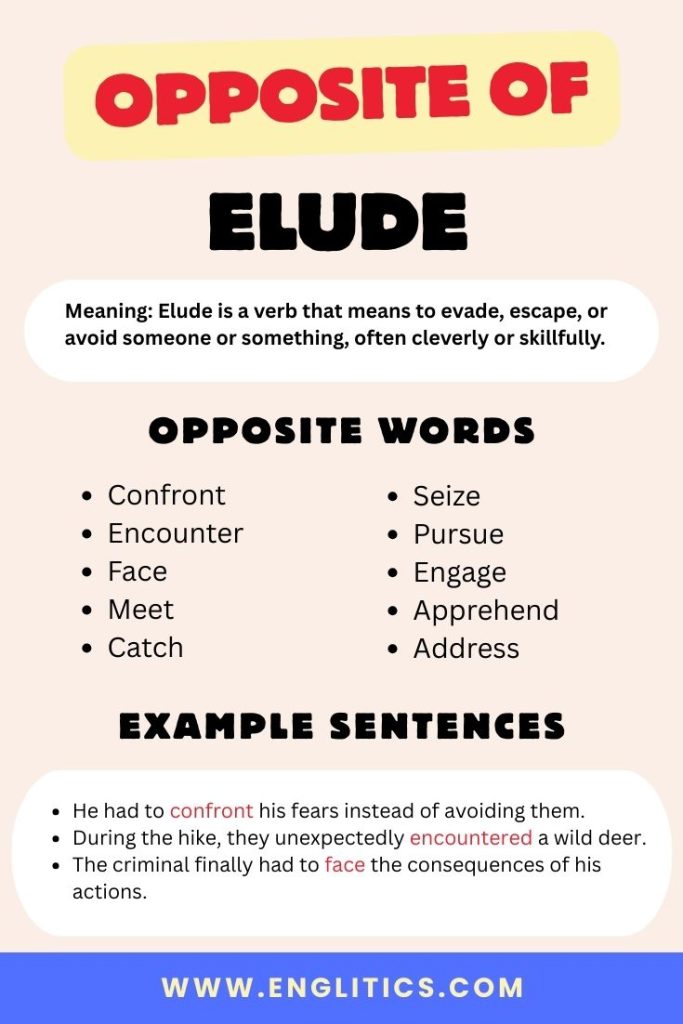
Antonyms for “elude” cover a range of meanings, from direct confrontation to comprehension and attraction. These antonyms can be categorized into several groups:
- Confrontation: Words like “confront,” “face,” and “encounter” imply direct engagement rather than avoidance.
- Attraction: Words like “attract,” “draw,” and “invite” suggest bringing something closer rather than escaping from it.
- Capture: Words like “capture,” “apprehend,” and “seize” indicate gaining control rather than losing it.
Each category offers a distinct perspective on the opposite of eluding, providing a rich vocabulary for expressing contrasting ideas.
Confront
“Confront” means to face someone or something directly and often aggressively. It implies a willingness to engage with a challenge or problem, rather than avoid it.
Definition: To deal with something directly and assertively.
Usage: When you confront a problem, you address it head-on. When you confront a person, you address them directly, often about an issue.
The following table provides examples of how “confront” acts as an antonym for “elude”.
| Example | Explanation |
|---|---|
| Instead of eluding the issue, he decided to confront it directly. | Here, “confront” is the direct opposite of “elude,” showing active engagement rather than avoidance. |
| She didn’t elude her fears; she confronted them with courage. | Instead of avoiding her fears, she faced them head-on. |
| The politician chose to confront the scandal rather than elude the media. | The politician addressed the scandal instead of trying to avoid the media’s attention. |
| He confronted his opponent, not eluding the challenge. | He accepted the challenge instead of avoiding it. |
| She confronted the difficult task, refusing to elude the hard work. | She embraced the task instead of trying to avoid the hard work. |
| The company decided to confront the declining sales figures, instead of eluding the problem. | The company addressed the problem instead of ignoring it. |
| The detective confronted the suspect, not eluding the truth. | The detective directly questioned the suspect to uncover the truth. |
| The manager confronted the employee about his poor performance, instead of eluding the necessary conversation. | The manager directly addressed the employee about his performance issues. |
| The doctor confronted the patient with the diagnosis, not eluding the seriousness of the situation. | The doctor directly informed the patient about the diagnosis. |
| The teacher confronted the student about the plagiarism, instead of eluding the school rules. | The teacher addressed the student about the act of plagiarism. |
| The lawyer confronted the witness with the evidence, not eluding the facts. | The lawyer directly presented the evidence to the witness. |
| The therapist encouraged the patient to confront their past traumas, instead of eluding them. | The therapist advised the patient to address and deal with their past traumas. |
| The coach confronted the team about their lack of effort, instead of eluding the issue. | The coach addressed the team about their lack of effort. |
| The programmer confronted the bug in the code, instead of eluding the problem. | The programmer directly addressed the bug in the code to fix it. |
| The artist confronted the blank canvas, instead of eluding the creative challenge. | The artist embraced the challenge of creating art on a blank canvas. |
| The writer confronted the writer’s block, instead of eluding the need to write. | The writer addressed the challenge of writer’s block. |
| The negotiator confronted the opposing party, instead of eluding the difficult discussions. | The negotiator engaged directly with the other party in difficult discussions. |
| The activist confronted the corporation about its environmental impact, instead of eluding the issue. | The activist directly addressed the corporation about its environmental impact. |
| The homeowner confronted the contractor about the unfinished work, instead of eluding the problem. | The homeowner directly addressed the contractor about the incomplete work. |
| The student confronted the professor about the unclear instructions, instead of eluding the confusion. | The student addressed the professor about the unclear instructions. |
| The journalist confronted the politician with tough questions, instead of eluding the issues. | The journalist directly questioned the politician. |
| The scientist confronted the data that contradicted their hypothesis, instead of eluding the findings. | The scientist addressed the data instead of ignoring it. |
| The athlete confronted the pain, instead of eluding the need for training. | The athlete addressed the pain and continued training. |
Face
“Face” means to confront and deal with something directly. It implies a direct encounter with a challenge or difficulty, rather than avoiding it.
Definition: To confront and deal with a difficult situation or person.
Usage: Facing a problem involves acknowledging and addressing it directly, without evasion.
The following table provides examples of how “face” acts as an antonym for “elude”.
| Example | Explanation |
|---|---|
| Instead of eluding the truth, she decided to face it head-on. | Here, “face” is the direct opposite of “elude,” indicating a direct confrontation with reality. |
| He didn’t elude his responsibilities; he faced them with determination. | Instead of avoiding his responsibilities, he tackled them with resolve. |
| The company chose to face the economic downturn rather than elude the challenges. | The company confronted the economic challenges instead of trying to avoid them. |
| She faced her fears, not eluding the opportunity for growth. | She confronted her fears instead of avoiding them, thus allowing personal growth. |
| He faced the consequences of his actions, refusing to elude the punishment. | He accepted the consequences instead of trying to evade them. |
| The team faced the difficult opponent, not eluding the tough competition. | The team met the opponent head-on instead of avoiding the match. |
| The student faced the exam, instead of eluding the challenge. | The student confronted the exam with confidence. |
| The public official faced the press, instead of eluding the questions. | The public official answered all the questions from the press. |
| The detective faced the suspect, instead of eluding the truth. | The detective confronted the suspect to uncover the truth. |
| The doctor faced the difficult diagnosis, instead of eluding the patient’s questions. | The doctor answered the patient’s questions. |
| The politician faced the voters, instead of eluding the public debate. | The politician participated in a public debate. |
| The entrepreneur faced the risks, instead of eluding the business challenges. | The entrepreneur embraces the business challenges. |
| The scientist faced the criticism, instead of eluding the peer review. | The scientist answered the questions asked by his peers. |
| The musician faced the audience, instead of eluding the performance. | The musician performed in front of the audience. |
| The artist faced the critics, instead of eluding the reviews. | The artist read the reviews. |
| The writer faced the blank page, instead of eluding the writer’s block. | The writer wrote on the blank page. |
| The actor faced the camera, instead of eluding the scene. | The actor filmed the scene. |
| The developer faced the deadline, instead of eluding the project. | The developer worked hard to deliver the project on time. |
| The manager faced the budget cuts, instead of eluding the financial issues. | The manager talked about the budget cuts. |
| The athlete faced the competition, instead of eluding the race. | The athlete competed in the race. |
| The chef faced the challenge, instead of eluding the new recipe. | The chef cooked the new recipe. |
| The explorer faced the unknown, instead of eluding the jungle. | The explorer went to the jungle. |
| The teacher faced the disruptive student, instead of eluding the classroom management. | The teacher talked to the student. |
Encounter
“Encounter” means to meet someone or something unexpectedly or to experience something, often a difficulty. It suggests a direct meeting rather than avoidance.
Definition: To unexpectedly experience or be faced with something difficult or hostile.
Usage: Encountering a problem means coming across it and dealing with it, often without prior planning.
The following table provides examples of how “encounter” acts as an antonym for “elude”.
| Example | Explanation |
|---|---|
| Instead of eluding the bear, they encountered it on the trail. | Here, “encounter” means they met the bear directly, rather than avoiding it. |
| She didn’t elude the challenges; she encountered them with resilience. | Instead of avoiding challenges, she faced them with strength. |
| The team encountered strong resistance, not eluding the difficult match. | The team faced strong opposition instead of avoiding the match. |
| The traveler encountered a storm, not eluding the bad weather. | The traveler faced the storm instead of avoiding the weather. |
| The hiker encountered a steep climb, not eluding the difficult terrain. | The hiker faced the steep climb instead of avoiding the terrain. |
| The ship encountered rough seas, not eluding the storm. | The ship faced the rough seas instead of avoiding the storm. |
| The scientist encountered an unexpected result, instead of eluding the data. | The scientist analyzed the data. |
| The detective encountered a clue, instead of eluding the evidence. | The detective investigated the clue. |
| The doctor encountered a rare disease, instead of eluding the diagnosis. | The doctor diagnosed the rare disease. |
| The writer encountered writer’s block, instead of eluding the empty page. | The writer tried to write. |
| The actor encountered stage fright, instead of eluding the performance. | The actor performed on stage. |
| The musician encountered a flat note, instead of eluding the song. | The musician continued playing the song. |
| The artist encountered criticism, instead of eluding the gallery. | The artist presented his art in the gallery. |
| The chef encountered a problem, instead of eluding the kitchen. | The chef tried to fix the problem. |
| The programmer encountered a bug, instead of eluding the code. | The programmer tried to fix the bug. |
| The student encountered a difficult question, instead of eluding the exam. | The student tried to answer the question. |
| The politician encountered protesters, instead of eluding the rally. | The politician talked to the protesters. |
| The athlete encountered an injury, instead of eluding the competition. | The athlete kept competing. |
| The entrepreneur encountered a setback, instead of eluding the business. | The entrepreneur tried to solve the problem. |
| The explorer encountered a new species, instead of eluding the jungle. | The explorer studied the new species. |
| The teacher encountered a disruptive student, instead of eluding the classroom. | The teacher tried to calm the student. |
| The negotiator encountered resistance, instead of eluding the talks. | The negotiator tried to solve the problem. |
| The journalist encountered censorship, instead of eluding the story. | The journalist wrote the story. |
Meet
“Meet” means to encounter or come into contact with someone or something. It implies a direct interaction rather than avoidance.
Definition: To come into the presence or company of someone or something.
Usage: Meeting a challenge involves facing it directly and engaging with it.
The following table provides examples of how “meet” acts as an antonym for “elude”.
| Example | Explanation |
|---|---|
| Instead of eluding the deadline, she met it with hard work. | Here, “meet” means she completed the work by the deadline, rather than avoiding it. |
| He didn’t elude the expectations; he met them with dedication. | Instead of avoiding the expectations, he fulfilled them with commitment. |
| The company met the demands, not eluding the customer’s needs. | The company fulfilled the demands instead of ignoring the customer’s needs. |
| The team met the challenge, not eluding the difficult task. | The team faced the difficult task. |
| The student met the requirements, not eluding the criteria. | The student fulfilled the requirements. |
| The athlete met the record, not eluding the goal. | The athlete broke the record. |
| The chef met the standards, not eluding the expectations. | The chef cooked the meal. |
| The artist met the vision, not eluding the creativity. | The artist painted the painting. |
| The writer met the deadline, not eluding the need to write. | The writer wrote the book. |
| The actor met the role, not eluding the character. | The actor played the role. |
| The musician met the rhythm, not eluding the music. | The musician played the music. |
| The programmer met the objective, not eluding the code. | The programmer coded the program. |
| The detective met the case, not eluding the investigation. | The detective investigated the case. |
| The doctor met the patient, not eluding the diagnosis. | The doctor diagnosed the patient. |
| The politician met the voters, not eluding the election. | The politician talked to the voters. |
| The entrepreneur met the investor, not eluding the funding. | The entrepreneur received the funding. |
| The scientist met the discovery, not eluding the research. | The scientist made the discovery. |
| The explorer met the unknown, not eluding the adventure. | The explorer explored the unknown. |
| The teacher met the student, not eluding the teaching. | The teacher taught the student. |
| The negotiator met the terms, not eluding the agreement. | The negotiator made the agreement. |
| The journalist met the source, not eluding the story. | The journalist wrote the story. |
| The athlete met the challenge, not eluding the competition. | The athlete competed in the competition. |
| The chef met the order, not eluding the cooking. | The chef cooked the meal. |
Attract
“Attract” means to draw someone or something towards oneself. It implies bringing something closer rather than escaping from it.
Definition: To cause to come to a place or participate in a venture by offering something of interest or advantage.
Usage: Attracting attention involves drawing it towards oneself, the opposite of avoiding it.
The following table provides examples of how “attract” acts as an antonym for “elude”.
| Example | Explanation |
|---|---|
| Instead of eluding attention, the celebrity tried to attract it. | Here, “attract” is the opposite of “elude,” showing a desire to be noticed rather than avoided. |
| The company worked to attract customers, not eluding potential clients. | Instead of avoiding potential clients, the company tried to bring them in. |
| The flower’s scent attracted bees, not eluding them. | The scent drew the bees in, the opposite of keeping them away. |
| The light attracted moths, not eluding them. | The moths flew into the light. |
| The music attracted dancers, not eluding them. | The dancers danced to the music. |
| The food attracted customers, not eluding them. | The customers bought the food. |
| The art attracted viewers, not eluding them. | The viewers looked at the art. |
| The story attracted readers, not eluding them. | The readers read the story. |
| The movie attracted audiences, not eluding them. | The audiences watched the movie. |
| The game attracted players, not eluding them. | The players played the game. |
| The sale attracted shoppers, not eluding them. | The shoppers bought the items on sale. |
| The event attracted attendees, not eluding them. | The attendees went to the event. |
| The advertisement attracted consumers, not eluding them. | The consumers bought the product. |
| The speaker attracted listeners, not eluding them. | The listeners listened to the speaker. |
| The leader attracted followers, not eluding them. | The followers followed the leader. |
| The magnet attracted metal, not eluding it. | The metal stuck to the magnet. |
| The honey attracted ants, not eluding them. | The ants surrounded the honey. |
| The warmth attracted people, not eluding them. | The people went to the warm place. |
| The job attracted applicants, not eluding them. | The applicants applied for the job. |
| The opportunity attracted entrepreneurs, not eluding them. | The entrepreneurs tried to take the opportunity. |
| The challenge attracted competitors, not eluding them. | The competitors competed. |
| The prize attracted participants, not eluding them. | The participants took part in the competition. |
| The invitation attracted guests, not eluding them. | The guests went to the party. |
Draw
“Draw” means to attract or cause to move towards a particular place or person. It implies pulling something closer rather than letting it escape.
Definition: To attract or entice.
Usage: Drawing attention involves attracting it towards oneself, the opposite of avoiding it.
The following table provides examples of how “draw” acts as an antonym for “elude”.
| Example | Explanation |
|---|---|
| Instead of eluding attention, the artist’s work drew crowds. | Here, “draw” means the artwork attracted people, the opposite of avoiding attention. |
| The advertisement drew customers, not eluding potential buyers. | Instead of avoiding potential buyers, the advertisement attracted them. |
| The music drew dancers to the floor, not eluding them. | The music made the dancers dance. |
| The scent drew bees to the flowers, not eluding them. | The scent attracted the bees. |
| The light drew moths, not eluding them. | The light attracted the moths. |
| The food drew hungry people, not eluding them. | The food attracted the people. |
| The performance drew audiences, not eluding them. | The performance attracted the audience. |
| The speaker drew listeners, not eluding them. | The speaker attracted the listeners. |
| The story drew readers, not eluding them. | The story attracted the readers. |
| The event drew attendees, not eluding them. | The event attracted the attendees. |
| The offer drew applicants, not eluding them. | The offer attracted the applicants. |
| The opportunity drew entrepreneurs, not eluding them. | The opportunity attracted the entrepreneurs. |
| The challenge drew competitors, not eluding them. | The challenge attracted the competitors. |
| The prize drew participants, not eluding them. | The prize attracted the participants. |
| The invitation drew guests, not eluding them. | The invitation attracted the guests. |
| The warmth drew people, not eluding them. | The warmth attracted the people. |
| The magnet drew metal, not eluding it. | The magnet attracted the metal. |
| The honey drew ants, not eluding them. | The honey attracted the ants. |
| The colors drew the eye, not eluding it. | The colors attracted the eye. |
| The sound drew attention, not eluding it. | The sound attracted the attention. |
| The aroma drew customers, not eluding them. | The aroma attracted the customers. |
| The display drew shoppers, not eluding them. | The display attracted the shoppers. |
| The mystery drew investigators, not eluding them. | The mystery attracted the investigators. |
Invite
“Invite” means to request someone to come to a place or to do something. It implies bringing someone closer rather than escaping from them.
Definition: To request the presence or participation of someone.
Usage: Inviting someone to an event is the opposite of avoiding them.
The following table provides examples of how “invite” acts as an antonym for “elude”.
| Example | Explanation |
|---|---|
| Instead of eluding guests, they decided to invite them to the party. | Here, “invite” is the opposite of “elude,” showing a desire to include people rather than avoid them. |
| The company invited feedback, not eluding customer opinions. | Instead of avoiding customer opinions, the company sought them out. |
| The host invited everyone to participate, not eluding anyone. | The host allowed everyone to participate. |
| The teacher invited questions, not eluding student inquiries. | The teacher let students ask questions. |
| The speaker invited discussion, not eluding different opinions. | The speaker let people discuss. |
| The leader invited participation, not eluding team involvement. | The leader let the team participate. |
| The organizer invited volunteers, not eluding help. | The organizer let the volunteers help. |
| The manager invited suggestions, not eluding employee ideas. | The manager let the employees suggest. |
| The artist invited interpretation, not eluding viewer perception. | The artist let the viewers interpret the painting. |
| The writer invited criticism, not eluding reader reviews. | The writer let the readers write reviews. |
| The musician invited collaboration, not eluding other artists. | The musician collaborated with other artists. |
| The programmer invited contributions, not eluding open source development. | The programmer let others contribute. |
| The detective invited witnesses, not eluding information. | The detective asked the witnesses questions. |
| The doctor invited patients, not eluding medical care. | The doctor let the patients come to his office. |
| The politician invited voters, not eluding public engagement. | The politician talked to the voters. |
| The entrepreneur invited investors, not eluding funding opportunities. | The entrepreneur asked the investors for funding. |
| The scientist invited peers, not eluding scientific review. | The scientist asked his peers. |
| The explorer invited adventurers, not eluding discovery. | The explorer asked the adventurers to come with him. |
| The chef invited diners, not eluding culinary experience. | The chef asked the diners to eat his food. |
| The athlete invited fans, not eluding support. | The athlete asked the fans for support. |
| The negotiator invited dialogue, not eluding compromise. | The negotiator tried to compromise. |
| The journalist invited sources, not eluding factual information. | The journalist asked the sources for information. |
| The company invited applications, not eluding potential hires. | The company asked people to apply for the job. |
Capture
“Capture” means to take into one’s possession or control by force or skill. It implies gaining control rather than losing it.
Definition: To take into one’s possession or control.
Usage: Capturing an enemy means gaining control over them, the opposite of letting them escape.
The following table provides examples of how “capture” acts as an antonym for “elude”.
| Example | Explanation |
|---|---|
| Instead of eluding the enemy, the soldiers managed to capture them. | Here, “capture” is the direct opposite of “elude,” showing gaining control rather than escaping. |
| The police captured the suspect, not eluding justice. | Instead of letting the suspect escape, the police apprehended them. |
| The photographer captured the moment, not eluding the perfect shot. | The photographer took the perfect shot. |
| The fisherman captured the fish, not eluding the catch. | The fisherman caught the fish. |
| The trap captured the animal, not eluding the prey. | The trap caught the animal. |
| The net captured the butterflies, not eluding them. | The net caught the butterflies. |
| The software captured the data, not eluding the information. | The software collected the data. |
| The reporter captured the story, not eluding the truth. | The reporter wrote the story. |
| The artist captured the scene, not eluding the beauty. | The artist painted the painting. |
| The writer captured the feeling, not eluding the emotion. | The writer wrote the book. |
| The actor captured the role, not eluding the character. | The actor played the role. |
| The musician captured the melody, not eluding the music. | The musician played the music. |
| The programmer captured the bug, not eluding the error. | The programmer fixed the bug. |
| The detective captured the criminal, not eluding the justice. | The detective arrested the criminal. |
| The doctor captured the disease, not eluding the diagnosis. | The doctor diagnosed the disease. |
| The chef captured the flavor, not eluding the taste. | The chef prepared the meal. |
| The student captured the concept, not eluding the understanding. | The student understood the concept. |
| The politician captured the vote, not eluding the election. | The politician won the vote. |
| The entrepreneur captured the market, not eluding the success. | The entrepreneur was successful. |
| The scientist captured the data, not eluding the discovery. | The scientist made the discovery. |
| The explorer captured the summit, not eluding the adventure. | The explorer climbed the summit. |
| The teacher captured the attention, not eluding the learning. | The teacher taught the class. |
| The negotiator captured the agreement, not eluding the deal. | The negotiator made the deal. |
| The athlete captured the victory, not eluding the competition. | The athlete won the competition. |
Apprehend
“Apprehend” means to seize or arrest someone. It implies taking someone into custody, the opposite of letting them escape.
Definition: To arrest someone for a crime.
Usage: Apprehending a criminal means capturing them and bringing them to justice, not allowing them to elude authorities.
The following table provides examples of how “apprehend” acts as an antonym for “elude”.
| Example | Explanation |
|---|---|
| Instead of eluding the police, the suspect was apprehended. | Here, “apprehend” means the police caught and arrested the suspect, the opposite of escaping. |
| The authorities apprehended the fugitive, not eluding justice. | Instead of letting the fugitive escape, the authorities captured them. |
| The officers apprehended the thief, not eluding the law. | The officers caught the thief. |
| The security guards apprehended the intruder, not eluding the premises. | The security guards caught the intruder. |
| The soldiers apprehended the spy, not eluding the intelligence. | The soldiers caught the spy. |
| The police apprehended the vandal, not eluding the property damage. | The police caught the vandal. |
| The detectives apprehended the suspect, not eluding the truth. | The detectives caught the suspect. |
| The FBI apprehended the terrorist, not eluding the threat. | The FBI caught the terrorist. |
| The border patrol apprehended the smuggler, not eluding the contraband. | The border patrol caught the smuggler. |
| The coast guard apprehended the pirate, not eluding the sea. | The coast guard caught the pirate. |
| The park ranger apprehended the poacher, not eluding the wildlife. | The park ranger caught the poacher. |
| The school principal apprehended the bully, not eluding the safety. | The school principal caught the bully. |
| The store manager apprehended the shoplifter, not eluding the theft. | The store manager caught the shoplifter. |
| The landlord apprehended the trespasser, not eluding the property rights. | The landlord caught the trespasser. |
| The homeowner apprehended the burglar, not eluding the security. | The homeowner caught the burglar. |
| The museum curator apprehended the art thief, not eluding the heritage. | The museum curator caught the art thief. |
| The librarian apprehended the book thief, not eluding the knowledge. | The librarian caught the book thief. |
| The judge apprehended the corrupt official, not eluding the justice. | The judge caught the corrupt official. |
| The prosecutor apprehended the fraudster, not eluding the law. | The prosecutor caught the fraudster. |
| The defense attorney apprehended the truth, not eluding the facts. | The defense attorney discovered the truth. |
| The journalist apprehended the story, not eluding the information. | The journalist wrote the story. |
| The historian apprehended the past, not eluding the events. | The historian wrote about the past. |
| The scientist apprehended the discovery, not eluding the research. | The scientist made the discovery. |
Seize
“Seize” means to take hold of something suddenly and forcibly. It implies gaining control quickly, the opposite of letting something elude one’s grasp.
Definition: To take hold of suddenly and forcibly
Usage: Seizing an opportunity means taking advantage of it quickly, not letting it pass by.
The following table provides examples of how “seize” acts as an antonym for “elude”.
| Example | Explanation |
|---|---|
| Instead of eluding the opportunity, she seized it with both hands. | Here, “seize” means she took immediate advantage of the opportunity, the opposite of letting it pass. |
| The army seized the territory, not eluding control. | Instead of losing control, the army took control of the territory. |
| The company seized the market share, not eluding success. | The company was successful. |
| The athlete seized the victory, not eluding the competition. | The athlete won the competition. |
| The detective seized the evidence, not eluding the truth. | The detective found the evidence. |
| The doctor seized the moment, not eluding the diagnosis. | The doctor made the diagnosis. |
| The politician seized the chance, not eluding the power. | The politician got the power. |
| The entrepreneur seized the initiative, not eluding the innovation. | The entrepreneur was innovative. |
| The scientist seized the discovery, not eluding the knowledge. | The scientist made the discovery. |
| The explorer seized the adventure, not eluding the journey. | The explorer went on the journey. |
| The teacher seized the attention, not eluding the teaching. | The teacher taught the lesson. |
| The negotiator seized the agreement, not eluding the deal. | The negotiator made the agreement. |
| The journalist seized the scoop, not eluding the story. | The journalist wrote the story. |
| The artist seized the inspiration, not eluding the creativity. | The artist made the art. |
| The writer seized the idea, not eluding the words. | The writer wrote the book. |
| The musician seized the rhythm, not eluding the music. | The musician played the music. |
| The programmer seized the code, not eluding the solution. | The programmer programmed the code. |
| The chef seized the flavor, not eluding the taste. | The chef cooked the meal. |
| The student seized the knowledge, not eluding the understanding. | The student understood the lesson. |
| The leader seized the power, not eluding the responsibility. | The leader took the responsibility. |
| The manager seized the control, not eluding the authority. | The manager became the authority. |
| The parent seized the opportunity, not eluding the education. | The parent educated the children. |
| The mentor seized the chance, not eluding the guidance. | The mentor guided the mentee. |
Usage Rules for Antonyms of Elude
When using antonyms of “elude,” it’s essential to consider the context to ensure accurate and effective communication. Here are some usage rules to guide you:
- Confrontation: Use “confront” or “face” when you want to emphasize direct engagement with a problem or challenge. For example, “Instead of eluding the issue, she decided to confront it head-on.”
- Attraction: Use “attract,” “draw,” or “invite” when you want to highlight the act of bringing something or someone closer. For example, “The company worked to attract customers, not eluding potential clients.”
- Capture: Use “capture,” “apprehend,” or “seize” when you want to emphasize gaining control or possession. For example, “Instead of eluding the enemy, the soldiers managed to capture them.”
Understanding these nuances will help you choose the most appropriate antonym to convey your intended meaning.
Common Mistakes
Even with a clear understanding of antonyms, it’s easy to make mistakes in usage. Here are some common mistakes to avoid when using antonyms of “elude”:
- Incorrect Antonym Choice: Choosing an antonym that doesn’t fit the context. For example, using “attract” when “confront” is more appropriate.
- Misunderstanding Nuances: Overlooking the subtle differences between antonyms. For example, using “meet” when “encounter” is more fitting.
- Grammatical Errors: Using the antonym in the wrong tense or form. For example, “He eludes faced the problem” (Correct: He faced the problem).
Being aware of these common pitfalls can help you avoid errors and use antonyms effectively.
Practice Exercises
Test your understanding with these practice exercises. Fill in the blanks with the most appropriate antonym of “elude” from the options provided.
1. Instead of eluding the challenge, the team decided to ________ it head-on.
(confront, attract, capture)
Answer: confront
2. The company worked hard to ________ new customers, not eluding potential clients.
(draw, seize, meet)
Answer: draw
3. The police managed to ________ the suspect, not eluding justice.
(apprehend, invite, face)
Answer: apprehend
4. She decided to ________ her fears instead of eluding them.
(face, attract, seize)
Answer: face
5. The event aimed to ________ attendees, not eluding participants.
(invite, confront, capture)
Answer: invite
Advanced Topics
For a deeper understanding, consider these advanced topics related to antonyms of “elude”:
- Figurative Language: How antonyms of “elude” are used in metaphors and similes to create vivid imagery and convey complex ideas.
- Contextual Variations: How the meaning of antonyms changes depending on the specific context and situation.
- Cross-Cultural Differences: How different cultures perceive and use antonyms of “elude,” reflecting diverse values and perspectives.
Exploring these topics can provide a more nuanced and sophisticated understanding of language.
FAQ
What is the best antonym for “elude” in a general context?
The best antonym depends on the specific context. However, “confront” and “capture” are often suitable general antonyms.
How can understanding antonyms improve my writing?
Understanding antonyms allows you to express contrasting ideas more effectively, add depth and nuance to your writing, and enhance overall clarity.
Are there any situations where “elude” and its antonyms can be used interchangeably?
No, “elude” and its antonyms have distinct meanings and should not be used interchangeably. Always consider the context to choose the most appropriate word.
Conclusion
Mastering the antonyms of “elude” is a valuable skill that enhances your vocabulary and improves your ability to communicate effectively. By understanding the nuances of words like “confront,” “attract,” and “capture,” you can express a wider range of ideas and convey your intended meaning with precision.
Whether you are writing, speaking, or simply trying to understand language better, this guide provides a solid foundation for expanding your linguistic toolkit.