The Opposite of Enough highlights situations where there’s a shortage, lack, or need for more. While “enough” means having just the right amount or meeting a need, its antonyms describe not meeting that standard—whether in quantity, quality, or ability.
Antonyms for Enough include insufficient, inadequate, and lacking. This guide will walk you through these terms with clear examples, helping you use them correctly in everyday situations or formal writing. Whether you’re studying English or polishing your communication skills, knowing these opposites will strengthen your vocabulary.
Defining “Enough”
The word “enough” is a versatile term in the English language that can function as a determiner, an adverb, or a pronoun. Its primary meaning revolves around sufficiency or adequacy.
It indicates that there is a quantity, quality, or degree that meets a particular requirement or satisfies a specific need. Understanding the different roles “enough” plays is crucial for grasping the concept of its antonyms.
As a determiner, “enough” precedes a noun and specifies that the quantity of that noun is sufficient. For example, “We have enough food for everyone.” As an adverb, “enough” modifies an adjective or another adverb, indicating that something is adequate to a certain degree. For example, “The water was warm enough to swim in.” As a pronoun, “enough” stands alone and refers to a sufficient amount or quantity that has already been mentioned or is understood. For example, “I’ve had enough, thank you.”
Structural Breakdown of “Enough”
The word “enough” doesn’t have a complex structure, but its placement within a sentence is crucial for conveying the intended meaning. When used as a determiner, it typically comes before the noun it modifies.
When used as an adverb, it usually follows the adjective or adverb it modifies. This placement is important to distinguish it from other similar words.
Consider the following examples:
- Determiner: “There are enough chairs for all the guests.” (Enough modifies the noun “chairs”)
- Adverb: “The music is loud enough.” (Enough modifies the adjective “loud”)
- Pronoun: “Just give me enough.” (Enough stands alone, referring to a previously mentioned quantity)
Understanding these structural patterns will help you use “enough” and its antonyms correctly and avoid common grammatical errors.
Opposite of Enough
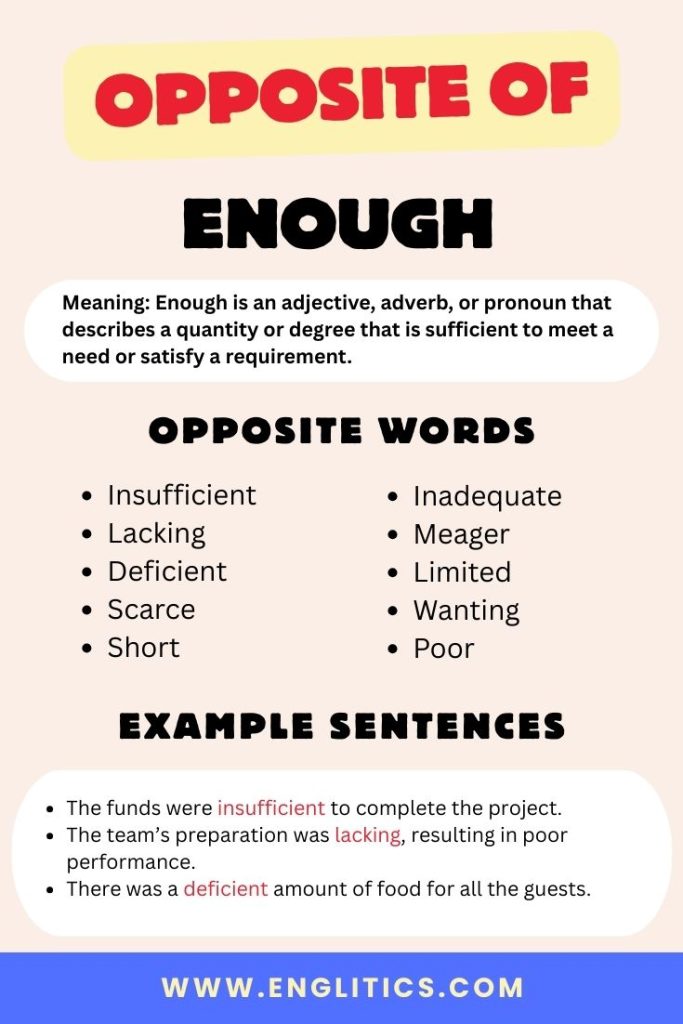
The antonyms for “enough” vary depending on the specific context. They generally express a state of deficiency or inadequacy.
Here are some of the most common antonyms, each with its own specific nuance:
Insufficient
“Insufficient” means not enough or inadequate for a specific purpose or need. It implies a lack that prevents something from being fully effective or satisfactory.
This is perhaps the most direct and common antonym for “enough.”
Lacking
“Lacking” indicates the absence of something that is needed or desired. It suggests a deficiency that can range from minor to significant, depending on the context.
This term often describes a specific missing element.
Scarce
“Scarce” refers to something that is limited in quantity or availability. It implies a shortage, often due to high demand or limited resources.
This antonym is particularly relevant when discussing resources and supplies.
Deficient
“Deficient” means lacking an essential quality or element. It suggests a significant inadequacy that can have negative consequences.
This term is frequently used in technical or scientific contexts.
Limited
“Limited” indicates that something is restricted in quantity, extent, or scope. It suggests a boundary or constraint that prevents something from being fully realized.
This term is often used to describe resources or capabilities.
Wanting
“Wanting” (when used as an adjective) means lacking or deficient in some respect. It implies a need or desire for something that is not present.
This word can sometimes carry a more formal or literary tone.
Inadequate
“Inadequate” means not good enough or not sufficient for a particular purpose. It suggests that something falls short of the required standard or expectation.
This term is commonly used to describe performance or quality.
Meager
“Meager” refers to something that is scanty, poor, or insufficient in quantity or quality. It implies a small or inadequate amount, often suggesting poverty or deprivation.
This word often describes resources or provisions.
Examples of Antonyms in Use
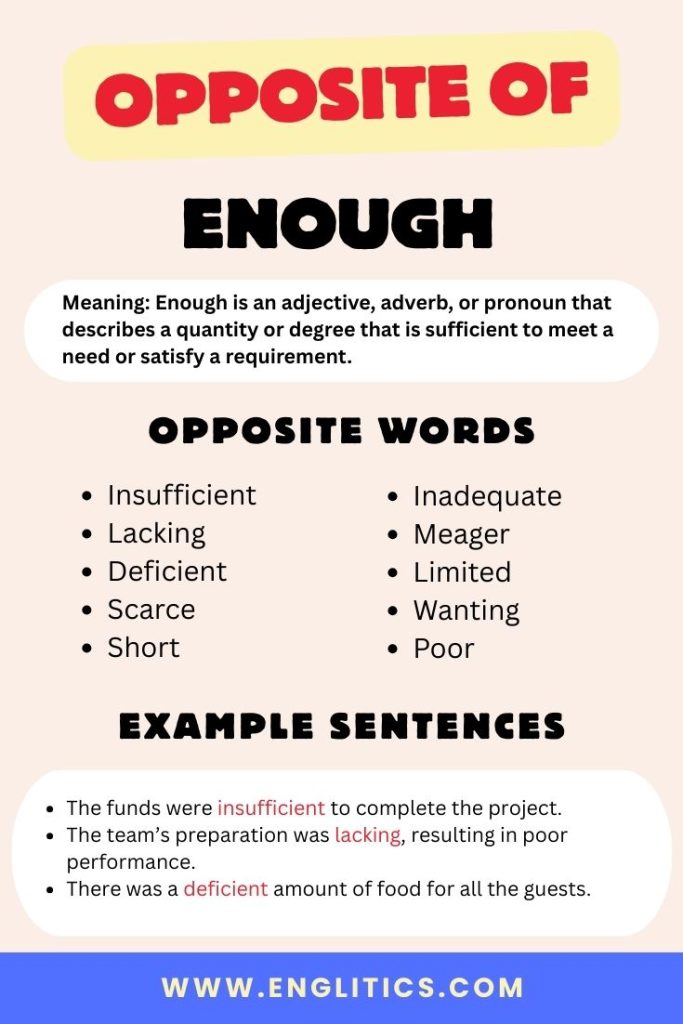
To fully understand the nuances of these antonyms, let’s explore how they are used in various contexts. The tables below provide examples illustrating the different shades of meaning each word conveys.
Table 1: Examples using “Insufficient”
This table showcases examples of sentences using the antonym “insufficient” in place of “enough”. Each sentence demonstrates a different context where “insufficient” highlights a lack of adequacy.
| Original Sentence (Using “Enough”) | Sentence with “Insufficient” |
|---|---|
| We have enough funding for the project. | We have insufficient funding for the project. |
| The evidence is enough to convict him. | The evidence is insufficient to convict him. |
| There is enough time to finish the task. | There is insufficient time to finish the task. |
| She had enough experience for the job. | She had insufficient experience for the job. |
| The supply of water was enough for the village. | The supply of water was insufficient for the village. |
| He had enough information to make a decision. | He had insufficient information to make a decision. |
| The security measures were enough to prevent theft. | The security measures were insufficient to prevent theft. |
| They had enough resources to complete the mission. | They had insufficient resources to complete the mission. |
| The explanation was enough to satisfy the audience. | The explanation was insufficient to satisfy the audience. |
| The support provided was enough to help them recover. | The support provided was insufficient to help them recover. |
| The data collected was enough to draw a conclusion. | The data collected was insufficient to draw a conclusion. |
| The training was enough to prepare them for the task. | The training was insufficient to prepare them for the task. |
| The light was enough to see clearly. | The light was insufficient to see clearly. |
| The space was enough to accommodate everyone. | The space was insufficient to accommodate everyone. |
| The fuel was enough to reach the destination. | The fuel was insufficient to reach the destination. |
| The medication was enough to relieve the pain. | The medication was insufficient to relieve the pain. |
| The staff was enough to handle the workload. | The staff was insufficient to handle the workload. |
| The budget was enough to cover the expenses. | The budget was insufficient to cover the expenses. |
| The preparation was enough to ensure success. | The preparation was insufficient to ensure success. |
| The protection was enough to keep them safe. | The protection was insufficient to keep them safe. |
| The help was enough to make a difference. | The help was insufficient to make a difference. |
| The heat was enough to melt the ice. | The heat was insufficient to melt the ice. |
| The detail was enough to paint the picture. | The detail was insufficient to paint the picture. |
Table 2: Examples using “Lacking”
This table illustrates the use of “lacking” as an antonym for “enough”. The examples demonstrate situations where a specific element or quality is absent, highlighting the deficiency.
| Original Sentence (Using “Enough”) | Sentence with “Lacking” |
|---|---|
| The report had enough detail. | The report was lacking in detail. |
| The team had enough motivation. | The team was lacking in motivation. |
| The strategy had enough foresight. | The strategy was lacking in foresight. |
| The presentation had enough clarity. | The presentation was lacking in clarity. |
| The argument had enough evidence. | The argument was lacking in evidence. |
| The performance had enough energy. | The performance was lacking in energy. |
| The design had enough creativity. | The design was lacking in creativity. |
| The explanation had enough depth. | The explanation was lacking in depth. |
| The solution had enough practicality. | The solution was lacking in practicality. |
| The project had enough support. | The project was lacking in support. |
| The recipe had enough flavor. | The recipe was lacking in flavor. |
| The room had enough light. | The room was lacking in light. |
| The candidate had enough experience. | The candidate was lacking experience. |
| The soil had enough nutrients. | The soil was lacking nutrients. |
| The car had enough power. | The car was lacking power. |
| The film had enough suspense. | The film was lacking suspense. |
| The book had enough excitement. | The book was lacking excitement. |
| The event had enough atmosphere. | The event was lacking atmosphere. |
| The artwork had enough originality. | The artwork was lacking originality. |
| The service had enough efficiency. | The service was lacking efficiency. |
| The communication had enough transparency. | The communication was lacking transparency. |
| The investigation had enough thoroughness. | The investigation was lacking thoroughness. |
| The software had enough security. | The software was lacking security. |
Table 3: Examples using “Scarce”
This table provides examples of “scarce” used as an antonym, highlighting situations where resources or commodities are limited and difficult to obtain.
| Original Sentence (Using “Enough”) | Sentence with “Scarce” |
|---|---|
| There was enough water during the drought. | Water was scarce during the drought. |
| Food was enough during the famine. | Food was scarce during the famine. |
| Jobs were enough in the small town. | Jobs were scarce in the small town. |
| Resources were enough after the disaster. | Resources were scarce after the disaster. |
| Money was enough for the basic necessities. | Money was scarce for the basic necessities. |
| Opportunities were enough in the rural area. | Opportunities were scarce in the rural area. |
| Medical supplies were enough in the war zone. | Medical supplies were scarce in the war zone. |
| Housing was enough after the hurricane. | Housing was scarce after the hurricane. |
| Fuel was enough during the energy crisis. | Fuel was scarce during the energy crisis. |
| Land was enough in the crowded city. | Land was scarce in the crowded city. |
| Clean air was enough in the industrial area. | Clean air was scarce in the industrial area. |
| Time was enough to complete the project. | Time was scarce to complete the project. |
| Talent was enough in the small town. | Talent was scarce in the small town. |
| Information was enough during the crisis. | Information was scarce during the crisis. |
| Kindness was enough among the strangers. | Kindness was scarce among the strangers. |
| Honesty was enough in the political arena. | Honesty was scarce in the political arena. |
| Patience was enough during the long wait. | Patience was scarce during the long wait. |
| Respect was enough in the heated debate. | Respect was scarce in the heated debate. |
| Trust was enough after the betrayal. | Trust was scarce after the betrayal. |
| Loyalty was enough during the difficult times. | Loyalty was scarce during the difficult times. |
| Empathy was enough in the community. | Empathy was scarce in the community. |
| Understanding was enough in the relationship. | Understanding was scarce in the relationship. |
| Forgiveness was enough after the offense. | Forgiveness was scarce after the offense. |
Table 4: Examples using “Deficient”
This table demonstrates the usage of “deficient” as an antonym for “enough”, emphasizing a lack of essential qualities or components.
| Original Sentence (Using “Enough”) | Sentence with “Deficient” |
|---|---|
| The diet had enough vitamins. | The diet was deficient in vitamins. |
| The soil had enough nutrients. | The soil was deficient in nutrients. |
| The engine had enough power. | The engine was deficient in power. |
| The blood had enough iron. | The blood was deficient in iron. |
| The system had enough security. | The system was deficient in security. |
| The research had enough data. | The research was deficient in data. |
| The building had enough insulation. | The building was deficient in insulation. |
| The air had enough oxygen. | The air was deficient in oxygen. |
| The knowledge had enough depth. | The knowledge was deficient in depth. |
| The skills had enough proficiency. | The skills were deficient in proficiency. |
| The food had enough flavor. | The food was deficient in flavor. |
| The light had enough intensity. | The light was deficient in intensity. |
| The explanation had enough clarity. | The explanation was deficient in clarity. |
| The plan had enough detail. | The plan was deficient in detail. |
| The analysis had enough insight. | The analysis was deficient in insight. |
| The understanding had enough nuance. | The understanding was deficient in nuance. |
| The communication had enough transparency. | The communication was deficient in transparency. |
| The investigation had enough thoroughness. | The investigation was deficient in thoroughness. |
| The training was enough preparation. | The training was deficient in preparation. |
| The support was enough assistance. | The support was deficient in assistance. |
| The resources were enough aid. | The resources were deficient in aid. |
| The funding was enough investment. | The funding was deficient in investment. |
| The effort was enough dedication. | The effort was deficient in dedication. |
Table 5: Examples using “Limited”
This table provides usage examples for the antonym “limited”, showing situations where the quantity, extent, or scope of something is restricted.
| Original Sentence (Using “Enough”) | Sentence with “Limited” |
|---|---|
| We have enough time to complete the project. | We have a limited amount of time to complete the project. |
| There is enough space in the room. | There is limited space in the room. |
| The budget is enough to cover all expenses. | The budget is limited, so we need to prioritize. |
| The resources are enough for our needs. | The resources are limited, requiring careful management. |
| The access to information is enough. | Access to information is limited to authorized personnel. |
| The number of tickets available is enough. | The number of tickets available is limited. |
| The scope of the investigation is enough. | The scope of the investigation is limited. |
| The opportunities are enough in this field. | Opportunities are limited in this field. |
| The freedom of speech is enough. | Freedom of speech is limited by certain laws. |
| The supply of electricity is enough. | The supply of electricity is limited during peak hours. |
| The area for development is enough. | The area for development is limited due to environmental concerns. |
| The potential for growth is enough. | The potential for growth is limited by market conditions. |
| The support we can offer is enough. | The support we can offer is limited by our resources. |
| The impact we can make is enough. | The impact we can make is limited by circumstances. |
| The involvement we can have is enough. | The involvement we can have is limited due to time constraints. |
| The knowledge we have is enough. | The knowledge we have is limited in this specific area. |
| The understanding we have is enough. | The understanding we have is limited without more information. |
| The control we have is enough. | The control we have is limited in this situation. |
| The influence we have is enough. | The influence we have is limited by our position. |
| The range of options is enough. | The range of options is limited. |
| The access to healthcare is enough. | Access to healthcare is limited in rural areas. |
| The amount of sunlight is enough. | The amount of sunlight is limited during the winter months. |
| The availability of clean water is enough. | The availability of clean water is limited in some regions. |
Usage Rules and Considerations
When choosing an antonym for “enough,” consider the specific context and the nuance you want to convey. “Insufficient” is a general term that can be used in most situations where something is not enough.
“Lacking” is suitable when referring to the absence of a specific element or quality. “Scarce” is best used when discussing limited resources or availability.
“Deficient” is appropriate in technical or scientific contexts, while “limited” indicates a restriction on quantity or scope. “Inadequate” emphasizes the failure to meet a required standard.
“Meager” highlights a small or inadequate amount, often in a negative or critical way.
Also, remember the grammatical role of “enough”. If “enough” is a determiner, its antonym must also function as a determiner or adjective.
If “enough” is an adverb, its antonym should also be an adverb or a phrase that can modify an adjective or adverb. Understanding these rules will ensure that you use the antonyms correctly and avoid grammatical errors.
Common Mistakes to Avoid
One common mistake is using “not enough” when a more precise antonym would be more effective. For example, instead of saying “The information was not enough,” it’s often better to say “The information was insufficient” or “The information was lacking in detail.” Another mistake is using the wrong antonym for the specific context.
For instance, using “scarce” when you really mean “inadequate” can change the meaning of the sentence.
Here are some examples of common mistakes and their corrections:
| Incorrect | Correct | Explanation |
|---|---|---|
| The resources were not enough. | The resources were insufficient. | “Insufficient” is more precise than “not enough.” |
| The water was scarce to swim in. | The water was not warm enough to swim in. | “Scarce” refers to limited availability, not temperature. |
| He had lacking money. | He had insufficient money. | “Lacking” needs a preposition (“lacking in”). |
| The food was inadequate of flavor. | The food was inadequate in flavor. | Correct preposition usage. |
Practice Exercises
Test your understanding of the antonyms for “enough” with these exercises.
Exercise 1: Choose the best antonym for “enough” in each sentence.
| Question | Options | Answer |
|---|---|---|
| The evidence presented was ____ to convict the suspect. | a) enough b) insufficient c) plentiful | b) insufficient |
| The team was ____ in leadership. | a) enough b) lacking c) abundant | b) lacking |
| Water was ____ during the drought. | a) enough b) scarce c) plentiful | b) scarce |
| The diet was ____ in essential vitamins. | a) enough b) deficient c) rich | b) deficient |
| There is a ____ amount of time to complete the project. | a) enough b) limited c) vast | b) limited |
| The funds provided were ____ to cover the expenses. | a) enough b) inadequate c) ample | b) inadequate |
| The meal was ____ to satisfy my hunger. | a) enough b) meager c) abundant | b) meager |
| The resources are ____ to handle the crisis. | a) enough b) wanting c) plentiful | b) wanting |
| The training was ____ to prepare them for the mission. | a) enough b) insufficient c) ample | b) insufficient |
| The explanation was ____ to clarify the situation. | a) enough b) inadequate c) thorough | b) inadequate |
Exercise 2: Rewrite the following sentences using an antonym for “enough.”
| Original Sentence | Rewritten Sentence |
|---|---|
| We have enough supplies for the trip. | We have insufficient supplies for the trip. |
| The presentation had enough detail. | The presentation was lacking in detail. |
| There was enough rainfall this year. | Rainfall was scarce this year. |
| The soil has enough nutrients for the plants. | The soil is deficient in nutrients for the plants. |
| We have enough time to finish the project. | We have limited time to finish the project. |
| The support was enough to make a difference. | The support was inadequate to make a difference. |
| The food was enough to satisfy their hunger. | The food was meager and did not satisfy their hunger. |
| The preparation was enough to ensure success. | The preparation was wanting and did not ensure success. |
| The data was enough to support the hypothesis. | The data was insufficient to support the hypothesis. |
| The light was enough to see in the dark. | The light was inadequate to see in the dark. |
Advanced Topics
For advanced learners, consider exploring idiomatic expressions that use “enough” and its antonyms. For example, “to have had enough” means to have reached one’s limit of tolerance.
Also, delve into the subtle differences between synonyms of the antonyms, such as “scanty,” “paltry,” and “deficient,” to further refine your vocabulary and understanding.
Furthermore, analyze how the choice of antonym can impact the tone and register of your writing. Using “meager” can create a more negative and critical tone than using “limited.” Understanding these nuances will enable you to express yourself with greater precision and sophistication.
Frequently Asked Questions
Q1: Is “not enough” always the best antonym for “enough”?
A: While “not enough” is grammatically correct, it is often less precise and less impactful than using a specific antonym like “insufficient,” “lacking,” or “scarce.” Choosing a more specific antonym can convey a clearer and more nuanced meaning.
Q2: How do I choose the right antonym for “enough”?
A: Consider the context and the specific nuance you want to convey. “Insufficient” is a general term, “lacking” indicates the absence of something specific, “scarce” refers to limited availability, “deficient” suggests a lack of essential qualities, “limited” indicates a restriction on quantity or scope, “inadequate” emphasizes the failure to meet a standard, and “meager” highlights a small or poor amount.
Q3: Can “enough” have more than one antonym in a sentence?
A: Yes, depending on the context. For example, “The resources were not enough; they were both scarce and inadequate.” In this case, both “scarce” and “inadequate” accurately describe the deficiency.
Q4: Are there any regional variations in the use of antonyms for “enough”?
A: While the core meanings of these antonyms are consistent across English-speaking regions, some idiomatic expressions or specific usages might vary. It’s always a good idea to be aware of the context and audience when choosing your words.
Q5: What is the difference between “insufficient” and “inadequate”?
A: “Insufficient” generally means not enough, while “inadequate” means not good enough or not meeting a required standard. “Insufficient” focuses on quantity or amount, while “inadequate” focuses on quality or suitability.
Q6: Is “too little” an antonym for “enough”?
A: Yes, “too little” can be considered an antonym for “enough,” especially when “enough” refers to a quantity. However, like “not enough,” it is often less precise than other antonyms.
Q7: When is it best to use “wanting” as an antonym for “enough”?
A: “Wanting” is best used in more formal or literary contexts to describe a lack or deficiency. It can also imply a longing or desire for what is missing.
Q8: How can I improve my vocabulary of
antonyms?
A: Reading widely, using a thesaurus, and practicing using new words in context are all effective ways to improve your vocabulary. Pay attention to how different words are used in different situations, and don’t be afraid to experiment with new vocabulary in your writing and speaking.
Conclusion
Understanding the antonyms for “enough” is a valuable asset for anyone seeking to enhance their English language skills. By mastering the nuances of words like “insufficient,” “lacking,” “scarce,” “deficient,” “limited,” “wanting,” “inadequate,” and “meager,” you can express yourself with greater precision and clarity.
Remember to consider the context, audience, and specific meaning you want to convey when choosing the most appropriate antonym. Keep practicing, and your vocabulary will continue to grow!