Fire refers to flames, heat, and burning—whether it’s a campfire, a house fire, or a symbol of strong emotion like passion or anger. The Opposite of Fire describes things that are cold, calm, or able to stop burning. These words help describe contrasts in temperature, energy, and emotion.
Words commonly used as Antonyms for Fire include ice, cold, freeze, extinguish, coolness, and calm. For example, while fire can destroy, water can put it out. These terms are useful when describing natural forces, emotional states, or temperature contrasts.
Definition of Fire
Fire is a rapid oxidation process, which is a chemical reaction involving the fast combination of a substance with oxygen to produce heat and light. It’s the visible effect of combustion, a type of chemical reaction. Fire can be a destructive force, consuming forests and buildings, but it also plays a vital role in many processes, such as cooking, heating, and generating energy. The word “fire” can also be used metaphorically to describe intense emotions, passion, or enthusiasm.
In its literal sense, fire requires three elements to exist: fuel, oxygen, and heat. These three elements are often referred to as the “fire triangle.” Removing any one of these elements will extinguish the fire.
Understanding the basic science of fire is helpful in understanding its antonyms, which often involve the absence of these elements or conditions that prevent combustion.
The word “fire” can function as both a noun and a verb. As a noun, it refers to the phenomenon of combustion itself.
As a verb, it can mean to ignite something, to shoot a weapon, or to dismiss someone from a job. The different meanings of “fire” as a noun and verb influence its antonyms, which must be considered in the context where the word is used.
Structural Breakdown of Antonyms
Antonyms are words that have opposite meanings. Understanding how antonyms are formed can help you expand your vocabulary and use language more precisely.
Antonyms can be created in several ways, including:
- Prefixes: Adding prefixes like un-, in-, dis-, or non- to a word can create its antonym. For example, happy becomes unhappy.
- Root Words: Some words have root words that inherently imply opposition. For example, hot and cold are antonyms because they represent opposite ends of the temperature spectrum.
- Context: The context in which a word is used can influence its antonym. For example, the antonym of “fire” in the context of a job might be “hire,” while in the context of a burning building, it might be “water.”
When identifying antonyms, it’s essential to consider the specific meaning of the word in question. “Fire” has both literal and figurative meanings, so its antonyms will vary depending on the context.
For example, the antonym of “fire” in the phrase “to fire a gun” is “to hold fire” or “to cease fire,” whereas the antonym of “fire” in the phrase “a raging fire” might be “stillness” or “calm.”
Understanding the different types of antonyms—complementary, gradable, and relational—is also helpful. Complementary antonyms are pairs where the presence of one means the absence of the other (e.g., alive/dead).
Gradable antonyms exist on a spectrum (e.g., hot/cold). Relational antonyms describe a relationship from opposite perspectives (e.g., buy/sell).
The antonyms of “fire” can fall into all three categories depending on the context.
Opposite of Fire
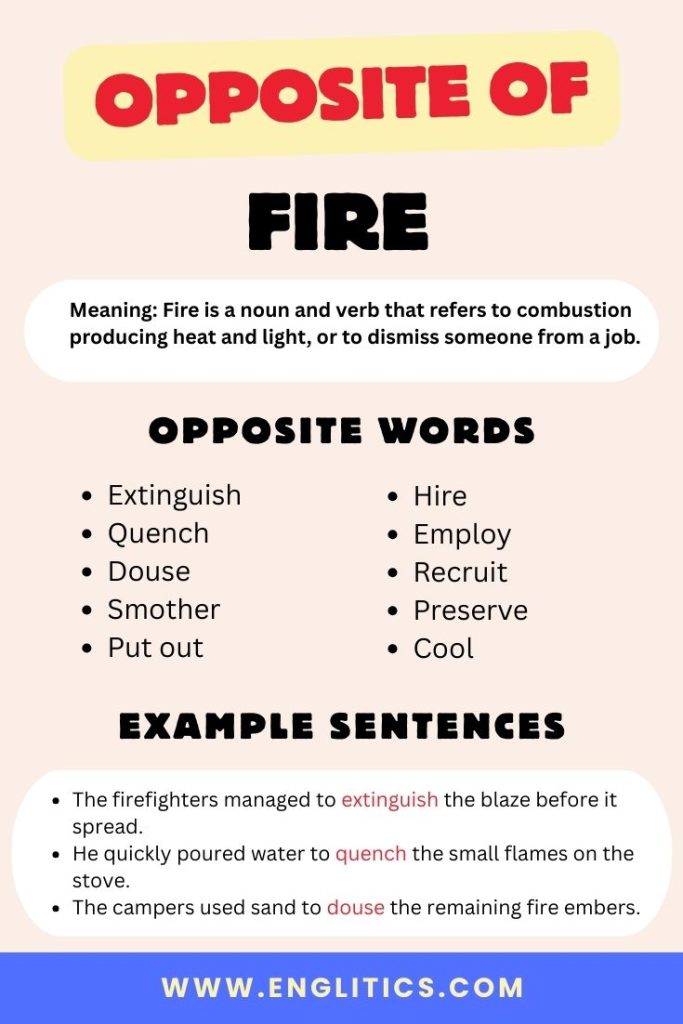
The antonyms for “fire” can be categorized into three main types: literal antonyms, figurative antonyms, and related concepts. Each category represents a different way of expressing the opposite of fire.
Literal Antonyms
Literal antonyms refer to the direct opposite of fire in its physical sense. These words describe the absence of fire, the prevention of fire, or the extinguishing of fire.
Examples of literal antonyms include:
- Water: The most common and effective way to extinguish fire.
- Ice: Represents extreme cold, the opposite of fire’s heat.
- Cold: The absence of heat, a necessary component for fire.
- Extinguishment: The act of putting out a fire.
- Suppression: The act of preventing a fire from starting or spreading.
These antonyms directly counteract the elements necessary for fire to exist: fuel, oxygen, and heat. For instance, water cools the fuel below its ignition point, extinguishing the fire.
Cold, ice, extinguishment, and suppression all work to inhibit or eliminate the combustion process.
Figurative Antonyms
Figurative antonyms refer to the opposite of fire in its metaphorical sense. These words describe the absence of passion, enthusiasm, or intensity.
Examples of figurative antonyms include:
- Apathy: Lack of interest, enthusiasm, or concern.
- Indifference: Lack of interest or concern.
- Lethargy: A state of sluggishness, inactivity, and lack of energy.
- Stagnation: A state of inactivity or lack of progress.
- Tranquility: A state of peace and quiet.
These antonyms represent the opposite of the intense emotions or activity associated with fire. Apathy and indifference suggest a lack of passion, while lethargy and stagnation imply a lack of energy or progress.
Tranquility represents a state of calmness, the opposite of the chaos and intensity that fire can represent.
Related Concepts
Related concepts are words that are not direct antonyms of “fire” but are closely associated with its opposite qualities. These words describe conditions or situations that are incompatible with fire or that mitigate its effects.
Examples of related concepts include:
- Prevention: Taking measures to stop a fire from starting.
- Safety: The condition of being protected from fire or other hazards.
- Control: The ability to manage or limit the spread of fire.
- Dampness: The presence of moisture, which can inhibit fire.
- Inertness: The state of being chemically inactive, unable to burn.
These concepts focus on preventing or managing the risks associated with fire. Prevention and safety emphasize proactive measures to avoid fire.
Control refers to the ability to limit its damage. Dampness and inertness describe conditions that make it difficult or impossible for fire to ignite or spread.
Examples of Antonyms for Fire
To further illustrate the different types of antonyms for “fire,” here are several examples organized by category. These examples demonstrate how the antonyms can be used in different contexts to convey various meanings.
Literal Antonyms Examples
The following table provides examples of literal antonyms for “fire” used in sentences. These examples show how these words can be used to describe situations where fire is absent or being extinguished.
| Antonym | Example Sentence |
|---|---|
| Water | The firefighters used water to extinguish the raging flames. |
| Ice | The ice storm created hazardous conditions but prevented any wildfires. |
| Cold | The cold weather made it difficult to start a campfire. |
| Extinguishment | The rapid extinguishment of the fire prevented further damage to the building. |
| Suppression | Early suppression efforts contained the forest fire before it spread to populated areas. |
| Flood | The flood waters completely doused the burning debris. |
| Douse | They had to douse the embers with water to ensure the fire was completely out. |
| Quench | The rain helped to quench the wildfires that had been burning for days. |
| Smother | He used a blanket to smother the small fire in the kitchen. |
| Dampen | The morning dew helped to dampen the dry grass, reducing the risk of fire. |
| Cool | The firefighters worked to cool down the hot spots to prevent reignition. |
| Freeze | The extreme conditions will freeze the water pipes. |
| Subzero | The subzero temperatures made it impossible for any brush fires to ignite. |
| Chill | A sudden chill swept through the air. |
| Snow | The heavy snow covered the ground, eliminating the risk of wildfires. |
| Hail | The sudden hail storm put out the small bonfire. |
| Sleet | The sleet made driving conditions treacherous and also prevented any outdoor burning. |
| Deactivate | They worked to deactivate the bomb before it could explode. |
| Neutralize | The chemical team was called in to neutralize the hazardous substance. |
| Wet | The wet conditions prevented the fire from spreading. |
| Moist | The moist earth was cool to the touch. |
| Soaked | The clothes were soaked after being left in the rain. |
| Drenched | We were drenched by the sudden downpour. |
| Saturated | The soil was saturated with water after the heavy rains. |
| Damp | The basement was damp and musty. |
Figurative Antonyms Examples
The following table provides examples of figurative antonyms for “fire” used in sentences. These examples show how these words can be used to describe the absence of passion, enthusiasm, or intensity.
| Antonym | Example Sentence |
|---|---|
| Apathy | The public’s apathy towards the political issue was disheartening. |
| Indifference | His indifference to the suffering of others was shocking. |
| Lethargy | After the long illness, she felt a sense of lethargy and had difficulty getting out of bed. |
| Stagnation | The company’s stagnation was a sign that it needed to innovate. |
| Tranquility | She found tranquility in the quiet solitude of the mountains. |
| Boredom | The long meeting induced a sense of sheer boredom among the attendees. |
| Ennui | A wave of ennui washed over him as he contemplated the monotonous routine. |
| Passiveness | His passiveness in the face of injustice was unsettling. |
| Docility | The horse’s docility made it a suitable mount for beginners. |
| Submissiveness | Her submissiveness in the relationship was a cause for concern. |
| Complacency | The team’s complacency after their initial success led to their downfall. |
| Resignation | He accepted his fate with a sense of quiet resignation. |
| Listlessness | The oppressive heat brought a feeling of listlessness to the afternoon. |
| Inactivity | Prolonged inactivity can lead to muscle atrophy. |
| Sluggishness | The heavy meal caused a feeling of sluggishness. |
| Dullness | The dullness of the lecture put many students to sleep. |
| Tedium | The tedium of the task was almost unbearable. |
| Monotony | The monotony of the assembly line job drove him to seek a new career. |
| Aversion | He had a strong aversion to public speaking. |
| Dislike | Her dislike for spicy food was well known. |
| Detachment | He watched the events unfold with a sense of cold detachment. |
| Aloofness | Her aloofness made it difficult to connect with her. |
| Distance | There was a palpable distance between them after the argument. |
| Coldness | Her coldness towards him was heartbreaking. |
| Quiet | The quiet of the morning was broken only by the birdsong. |
| Calm | The calm sea reflected the peaceful sky. |
Related Concepts Examples
The following table provides examples of related concepts used in sentences. These examples show how these words can be used to describe conditions or situations that are incompatible with fire or that mitigate its effects.
| Concept | Example Sentence |
|---|---|
| Prevention | Prevention is the key to avoiding wildfires. |
| Safety | Safety regulations are in place to protect workers from fire hazards. |
| Control | The firefighters worked to gain control of the spreading flames. |
| Dampness | The dampness of the forest floor helped to prevent the fire from spreading quickly. |
| Inertness | Nitrogen gas is used to create an atmosphere of inertness, preventing combustion. |
| Preparedness | Preparedness for a fire emergency includes having a fire extinguisher and knowing evacuation routes. |
| Regulation | Fire regulations are designed to minimize the risk of accidental fires. |
| Insurance | Homeowners’ insurance can help cover the costs of fire damage. |
| Codes | Building codes mandate the use of fire-resistant materials. |
| Standards | Fire standards ensure that equipment meets certain safety requirements. |
| Protocols | Emergency protocols are in place to guide responses to fire incidents. |
| Guidelines | Safety guidelines provide advice on preventing fires in the workplace. |
| Procedures | Evacuation procedures outline the steps to take during a fire emergency. |
| Mitigation | Fire mitigation strategies aim to reduce the potential impact of wildfires. |
| Containment | The goal of fire containment is to limit the spread of the flames. |
| Suppression | Aggressive fire suppression tactics can help to extinguish fires quickly. |
| Management | Effective fire management involves a combination of prevention, suppression, and mitigation strategies. |
| Planning | Fire planning is essential for ensuring the safety of communities in fire-prone areas. |
| Cooling | The cooling effect of the rain helped to slow the spread of the fire. |
| Shielding | The building’s fire-resistant walls provided shielding from the flames. |
| Protection | Fire-resistant clothing offers protection to firefighters. |
| Safety | Fire safety is a top priority in the workplace. |
| Security | Fire security measures are in place to prevent arson. |
| Safeguard | The sprinkler system is a safeguard against fire damage. |
| Defense | The firebreak served as a defense against the spreading flames. |
Usage Rules for Antonyms of Fire
When using antonyms for “fire,” it’s important to consider the context in which the word is being used. The choice of antonym will depend on whether you are referring to fire in its literal sense or its figurative sense.
- Literal Context: When referring to fire in its physical sense, use antonyms such as water, cold, extinguishment, or suppression. These words directly describe the absence of fire or the act of putting it out. For example: “The firefighters used water to extinguish the fire.”
- Figurative Context: When referring to fire in its metaphorical sense, use antonyms such as apathy, indifference, lethargy, or tranquility. These words describe the absence of passion, enthusiasm, or intensity. For example: “His apathy towards the project was discouraging.”
- Related Concepts: When discussing concepts related to fire, such as prevention or safety, use words like prevention, safety, or control. These words describe conditions or situations that are incompatible with fire or that mitigate its effects. For example: “Prevention is the best way to avoid house fires.”
It’s also important to consider the specific nuance you want to convey. For example, water is a general term for extinguishing fire, while suppression implies a more proactive and strategic approach to preventing a fire from spreading. Similarly, apathy suggests a lack of interest, while lethargy implies a lack of energy.
Pay attention to the grammatical structure of the sentence. The antonym should fit grammatically in the same way that “fire” would.
If “fire” is used as a noun, the antonym should also be a noun. If “fire” is used as a verb, the antonym should also be a verb or a verb phrase.
Common Mistakes When Using Antonyms of Fire
One common mistake is using the wrong type of antonym for the context. For example, using apathy when you mean water, or vice versa. It’s important to carefully consider the meaning you want to convey and choose the antonym that best fits the context.
Another common mistake is using antonyms that are too general or imprecise. For example, using bad as an antonym for “fire” is not very specific. It’s better to use more precise antonyms such as water, apathy, or prevention, depending on the context.
Here are some examples of common mistakes and how to correct them:
| Incorrect | Correct | Explanation |
|---|---|---|
| The fire was extinguished by apathy. | The fire was extinguished by water. | Apathy is a figurative antonym and doesn’t make sense in a literal context. |
| His water towards the project was evident. | His apathy towards the project was evident. | Water is a literal antonym and doesn’t make sense in a figurative context. |
| The fire caused safety. | The fire caused damage. / Safety measures were implemented to prevent the fire. | Safety is a related concept, not a direct consequence of fire. The sentence needs restructuring. |
| The fire was very indifference. | The situation was met with indifference. | Indifference is a noun and needs to be used appropriately in the sentence. |
| He was fire. | He was lethargic. | Using a figurative antonym to describe someone. |
Always double-check your sentences to ensure that the antonym you have chosen is appropriate for the context and that it fits grammatically. If you are unsure, consult a dictionary or thesaurus.
Practice Exercises
Test your understanding of antonyms for “fire” with these practice exercises. Choose the best antonym for “fire” in each sentence.
Exercise 1: Literal Antonyms
| Question | Options | Answer |
|---|---|---|
| The firefighters used ______ to put out the blaze. | a) apathy b) water c) lethargy d) prevention | b) water |
| The ______ weather prevented any wildfires from starting. | a) hot b) cold c) indifferent d) apathetic | b) cold |
| The ______ of the fire was a top priority for the emergency responders. | a) ignition b) extinguishment c) apathy d) stagnation | b) extinguishment |
| Early ______ efforts contained the forest fire before it spread. | a) suppression b) ignition c) indifference d) lethargy | a) suppression |
| They had to ______ the embers with water to ensure the fire was completely out. | a) ignite b) douse c) encourage d) ignore | b) douse |
| The rain helped to ______ the wildfires. | a) start b) quench c) fuel d) ignite | b) quench |
| He used a blanket to ______ the small fire. | a) fan b) smother c) encourage d) ignore | b) smother |
| The morning dew helped to ______ the dry grass. | a) ignite b) dampen c) fuel d) ignore | b) dampen |
| The firefighters worked to ______ down the hot spots. | a) heat b) cool c) ignite d) fuel | b) cool |
| The _____ conditions prevented the fire from spreading. | a) dry b) wet c) hot d) windy | b) wet |
Exercise 2: Figurative Antonyms
| Question | Options | Answer |
|---|---|---|
| His ______ towards the project was evident in his lack of effort. | a) enthusiasm b) apathy c) fire d) passion | b) apathy |
| Her ______ to the suffering of others was shocking. | a) concern b) indifference c) passion d) enthusiasm | b) indifference |
| After the long illness, she felt a sense of ______ and had difficulty getting out of bed. | a) energy b) lethargy c) passion d) enthusiasm | b) lethargy |
| The company’s ______ was a sign that it needed to innovate. | a) progress b) stagnation c) passion d) enthusiasm | b) stagnation |
| She found ______ in the quiet solitude of the mountains. | a) chaos b) tranquility c) fire d) passion | b) tranquility |
| The long meeting induced a sense of sheer ______. | a) excitement b) boredom c) interest d) enthusiasm | b) boredom |
| A wave of ______ washed over him. | a) enthusiasm b) ennui c) passion d) excitement | b) ennui |
| His ______ in the face of injustice was unsettling. | a) action b) passiveness c) fire d) passion | b) passiveness |
| The horse’s ______ made it suitable for beginners. | a) wildness b) docility c) fire d) passion | b) docility |
| The team’s ______ after their initial success. | a) drive b) complacency c) enthusiasm d) passion | b) complacency |
Exercise 3: Related Concepts
| Question | Options | Answer |
|---|---|---|
| ______ is the key to avoiding wildfires. | a) Ignition b) Prevention c) Fire d) Combustion | b) Prevention |
| ______ regulations are in place to protect workers from fire hazards. | a) Safety b) Danger c) Risk d) Hazard | a) Safety |
| The firefighters worked to gain ______ of the spreading flames. | a) loss b) control c) chaos d) freedom | b) control |
| The ______ of the forest floor helped to prevent the fire from spreading quickly. | a) dryness b) dampness c) flammability d) aridity | b) dampness |
| Nitrogen gas is used to create an atmosphere of ______. | a) flammability b) inertness c) combustion d) oxidation | b) inertness |
| ______ for a fire emergency includes having a fire extinguisher. | a) Unpreparedness b) Preparedness c) Negligence d) Carelessness | b) Preparedness |
| Fire ______ are designed to minimize the risk of accidental fires. | a) laws b) regulations c) chaos d) freedom | b) regulations |
| Homeowners’ ______ can help cover the costs of fire damage. | a) debt b) insurance c) poverty d) loss | b) insurance |
| Building ______ mandate the use of fire-resistant materials. | a) codes b) laws c) chaos d) freedom | a) codes |
| Fire ______ ensure that equipment meets certain safety requirements. | a) chaos b) standards c) freedom d) irregularities | b) standards |
Advanced Topics
For advanced learners, exploring the nuances of figurative language and idiomatic expressions related to “fire” and its antonyms can be particularly rewarding. For example, consider the idiom “fight fire with fire,” which doesn’t literally involve fire but means to respond to an attack with a similar or stronger attack.
The antonym of this idiom might be “turn the other cheek,” which suggests a more passive and conciliatory approach.
Another advanced topic is the use of antonyms in literary devices such as antithesis and oxymoron. Antithesis involves placing two contrasting ideas side by side to create a balanced and memorable effect. For example: “Where there is fire, there is also the potential for extinguishment.” Oxymoron combines two contradictory terms into a single expression, such as “cold fire,” which could describe a situation that seems passionate but is actually devoid of genuine emotion.
Exploring the cultural and historical significance of fire and its antonyms can also provide a deeper understanding of their usage. Fire has been a symbol of warmth, light, and destruction throughout history, while its antonyms have represented safety, peace, and tranquility.
Understanding these cultural associations can help you use these words more effectively and appropriately.
Frequently Asked Questions
Here are some frequently asked questions about antonyms for “fire”:
- What is the most common antonym for “fire”?
The most common antonym for “fire” in its literal sense is water. It is the most direct and effective way to extinguish fire. - What is a figurative antonym for “fire”?
A figurative antonym for “fire” is apathy. It represents the absence of passion, enthusiasm, or concern. - How do I choose the right antonym for “fire”?
Consider the context in which “fire” is being used. If it’s a literal context, use literal antonyms like water or cold. If it’s a figurative context, use figurative antonyms like apathy or indifference. - Can “ice” be considered an antonym for “fire”?
Yes, ice can be considered an antonym for “fire” in a literal sense because it represents extreme cold, which is the opposite of fire’s heat. - Is “prevention” an antonym for “fire”?
Prevention is not a direct antonym, but it is a related concept. It describes taking proactive measures to stop a fire from starting. - What is the opposite of “to fire” someone from a job?
The opposite of “to fire” someone from a job is “to hire” or “to employ” them. - How can I improve my vocabulary of antonyms for “fire”?
Read widely, use a thesaurus, and practice using different antonyms in your writing and speech. Pay attention to the context in which the words are used. - Are there any idioms that use antonyms of “fire”?
While there aren’t many common idioms that directly use antonyms of fire, understanding the opposite concepts can help you interpret other idioms. For example, understanding “apathy” can help you understand idioms related to lack of motivation or enthusiasm.
Conclusion
Understanding antonyms for “fire” is essential for expanding your vocabulary and using language more precisely. By exploring literal antonyms like water and cold, figurative antonyms like apathy and indifference, and related concepts like prevention and safety, you can express a wide range of meanings and nuances in your writing and speech. Remember to consider the context in which “fire” is being used and choose the antonym that best fits the situation.
Practice using these antonyms in your everyday communication and continue to explore the rich world of vocabulary. The more you practice, the more confident you will become in your ability to use language effectively and accurately.
Keep reading, keep learning, and keep expanding your linguistic horizons!
By mastering the antonyms for “fire,” you’ll not only enhance your vocabulary but also gain a deeper appreciation for the power and versatility of the English language. Keep exploring, keep practicing, and enjoy
the journey of language learning!