Gaudy describes something that is overly bright, showy, or flashy in a way that feels excessive or lacking good taste. It’s often used to criticize styles or designs that try too hard to attract attention. The Opposite of Gaudy refers to things that are simple, elegant, or modest in appearance.
Common Antonyms for Gaudy include plain, understated, subtle, refined, tasteful, and modest. For example, a plain white dress might be seen as the opposite of a gaudy, glitter-covered outfit. These words help describe styles or choices that value quiet beauty and balance.
Definition of Gaudy
Gaudy is an adjective that describes something that is excessively showy, bright, and often tasteless. It implies a lack of sophistication and a vulgar display of wealth or ornamentation. Gaudy items are typically characterized by clashing colors, excessive embellishments, and an overall lack of aesthetic harmony. Essentially, something gaudy is trying too hard to be impressive and ends up being unattractive.
The term often carries a negative connotation, suggesting that the item or style in question is not only visually loud but also lacks refinement and good taste. Think of a brightly colored dress adorned with too many sequins, or a car with excessive chrome detailing.
These are prime examples of things that might be described as gaudy.
The word “gaudy” can be applied to various things, including clothing, jewelry, decorations, and even behavior. It is often used to criticize displays of wealth or status that are perceived as vulgar or ostentatious.
It is important to note that what one person considers gaudy, another might find appealing, as taste is subjective. However, the generally accepted definition of gaudy implies a lack of subtlety and an excess of ornamentation that detracts from the overall aesthetic appeal.
Structural Breakdown of Gaudy in Sentences
Understanding how “gaudy” functions within a sentence is essential for grasping its meaning and usage. “Gaudy” is an adjective, meaning it modifies a noun or pronoun.
It typically precedes the noun it describes, but can also follow a linking verb.
Here are some examples illustrating the structural use of “gaudy”:
- Attributive Position: The gaudy necklace clashed with her simple dress. (Gaudy modifies necklace)
- Predicate Position: The decorations were gaudy and overwhelming. (Gaudy follows the linking verb were and describes decorations)
- With Intensifiers: It was an extremely gaudy display of wealth. (Extremely intensifies the adjective gaudy)
The word order is crucial for clarity. Placing “gaudy” in the wrong position can alter the sentence’s meaning or make it grammatically incorrect.
For instance, “necklace gaudy” is not grammatically sound; it must be “gaudy necklace.”
Understanding the adjectival function of “gaudy” allows you to construct grammatically correct and meaningful sentences. Pay attention to its placement and the nouns it modifies to ensure clear and effective communication.
Opposite of Gaudy
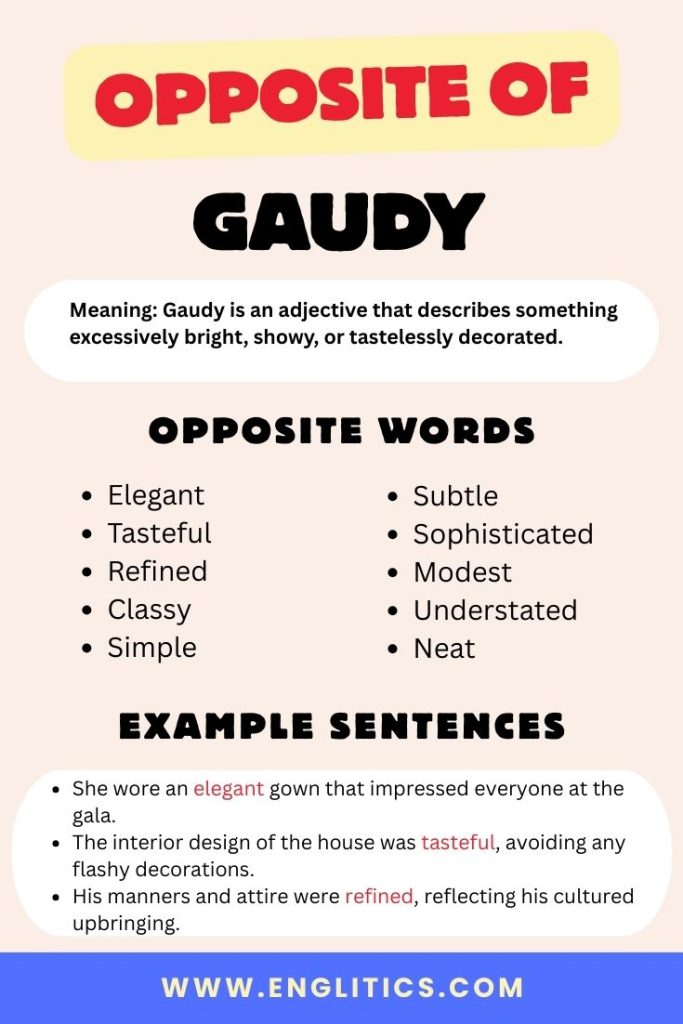
The opposite of gaudy can be expressed through a variety of words, each with its own subtle nuance. Understanding these antonyms allows for a more precise and sophisticated vocabulary.
Here, we’ll explore several key antonyms for “gaudy,” examining their meanings and applications.
Understated
Understated implies a subtle and refined elegance. It suggests a quality of quiet sophistication that avoids being overly flashy or ostentatious. Something that is understated is often more appealing in its simplicity than something that is gaudy.
Understated items or styles often rely on high-quality materials and meticulous craftsmanship rather than excessive ornamentation. This creates a sense of timelessness and enduring appeal.
Example: “She wore an understated dress that exuded quiet confidence.”
Simple
Simple refers to something that is plain, unadorned, and without unnecessary complexity. It emphasizes functionality and clarity over elaborate decoration. Simplicity can be seen as a virtue, especially in contrast to the excessiveness implied by “gaudy.”
Simple designs often focus on clean lines and essential elements, creating a sense of calm and order. This can be a refreshing alternative to the visual chaos associated with gaudiness.
Example: “The room was decorated in a simple, yet elegant style.”
Elegant
Elegant describes something that is graceful, stylish, and refined. It suggests a sense of beauty and sophistication that is achieved through careful attention to detail and a harmonious arrangement of elements. Elegance is often associated with classic designs and timeless appeal.
Elegant items or styles typically avoid excessive ornamentation, focusing instead on quality materials and impeccable craftsmanship. This creates a sense of understated luxury and sophistication.
Example: “The ballroom was decorated with elegant chandeliers and flowing draperies.”
Refined
Refined implies a high degree of cultivation, taste, and sophistication. It suggests a careful attention to detail and a rejection of anything crude or vulgar. A refined aesthetic is characterized by subtlety, grace, and a sense of understated elegance.
Refined items or styles often reflect a deep appreciation for quality and craftsmanship. They are typically characterized by subtle details and a harmonious blend of elements.
Example: “Her refined taste was evident in every aspect of her home decor.”
Tasteful
Tasteful suggests an adherence to standards of good taste and appropriateness. It implies a sense of balance, harmony, and restraint. Something that is tasteful avoids being overly flashy or ostentatious, instead opting for a more subtle and refined approach.
Tasteful designs often reflect a deep understanding of aesthetics and a sensitivity to the surrounding environment. They are typically characterized by a harmonious blend of colors, textures, and forms.
Example: “The wedding decorations were tasteful and elegant, creating a warm and inviting atmosphere.”
Subtle
Subtle refers to something that is delicate, understated, and not immediately obvious. It suggests a quality of quiet sophistication that rewards careful observation. Subtle details can add depth and complexity to a design without being overwhelming.
Subtle colors, textures, and patterns can create a sense of understated elegance and sophistication. This is often a welcome contrast to the boldness and excessiveness associated with gaudiness.
Example: “The painting featured subtle variations in color that created a sense of depth and movement.”
Classic
Classic describes something that is timeless, enduring, and of recognized quality. It suggests a style that has stood the test of time and continues to be admired for its elegance and sophistication. Classic designs often avoid fleeting trends, focusing instead on enduring principles of beauty and functionality.
Classic styles are often characterized by clean lines, simple forms, and high-quality materials. This creates a sense of timeless elegance and sophistication that transcends trends.
Example: “She wore a classic black dress that never goes out of style.”
Modest
Modest implies a sense of humility, restraint, and simplicity. It suggests an avoidance of ostentation and a focus on functionality and practicality. Modest designs are often characterized by a lack of ornamentation and a focus on essential elements.
Modest clothing, decor, or behavior often reflects a desire to avoid drawing attention to oneself. This can be a refreshing alternative to the self-aggrandizement often associated with gaudiness.
Example: “She lived a modest life, focused on helping others rather than accumulating wealth.”
Examples of Antonyms in Use
To further illustrate the use of antonyms for “gaudy,” consider the following examples organized by category. These tables showcase how each antonym can be used in different contexts to convey a sense of sophistication, simplicity, and good taste.
The following table provides examples of “understated” as an antonym for “gaudy” in various contexts. Notice how the sentences emphasize subtlety and refinement.
| Gaudy | Understated |
|---|---|
| The bride’s dress was gaudy, covered in excessive sequins and lace. | The bride’s dress was understated, with a simple silhouette and delicate lace detailing. |
| His gaudy jewelry screamed of nouveau riche sensibilities. | His understated cufflinks hinted at a quiet, old-money elegance. |
| The gaudy decorations clashed with the historic architecture of the building. | The understated decorations complemented the historic architecture of the building. |
| She wore a gaudy, brightly colored outfit that drew unwanted attention. | She wore an understated, neutral-toned outfit that exuded confidence and style. |
| The gaudy car, with its custom rims and loud paint job, was an eyesore. | The understated car, with its classic design and subtle detailing, was a symbol of refined taste. |
| His gaudy mansion was a testament to his lack of taste. | His understated home was a testament to his appreciation for simple elegance. |
| The gaudy party decorations were overwhelming and distracting. | The understated party decorations created a relaxed and sophisticated atmosphere. |
| Her gaudy makeup made her look like a caricature of herself. | Her understated makeup enhanced her natural beauty. |
| The gaudy advertisement was a desperate attempt to attract attention. | The understated advertisement relied on subtle messaging and elegant design. |
| The gaudy Christmas lights were a neighborhood eyesore. | The understated Christmas lights created a warm and inviting atmosphere. |
| He gave a gaudy, over-the-top performance. | He gave an understated, nuanced performance. |
| The artwork was gaudy and lacked any real artistic merit. | The artwork was understated and possessed a quiet, contemplative beauty. |
| The gaudy furniture was uncomfortable and impractical. | The understated furniture was comfortable and functional. |
| The gaudy website was difficult to navigate and visually overwhelming. | The understated website was easy to navigate and visually appealing. |
| The gaudy handbag was covered in logos and embellishments. | The understated handbag was made of high-quality leather with minimal detailing. |
| The gaudy restaurant was loud and overwhelming. | The understated restaurant was quiet and intimate. |
| The gaudy presentation was full of distracting animations and sound effects. | The understated presentation was clear, concise, and focused on the key information. |
| The gaudy ring was too large and flashy. | The understated ring was delicate and elegant. |
| The gaudy performance was an embarrassment. | The understated performance was a triumph of subtlety. |
This table provides examples of “simple” as an antonym for “gaudy.” Emphasis is placed on the lack of unnecessary ornamentation and the focus on functionality.
| Gaudy | Simple |
|---|---|
| The gaudy room was filled with ornate furniture and clashing colors. | The simple room was furnished with only the essentials, creating a sense of calm. |
| The gaudy website was cluttered with advertisements and flashing banners. | The simple website was easy to navigate and free of distractions. |
| She wore a gaudy dress covered in sequins and beads. | She wore a simple dress with clean lines and no embellishments. |
| The gaudy decorations were overwhelming and distracting. | The simple decorations created a peaceful and inviting atmosphere. |
| The gaudy car was customized with excessive chrome and bright colors. | The simple car was practical, reliable, and unadorned. |
| The gaudy painting was a chaotic mess of colors and textures. | The simple painting featured clean lines and a limited color palette. |
| The gaudy jewelry was heavy and uncomfortable to wear. | The simple jewelry was lightweight and easy to wear. |
| The gaudy font was difficult to read and visually distracting. | The simple font was clear, legible, and easy on the eyes. |
| The gaudy design was overly complicated and confusing. | The simple design was straightforward and easy to understand. |
| The gaudy meal was overloaded with rich sauces and exotic ingredients. | The simple meal was prepared with fresh, wholesome ingredients and minimal seasoning. |
| The gaudy invitation was filled with elaborate fonts and excessive graphics. | The simple invitation was elegant and understated. |
| The gaudy presentation was a visual overload, full of distracting animations. | The simple presentation was clear, concise, and focused on the key points. |
| The gaudy packaging was designed to attract attention at any cost. | The simple packaging was eco-friendly and functional. |
| The gaudy language was full of jargon and hyperbole. | The simple language was direct and easy to understand. |
| The gaudy approach was aggressive and intrusive. | The simple approach was gentle and respectful. |
| The gaudy solution was overly complex and expensive. | The simple solution was effective and affordable. |
| The gaudy story was embellished with sensational details. | The simple story was straightforward and honest. |
| The gaudy lifestyle was focused on material possessions and superficial pleasures. | The simple lifestyle was focused on experiences and relationships. |
| The gaudy display was designed to impress rather than inform. | The simple display was designed to educate and engage. |
| The gaudy marketing campaign promised unrealistic results. | The simple marketing campaign focused on transparency and honesty. |
This table highlights “elegant” as an antonym, focusing on grace, style, and refinement.
| Gaudy | Elegant |
|---|---|
| The gaudy decorations were a jumbled mess of colors and textures. | The elegant decorations were carefully chosen to create a harmonious atmosphere. |
| Her gaudy outfit was inappropriate for the formal event. | Her elegant outfit was perfectly suited for the formal event. |
| The gaudy chandelier was an eyesore in the otherwise beautiful room. | The elegant chandelier was a stunning centerpiece in the room. |
| The gaudy furniture was uncomfortable and impractical. | The elegant furniture was both beautiful and functional. |
| The gaudy website was difficult to navigate and visually overwhelming. | The elegant website was easy to use and visually appealing. |
| The gaudy party was loud, chaotic, and lacked any sense of sophistication. | The elegant party was sophisticated, refined, and memorable. |
| The gaudy presentation was full of distracting animations and sound effects. | The elegant presentation was polished, professional, and engaging. |
| The gaudy language was full of clichés and hyperbole. | The elegant language was articulate, precise, and evocative. |
| The gaudy solution was overly complex and impractical. | The elegant solution was simple, effective, and efficient. |
| The gaudy story was sensationalized and lacked any depth. | The elegant story was nuanced, insightful, and thought-provoking. |
| The gaudy lifestyle was focused on material possessions and superficial pleasures. | The elegant lifestyle was focused on experiences, relationships, and personal growth. |
| The gaudy display was designed to impress rather than inform. | The elegant display was designed to educate and inspire. |
| The gaudy marketing campaign was aggressive and intrusive. | The elegant marketing campaign was subtle, sophisticated, and respectful. |
| The gaudy restaurant was noisy, crowded, and overpriced. | The elegant restaurant was quiet, intimate, and offered impeccable service. |
| The gaudy building was an architectural monstrosity. | The elegant building was a masterpiece of design and craftsmanship. |
| His gaudy behavior was offensive and inappropriate. | His elegant behavior was gracious and respectful. |
| The gaudy design was a chaotic mess of colors and patterns. | The elegant design was a harmonious blend of form and function. |
| The gaudy performance was an embarrassment to watch. | The elegant performance was a testament to skill and artistry. |
| The gaudy ring was too large and flashy. | The elegant ring was delicate and refined. |
| The gaudy handbag was covered in logos and embellishments. | The elegant handbag was made of high-quality leather with minimal detailing. |
This table showcases the use of “refined” as an antonym, highlighting cultivation, taste, and sophistication.
| Gaudy | Refined |
|---|---|
| The gaudy jewelry was a mass-produced imitation of a luxury brand. | The refined jewelry was handcrafted from high-quality materials. |
| Her gaudy manners were a constant source of embarrassment. | Her refined manners were a testament to her upbringing and social grace. |
| The gaudy artwork was a crude and tasteless depiction of a classic subject. | The refined artwork was a subtle and nuanced interpretation of a classic subject. |
| The gaudy language was full of slang and vulgar expressions. | The refined language was articulate, precise, and evocative. |
| The gaudy taste in clothing was a reflection of her superficial values. | The refined taste in clothing was a reflection of her appreciation for quality and craftsmanship. |
| The gaudy lifestyle was characterized by excess and ostentation. | The refined lifestyle was characterized by simplicity, elegance, and mindfulness. |
| The gaudy approach to marketing was aggressive and manipulative. | The refined approach to marketing was subtle, informative, and respectful. |
| The gaudy design was a chaotic mess of colors and patterns. | The refined design was a harmonious blend of form and function. |
| The gaudy performance was a cheap imitation of a true artist. | The refined performance was a testament to years of training and dedication. |
| The gaudy meal was overloaded with rich sauces and artificial flavors. | The refined meal was prepared with fresh, seasonal ingredients and subtle seasoning. |
| The gaudy packaging was designed to attract attention at any cost. | The refined packaging was elegant, understated, and eco-friendly. |
| The gaudy building was an architectural eyesore. | The refined building was a masterpiece of design and craftsmanship. |
| The gaudy presentation was full of distracting animations and sound effects. | The refined presentation was clear, concise, and focused on the key information. |
| The gaudy solution was overly complex and impractical. | The refined solution was simple, effective, and efficient. |
| The gaudy story was sensationalized and lacked any depth. | The refined story was nuanced, insightful, and thought-provoking. |
| The gaudy display was designed to impress rather than inform. | The refined display was designed to educate and engage. |
| The gaudy restaurant was noisy, crowded, and overpriced. | The refined restaurant was quiet, intimate, and offered impeccable service. |
| The gaudy hotel was decorated in a tasteless manner. | The refined hotel was tastefully decorated. |
| The gaudy room was over the top. | The refined room was subtle in its decor. |
Usage Rules for Antonyms of Gaudy
Using antonyms effectively requires understanding the specific context and the nuances of each word. Here are some general usage rules to keep in mind when using antonyms for “gaudy”:
- Consider the context: The best antonym will depend on what aspect of “gaudy” you want to negate. Are you focusing on the lack of sophistication, the excessiveness, or the poor taste?
- Maintain consistency: Ensure that the antonym you choose aligns with the overall tone and style of your writing.
- Avoid clichés: While classic antonyms like “simple” and “elegant” are useful, try to vary your vocabulary to avoid sounding repetitive.
- Pay attention to connotation: Some antonyms, like “modest,” may carry additional connotations that are not always desirable.
For example, if you want to emphasize the lack of sophistication, “refined” or “elegant” might be the best choice. If you want to highlight the absence of excess, “simple” or “understated” might be more appropriate.
If you mean to convey a sense of good taste, “tasteful” is the most direct choice.
Common Mistakes
One common mistake is using antonyms that are too broad or general. For example, using “nice” as an antonym for “gaudy” is not precise enough.
“Nice” is a general term that doesn’t capture the specific qualities that “gaudy” negates. Here are some examples of common mistakes and how to correct them:
| Incorrect | Correct | Explanation |
|---|---|---|
| The gaudy painting was not good. | The gaudy painting was understated and refined. | “Good” is too general; “understated” and “refined” are more specific and effective. |
| Her gaudy dress was bad. | Her gaudy dress was simple and elegant. | “Bad” is vague; “simple” and “elegant” provide a clearer contrast. |
| The gaudy decorations were not interesting. | The gaudy decorations were tasteful and subtle. | “Interesting” is subjective; “tasteful” and “subtle” address the specific issue of gaudiness. |
Another common mistake is using antonyms that don’t fit the context. For example, describing a building as “modest” might be appropriate if you’re emphasizing its size and simplicity, but it wouldn’t be the best choice if you’re trying to highlight its elegance or sophistication.
Always consider the specific qualities you want to emphasize when choosing an antonym.
Practice Exercises
Test your understanding of antonyms for “gaudy” with these practice exercises. Choose the best antonym from the options provided to complete each sentence.
Exercise 1: Fill in the Blanks
- The ________ decorations created a peaceful and inviting atmosphere, a stark contrast to the gaudy displays of the past.
- (a) simple
- (b) bad
- (c) interesting
- Her ________ dress was perfectly suited for the formal event, unlike the gaudy outfits some of the other guests wore.
- (a) elegant
- (b) nice
- (c) okay
- The ________ jewelry was handcrafted from high-quality materials, a far cry from the gaudy, mass-produced pieces on display elsewhere.
- (a) refined
- (b) terrible
- (c) unusual
- The ________ website was easy to navigate and visually appealing, in contrast to the gaudy, cluttered sites that overwhelm many users.
- (a) understated
- (b) awful
- (c) strange
- The ________ lifestyle focused on experiences and relationships, a refreshing change from the gaudy pursuit of material possessions.
- (a) modest
- (b) wrong
- (c) weird
- She wore a ________ dress to the party, a far cry from the gaudy outfits she usually chooses.
- (a) tasteful
- (b) ugly
- (c) peculiar
- The ________ colors of the room created a calming effect compared to the gaudy, clashing shades in the other room.
- (a) subtle
- (b) gross
- (c) bizarre
- The ________ design of the building has stood the test of time unlike the gaudy, trendy designs that quickly fall out of favor.
- (a) classic
- (b) nasty
- (c) awkward
- Her ________ behavior was refreshing given the gaudy displays of wealth and status she was used to seeing.
- (a) modest
- (b) poor
- (c) goofy
- The ________ decorations at the event were a welcome change from the gaudy displays of previous years.
- (a) elegant
- (b) bad
- (c) dorky
Exercise 1: Answers
- (a) simple
- (a) elegant
- (a) refined
- (a) understated
- (a) modest
- (a) tasteful
- (a) subtle
- (a) classic
- (a) modest
- (a) elegant
Exercise 2: Rewrite the Sentences
Rewrite the following sentences, replacing the word “gaudy” with a suitable antonym.
- The gaudy decorations clashed with the elegant architecture of the building.
- Her gaudy outfit was inappropriate for the somber occasion.
- The gaudy website was difficult to navigate and visually overwhelming.
- His gaudy behavior was offensive and inappropriate.
- The gaudy furniture was uncomfortable and impractical.
- The gaudy painting was a chaotic mess of colors and textures.
- The gaudy jewelry was heavy and uncomfortable to wear.
- The gaudy font was difficult to read and visually distracting.
- The gaudy design was overly complicated and confusing.
- The gaudy meal was overloaded with rich sauces and exotic ingredients.
Exercise 2: Suggested Answers
- The understated decorations complemented the elegant architecture of the building.
- Her simple outfit was appropriate for the somber occasion.
- The elegant website was easy to navigate and visually appealing.
- His refined behavior was gracious and respectful.
- The tasteful furniture was comfortable and practical.
- The subtle painting featured clean lines and a limited color palette.
- The lightweight jewelry was comfortable and easy to wear.
- The legible font was clear and easy on the eyes.
- The straightforward design was easy to understand.
- The simple meal was prepared with fresh, wholesome ingredients and minimal seasoning.
Advanced Topics: Nuances and Connotations
Beyond the basic definitions, it’s important to understand the subtle nuances and connotations associated with each antonym. For instance, “modest” can sometimes imply a lack of ambition or confidence, while “simple” can suggest a lack of sophistication.
The best antonym will depend on the specific qualities you want to emphasize and the overall message you want to convey.
Consider also the cultural context. What is considered “gaudy” in one culture might be perfectly acceptable, or even admired, in another.
Similarly, the connotations of antonyms like “modest” or “simple” can vary depending on cultural norms and values.
Finally, pay attention to the emotional impact of your word choices. Some antonyms, like “refined” or “elegant,” can evoke a sense of admiration or respect, while others, like “simple” or “understated,” can convey a sense of humility or practicality.
Choose the words that best reflect the emotions you want to evoke in your audience.
FAQ
- What is the best antonym for “gaudy”?There is no single “best” antonym for “gaudy.” The most appropriate choice depends on the specific context and the aspect of “gaudy” you want to negate. “Understated,” “simple,” “elegant,” “refined,” “tasteful,” “subtle,” “classic,” and “modest” are all valid options, each with its own nuances.
- Can “plain” be used as an antonym for “gaudy”?Yes, “plain” can be used as an antonym for “gaudy,” especially when emphasizing the lack of ornamentation or embellishment. However, “plain” can also suggest a lack of attractiveness, so it’s important to consider the overall tone and message you want to convey.
- Is it ever appropriate to use “gaudy” in a positive way?While “gaudy” typically carries a negative connotation, it can sometimes be used in a playful or ironic way to describe something that is deliberately over-the-top or campy. However, this is a less common usage and should be used with caution to avoid misinterpretation.
- How can I improve my vocabulary of antonyms?Reading widely, using a thesaurus, and paying attention to the way words are used in context are all effective ways to expand your vocabulary of antonyms. Practice using new words in your own writing and speaking to solidify your understanding.
- Are there any situations where “gaudy” and its antonyms are subjective?Yes, taste is subjective, and what one person considers “gaudy,” another might find appealing. Similarly, the qualities that are valued in antonyms like “elegant” or “refined” can vary depending on individual preferences and cultural norms. It’s important to be aware of these subjective factors when using these words.
- What part of speech is ‘gaudy’?‘Gaudy’ is an adjective. It describes a noun, indicating that the noun is excessively showy and lacking in good taste.
- How do you avoid using “gaudy” and its antonyms incorrectly?Always consider the context and the specific qualities you want to emphasize. Look up the definitions of unfamiliar words and pay attention to how they are used in reputable sources. Practice using new words in your own writing and speaking to solidify your understanding.
- Can “understated” ever be a negative quality?