Antonyms for “gentle” include words like harsh, rough, aggressive, severe, violent, and abrasive. These words describe qualities or actions that lack calmness, tenderness, or subtlety. Whether you’re discussing tone of voice, physical touch, behavior, or even weather, each antonym paints a vivid contrast to gentleness.
Using the opposite of gentle allows for more precise expression when describing forceful actions, unfriendly attitudes, or intense environments. These antonyms are especially useful in writing, conversation, and emotional description—helping you accurately communicate when something is unkind, abrupt, or overpowering in nature.
Definition of “Gentle”
The word “gentle” is an adjective that describes someone or something characterized by a mild, kind, and tender nature. It implies a lack of harshness, force, or severity.
“Gentle” can refer to a person’s demeanor, an action, or even a physical quality. For example, a gentle breeze is soft and mild, while a gentle person is kind and considerate.
Understanding the various facets of “gentle” is key to grasping the nuances of its antonyms.
In terms of grammatical classification, “gentle” functions primarily as an adjective, modifying nouns to describe their qualities. It can also be used as a verb, although less commonly, to mean “to tame” or “to make gentle.” The contexts in which “gentle” is used are broad, ranging from describing personal interactions to natural phenomena. The word suggests a deliberate avoidance of causing harm or distress.
Structural Breakdown: Understanding Opposites
Antonyms, also known as opposites, are words with meanings that are contrary to each other. Understanding how antonyms function in language is essential for effective communication.
There are several types of antonyms, including:
- Complementary Antonyms: These are pairs where the presence of one implies the absence of the other (e.g., alive/dead, on/off).
- Gradable Antonyms: These represent points on a continuum, allowing for degrees of difference (e.g., hot/cold, big/small). “Gentle” and its antonyms often fall into this category.
- Relational Antonyms: These describe a relationship from opposite perspectives (e.g., teacher/student, buy/sell).
When considering antonyms for “gentle,” we primarily deal with gradable antonyms. These words represent varying degrees of forcefulness, harshness, or intensity, providing a spectrum of options to express the opposite of gentleness.
For instance, words like “rough,” “harsh,” and “violent” all represent different levels of the absence of gentleness.
Opposite of Gentle
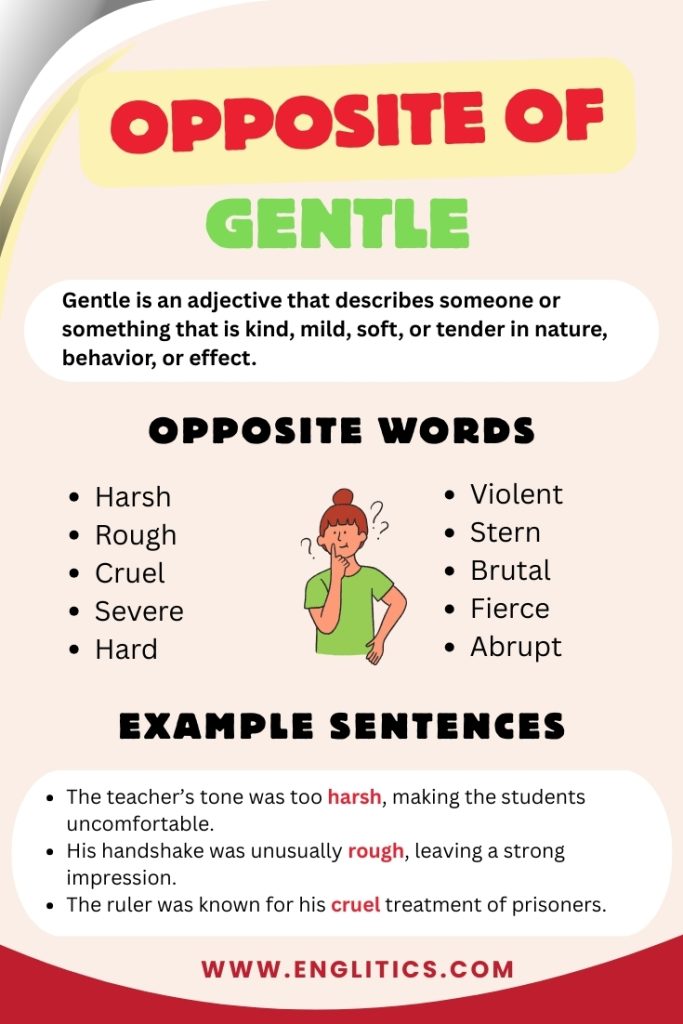
The antonyms for “gentle” can be categorized based on the specific aspect of “gentle” they oppose. Here’s a breakdown of some key categories and their corresponding words:
Harsh
Harsh implies a severe or cruel quality. It suggests a lack of compassion or leniency.
Violent
Violent suggests the use of physical force so as to injure, abuse, damage, or destroy.
Rough
Rough suggests a lack of smoothness or refinement. It can refer to texture, behavior, or conditions.
Severe
Severe describes something strict, harsh, or rigorous. It often implies a serious or critical nature.
Forceful
Forceful implies the use of power or strength to achieve a result. It suggests assertiveness and determination.
Brutal
Brutal suggests extreme violence or cruelty. It implies a lack of empathy or consideration for others.
Callous
Callous describes someone who is insensitive and uncaring. It suggests a lack of empathy or emotional responsiveness.
Aggressive
Aggressive suggests a readiness to attack or confront. It implies a forceful and assertive approach.
Insensitive
Insensitive describes someone who is not aware of or responsive to the feelings of others. It suggests a lack of tact or consideration.
Examples of Antonyms in Sentences
To illustrate the usage of these antonyms, let’s examine them in context. The following tables provide examples of how each antonym can be used in sentences, contrasting them with the concept of “gentle.”
Table 1: Examples of “Harsh” as an Antonym for “Gentle”
| Sentence with “Gentle” | Sentence with “Harsh” |
|---|---|
| The nurse had a gentle touch when administering the injection. | The critic delivered a harsh review of the play. |
| The gentle breeze rustled the leaves. | The harsh wind whipped through the mountains. |
| He gave a gentle reminder to complete the task. | She gave a harsh reprimand for the mistake. |
| The therapist offered gentle guidance. | The dictator imposed harsh laws on the population. |
| The mother spoke in a gentle tone to her child. | The sergeant spoke in a harsh tone to the recruits. |
| The artist used gentle strokes to create the painting. | The winter brought a harsh frost that killed the crops. |
| The dog was trained with gentle methods. | The prisoners were subjected to harsh treatment. |
| The doctor recommended gentle exercise. | The medicine had harsh side effects. |
| The teacher gave gentle encouragement to the students. | The judge handed down a harsh sentence. |
| She had a gentle way of explaining difficult concepts. | He had a harsh way of criticizing others’ work. |
| The sunlight was gentle in the early morning. | The midday sun was harsh and unforgiving. |
| The fabric felt gentle against her skin. | The sandpaper had a harsh, abrasive texture. |
| He offered a gentle smile as a greeting. | He gave a harsh glare that silenced the room. |
| The waves lapped gently against the shore. | The waves crashed harshly against the rocks. |
| The music was gentle and soothing. | The noise was harsh and grating on the ears. |
| The leader provided gentle leadership. | The leader imposed harsh discipline. |
| The process was handled with gentle care. | The process was handled with harsh efficiency. |
| The reminder was a gentle nudge. | The reminder was a harsh warning. |
| The touch was a gentle caress. | The touch was a harsh slap. |
| The method was a gentle approach. | The method was a harsh intervention. |
| The words were gentle and kind. | The words were harsh and critical. |
| The rain fell gently on the roof. | The rain beat down harshly on the roof. |
| The treatment was gentle and compassionate. | The treatment was harsh and unforgiving. |
| The feedback was provided in a gentle manner. | The feedback was provided in a harsh manner. |
| The discipline was gentle and understanding. | The discipline was harsh and punitive. |
This table demonstrates how “harsh” contrasts with “gentle” in various contexts, highlighting the difference in severity and lack of compassion.
Table 2: Examples of “Violent” as an Antonym for “Gentle”
| Sentence with “Gentle” | Sentence with “Violent” |
|---|---|
| The gentle waves lapped at the shore. | The violent storm raged across the sea. |
| She handled the antique vase with gentle care. | The protesters engaged in violent clashes with the police. |
| The nurse administered the medicine with a gentle touch. | The earthquake caused violent tremors. |
| He spoke in a gentle voice to calm the child. | The argument escalated into a violent confrontation. |
| The artist used gentle strokes to create the delicate painting. | The explosion caused a violent shockwave. |
| The gardener pruned the roses with gentle precision. | The hurricane brought violent winds and flooding. |
| The mother rocked the baby with a gentle motion. | The crowd became violent after the game. |
| The teacher used gentle methods to guide the students. | The attack was sudden and violent. |
| The therapist offered gentle support to the patient. | The revolution was marked by violent uprisings. |
| The wind blew gently through the trees. | The wind howled violently during the storm. |
| He treated the stray animal with gentle kindness. | The bully displayed violent behavior towards the smaller children. |
| The stream flowed gently through the valley. | The river surged violently after the heavy rain. |
| The cat approached the kitten with gentle curiosity. | The dog reacted with violent aggression towards the intruder. |
| She gave a gentle push to help him along. | He delivered a violent blow that knocked him down. |
| The music played a gentle melody. | The film depicted scenes of violent conflict. |
| The sun shone with a gentle warmth. | The fire burned with a violent intensity. |
| The snow fell in gentle flurries. | The earthquake caused violent shaking of the ground. |
| The touch was a gentle caress. | The punch was a violent strike. |
| The handling of the fragile object was gentle and careful. | The mishandling of the equipment resulted in violent damage. |
| The correction was made with gentle understanding. | The suppression of the protest was violent and forceful. |
| The persuasion was a gentle suggestion. | The coercion was a violent threat. |
| The breeze was a gentle whisper. | The explosion was a violent roar. |
| His movements were gentle and deliberate. | His movements were violent and uncontrolled. |
| The dance was gentle and graceful. | The fight was violent and chaotic. |
| The removal of the splinter was gentle and painless. | The extraction of the tooth was violent and excruciating. |
This table illustrates how “violent” contrasts with “gentle,” emphasizing the use of force and potential for harm.
Table 3: Examples of “Rough” as an Antonym for “Gentle”
| Sentence with “Gentle” | Sentence with “Rough” |
|---|---|
| The baby’s skin was gentle and soft. | The construction worker had rough hands. |
| The sea was calm and gentle. | The sea was rough due to the storm. |
| He gave the dog a gentle pat on the head. | The children were playing a rough game of tag. |
| The fabric had a gentle texture. | The sandpaper had a rough surface. |
| She spoke in a gentle tone of voice. | He had a rough manner of speaking. |
| The path was gentle and easy to walk. | The trail was rough and uneven. |
| The handling of the delicate instrument was gentle. | The moving company gave the furniture a rough ride. |
| The treatment was gentle and soothing. | The seasickness made for a rough journey. |
| The artist used gentle brushstrokes. | The sketch was done with rough lines. |
| The application of the ointment was gentle. | The treatment involved a rough scrubbing. |
| The material was gentle on the skin. | The wool sweater had a rough feel. |
| The music was gentle and calming. | The music was rough and unrefined. |
| The breeze was gentle and refreshing. | The wind was rough and biting. |
| The landing was gentle and smooth. | The landing was rough and bumpy. |
| The transition was gentle and seamless. | The change was rough and jarring. |
| The care was gentle and considerate. | The handling was rough and careless. |
| The waves were gentle and playful. | The waves were rough and turbulent. |
| The surface was gentle to the touch. | The surface was rough and abrasive. |
| The journey was gentle and uneventful. | The journey was rough and challenging. |
| The encouragement was gentle and supportive. | The criticism was rough and blunt. |
| The application was gentle and precise. | The job was done with rough and ready methods. |
| The approach was gentle and considerate. | The approach was rough and insensitive. |
| The style was gentle and refined. | The style was rough and unpolished. |
| The method was gentle and effective. | The solution was a rough fix. |
| The feedback was gentle and constructive. | The feedback was rough and dismissive. |
This table demonstrates how “rough” contrasts with “gentle,” highlighting the lack of smoothness or refinement.
Table 4: Examples of “Severe” as an Antonym for “Gentle”
| Sentence with “Gentle” | Sentence with “Severe” |
|---|---|
| The teacher gave gentle guidance to the students. | The judge imposed a severe sentence on the criminal. |
| The patient experienced gentle discomfort after the procedure. | The patient suffered severe pain after the surgery. |
| The reprimand was gentle and understanding. | The criticism was severe and unforgiving. |
| The weather was gentle and mild. | The winter brought severe storms and blizzards. |
| The discipline was gentle and encouraging. | The punishment was severe and harsh. |
| He offered gentle advice to his friend. | The doctor gave a severe warning about his health. |
| She used a gentle approach to solve the problem. | The authorities took severe measures to control the outbreak. |
| The impact was gentle and minimal. | The damage was severe and extensive. |
| The criticism was delivered in a gentle manner. | The criticism was delivered in a severe tone. |
| The symptoms were gentle and manageable. | The symptoms were severe and debilitating. |
| The pressure was gentle and applied with care. | The pressure was severe and caused discomfort. |
| The measures taken were gentle and cautious. | The measures taken were severe and drastic. |
| The restrictions were gentle and flexible. | The restrictions were severe and rigid. |
| The warning was gentle and suggestive. | The warning was severe and explicit. |
| The treatment was gentle and non-invasive. | The treatment was severe and required hospitalization. |
| The feedback was gentle and encouraging. | The feedback was severe and critical. |
| The measures were gentle and preventive. | The measures were severe and reactive. |
| The approach was gentle and gradual. | The approach was severe and immediate. |
| The handling was gentle and delicate. | The handling was severe and rough. |
| The consequences were gentle and lenient. | The consequences were severe and unforgiving. |
| The reminder was gentle and subtle. | The reminder was severe and direct. |
| The test was a gentle assessment. | The test was a severe examination. |
| The discipline was gentle and understanding. | The discipline was severe and uncompromising. |
| The evaluation was gentle and balanced. | The evaluation was severe and critical. |
| The impact was gentle and subtle. | The impact was severe and noticeable. |
This table illustrates how “severe” contrasts with “gentle,” emphasizing the strict, harsh, or rigorous nature of something.
Usage Rules and Considerations
When choosing an antonym for “gentle,” consider the specific context and the nuance you wish to convey. Here are some guidelines:
- Consider the degree of opposition: Choose an antonym that accurately reflects the level of forcefulness or harshness you want to express. “Rough” is less intense than “violent,” for example.
- Pay attention to connotation: Some antonyms have negative connotations (e.g., “brutal,” “callous”), while others are more neutral (e.g., “forceful”). Select a word that aligns with the overall tone and purpose of your writing.
- Think about the specific aspect of “gentle” you’re negating: Are you opposing the kindness, the lack of force, or the smoothness? This will help you narrow down the most appropriate antonym.
- Avoid overusing strong antonyms: Using words like “violent” or “brutal” when a milder antonym like “rough” or “forceful” would suffice can create an exaggerated or melodramatic effect.
Common Mistakes to Avoid
Here are some common mistakes to avoid when using antonyms for “gentle”:
- Using an antonym that is too strong:
- Incorrect: The doctor’s touch was brutal when he examined the child.
- Correct: The doctor’s touch was rough when he examined the child.
- Using an antonym that doesn’t fit the context:
- Incorrect: The callous breeze rustled the leaves.
- Correct: The harsh breeze rustled the leaves.
- Misunderstanding the nuances of different antonyms:
- Incorrect: He was a violent leader, known for his strict rules.
- Correct: He was a severe leader, known for his strict rules.
It’s important to understand the subtle differences between the various antonyms to ensure accurate and effective communication.
Practice Exercises
Test your understanding of antonyms for “gentle” with these exercises.
Exercise 1: Fill in the Blank
Choose the best antonym for “gentle” from the options provided to complete each sentence.
| Question | Options | Answer |
|---|---|---|
| 1. Instead of a ______ pat, he gave the dog a forceful shove. | (a) gentle (b) rough (c) kind | (a) |
| 2. The ______ winds made it difficult to sail. | (a) gentle (b) harsh (c) mild | (b) |
| 3. The protesters became ______ and started throwing rocks. | (a) gentle (b) violent (c) peaceful | (b) |
| 4. The teacher gave a ______ lecture about the importance of responsibility. | (a) gentle (b) severe (c) kind | (b) |
| 5. His ______ demeanor intimidated those around him. | (a) gentle (b) forceful (c) kind | (b) |
| 6. The dictator was known for his ______ treatment of political opponents. | (a) gentle (b) brutal (c) kind | (b) |
| 7. The ______ remarks showed a complete disregard for her feelings. | (a) gentle (b) callous (c) kind | (b) |
| 8. The ______ player was ejected from the game for unsportsmanlike conduct. | (a) gentle (b) aggressive (c) kind | (b) |
| 9. His ______ comments revealed a lack of understanding and empathy. | (a) gentle (b) insensitive (c) kind | (b) |
| 10. The ______ terrain made the hike challenging for beginners. | (a) gentle (b) rough (c) kind | (b) |
Exercise 2: Sentence Transformation
Rewrite each sentence using an antonym for “gentle” to convey the opposite meaning.
| Original Sentence | Rewritten Sentence |
|---|---|
| 1. She handled the fragile glass with gentle care. | 1. She handled the fragile glass with rough hands, causing it to break. |
| 2. The breeze was gentle and refreshing. | 2. The wind was harsh and biting. |
| 3. The teacher offered gentle encouragement to the students. | 3. The teacher gave severe criticism to the students. |
| 4. The waves lapped gently against the shore. | 4. The waves crashed violently against the shore. |
| 5. He spoke in a gentle voice to calm the child. | 5. He shouted in a forceful voice to intimidate the child. |
| 6. The artist used gentle strokes to create the painting. | 6. The artist used rough strokes to create the painting. |
| 7. The leader provided gentle guidance to the team. | 7. The leader imposed forceful commands on the team. |
| 8. The treatment was gentle and compassionate. | 8. The treatment was brutal and uncaring. |
| 9. The feedback was provided in a gentle manner. | 9. The feedback was provided in a callous manner. |
| 10. The discipline was gentle and understanding. | 10. The discipline was severe and punitive. |
Advanced Topics: Nuances and Context
Beyond the basic definitions and examples, understanding the nuances of antonyms for “gentle” requires considering the context in which they are used. The choice of antonym can significantly impact the tone and meaning of a sentence.
For example, consider the difference between saying “He was a forceful leader” and “He was a brutal leader.” While both “forceful” and “brutal” are antonyms of “gentle,” they convey very different impressions. “Forceful” suggests assertiveness and determination, while “brutal” implies violence and cruelty. The context of the situation and the specific qualities you want to emphasize will determine the most appropriate choice.
Furthermore, the use of figurative language can add another layer of complexity. Metaphors and similes can employ antonyms of “gentle” to create vivid imagery and evoke strong emotions. For instance, describing a storm as “a violent beast” is more impactful than simply saying “the storm was violent.”
Frequently Asked Questions (FAQ)
Here are some frequently asked questions about antonyms for “gentle”:
- What is the best single antonym for “gentle”?There isn’t one single “best” antonym, as the most appropriate choice depends on the context. However, “harsh” is often a good general antonym, as it captures the lack of kindness and mildness.
- Are there any positive antonyms for “gentle”?While many antonyms have negative connotations, “forceful” can be considered a positive antonym in certain contexts, as it suggests strength and assertiveness without necessarily implying cruelty or violence.
- How can I improve my understanding of antonyms in general?Reading widely, using a thesaurus, and practicing sentence construction are all effective ways to improve your understanding of antonyms. Pay attention to how different words are used in context and try to identify subtle differences in meaning.
- Is “rough” always a negative antonym for “gentle”?Not always. While “rough” often implies a lack of refinement or smoothness, it can also be used in a neutral or even positive way in certain contexts. For example, “a rough diamond” refers to someone with hidden potential.
- How do I choose the right antonym for “gentle” in my writing?Consider the specific aspect of “gentle” you want to oppose, the degree of forcefulness or harshness you want to convey, and the overall tone and purpose of your writing. Use a thesaurus to explore different options and choose the word that best fits your needs.
- Can “cruel” be considered an antonym for “gentle”?Yes, “cruel” can be considered an antonym for “gentle.” Cruel implies a deliberate intention to cause pain or suffering, highlighting a complete lack of the kindness and compassion associated with gentleness.
- What is the difference between “insensitive” and “callous”?“Insensitive” suggests a lack of awareness or understanding of others’ feelings, while “callous” implies a hardened indifference and a lack of empathy. Callousness is generally considered a more severe form of insensitivity.
- Are there any situations where “gentle” and its antonyms can be used together in the same sentence?Yes, you can use “gentle” and its antonyms together to create contrast or highlight a change in behavior or situation. For example, “He started with a gentle approach, but soon became more forceful.”
Conclusion
Mastering antonyms for “gentle” allows for more precise and nuanced communication. By understanding the different categories of antonyms, their connotations, and their usage in context, you can effectively express the opposite of gentleness in a variety of situations.
Remember to consider the degree of opposition, pay attention to connotation, and avoid overusing strong antonyms. Practice using these words in your writing and speaking to solidify your understanding and enhance your vocabulary.
With continued effort, you’ll be able to confidently and accurately use antonyms for “gentle” to enrich your language skills.