Growth signifies progress, increase, or development—whether it’s in business, nature, mindset, or population. But not all situations move forward. When decline, reduction, or stagnation occurs, that’s when the opposite of growth becomes relevant. Antonyms for growth help describe shrinking, decay, or a lack of advancement.
The opposite of growth includes words like decline, shrinkage, recession, stagnation, and decay. While decline and recession often relate to economic or business downturns, stagnation reflects halted progress, and decay implies gradual deterioration. These words are especially useful in economics, health, personal development, or environmental discussions.
Table of Contents
- Introduction
- Definition of Growth
- Structural Breakdown
- Types and Categories of Antonyms for Growth
- Examples
- Usage Rules
- Common Mistakes
- Practice Exercises
- Advanced Topics
- FAQ
- Conclusion
Definition of Growth
Growth, in its broadest sense, refers to an increase in size, number, value, or strength. It implies a positive progression and development over time. In various contexts, “growth” can describe physical enlargement (e.g., a plant growing taller), economic expansion (e.g., a country’s GDP increasing), personal development (e.g., gaining new skills), or even abstract concepts like the growth of an idea.
The word “growth” functions primarily as a noun, but it can also be used as part of a verb phrase (e.g., “growing rapidly”). It is often associated with progress, improvement, and advancement.
Understanding its positive connotations is essential for grasping the significance of its antonyms, which describe the absence or reversal of these qualities.
Structural Breakdown
The word “growth” is a noun derived from the verb “grow.” Its structure is simple, consisting of a root word (“grow”) and a suffix (“-th”) that transforms the verb into a noun. The “th” suffix often indicates a state, condition, or process.
For instance, “warmth” is the state of being warm, and “length” is the measure of being long. Similarly, “growth” represents the state or process of growing.
Understanding this structural breakdown can aid in recognizing related words and their meanings. For example, “growing,” “grown,” and “grower” are all derived from the same root and share semantic connections.
Analyzing the structure of “growth” provides insight into its function and meaning within the English language.
Opposite of Growth
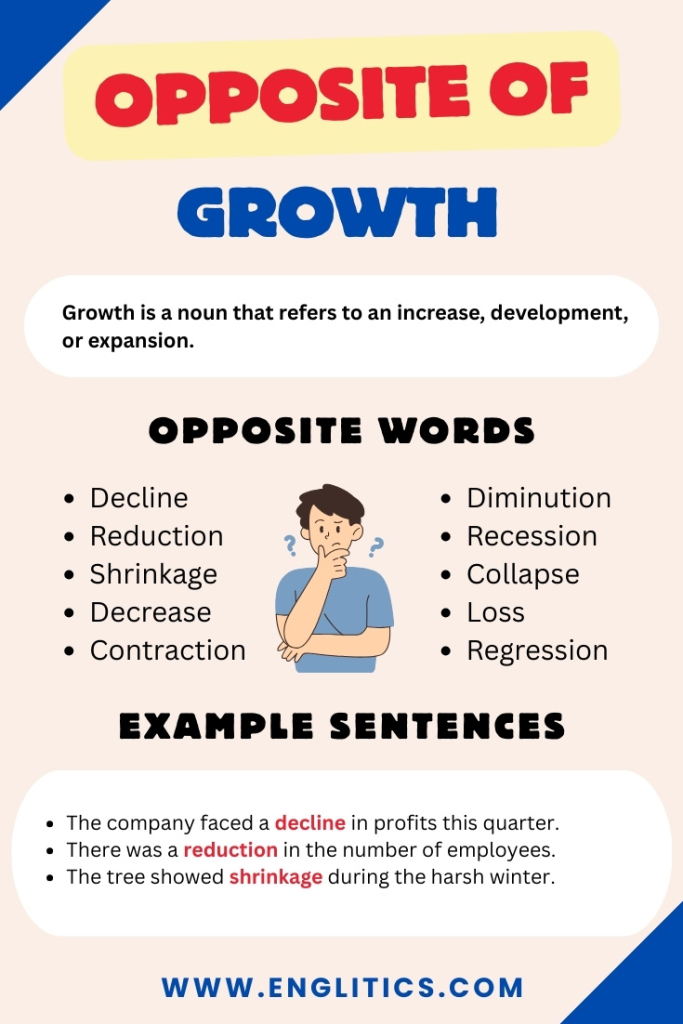
The antonyms for “growth” encompass a range of concepts, each with its own specific nuance. These antonyms can be broadly categorized into stagnation, decline, decay, regression, atrophy, and deterioration.
Each category describes a different aspect of the absence or reversal of growth.
Stagnation
Stagnation refers to a state of inactivity, where there is no progress or development. It implies a lack of movement or advancement, often due to unfavorable conditions or a lack of stimulation. Stagnation can occur in various contexts, such as economic stagnation, where a country’s economy fails to grow, or personal stagnation, where an individual feels stuck and unable to progress.
Decline
Decline signifies a gradual decrease in quality, quantity, or importance. It suggests a downward trend, often from a previously higher level. Decline can be observed in areas such as population decline, where the number of inhabitants decreases, or a decline in health, where a person’s physical condition worsens.
Decay
Decay describes the process of rotting or decomposition. It implies a gradual deterioration due to natural causes or neglect. Decay is often associated with organic matter, such as decaying food or wood, but it can also be used metaphorically to describe the decline of institutions or relationships.
Regression
Regression refers to a return to a previous, less developed state. It implies a backward movement, often after a period of progress. Regression can be observed in areas such as child development, where a child may regress to earlier behaviors, or in economic cycles, where an economy may regress into a recession.
Atrophy
Atrophy describes the wasting away of body tissue or an organ, typically due to lack of use or nourishment. It implies a gradual decline in size or strength. Atrophy is commonly associated with muscles, but it can also be used metaphorically to describe the decline of skills or abilities.
Deterioration
Deterioration signifies the process of becoming progressively worse. It implies a decline in quality, condition, or value. Deterioration can be observed in areas such as the deterioration of infrastructure, where roads and bridges fall into disrepair, or the deterioration of mental health, where a person’s cognitive abilities decline.
Examples
To illustrate the different antonyms for “growth,” the following tables provide examples of their usage in various contexts. These examples highlight the subtle differences in meaning and application among these terms.
Stagnation Examples
The following table provides examples of how the word “stagnation” and its related forms are used in sentences.
| Sentence | Context |
|---|---|
| The company experienced a period of stagnation after the new regulations were implemented. | Business |
| The pond’s stagnation led to an overgrowth of algae. | Environment |
| His career suffered from stagnation due to a lack of opportunities. | Career |
| The stagnation of the economy worried many citizens. | Economics |
| The political stagnation prevented any meaningful reforms. | Politics |
| The project reached a point of stagnation, with no new progress being made. | Project Management |
| She felt a sense of personal stagnation and decided to make a change. | Personal Development |
| The stagnation in the housing market led to lower property values. | Real Estate |
| The cultural stagnation stifled creativity and innovation. | Culture |
| The stagnation of the water in the vase caused the flowers to wilt. | Gardening |
| The artist’s work entered a phase of stagnation, lacking new inspiration. | Art |
| The educational system faced stagnation due to outdated methods. | Education |
| The athlete’s performance showed signs of stagnation, plateauing after initial gains. | Sports |
| The old town suffered from economic stagnation as industries moved elsewhere. | Urban Planning |
| The company’s stock price experienced stagnation, remaining unchanged for months. | Finance |
| The scientist worried about the stagnation of research in the field. | Science |
| The relationship reached a point of stagnation, with no new experiences or growth. | Relationships |
| The stagnation of the debate led to no resolution being reached. | Politics |
| The stagnation in technological development worried the investors. | Technology |
| The soil’s stagnation prevented healthy plant growth. | Agriculture |
| The stagnation of innovation led to a decline in competitiveness. | Business Strategy |
| The stagnation of the peace process frustrated international mediators. | International Relations |
| The prolonged stagnation of wages affected worker morale. | Labor Economics |
Decline Examples
The following table provides examples of how the word “decline” and its related forms are used in sentences.
| Sentence | Context |
|---|---|
| The company’s profits experienced a sharp decline last quarter. | Business |
| There has been a noticeable decline in the bee population. | Environment |
| His health began to decline after the surgery. | Health |
| The Roman Empire suffered a long period of decline. | History |
| The quality of education has been in decline for several years. | Education |
| The city’s infrastructure is showing signs of decline. | Urban Planning |
| He declined the invitation to the party. | Social |
| The value of the currency is in decline. | Economics |
| The number of students enrolled in the program is declining. | Education |
| The old building is in a state of decline. | Architecture |
| The politician’s popularity began to decline after the scandal. | Politics |
| The species is facing a rapid decline in its natural habitat. | Ecology |
| The patient’s condition continued to decline despite medical intervention. | Medicine |
| The once-thriving industry experienced a significant decline due to globalization. | Industry |
| The ancient civilization’s decline was attributed to a combination of factors. | Archaeology |
| The company’s market share began to decline as competitors emerged. | Marketing |
| The artist’s creative output suffered a decline in later years. | Art |
| The academic standards in the school were in noticeable decline. | Education |
| The city’s air quality experienced a decline due to increased pollution. | Environmental Science |
| The athlete’s performance began to decline with age. | Sports Science |
| The community witnessed a decline in social cohesion due to various factors. | Sociology |
| The decline in voter turnout worried political analysts. | Political Science |
| The moral decline in society was a concern for many. | Ethics |
Decay Examples
The following table provides examples of how the word “decay” and its related forms are used in sentences.
| Sentence | Context |
|---|---|
| The decay of the fruit was hastened by the warm weather. | Science |
| Dental decay can be prevented with regular brushing. | Health |
| The old building was showing signs of structural decay. | Architecture |
| The moral decay of society was a concern for many. | Social Issues |
| The leaves began to decay in the autumn. | Nature |
| The wood was rotting due to decay. | Construction |
| The politician spoke about the decay of traditional values. | Politics |
| The scientist studied the process of organic decay. | Biology |
| The city’s infrastructure suffered from years of decay. | Urban Planning |
| The artist depicted the theme of decay in his painting. | Art |
| The historical documents were suffering from decay due to poor storage. | History |
| The agricultural land was experiencing soil decay because of overfarming. | Agriculture |
| The athlete’s physical condition began to decay after the injury. | Sports |
| The community struggled with social decay as crime rates rose. | Sociology |
| The economic system was undergoing decay due to corruption. | Economics |
| The ethical standards in the industry began to decay over time. | Business Ethics |
| The relationship suffered from decay due to lack of communication. | Relationship |
| The decay of the legal system led to injustice. | Law |
| The decay of the environment threatened the planet. | Environmentalism |
| The decay of family values was a concern for many sociologists. | Sociology |
| The intellectual decay was a result of lack of education. | Education |
| The urban decay was visible in the abandoned buildings. | Urban Studies |
Regression Examples
The following table provides examples of how the word “regression” and its related forms are used in sentences.
| Sentence | Context |
|---|---|
| The patient experienced a regression in their mental state. | Psychology |
| The economy suffered a regression during the recession. | Economics |
| The child showed signs of regression after the traumatic event. | Child Development |
| The project experienced a regression due to technical difficulties. | Project Management |
| The country’s democratic progress suffered a regression. | Politics |
| The athlete experienced a regression in performance after the injury. | Sports |
| The student showed signs of regression in their academic performance. | Education |
| The therapy aimed to prevent further regression. | Therapy |
| The software update caused a regression in functionality. | Technology |
| The community experienced a regression in social cohesion. | Sociology |
| The company’s innovation suffered a regression due to a lack of investment. | Business |
| The ecosystem experienced a regression in biodiversity. | Ecology |
| The patient’s physical condition experienced a regression after stopping treatment. | Medicine |
| The industry faced a regression due to changing consumer preferences. | Marketing |
| The artist felt a regression in his creative abilities. | Art |
| The educational system suffered a regression due to budget cuts. | Education |
| The city’s infrastructure experienced a regression due to neglect. | Urban Planning |
| The athlete’s training regimen was adjusted to prevent regression. | Sports Science |
| The society experienced a regression in ethical standards. | Ethics |
| The legal system suffered a regression due to corruption. | Law |
| The environmental efforts experienced a regression due to policy changes. | Environmentalism |
Atrophy Examples
The following table provides examples of how the word “atrophy” and its related forms are used in sentences.
| Sentence | Context |
|---|---|
| The muscle atrophy was caused by prolonged inactivity. | Medicine |
| The lack of use caused the skills to atrophy. | Skills Development |
| The brain can experience atrophy with age. | Neuroscience |
| The company’s innovation began to atrophy. | Business |
| The relationship suffered from emotional atrophy. | Relationships |
| The scientist studied the causes of muscle atrophy. | Biology |
| The city’s cultural scene began to atrophy. | Culture |
| The athlete’s strength suffered from muscle atrophy after the injury. | Sports |
| The educational system experienced intellectual atrophy. | Education |
| The organization’s influence began to atrophy. | Organization Studies |
| The patient underwent physical therapy to prevent further muscle atrophy. | Physical Therapy |
| The company’s market share began to atrophy as competitors innovated. | Marketing |
| The artist feared that his creative talent would atrophy without practice. | Art |
| The academic program suffered from intellectual atrophy due to outdated curriculum. | Education |
| The city’s infrastructure experienced atrophy due to lack of maintenance. | Urban Planning |
| The athlete’s physical conditioning began to atrophy during the off-season. | Sports Science |
| The society’s ethical values suffered from moral atrophy over time. | Ethics |
| The legal system experienced atrophy due to bureaucratic inefficiencies. | Law |
| The environmental protection efforts suffered from atrophy due to lack of funding. | Environmentalism |
| The family’s communication skills began to atrophy over time. | Family Studies |
| The cultural heritage of the region experienced atrophy due to modernization. | Cultural Studies |
Deterioration Examples
The following table provides examples of how the word “deterioration” and its related forms are used in sentences.
| Sentence | Context |
|---|---|
| The deterioration of the building was evident. | Architecture |
| The patient’s condition showed signs of deterioration. | Medicine |
| The environment suffered from rapid deterioration. | Environment |
| The company’s financial situation began to deteriorate. | Business |
| The relationship experienced a gradual deterioration. | Relationships |
| The city’s infrastructure underwent significant deterioration. | Urban Planning |
| The quality of the product began to deteriorate. | Manufacturing |
| The athlete’s performance showed signs of deterioration. | Sports |
| The educational resources suffered from deterioration. | Education |
| The organization’s reputation began to deteriorate. | Public Relations |
| The patient’s mental health experienced further deterioration. | Psychology |
| The company’s market position began to deteriorate due to competition. | Marketing |
| The artist’s eyesight suffered from gradual deterioration. | Art |
| The academic standards in the school showed signs of deterioration. | Education |
| The city’s air quality experienced deterioration due to pollution. | Environmental Science |
| The athlete’s physical conditioning began to deteriorate with age. | Sports Science |
| The society’s social fabric experienced deterioration due to inequality. | Sociology |
| The legal system suffered from deterioration due to corruption. | Law |
| The environmental sustainability efforts experienced deterioration due to neglect. | Environmentalism |
| The family’s communication patterns began to deteriorate over time. | Family Studies |
| The cultural heritage of the region experienced deterioration due to urbanization. | Cultural Studies |
Usage Rules
The antonyms of “growth” have specific usage rules that govern their appropriate application. Here are some key guidelines:
- Stagnation is best used when describing a lack of progress or movement. It implies a standstill rather than a decline. For example, “The economy is experiencing stagnation due to high unemployment.”
- Decline is appropriate when describing a gradual decrease in quality, quantity, or importance. It suggests a downward trend. For example, “The company’s sales have been in decline for the past year.”
- Decay is used to describe the process of rotting or decomposition. It is often associated with organic matter but can also be used metaphorically. For example, “The old building was showing signs of decay.”
- Regression is suitable when describing a return to a previous, less developed state. It implies a backward movement. For example, “The child exhibited regression in their language skills.”
- Atrophy is best used when describing the wasting away of body tissue or an organ, or metaphorically, the decline of skills or abilities. It implies a gradual decline in size or strength. For example, “Prolonged inactivity can lead to muscle atrophy.”
- Deterioration is appropriate when describing the process of becoming progressively worse. It implies a decline in quality, condition, or value. For example, “The patient’s health experienced rapid deterioration.”
It is important to choose the antonym that most accurately reflects the specific context and meaning you wish to convey. Paying attention to the nuances of each word will enhance the clarity and precision of your communication.
Common Mistakes
Using antonyms incorrectly can lead to miscommunication and confusion. Here are some common mistakes to avoid when using antonyms for “growth”:
| Incorrect | Correct | Explanation |
|---|---|---|
| The company experienced decay in profits. | The company experienced a decline in profits. | “Decay” implies rotting or decomposition, which is not appropriate for describing financial performance. “Decline” is the correct term for a decrease in profits. |
| His skills suffered from stagnation due to lack of use. | His skills suffered from atrophy due to lack of use. | “Stagnation” implies a lack of movement, while “atrophy” implies a wasting away. In this context, “atrophy” is more accurate. |
| The child showed signs of deterioration in their behavior. | The child showed signs of regression in their behavior. | “Deterioration” implies a worsening condition, while “regression” implies a return to a previous state. In this context, “regression” is more appropriate. |
| The water was experiencing decline, leading to algae growth. | The water was experiencing stagnation, leading to algae growth. | “Decline” implies a reduction, while “stagnation” implies a lack of movement. In this context, “stagnation” is more accurate. |
| The building suffered from atrophy, becoming unsafe. | The building suffered from deterioration, becoming unsafe. | “Atrophy” is typically used for living organisms. “Deterioration” is more appropriate for describing the condition of a building. |
Practice Exercises
Test your understanding of the antonyms for “growth” with the following exercises.
Exercise 1: Fill in the Blanks
Complete each sentence with the most appropriate antonym for “growth” from the following list: stagnation, decline, decay, regression, atrophy, deterioration.
| Question | Answer |
|---|---|
| 1. The economy experienced a period of __________ after the financial crisis. | stagnation |
| 2. The company’s market share suffered a significant __________. | decline |
| 3. The fruit began to __________ rapidly in the warm weather. | decay |
| 4. The patient showed signs of __________ after the traumatic experience. | regression |
| 5. Prolonged inactivity can lead to muscle __________. | atrophy |
| 6. The bridge’s structural __________ posed a safety risk. | deterioration |
| 7. The project faced __________ due to lack of funding and resources. | stagnation |
| 8. The bee population is in __________ due to habitat loss and pesticide use. | decline |
| 9. The old wooden fence began to __________ after years of exposure to the elements. | decay |
| 10. The student’s academic performance showed __________ after transferring to a new school. | regression |
Exercise 2: Synonym or Antonym
Determine whether the given word is a synonym or antonym for “growth.”
| Word | Synonym/Antonym |
|---|---|
| Development | Synonym |
| Decline | Antonym |
| Expansion | Synonym |
| Stagnation | Antonym |
| Progress | Synonym |
| Decay | Antonym |
| Advancement | Synonym |
| Regression | Antonym |
| Increase | Synonym |
| Atrophy | Antonym |
Exercise 3: Sentence Completion
Choose the word that best completes the sentence from the options provided.
| Question | Options | Answer |
|---|---|---|
| 1. The city’s economy experienced __________ due to the closure of the factory. | (a) growth (b) decline (c) expansion | (b) decline |
| 2. The patient’s muscles began to __________ after being bedridden for weeks. | (a) grow (b) atrophy (c) develop | (b) atrophy |
| 3. The old house showed signs of __________ with peeling paint and rotting wood. | (a) growth (b) decay (c) progress | (b) decay |
| 4. The project suffered from __________ due to a lack of clear direction. | (a) growth (b) stagnation (c) development | (b) stagnation |
| 5. The child’s language skills showed __________ after the disruption in their schooling. | (a) progress (b) regression (c) advancement | (b) regression |
| 6. The road surface experienced __________ after years of heavy traffic and neglect. | (a) development (b) deterioration (c) expansion | (b) deterioration |
| 7. The company’s profits began to __________ as new competitors entered the market. | (a) expand (b) grow (c) decline | (c) decline |
| 8. The once vibrant city now faced widespread __________ due to economic hardship. | (a) growth (b) stagnation (c) development | (b) stagnation |
| 9. Without proper care, the harvested crops will begin to __________. | (a) flourish (b) decay (c) thrive | (b) decay |
| 10. The athlete’s performance suffered a __________ after the injury sidelined them for months. | (a) progression (b) regression (c) advancement | (b) regression |
Advanced Topics
For advanced learners, exploring the nuances of these antonyms within specific fields can be particularly rewarding. For example, in economics, the concept of “degrowth” challenges the conventional focus on continuous economic expansion, advocating instead for a planned reduction of production and consumption to achieve ecological sustainability.
In medicine, understanding the mechanisms of tissue atrophy is crucial for developing effective treatments for muscle-wasting diseases. In psychology, exploring the causes and consequences of regression can inform
effective therapeutic interventions.
Furthermore, analyzing the historical usage of these antonyms can provide valuable insights into how societal attitudes towards progress and decline have evolved over time. For instance, the concept of “moral decay” has been a recurring theme in literature and philosophy, reflecting anxieties about the erosion of traditional values and the perceived decline of civilization.
FAQ
- Q: What is the difference between “decline” and “decay”?
- A: “Decline” refers to a gradual decrease in quality, quantity, or importance, while “decay” refers to the process of rotting or decomposition. “Decline” is often used in more abstract contexts, while “decay” is typically associated with physical objects or organisms.
- Q: When should I use “stagnation” instead of “regression”?
- A: Use “stagnation” when you want to emphasize a lack of progress or movement. Use “regression” when you want to emphasize a return to a previous, less developed state.
- Q: Can “atrophy” be used in non-medical contexts?
- A: Yes, “atrophy” can be used metaphorically to describe the decline of skills, abilities, or other non-physical attributes due to lack of use or stimulation.
- Q: How does “deterioration” differ from “decay”?
- A: “Deterioration” is a broader term that refers to the process of becoming progressively worse in any aspect, while “decay” specifically refers to rotting or decomposition.
- Q: Are there any positive connotations associated with these antonyms?
- A: While these words generally have negative connotations, in certain contexts, controlled decline or “degrowth” can be seen as a positive strategy for achieving sustainability or reducing harmful impacts.
Conclusion
Mastering the antonyms for “growth” is essential for developing a nuanced understanding of the English language. By recognizing the subtle differences between stagnation, decline, decay, regression, atrophy, and deterioration, learners can enhance their ability to communicate complex ideas with precision and clarity.
Through detailed examples, usage rules, and practice exercises, this article has provided a comprehensive guide to these contrasting terms, empowering English language learners of all levels to expand their vocabulary and refine their expressive capabilities. Whether you are preparing for an exam, writing a research paper, or simply aiming to improve your communication skills, a solid grasp of these antonyms will prove invaluable in effectively conveying concepts related to the absence or reversal of growth.