Humble describes someone who doesn’t brag, puts others first, and stays grounded—no matter how successful they are. It’s often seen as a positive trait that shows self-awareness and respect for others. But not everyone keeps a low profile. When someone is full of pride or constantly seeks attention, the opposite of humble paints a clearer picture.
Antonyms for humble include words like arrogant, proud, boastful, conceited, and egotistical. These words highlight behavior that’s self-centered or overly confident. In this article, you’ll learn how each opposite word is used, what tone it carries, and how to choose the best fit depending on the situation or personality you’re describing.
Definition of Humble
The word “humble” describes a modest or low view of one’s own importance; it can also refer to low social, political, or economic rank. A humble person is generally seen as unpretentious, respectful, and aware of their limitations.
Humility is often considered a virtue, signifying a lack of arrogance or excessive pride.
In a broader sense, “humble” can also describe something of modest quality or unassuming nature, such as a humble dwelling or a humble beginning. The core meaning, however, revolves around a lack of self-aggrandizement and a recognition of one’s place in a larger context.
Understanding the multifaceted nature of “humble” is essential for grasping the nuances of its antonyms. Each antonym captures a different facet of the opposite of humility, ranging from overt arrogance to subtle self-importance.
Structural Breakdown
The word “humble” comes from the Latin word humilis, meaning “low” or “near the ground.” This etymological root provides insight into the word’s core meaning of lowliness and lack of elevation. Understanding the word’s origin helps to contrast it with its antonyms, which often imply a sense of elevation or superiority.
Grammatically, “humble” can function as both an adjective and a verb. As an adjective, it describes a quality or characteristic (e.g., “a humble servant”).
As a verb, it means to lower someone in dignity or importance (e.g., “He was humbled by the experience”).
The antonyms of “humble” often share structural characteristics that reflect their opposing meanings. Many antonyms are adjectives that describe characteristics associated with pride, arrogance, or self-importance.
These words often have roots that suggest elevation, power, or superiority, contrasting sharply with the “low” or “grounded” connotation of “humble.”
Opposite of Humble
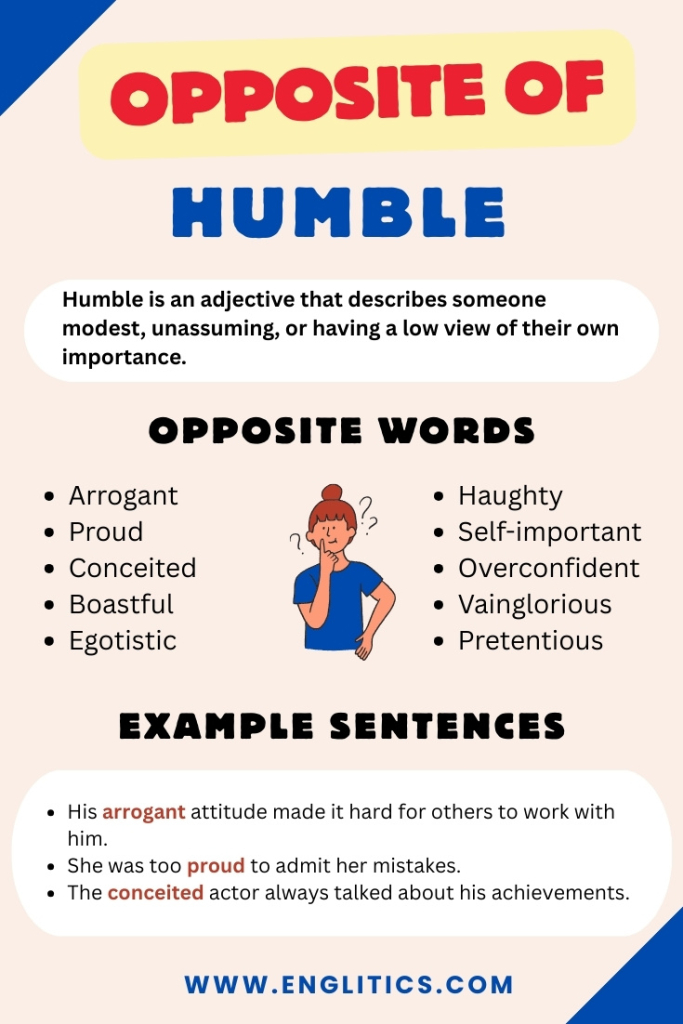
The antonyms of “humble” can be categorized based on the specific aspect of humility they oppose. Some antonyms emphasize arrogance and pride, while others focus on boastfulness, conceit, or domineering behavior.
Understanding these categories allows for more precise and nuanced use of language.
Arrogant and Proud
Arrogant and proud are common antonyms for “humble.” “Arrogant” suggests an exaggerated sense of one’s own importance or abilities, often accompanied by a disdain for others. “Proud,” while sometimes used positively, can also indicate an excessive belief in one’s own superiority or achievements.
Arrogance often manifests as condescending behavior and a belief that one is inherently better than others. Pride, in its negative sense, can lead to a refusal to acknowledge one’s flaws or limitations.
Boastful and Braggart
Boastful and braggart describe individuals who excessively praise their own accomplishments or qualities. These words emphasize the act of self-promotion and the desire to impress others with one’s supposed superiority.
Boastfulness often involves exaggerating one’s achievements or possessions, while a braggart is someone who habitually brags about themselves, often to the point of being annoying or offensive.
Conceited and Egotistical
Conceited and egotistical refer to individuals who have an excessively high opinion of themselves. These words highlight the internal belief in one’s own superiority, rather than the outward display of boastfulness.
Conceit often involves a sense of self-admiration and a belief that one is exceptionally attractive, intelligent, or talented. Egotism, on the other hand, emphasizes self-centeredness and a preoccupation with one’s own needs and desires.
Domineering and Imperious
Domineering and imperious describe individuals who exert control over others in an arrogant or overbearing manner. These words emphasize the abuse of power and the disregard for the rights and feelings of others.
Domineering behavior often involves dictating rules and making decisions without consulting others, while an imperious attitude is characterized by a commanding and authoritative demeanor.
Ostentatious and Pretentious
Ostentatious and pretentious describe behaviors that are designed to impress others with one’s wealth, status, or knowledge. These words highlight the outward display of superiority, often in a superficial or insincere manner.
Ostentation involves displaying wealth or possessions in a showy and extravagant way, while pretentiousness involves adopting mannerisms or beliefs that are not genuine, in order to appear more sophisticated or cultured.
Examples of Antonyms in Use
The following tables provide examples of how the antonyms of “humble” can be used in sentences. Each table focuses on a specific category of antonyms, illustrating the nuances of each word and its appropriate context.
Arrogant Examples
The table below illustrates the usage of “arrogant” in various contexts. The examples highlight how arrogance manifests in different scenarios, from professional settings to personal relationships.
| Sentence |
|---|
| His arrogant attitude alienated many of his colleagues. |
| The arrogant CEO refused to listen to the concerns of his employees. |
| She was known for her arrogant dismissal of anyone who disagreed with her. |
| The professor’s arrogant lectures were filled with condescending remarks. |
| His arrogant disregard for the rules led to his downfall. |
| The politician’s arrogant promises were quickly forgotten. |
| Her arrogant demeanor made it difficult to approach her. |
| The company’s arrogant marketing campaign backfired spectacularly. |
| His arrogant assumption that he was always right proved to be his undoing. |
| The arrogant student believed he was too smart to study. |
| Her arrogant laughter echoed through the room, making everyone uncomfortable. |
| The arrogant general demanded absolute obedience from his troops. |
| His arrogant critique of her work was unnecessarily harsh. |
| The arrogant athlete attributed his success solely to his own talent. |
| Her arrogant refusal to compromise led to a stalemate. |
| The arrogant developer bulldozed the historic building without a second thought. |
| His arrogant pronouncements on matters he knew little about were embarrassing. |
| The arrogant leader ignored the warnings of his advisors. |
| Her arrogant boasting about her wealth offended many people. |
| The arrogant lawyer treated the judge with disrespect. |
| His arrogant disregard for safety regulations caused a serious accident. |
| The arrogant artist refused to listen to any criticism of his work. |
| Her arrogant belief in her own infallibility was her greatest weakness. |
| The arrogant manager micromanaged every aspect of his team’s work. |
| His arrogant attitude towards the service staff was appalling. |
| The arrogant scholar dismissed the ideas of his colleagues as simplistic. |
Proud Examples
The following table demonstrates the use of “proud” as an antonym for “humble,” focusing on its negative connotations of excessive self-esteem and a sense of superiority.
| Sentence |
|---|
| He was too proud to admit he needed help. |
| Her proud nature prevented her from apologizing. |
| The proud king refused to negotiate with the rebels. |
| His proud demeanor made him unapproachable. |
| She was proud of her accomplishments, but also arrogant about them. |
| The proud warrior boasted of his victories. |
| His proud silence spoke volumes about his disdain. |
| The proud nation refused to bow to international pressure. |
| She was too proud to accept charity. |
| The proud aristocrat looked down on the commoners. |
| His proud refusal to listen to advice led to his downfall. |
| The proud queen demanded absolute loyalty. |
| She was proud of her lineage and never let anyone forget it. |
| The proud company refused to acknowledge its mistakes. |
| His proud arrogance was his defining characteristic. |
| The proud general dismissed the enemy as weak. |
| She was too proud to show any vulnerability. |
| The proud institution refused to adapt to changing times. |
| His proud insistence on doing everything himself slowed down the project. |
| The proud family guarded their secrets fiercely. |
| She was proud of her independence and refused to rely on anyone. |
| The proud leader ignored the suffering of his people. |
| His proud nature made it difficult for him to form close relationships. |
| The proud empire crumbled under its own weight. |
| She was too proud to admit her flaws. |
Boastful Examples
This table provides examples of how “boastful” is used to describe someone who excessively brags about their achievements or possessions. The examples illustrate the various ways boastfulness can manifest in speech and behavior.
| Sentence |
|---|
| He was boastful about his new car and never stopped talking about it. |
| Her boastful claims about her intelligence were tiresome. |
| The boastful athlete bragged about his training regimen. |
| His boastful stories were often exaggerations of the truth. |
| She was known for her boastful displays of wealth. |
| The boastful entrepreneur constantly talked about his success. |
| His boastful attitude made him unpopular with his peers. |
| The boastful politician promised unrealistic results. |
| She was boastful about her travels and always showed off her photos. |
| The boastful student claimed he didn’t need to study. |
| His boastful pronouncements were often unfounded. |
| The boastful musician bragged about his talent. |
| She was boastful about her cooking skills, but her food was mediocre. |
| The boastful manager took credit for his team’s achievements. |
| His boastful demeanor was off-putting. |
| The boastful actor talked endlessly about his upcoming roles. |
| She was boastful about her connections and name-dropped constantly. |
| The boastful inventor claimed his invention would change the world. |
| His boastful remarks were met with skepticism. |
| The boastful writer promoted his book aggressively. |
| She was boastful about her fitness and always posted gym selfies. |
| The boastful chef bragged about his Michelin star aspirations. |
| His boastful comments during the meeting were inappropriate. |
| The boastful sales person exaggerated the product’s capabilities. |
| She was boastful about her academic achievements. |
Conceited Examples
The following table illustrates the usage of “conceited” in various contexts. The examples highlight how conceit manifests in different scenarios, often characterized by an inflated sense of self-worth.
| Sentence |
|---|
| He was too conceited to admit he had made a mistake. |
| Her conceited attitude made it difficult to work with her. |
| The conceited artist believed his work was beyond criticism. |
| His conceited remarks were often insensitive and hurtful. |
| She was known for her conceited belief in her own beauty. |
| The conceited professor looked down on his students. |
| His conceited demeanor made him seem arrogant and unapproachable. |
| The conceited politician thought he was above the law. |
| She was conceited about her intelligence and often flaunted her knowledge. |
| The conceited student believed he was smarter than the teacher. |
| His conceited pronouncements were based on little evidence. |
| The conceited musician thought he was a genius. |
| She was conceited about her fashion sense, but her outfits were often bizarre. |
| The conceited manager micromanaged his team because he didn’t trust their abilities. |
| His conceited self-assurance was often misplaced. |
| The conceited actor believed he was destined for greatness. |
| She was conceited about her social status and treated others with disdain. |
| The conceited inventor thought his ideas were revolutionary. |
| His conceited attitude alienated his friends. |
| The conceited writer dismissed other authors as inferior. |
| She was conceited about her physical appearance. |
| The conceited chef thought his cooking was unparalleled. |
| His conceited comments were often sarcastic and condescending. |
| The conceited sales person exaggerated the product’s benefits. |
| She was conceited about her artistic talent. |
Domineering Examples
This table provides examples of how “domineering” is used to describe someone who exerts excessive control over others. The examples illustrate the various ways domineering behavior can manifest in different relationships and settings.
| Sentence |
|---|
| He had a domineering personality and always wanted to be in charge. |
| Her domineering mother controlled every aspect of her life. |
| The domineering boss made all the decisions without consulting his employees. |
| His domineering attitude made it difficult to have a conversation with him. |
| She was trapped in a relationship with a domineering partner. |
| The domineering father ruled his family with an iron fist. |
| His domineering presence intimidated everyone around him. |
| The domineering manager stifled creativity and innovation. |
| She was tired of his domineering behavior and decided to leave. |
| The domineering teacher enforced strict rules and punished any disobedience. |
| His domineering commands were met with resentment. |
| The domineering leader suppressed dissent and opposition. |
| She was domineering in her opinions and refused to listen to other viewpoints. |
| The domineering government controlled every aspect of its citizens’ lives. |
| His domineering influence shaped the company’s culture. |
| The domineering general demanded absolute obedience. |
| She was domineering in her relationships and always wanted things her way. |
| The domineering corporation exploited its workers. |
| His domineering nature made him difficult to work with. |
| The domineering editor controlled the newspaper’s content. |
| She was domineering in her parenting style. |
| The domineering landlord imposed unfair terms on his tenants. |
| His domineering comments discouraged others from speaking up. |
| The domineering salesperson pressured customers into buying things they didn’t need. |
| She was domineering in her management style, leading to high turnover. |
Usage Rules and Nuances
When using antonyms for “humble,” it’s important to consider the specific context and the intended meaning. Each antonym carries its own nuances and connotations, and choosing the right word can significantly impact the message you convey.
For example, “arrogant” implies a sense of superiority and disdain for others, while “proud” can sometimes be used positively to indicate a sense of satisfaction in one’s achievements. “Boastful” emphasizes the act of self-promotion, while “conceited” focuses on the internal belief in one’s own importance.
Understanding these nuances is crucial for avoiding miscommunication and ensuring that your language accurately reflects your intended meaning. Pay attention to the specific characteristics and behaviors that each antonym describes, and choose the word that best captures the essence of the opposite of humility in the given context.
Consider also the level of formality. Some antonyms, like “imperious,” are more formal and suitable for academic or professional writing, while others, like “braggart,” are more informal and appropriate for casual conversation.
Common Mistakes
One common mistake is using “proud” as a direct synonym for “arrogant.” While “proud” can sometimes indicate an excessive sense of self-importance, it can also be used positively to describe a feeling of satisfaction in one’s achievements. It’s important to distinguish between healthy pride and excessive arrogance.
Another common mistake is confusing “boastful” with “confident.” While both words describe individuals who express their abilities or achievements, “boastful” implies an excessive and often exaggerated display of self-promotion, while “confident” suggests a genuine belief in one’s own capabilities.
A further mistake is using “pretentious” interchangeably with “ostentatious.” While both words describe behaviors designed to impress others, “pretentious” focuses on adopting mannerisms or beliefs that are not genuine, while “ostentatious” emphasizes the outward display of wealth or status.
Here are some examples of common mistakes and their corrections:
| Incorrect | Correct |
|---|---|
| He was proud to a fault, always putting others down. | He was arrogant to a fault, always putting others down. |
| She was boastful, simply stating her accomplishments. | She was confident, simply stating her accomplishments. |
| His pretentious car was a clear sign of his wealth. | His ostentatious car was a clear sign of his wealth. |
Practice Exercises
These exercises will help you practice using antonyms for “humble” in different contexts. Choose the best antonym from the options provided to complete each sentence.
Exercise 1: Multiple Choice
| Question | Options | Answer |
|---|---|---|
| His ______ attitude made it difficult to work with him. | (a) Humble (b) Arrogant (c) Modest (d) Meek | (b) Arrogant |
| She was too ______ to admit she needed help. | (a) Humble (b) Proud (c) Shy (d) Timid | (b) Proud |
| The ______ athlete bragged about his achievements. | (a) Humble (b) Boastful (c) Reserved (d) Quiet | (b) Boastful |
| He was too ______ to see his own faults. | (a) Modest (b) Conceited (c) Bashful (d) Demure | (b) Conceited |
| The ______ manager made all the decisions without consulting his team. | (a) Humble (b) Domineering (c) Submissive (d) Passive | (b) Domineering |
| Her ______ display of wealth was quite vulgar. | (a) Humble (b) Ostentatious (c) Simple (d) Plain | (b) Ostentatious |
| He tried to sound ______ by using big words he didn’t understand. | (a) Humble (b) Pretentious (c) Genuine (d) Sincere | (b) Pretentious |
| The ______ student always knew the answer and made sure everyone else did too. | (a) Humble (b) Egotistical (c) Quiet (d) Introverted | (b) Egotistical |
| The ______ leader demanded absolute obedience from his followers. | (a) Humble (b) Imperious (c) Meek (d) Docile | (b) Imperious |
| His ______ comments made everyone uncomfortable. | (a) Humble (b) Arrogant (c) Thoughtful (d) Considerate | (b) Arrogant |
Exercise 2: Sentence Completion
Fill in the blanks with the most appropriate antonym for “humble” from the list: arrogant, proud, boastful, conceited, domineering.
- His ______ attitude made it difficult to have a productive conversation.
- She was too ______ to ask for help, even when she was struggling.
- The ______ child constantly bragged about his toys.
- He was so ______ that he couldn’t see his own flaws.
- The ______ boss controlled every aspect of the project.
Answers:
- Arrogant
- Proud
- Boastful
- Conceited
- Domineering
Exercise 3: Contextual Usage
Rewrite the following sentences, replacing the underlined word “humble” with an appropriate antonym.
- Despite his success, he remained humble.
- She gave a humble apology for her mistake.
- He comes from a humble background.
- The team celebrated their victory in a humble manner.
- He accepted the award with a humble speech.
Possible Answers:
- Despite his success, he remained arrogant/proud/boastful. (depending on the context, and how the success changed him)
- She gave an arrogant/boastful/conceited “apology” for her mistake. (Note: In this context the antonym implies insincerity.)
- He comes from an ostentatious/pretentious background (implying he pretends to be from a modest background).
- The team celebrated their victory in a domineering/ostentatious manner.
- He accepted the award with an arrogant/boastful speech.
Advanced Topics
For advanced learners, exploring the philosophical and psychological implications of humility and its antonyms can provide a deeper understanding of these concepts. Consider researching the role of humility in different cultures and religions, as well as the psychological factors that contribute to arrogance, pride, and other related traits.
Furthermore, analyzing literary works that explore the themes of humility and its opposites can offer valuable insights into the complexities of human nature. Look for examples of characters who embody humility and those who exhibit arrogance, pride, or other related traits, and consider how these characteristics shape their actions and relationships.
Exploring the etymology of these words in different languages can also provide a richer understanding of their nuances and cultural connotations. Research the origins of words related to humility and its antonyms in languages such as Latin, Greek, and Sanskrit, and consider how their meanings have evolved over time.
Frequently Asked Questions
Q1: Is “proud” always an antonym for “humble”?
No, “proud” can have both positive and negative connotations. In a positive sense, it describes a feeling of satisfaction in one’s achievements.
However, when it implies an excessive belief in one’s own superiority, it becomes an antonym for “humble.”
Q2: What is the difference between “arrogant” and “conceited”?
“Arrogant” suggests an exaggerated sense of one’s own importance or abilities, often accompanied by a disdain for others. “Conceited” refers to an excessively high opinion of oneself, focusing on self-admiration and a belief that one is exceptionally attractive, intelligent, or talented.
Q3: How does “boastful” differ from “confident”?
“Boastful” implies an excessive and often exaggerated display of self-promotion, while “confident” suggests a genuine belief in one’s own capabilities without the need to excessively brag about them. Confidence is generally considered a positive trait, while boastfulness is often seen as annoying or offensive.
Q4: When is it appropriate to use “imperious” instead of “domineering”?
“Imperious” is a more formal term that suggests a commanding and authoritative demeanor, often associated with someone in a position of power. “Domineering” is a more general term that describes someone who exerts control over others in an overbearing manner.
“Imperious” is often used in more formal writing or when describing someone in a position of authority, while “domineering” can be used in a wider range of contexts.
Q5: What is the difference between “ostentatious” and “pretentious”?
“Ostentatious” emphasizes the outward display of wealth or status, often in a showy and extravagant way. “Pretentious” focuses on adopting mannerisms or beliefs that are not genuine, in order to appear more sophisticated or cultured.
Ostentation is about showing off what you have, while pretentiousness is about trying to be something you’re not.
Q6: Can someone be both humble and proud?
Yes, it is possible to be both humble and proud. A person can be proud of their accomplishments while still maintaining a modest view of their own importance.
The key is to avoid excessive arrogance or boastfulness and to remain respectful of others.
Q7: Are there any situations where arrogance might be beneficial?
In some competitive environments, a degree of self-confidence and assertiveness, which might border on arrogance, can be beneficial. However, it’s important to balance this with humility and respect for others to avoid alienating colleagues or making poor decisions.
Q8: How can I avoid being perceived as arrogant or boastful?
Be mindful of your language and tone, avoid exaggerating your achievements, and give credit to others when appropriate. Listen actively to others, and be open to feedback.
Focus on your accomplishments rather than comparing yourself to others, and remember that true confidence comes from within, not from seeking external validation.
Conclusion
Mastering the antonyms of “humble” is essential for effective communication and nuanced expression. By understanding the different categories of antonyms, such as arrogant, proud, boastful, conceited, domineering, ostentatious, and pretentious, you can more accurately convey the opposite of humility in various contexts.
Remember to consider the specific nuances of each word and to avoid common mistakes such as confusing “proud” with “arrogant” or “boastful” with “confident.” Practice using these antonyms in your own writing and speech, and pay attention to how they are used by others. With continued effort, you can expand your vocabulary and enhance your ability to express a wide range of attitudes and behaviors.
By understanding the subtle differences between these words, you can communicate more effectively and avoid misunderstandings. Continue to practice and refine your understanding of these concepts, and you will become a more confident and articulate English speaker.