Impressive is used to describe something that stands out—whether it’s a powerful speech, an amazing skill, or a striking appearance. It captures attention, earns praise, and leaves a strong impact. But sometimes, things are just the opposite: ordinary, weak, or completely forgettable. That’s when the opposite of impressive comes into play.
Antonyms for impressive include words like unremarkable, forgettable, ordinary, weak, and underwhelming. These words help describe moments, people, or performances that fail to excite or leave a mark. In this guide, you’ll learn how to use these opposite words clearly and correctly, with real-life examples to build your vocabulary.
Definition of “Impressive”
The word “impressive” is an adjective used to describe something that evokes admiration, respect, or a strong positive feeling. It suggests a quality that stands out, leaving a lasting impact on the observer.
“Impressive” can apply to a wide range of subjects, including achievements, performances, objects, and even personal qualities. It often implies a level of skill, grandeur, or significance that exceeds expectations.
In essence, something that is “impressive” is noteworthy and commands attention due to its superior qualities. Think of an impressive building, an impressive feat of athleticism, or an impressive display of intelligence.
All these examples share the common thread of eliciting a sense of awe or respect.
The term carries a positive connotation and is frequently used to highlight excellence or remarkable attributes. Its usage spans across various contexts, from formal writing to casual conversation, making it a versatile adjective in the English language.
Structural Breakdown of Antonyms
Antonyms are words that have opposite meanings. The relationship between a word and its antonym is known as opposition.
Understanding how antonyms function requires recognizing different types of opposition, which can be broadly categorized as complementary, gradable, and relational.
Complementary antonyms are pairs where the presence of one implies the absence of the other. For example, “alive” and “dead” are complementary; something cannot be both alive and dead at the same time. With “impressive,” there aren’t direct complementary antonyms in the strictest sense, but some words come close in certain contexts.
Gradable antonyms represent points on a scale. These antonyms allow for degrees of comparison. For example, “hot” and “cold” are gradable; something can be warm, lukewarm, or freezing – all points on a scale between hot and cold. Many antonyms of “impressive” fall into this category, such as “mediocre” or “ordinary,” which suggest varying degrees of lacking impressiveness.
Relational antonyms describe a relationship from opposite perspectives. For instance, “teacher” and “student” are relational antonyms; one cannot exist without the other. Antonyms of “impressive” don’t typically fall into this category, as they focus on the inherent qualities of the subject rather than a relationship.
Opposite of Impressive
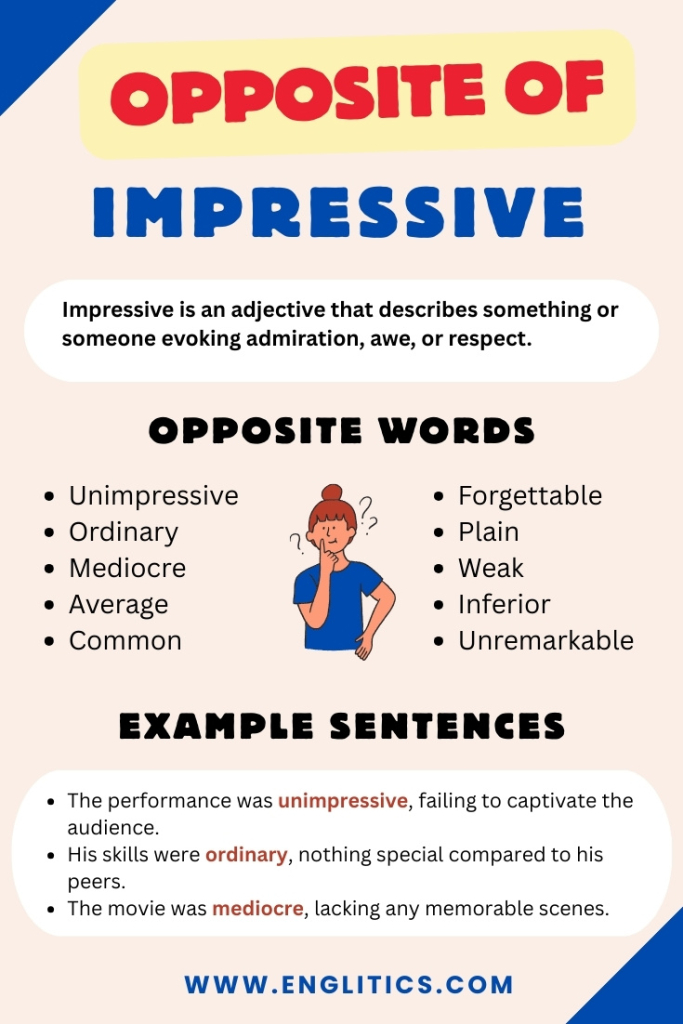
Finding the right antonym for “impressive” depends heavily on the context. Here are several categories of antonyms, each with slightly different nuances:
Unremarkable
“Unremarkable” describes something that is not worthy of attention or note. It’s a general term for something that doesn’t stand out in any significant way.
This is a very common and useful antonym for impressive because it directly negates the idea of something being noteworthy.
Ordinary
“Ordinary” suggests something that is commonplace or typical. It lacks any special or distinctive qualities.
When something is ordinary, it blends in with the background and doesn’t elicit any particular interest or excitement. This antonym is useful when you want to convey that something is average or run-of-the-mill.
Mediocre
“Mediocre” implies a level of quality that is neither good nor bad, but rather average or below average. It suggests a lack of excellence or distinction.
This antonym is stronger than “ordinary” and often carries a slightly negative connotation, implying that something could be better.
Poor
“Poor” indicates a deficiency in quality or standard. It can refer to a lack of skill, resources, or effort.
This antonym is suitable when describing something that is noticeably inadequate or substandard. It often implies a negative judgment about the subject’s quality or performance.
Lacking
“Lacking” suggests that something is missing essential qualities or components. It highlights a deficiency or absence that detracts from the overall quality.
This antonym is useful when you want to emphasize what is absent rather than focusing on negative qualities.
Disappointing
“Disappointing” describes something that fails to meet expectations or hopes. It evokes a feeling of dissatisfaction or letdown.
This antonym is particularly appropriate when there was an anticipation of something being impressive, but it fell short.
Terrible
“Terrible” signifies something extremely bad or unpleasant. It suggests a high degree of negativity and often implies that something is deeply flawed or offensive.
This antonym is the strongest and should be used when something is significantly below acceptable standards.
Insignificant
“Insignificant” denotes something that is unimportant or without consequence. It suggests a lack of value or impact.
This antonym is useful when you want to emphasize that something has no real importance or effect.
Examples of Antonyms in Sentences
Here are several tables illustrating the use of antonyms for “impressive” in sentences. Each table focuses on a specific antonym and provides multiple examples to show its usage in different contexts.
The following table presents examples using “unremarkable” as an antonym for “impressive.”
| Sentence Using “Impressive” | Sentence Using “Unremarkable” |
|---|---|
| The athlete delivered an impressive performance, breaking several records. | The athlete’s performance was unremarkable; he finished in the middle of the pack. |
| The architecture of the building was truly impressive, showcasing intricate details. | The architecture of the building was unremarkable, resembling many other structures in the city. |
| Her knowledge of the subject was impressive, demonstrating years of study. | Her knowledge of the subject was unremarkable, showing only a basic understanding. |
| The magician’s tricks were incredibly impressive, leaving the audience in awe. | The magician’s tricks were unremarkable, failing to captivate the audience. |
| The scenery was impressive, with towering mountains and lush valleys. | The scenery was unremarkable, consisting of flat plains and sparse vegetation. |
| His dedication to the project was truly impressive. | His contribution to the project was unremarkable. |
| The chef created an impressive dish with exotic ingredients. | The chef prepared an unremarkable meal, using basic ingredients. |
| The company reported impressive profits this quarter. | The company reported unremarkable profits this quarter. |
| The politician delivered an impressive speech that resonated with voters. | The politician gave an unremarkable speech that failed to inspire. |
| The student wrote an impressive essay that earned top marks. | The student wrote an unremarkable essay that received an average grade. |
| The fireworks display was impressive, lighting up the night sky. | The fireworks display was unremarkable, with few memorable bursts. |
| The museum showcased an impressive collection of ancient artifacts. | The museum displayed an unremarkable collection of everyday items. |
| The singer’s vocal range was impressive. | The singer’s vocal range was unremarkable. |
| The dancer’s technique was impressive and precise. | The dancer’s technique was unremarkable and sloppy. |
| The inventor created an impressive new technology. | The inventor created an unremarkable gadget. |
| The rescue team performed an impressive operation. | The rescue team conducted an unremarkable search effort. |
| The artist’s painting was an impressive masterpiece. | The artist’s painting was an unremarkable sketch. |
| The negotiator secured an impressive deal. | The negotiator reached an unremarkable agreement. |
| The explorer discovered an impressive new species. | The explorer found an unremarkable plant. |
| The CEO demonstrated impressive leadership skills. | The CEO showed unremarkable management skills. |
Next, this table shows examples using “ordinary” as an antonym for “impressive.”
| Sentence Using “Impressive” | Sentence Using “Ordinary” |
|---|---|
| The car’s performance was impressive, with incredible speed and handling. | The car’s performance was ordinary, with average speed and handling. |
| The jewelry was impressive, adorned with rare and valuable gems. | The jewelry was ordinary, made of common materials. |
| The student’s presentation was impressive, captivating the entire class. | The student’s presentation was ordinary, failing to engage the audience. |
| The view from the mountaintop was impressive, stretching for miles. | The view from the backyard was ordinary, offering nothing special. |
| The level of collaboration within the team was impressive. | The level of collaboration within the team was ordinary. |
| The party was an impressive affair, with lavish decorations. | The party was an ordinary gathering. |
| The book was an impressive work of literature. | The book was an ordinary story. |
| The garden was an impressive display of horticulture. | The garden was an ordinary patch of land. |
| The building was an impressive example of modern design. | The building was an ordinary structure. |
| The meal was an impressive culinary experience. | The meal was an ordinary dining experience. |
| The sound system produced an impressive audio experience. | The sound system provided an ordinary listening experience. |
| The conference was an impressive gathering of experts. | The conference was an ordinary meeting. |
| The product launch was an impressive success. | The product launch was an ordinary event. |
| The fireworks show was an impressive spectacle. | The fireworks show was an ordinary display. |
| The customer service was impressive and attentive. | The customer service was ordinary and indifferent. |
| The professor gave an impressive lecture. | The professor gave an ordinary talk. |
| The artwork was an impressive creation. | The artwork was an ordinary piece. |
| The project management was impressive and efficient. | The project management was ordinary and slow. |
| The scientific discovery was impressive and groundbreaking. | The scientific discovery was ordinary and routine. |
| The teacher used an impressive teaching method. | The teacher used an ordinary teaching technique. |
This table illustrates the use of “mediocre” as an antonym for “impressive.”
| Sentence Using “Impressive” | Sentence Using “Mediocre” |
|---|---|
| The restaurant’s food was impressive, with innovative flavors and presentation. | The restaurant’s food was mediocre, with bland flavors and uninspired presentation. |
| The movie was impressive, with a compelling storyline and excellent acting. | The movie was mediocre, with a predictable storyline and average acting. |
| His performance on the test was impressive, demonstrating a thorough understanding of the material. | His performance on the test was mediocre, showing only a superficial understanding of the material. |
| The craftsmanship of the furniture was impressive, reflecting skilled artistry. | The craftsmanship of the furniture was mediocre, showing a lack of attention to detail. |
| The results of the experiment were impressive, confirming the hypothesis. | The results of the experiment were mediocre, providing inconclusive data. |
| The team’s effort was impressive and well-coordinated. | The team’s effort was mediocre and disorganized. |
| The novel was an impressive literary achievement. | The novel was a mediocre attempt at storytelling. |
| The sculpture was an impressive work of art. | The sculpture was a mediocre piece. |
| The presentation was an impressive display of knowledge. | The presentation was a mediocre display of information. |
| The software was an impressive piece of engineering. | The software was a mediocre application. |
| The customer service team provided impressive support. | The customer service team offered mediocre assistance. |
| The marketing campaign was an impressive success. | The marketing campaign was a mediocre effort. |
| The financial report showed impressive growth. | The financial report showed mediocre performance. |
| The athlete’s stamina was impressive. | The athlete’s stamina was mediocre. |
| The employee’s productivity was impressive. | The employee’s productivity was mediocre. |
| The student’s writing skills were impressive. | The student’s writing skills were mediocre. |
| The chef’s culinary skills were impressive. | The chef’s culinary skills were mediocre. |
| The musician’s performance was impressive. | The musician’s performance was mediocre. |
| The negotiator’s skills were impressive. | The negotiator’s skills were mediocre. |
| The leader’s vision was impressive. | The leader’s vision was mediocre. |
This table shows examples using “poor” as an antonym for “impressive.”
| Sentence Using “Impressive” | Sentence Using “Poor” |
|---|---|
| The quality of the product was impressive, ensuring customer satisfaction. | The quality of the product was poor, leading to numerous complaints. |
| The sound quality of the recording was impressive, capturing every nuance. | The sound quality of the recording was poor, making it difficult to hear. |
| The service at the hotel was impressive, with attentive and courteous staff. | The service at the hotel was poor, with inattentive and rude staff. |
| The construction of the bridge was impressive, demonstrating engineering excellence. | The construction of the bridge was poor, raising safety concerns. |
| The design of the website was impressive, providing a user-friendly experience. | The design of the website was poor, making it difficult to navigate. |
| The research was impressive and thorough. | The research was poor and incomplete. |
| The management showed impressive leadership. | The management showed poor judgment. |
| The investment yielded impressive returns. | The investment yielded poor results. |
| The living conditions were impressive and comfortable. | The living conditions were poor and cramped. |
| The educational resources were impressive and extensive. | The educational resources were poor and limited. |
| The security measures were impressive and effective. | The security measures were poor and ineffective. |
| The infrastructure was impressive and well-maintained. | The infrastructure was poor and neglected. |
| The health care services were impressive and accessible. | The health care services were poor and unavailable. |
| The community support was impressive and strong. | The community support was poor and weak. |
| The environmental policies were impressive and effective. | The environmental policies were poor and damaging. |
| The government demonstrated impressive governance. | The government showed poor administration. |
| The economy showed impressive growth. | The economy showed poor performance. |
| The company’s ethics were impressive. | The company’s ethics were poor. |
| The public transportation was impressive. | The public transportation was poor. |
| The cultural events were impressive. | The cultural events were poor. |
This table illustrates the use of “disappointing” as an antonym for “impressive.”
| Sentence Using “Impressive” | Sentence Using “Disappointing” |
|---|---|
| The sequel to the movie was impressive, exceeding all expectations. | The sequel to the movie was disappointing, failing to live up to the original. |
| The new restaurant was impressive, offering a unique dining experience. | The new restaurant was disappointing, with mediocre food and service. |
| The conference speaker was impressive, delivering insightful commentary. | The conference speaker was disappointing, offering little new information. |
| The upgraded software was impressive, offering new and useful features. | The upgraded software was disappointing, with numerous bugs and glitches. |
| The project outcome was impressive, meeting all objectives and deadlines. | The project outcome was disappointing, falling short of expectations. |
| The election results were impressive, showing strong support for the candidate. | The election results were disappointing, indicating a lack of voter confidence. |
| The scientific study produced impressive findings. | The scientific study produced disappointing results. |
| The art exhibition was impressive and well-curated. | The art exhibition was disappointing and poorly organized. |
| The company’s innovation was impressive. | The company’s innovation was disappointing. |
| The educational program was impressive and effective. | The educational program was disappointing and ineffective. |
| The government’s response was impressive and swift. | The government’s response was disappointing and slow. |
| The concert was an impressive performance. | The concert was a disappointing show. |
| The product demonstration was impressive. | The product demonstration was disappointing. |
| The customer feedback was impressive. | The customer feedback was disappointing. |
| The job interview was impressive. | The job interview was disappointing. |
| The presentation skills were impressive. | The presentation skills were disappointing. |
| The problem-solving ability was impressive. | The problem-solving ability was disappointing. |
| The communication skills were impressive. | The communication skills were disappointing. |
| The level of detail was impressive. | The level of detail was disappointing. |
| The overall experience was impressive. | The overall experience was disappointing. |
Usage Rules and Considerations
When selecting an antonym for “impressive,” consider the specific context and the nuance you want to convey. Each antonym carries a slightly different meaning and implication.
Here are some general rules and considerations:
- Context Matters: The most important factor is the specific situation you’re describing. Are you simply stating that something isn’t noteworthy (“unremarkable”), or are you expressing disappointment (“disappointing”)?
- Level of Negativity: Some antonyms, like “terrible,” are strongly negative, while others, like “ordinary,” are more neutral. Choose the word that accurately reflects the degree of negativity you intend.
- Audience Awareness: Consider your audience and their understanding of the language. Simple antonyms like “unremarkable” might be more suitable for general audiences, while more nuanced antonyms like “mediocre” might be appropriate for a more sophisticated audience.
- Formal vs. Informal: Some antonyms are more appropriate for formal writing, while others are better suited for informal conversation. For example, “insignificant” is generally more formal than “lacking.”
Common Mistakes to Avoid
Here are some common mistakes to avoid when using antonyms for “impressive”:
- Misusing Strong Antonyms: Avoid using overly strong antonyms like “terrible” when a milder term like “unremarkable” is more accurate.
- Ignoring Context: Failing to consider the specific context can lead to choosing an inappropriate antonym that doesn’t accurately reflect the situation.
- Incorrect Connotations: Be aware of the connotations of different antonyms. Some words might carry unintended negative or positive implications.
- Overusing the Same Antonym: Vary your vocabulary by using different antonyms to avoid repetition and make your writing more engaging.
Here are examples of common mistakes:
| Incorrect | Correct | Explanation |
|---|---|---|
| The presentation was impressive, but the food was terrible. | The presentation was impressive, but the food was mediocre. | “Terrible” is too strong a word if the food was simply average or slightly below average. |
| The architecture was impressive, but the garden was insignificant. | The architecture was impressive, but the garden was ordinary. | “Insignificant” implies the garden had no importance, which may not be accurate. “Ordinary” is a more appropriate antonym. |
| The movie was impressive, but the acting was lacking. | The movie was impressive, but the acting was disappointing. | “Lacking” is vague. “Disappointing” better conveys that the acting was not up to par with the movie’s overall quality. |
| The results were impressive, but the effort was poor. | The results were impressive, but the effort was unremarkable. | If the results were impressive, “poor” doesn’t make sense. “Unremarkable” suggests the effort didn’t stand out, despite the good results. |
Practice Exercises
Test your understanding of antonyms for “impressive” with these practice exercises.
Exercise 1: Fill in the Blank
Choose the best antonym for “impressive” from the options provided to complete each sentence.
| Question | Options | Answer |
|---|---|---|
| While the fireworks display was expected to be spectacular, it turned out to be quite __________. | (a) remarkable, (b) ordinary, (c) amazing | (b) ordinary |
| The student’s essay, while not terrible, was rather __________, failing to demonstrate any original thought. | (a) impressive, (b) mediocre, (c) excellent | (b) mediocre |
| Despite the hype, the new product’s performance was __________, with numerous bugs and glitches. | (a) outstanding, (b) disappointing, (c) superb | (b) disappointing |
| The quality of the craftsmanship was so __________ that the furniture fell apart within weeks. | (a) impressive, (b) poor, (c) exceptional | (b) poor |
| Although the speaker was knowledgeable, his presentation was __________, failing to engage the audience. | (a) captivating, (b) unremarkable, (c) fascinating | (b) unremarkable |
| The company’s profits, while steady, were __________, showing no significant growth. | (a) substantial, (b) insignificant, (c) considerable | (b) insignificant |
| The meal was __________, lacking any flavor or creativity. | (a) delightful, (b) terrible, (c) wonderful | (b) terrible |
| The team’s collaboration was __________, leading to a disorganized and inefficient project. | (a) outstanding, (b) lacking, (c) superb | (b) lacking |
| The level of customer service was __________, with long wait times and unhelpful staff. | (a) impressive, (b) poor, (c) excellent | (b) poor |
| The novel’s plot was __________, failing to offer any surprises or twists. | (a) gripping, (b) ordinary, (c) captivating | (b) ordinary |
Exercise 2: Sentence Transformation
Rewrite the following sentences, replacing the word “impressive” with an appropriate antonym.
| Original Sentence | Rewritten Sentence |
|---|---|
| The athlete’s speed and agility were truly impressive. | The athlete’s speed and agility were quite unremarkable. |
| The movie’s special effects were impressive, creating a visually stunning experience. | The movie’s special effects were disappointing, failing to create a visually stunning experience. |
| The museum’s collection of artifacts was impressive, showcasing a rich history. | The museum’s collection of artifacts was ordinary, showcasing no unique finds. |
| The chef’s culinary skills were impressive, delighting diners with innovative dishes. | The chef’s culinary skills were mediocre, providing diners with average meals. |
| The company’s financial performance was impressive, showing significant growth and profitability. | The company’s financial performance was insignificant, showing no significant growth or profitability. |
| The level of detail in the artwork was impressive, capturing every nuance of the subject. | The level of detail in the artwork was lacking, failing to capture the nuances of the subject. |
| The quality of the education was impressive, providing students with a strong foundation. | The quality of the education was poor, failing to provide students with a strong foundation. |
| The politician’s speech was impressive, resonating with voters and inspiring hope. | The politician’s speech was unremarkable, failing to resonate with voters and inspire hope. |
| The product’s features were impressive, offering innovative solutions to customer needs. | The product’s features were ordinary, offering no innovative solutions to customer needs. |
| The student’s research was impressive, contributing significant insights to the field. | The student’s research was mediocre, contributing little insight to the field. |
Advanced Topics: Nuances and Context
For advanced learners, it’s important to understand the subtle nuances and contextual factors that influence the choice of antonyms. The effectiveness of communication often depends on selecting the most precise word to convey the intended meaning.
This requires a deep understanding of synonyms, connotations, and idiomatic expressions.
Consider the intensity and emotional weight of the antonym. For example, “lacking” is a relatively neutral term, while “terrible” carries a strong negative connotation.
The choice depends on the degree of negativity or criticism you wish to express. Similarly, “unremarkable” simply means not noteworthy, while “disappointing” implies a failed expectation.
Also, be aware of the cultural context. Some words may have different connotations or implications in different cultures or regions.
Understanding these cultural nuances can help you avoid misunderstandings and communicate more effectively.
Frequently Asked Questions
Here are some frequently asked questions about antonyms for “impressive”:
- What is the best antonym for “impressive” in general?
There is no single “best” antonym. The ideal choice depends on the specific context.Consider what aspect of “impressive” you want to negate. “Unremarkable” is a good general antonym, but other options may be more appropriate depending on the nuance you want to convey. - How do I choose the right antonym for “impressive” in my writing?
Think about the specific meaning you want to convey. Do you want to express that something is simply average, or do you want to express disappointment or criticism? Choose the antonym that best reflects your intended meaning. - Are there any formal or informal antonyms for “impressive”?
Yes, some antonyms are more formal than others. For example, “insignificant” is generally more formal than “lacking.” Consider your audience and the overall tone of your writing when making your choice. - Can an antonym for “impressive” also be a synonym for another word?
Yes, antonyms and synonyms can overlap. For example, “poor” can be an antonym for “impressive” and a synonym for “substandard.” - What is the difference between “ordinary” and “unremarkable”?
Both “ordinary” and “unremarkable” suggest a lack of special qualities, but “ordinary” emphasizes the commonness or typicality of something, while “unremarkable” emphasizes its lack of noteworthiness.
Conclusion
Mastering antonyms for “impressive” allows for richer, more precise communication. By understanding the nuances of words like “unremarkable,” “ordinary,” “mediocre,” “poor,” “lacking,” “disappointing,” “terrible,” and “insignificant,” you can effectively convey a wide range of meanings and express your ideas with greater accuracy.
Remember to consider the context, level of negativity, and audience when selecting the most appropriate antonym. With practice and attention to detail, you can enhance your writing and speaking skills, making your communication more compelling and effective.