Lonely describes the feeling of being alone, isolated, or emotionally distant from others. It often comes with sadness, disconnection, or the desire for company. But not every moment of solitude is painful—and not everyone feels alone. When you want to describe connection, companionship, or belonging, the opposite of lonely is a better fit.
Antonyms for lonely include words like connected, loved, included, supported, and together. These words express feelings of closeness, friendship, and emotional warmth. Whether you’re describing a person’s social life or emotional state, using the right opposite helps highlight comfort, community, and the presence of others.
Definition of “Lonely”
Lonely is an adjective that describes a state of being sad or dejected as a result of having no friends or company. It often implies a feeling of isolation, emptiness, and a longing for connection. Loneliness can be a temporary emotional state or a more chronic condition, affecting individuals of all ages and backgrounds.
In essence, to be lonely is to experience a significant gap between one’s desired and actual social connections. This feeling can arise from physical isolation, such as being alone in a remote location, or from emotional isolation, even when surrounded by others.
The key element is the perceived lack of meaningful relationships and social support.
Structural Breakdown of “Lonely”
The word “lonely” is derived from the word “lone,” which means single or solitary. Adding the suffix “-ly” transforms “lone” into an adjective describing the state of being alone and feeling the negative emotions associated with it.
Understanding the structure of “lonely” can help us appreciate its nuances. The base word, “lone,” highlights the state of being physically alone, while the suffix “-ly” adds the emotional dimension of sadness and longing.
This combination emphasizes that loneliness is not merely about being physically isolated but also about the emotional experience of lacking connection.
Opposite of Lonely
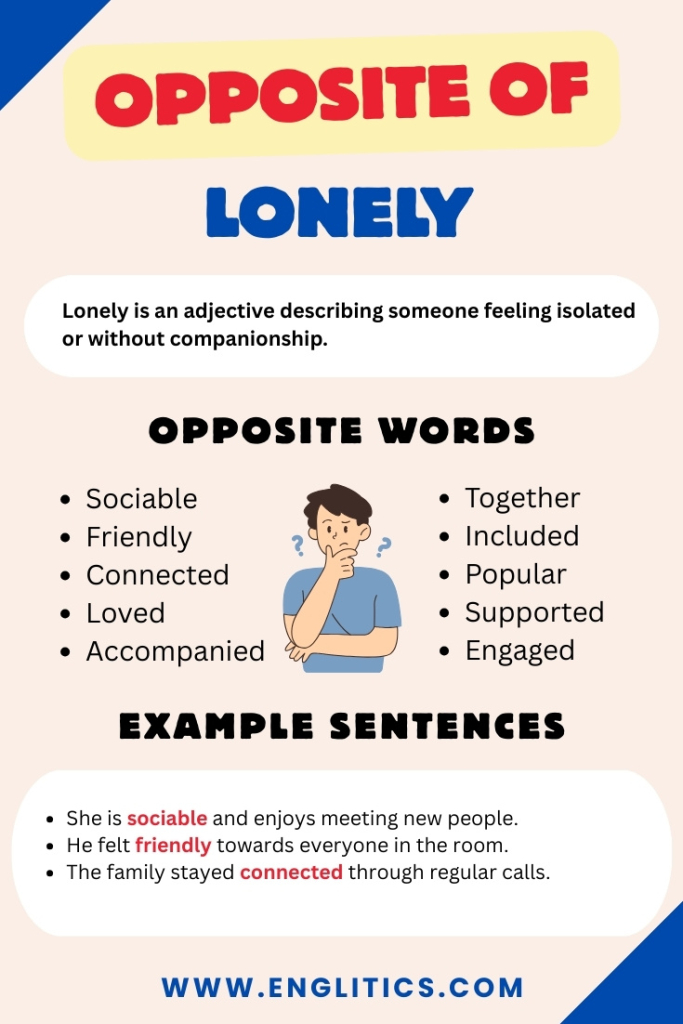
Antonyms for “lonely” can be categorized based on the specific aspect of loneliness they negate. These categories include words related to company, social engagement, happiness, and connectedness.
Each category offers a different perspective on the opposite of loneliness.
Company and Companionship
These antonyms emphasize the presence of others and the enjoyment of their company. They focus on the social aspect of overcoming loneliness by being with friends, family, or other people.
Words like accompanied, attended, and surrounded highlight the physical presence of others. Other relevant terms include befriended, partnered, and united, emphasizing the positive aspects of having companions and sharing experiences.
Social Engagement and Activity
This category includes words that suggest active participation in social events and interactions. They focus on being involved in activities with others, fostering a sense of belonging and purpose.
Terms such as involved, participating, and active suggest a state of being engaged in social activities. Other relevant words include sociable, outgoing, and gregarious, which describe personality traits that facilitate social interaction and reduce feelings of isolation.
Happiness and Contentment
These antonyms focus on the emotional state of being happy and satisfied, which often results from strong social connections and a sense of fulfillment. They highlight the positive emotions that counteract the sadness and emptiness associated with loneliness.
Words like happy, content, and cheerful describe a general state of well-being. Other relevant terms include fulfilled, satisfied, and joyful, which emphasize the sense of purpose and satisfaction that can arise from meaningful relationships and social engagement.
Connectedness and Belonging
This category includes words that emphasize the feeling of being connected to others and belonging to a group or community. They focus on the emotional and psychological aspects of overcoming loneliness by fostering a sense of identity and shared purpose.
Terms such as connected, integrated, and attached suggest a strong sense of belonging. Other relevant words include accepted, included, and supported, which emphasize the positive aspects of being part of a community and receiving social support.
Examples of Antonyms for “Lonely”
The following examples illustrate how different antonyms for “lonely” can be used in various contexts. These examples are organized by the categories discussed above, providing a comprehensive overview of the diverse ways to express the opposite of loneliness.
Examples of Antonyms Related to Company
This table provides examples of antonyms related to company and companionship, demonstrating how they can be used in sentences to convey the presence of others and the enjoyment of their company. These examples showcase the social aspect of overcoming loneliness.
| Antonym | Example Sentence |
|---|---|
| Accompanied | She felt much better when she was accompanied by her friends on the trip. |
| Attended | The conference was well attended, and she made many new connections. |
| Surrounded | He felt safe and loved, surrounded by his family during the holidays. |
| Befriended | She quickly befriended her new colleagues and no longer felt isolated at work. |
| Partnered | They partnered up for the project, which made the work much more enjoyable. |
| United | The community was united in their efforts to support the local school. |
| With | She was happy to be with her family for the holidays. |
| Together | They worked together to solve the problem. |
| Joined | He joined a club to meet new people. |
| In company | She enjoyed being in company with her friends. |
| Escorted | She was escorted to the event by her date. |
| Chaperoned | The students were chaperoned by their teachers on the field trip. |
| Attended by | The meeting was attended by all the key stakeholders. |
| In the presence of | She felt comfortable in the presence of her close friends. |
| Alongside | He worked alongside his colleagues on the project. |
| Associated | She was associated with a group of like-minded individuals. |
| Among | He felt at home among his friends. |
| Allied | The countries were allied in their fight against the common enemy. |
| Affiliated | She was affiliated with a reputable organization. |
| Attached | He was attached to his family and friends. |
| Surrounded by | She felt loved and supported, surrounded by her family. |
| In the midst of | He was happy to be in the midst of the celebration. |
| In concert with | They worked in concert with each other to achieve their goals. |
| In collaboration with | The project was completed in collaboration with several organizations. |
| In partnership with | The company worked in partnership with a local charity. |
Examples of Antonyms Related to Social Engagement
This table provides examples of antonyms related to social engagement and activity, demonstrating how they can be used in sentences to convey active participation in social events and interactions. These examples showcase the importance of being involved in activities with others.
| Antonym | Example Sentence |
|---|---|
| Involved | She became involved in several community projects, which helped her feel more connected. |
| Participating | He enjoyed participating in the local sports league and making new friends. |
| Active | She led an active social life, always attending parties and events. |
| Sociable | He was a sociable person who enjoyed meeting new people and making conversation. |
| Outgoing | Her outgoing personality made it easy for her to make friends wherever she went. |
| Gregarious | He was a gregarious individual who thrived in social gatherings and parties. |
| Engaged | She was engaged in a lively conversation with her colleagues. |
| Interacting | The children were interacting playfully in the park. |
| Mingling | He spent the evening mingling with guests at the party. |
| Networking | She attended the conference for the purpose of networking with professionals in her field. |
| Entertaining | They enjoyed entertaining guests at their home. |
| Hosting | She was hosting a dinner party for her friends. |
| Attending | He was attending a workshop on leadership skills. |
| Taking part in | She was taking part in a charity run to raise money for cancer research. |
| Contributing to | He was contributing to the community by volunteering at the local soup kitchen. |
| Collaborating with | They were collaborating with each other on a research project. |
| Communicating with | She was communicating with her family regularly through video calls. |
| Corresponding with | He was corresponding with pen pals from different countries. |
| In touch with | She stayed in touch with her old friends from college. |
| Connected with | He felt connected with his colleagues through their shared interests. |
| Socializing with | She enjoyed socializing with her friends at the local cafe. |
| Hanging out with | He liked hanging out with his friends after school. |
| Spending time with | She cherished spending time with her family on weekends. |
| Keeping company with | He enjoyed keeping company with his neighbors. |
| Involvement in | Her involvement in various clubs and organizations kept her busy and engaged. |
Examples of Antonyms Related to Happiness and Contentment
This table provides examples of antonyms related to happiness and contentment, demonstrating how they can be used in sentences to convey positive emotions and a sense of well-being. These examples showcase the emotional aspect of overcoming loneliness.
| Antonym | Example Sentence |
|---|---|
| Happy | She felt happy and content after spending the day with her loved ones. |
| Content | He was content with his life, surrounded by good friends and a loving family. |
| Cheerful | Her cheerful disposition made her a joy to be around. |
| Fulfilled | She felt fulfilled by her work and her relationships with others. |
| Satisfied | He was satisfied with his accomplishments and the positive impact he had on others. |
| Joyful | The children were joyful as they played together in the park. |
| Pleased | She was pleased with the outcome of the project. |
| Delighted | He was delighted to receive the award. |
| Gratified | She felt gratified by the positive feedback she received. |
| Elated | He was elated after winning the competition. |
| Blissful | They spent a blissful honeymoon on a tropical island. |
| Ecstatic | She was ecstatic to hear the good news. |
| Jubilant | The crowd was jubilant after the team won the championship. |
| Merry | They had a merry Christmas celebration with family and friends. |
| Glad | She was glad to see her friends after a long time. |
| Upbeat | He had an upbeat attitude despite the challenges he faced. |
| Optimistic | She was optimistic about the future. |
| Positive | He maintained a positive outlook on life. |
| Carefree | They enjoyed a carefree summer vacation. |
| Lighthearted | She had a lighthearted approach to life. |
| Contented | He felt contented sitting by the fireplace with a good book. |
| At peace | She was at peace with herself and her surroundings. |
| Serene | The lake was serene and peaceful. |
| Tranquil | He found solace in the tranquil atmosphere of the countryside. |
| Calm | She remained calm despite the stressful situation. |
Examples of Antonyms Related to Connectedness and Belonging
This table provides examples of antonyms related to connectedness and belonging, demonstrating how they can be used in sentences to convey a sense of connection to others and a feeling of being part of a group or community. These examples showcase the psychological aspect of overcoming loneliness.
| Antonym | Example Sentence |
|---|---|
| Connected | She felt connected to her colleagues through their shared passion for the project. |
| Integrated | He became fully integrated into the new community after volunteering at the local center. |
| Attached | She was deeply attached to her family and friends, finding comfort in their support. |
| Accepted | He felt accepted by his peers, which boosted his confidence and self-esteem. |
| Included | She was always included in social gatherings, which made her feel valued and appreciated. |
| Supported | He felt supported by his community during the difficult times. |
| Linked | The two companies were linked through a partnership agreement. |
| Associated | She was associated with a group of environmental activists. |
| Related | The two events were related to each other. |
| Unified | The team was unified in their goal to win the championship. |
| Bound | They were bound by a shared sense of purpose. |
| Tied | Their fates were tied together. |
| Intertwined | Their lives were intertwined through their shared experiences. |
| Interconnected | The world is becoming increasingly interconnected through technology. |
| Embedded | He was embedded in the local community. |
| Rooted | She was rooted in her family traditions. |
| Grounded | He felt grounded by his strong relationships. |
| Established | She was well established in her career and her community. |
| Settled | They were settled in their new home. |
| Anchored | He felt anchored by his faith. |
| Involved in | She was involved in several community projects. |
| Engaged in | He was engaged in a meaningful conversation. |
| A part of | She felt like a part of the team. |
| Belonging to | He felt like he was belonging to a supportive community. |
| Affiliated with | She was affiliated with a reputable organization. |
Usage Rules for Antonyms of “Lonely”
When using antonyms for “lonely,” it’s important to consider the context and the specific nuance you want to convey. Each antonym carries a slightly different meaning, and choosing the right word can make a significant difference in the clarity and impact of your communication.
For example, “accompanied” emphasizes the physical presence of others, while “befriended” highlights the development of a positive relationship. “Sociable” describes a personality trait, while “involved” suggests active participation in social activities.
Understanding these subtle differences will help you use antonyms for “lonely” more effectively.
Consider the following guidelines:
- Choose the antonym that best reflects the specific aspect of loneliness you want to negate. If you want to emphasize the presence of others, use words like “accompanied” or “surrounded.” If you want to highlight social engagement, use words like “involved” or “participating.”
- Pay attention to the connotations of the antonym. Some words may carry additional meanings or associations that are not relevant to your intended message. For example, “gregarious” can sometimes imply excessive sociability.
- Consider the formality of the context. Some antonyms are more appropriate for formal writing, while others are better suited for informal conversation. For example, “in the company of” is more formal than “hanging out with.”
Common Mistakes When Using Antonyms of “Lonely”
One common mistake is using an antonym that doesn’t quite fit the context. For instance, saying “He is happy” when you mean “He is surrounded by friends.” While happiness can be a result of not being lonely, it doesn’t directly address the lack of company.
Another mistake is using antonyms interchangeably without considering their specific nuances. For example, using “sociable” when you actually mean “involved,” which implies active participation rather than just a friendly disposition.
Always consider the specific meaning you want to convey.
Here are some examples of common mistakes and their corrections:
| Incorrect | Correct | Explanation |
|---|---|---|
| He is happy, so he is not lonely. | He is surrounded by friends, so he is not lonely. | “Happy” is a related emotion, but “surrounded by friends” directly addresses the lack of company. |
| She is sociable, so she is not lonely. | She is involved in many activities, so she is not lonely. | “Sociable” describes a personality trait, while “involved” indicates active participation. |
| He is content, therefore he has friends. | He has friends, therefore he is not lonely. | “Content” is an emotional state, while having friends directly counters loneliness. |
Practice Exercises
Test your understanding of antonyms for “lonely” with these practice exercises. Choose the best antonym for “lonely” to complete each sentence.
Exercise 1: Fill in the Blanks
| Question | Possible Answers | Answer |
|---|---|---|
| She felt _________ when she joined the book club. | a) lonely b) connected c) isolated | b) connected |
| He was _________ by his family during the holidays. | a) lonely b) surrounded c) abandoned | b) surrounded |
| They were _________ in their efforts to support the community. | a) divided b) united c) separated | b) united |
| She is very _________ and enjoys meeting new people. | a) shy b) sociable c) reclusive | b) sociable |
| He felt _________ after receiving the award. | a) sad b) joyful c) depressed | b) joyful |
| She became _________ in several volunteer projects. | a) disinterested b) involved c) apathetic | b) involved |
| They were _________ to each other through their shared experiences. | a) indifferent b) attached c) estranged | b) attached |
| He felt _________ by his peers at the new school. | a) rejected b) accepted c) excluded | b) accepted |
| She was always _________ in social gatherings. | a) ignored b) included c) overlooked | b) included |
| He felt _________ by his friends during the difficult times. | a) unsupported b) supported c) neglected | b) supported |
Exercise 2: Multiple Choice
| Question | Possible Answers | Answer |
|---|---|---|
| Which word is an antonym for “lonely”? | a) isolated b) accompanied c) solitary | b) accompanied |
| Which word suggests active participation and is an antonym for “lonely”? | a) passive b) participating c) withdrawn | b) participating |
| Which word implies a feeling of happiness and is an antonym for “lonely”? | a) melancholy b) content c) despondent | b) content |
| Which word suggests a strong sense of belonging and is an antonym for “lonely”? | a) alienated b) connected c) detached | b) connected |
| Which word describes a personality trait that is the opposite of being lonely? | a) introverted b) outgoing c) reserved | b) outgoing |
| Which word best replaces “not lonely” in the sentence: “She is _________ because she has many friends.” | a) forlorn b) gregarious c) isolated | b) gregarious |
| Which word best describes someone who is the opposite of lonely in a professional setting? | a) isolated b) collaborative c) detached | b) collaborative |
| The opposite of feeling lonely during the holidays is feeling _________. | a) abandoned b) merry c) desolate | b) merry |
| Which word is the best antonym for “lonely” when describing a group of people working together? | a) solitary b) unified c) separated | b) unified |
| Which word best describes a person who is the opposite of lonely because they are always helping others? | a) selfish b) involved c) indifferent | b) involved |
Advanced Topics: Nuances and Connotations
At an advanced level, understanding the nuances and connotations of antonyms for “lonely” becomes crucial. Some words, while technically antonyms, might carry subtle implications that make them more or less appropriate depending on the context.
For example, “popular” can be an antonym for “lonely,” but it implies a certain level of social status and admiration that might not always be relevant. Similarly, “busy” can mean not having time to feel lonely, but it doesn’t necessarily imply positive social connections.
Exploring these nuances can help you choose the most precise and effective antonym to convey your intended meaning. Consider the following:
- The degree of social interaction: Some antonyms imply a high level of social interaction (e.g., “gregarious”), while others suggest a more moderate level (e.g., “sociable”).
- The quality of social connections: Some antonyms emphasize the positive aspects of relationships (e.g., “befriended”), while others simply indicate the presence of others (e.g., “attended”).
- The emotional state: Some antonyms focus on the positive emotions associated with social connection (e.g., “happy”), while others emphasize the absence of negative emotions (e.g., “not lonely”).
Frequently Asked Questions
Here are some frequently asked questions about antonyms for “lonely,” along with detailed answers to help you deepen your understanding.
- What is the best single antonym for “lonely”?There isn’t one single “best” antonym, as the most appropriate word depends on the context. However, “accompanied” is a good general antonym as it directly addresses the state of being alone. Other strong contenders include “connected” and “befriended,” depending on the specific nuance you want to convey.
- How do I choose the right antonym for “lonely” in a sentence?Consider what aspect of loneliness you want to negate. If you want to emphasize the presence of others, use “accompanied” or “surrounded.” If you want to highlight social activity, use “involved” or “participating.” If you want to focus on the resulting emotion, use “happy” or “content.”
- Are there any negative connotations associated with some antonyms for “lonely”?Yes, some antonyms can have negative connotations if used inappropriately. For example, “popular” can imply superficiality, and “busy” can suggest being too preoccupied to form meaningful connections. Always consider the specific context and the potential implications of your word choice.
- Can “independent” be considered an antonym for “lonely”?Not directly. While independence can be a positive trait, it doesn’t necessarily negate the feeling of loneliness. Someone can be independent and self-sufficient but still experience loneliness if they lack meaningful social connections.
- Is there a difference between “alone” and “lonely”?Yes, “alone” simply means being physically apart from others, while “lonely” implies a negative emotional state associated with being alone. You can be alone without feeling lonely, and you can feel lonely even when surrounded by others.
- Is “loved” an antonym for “lonely”?Yes, “loved” can be considered an antonym for “lonely” in the sense that it represents the opposite emotional state. Feeling loved implies a deep connection and sense of belonging, which directly counters the feelings of isolation and sadness associated with loneliness. However, it’s important to note that “loved” focuses more on the emotional aspect of connection, while other antonyms like “befriended” or “accompanied” emphasize the social aspect of having companions.
- How does culture influence our understanding of “lonely” and its antonyms?Culture plays a significant role in shaping our understanding and experience of loneliness. In some cultures, collectivism is highly valued, and strong social connections are emphasized, making loneliness a more stigmatized and less tolerated emotion. In contrast, individualistic cultures may place a greater emphasis on self-reliance and independence, potentially normalizing feelings of solitude or detachment to some extent. The antonyms for “lonely” can also be culturally influenced. For instance, the concept of “belonging” may carry different connotations in different cultures, with some cultures prioritizing group harmony and conformity, while others value individual expression and uniqueness within a community.
- Can technology help combat loneliness?Technology can be a double-edged sword when it comes to loneliness. On one hand, it can provide opportunities for connecting with others, especially for those who are geographically isolated or have difficulty meeting people in person. Social media platforms, online communities, and video conferencing tools can facilitate communication and foster a sense of belonging. However, excessive reliance on technology can also lead to a superficial sense of connection, replacing genuine face-to-face interactions with shallow online engagements. It’s essential to use technology mindfully and intentionally, prioritizing meaningful connections and real-world interactions to effectively combat loneliness.
Conclusion
Understanding antonyms for “lonely” is essential for expressing the full spectrum of human emotions. By mastering words like “accompanied,” “involved,” “happy,” and “connected,” you can more accurately and effectively convey feelings of connection, companionship, and belonging.
Remember to consider the context and the specific nuance you want to convey when choosing an antonym for “lonely.” Pay attention to the connotations of the word and the formality of the situation. With practice, you can expand your vocabulary and enhance your communication skills, allowing you to express the opposite of loneliness with confidence and precision.
Continue to explore the nuances of language and the power of words to express the complexities of human experience. By doing so, you can not only improve your communication skills but also deepen your understanding of yourself and the world around you.
Keep practicing, keep learning, and keep connecting!